
Sign up to save your podcasts
Or



We often use the term “social fabric” by way of analogy to the complex economic and governing relationships woven into communities of people. In Plato’s Statesman, the Visitor from Elea equates the art of fabric-weaving with ruling, and asserts that the ruler must measure the fabric not to its extremes but to its mean in order to promote harmony in its connections. What skills and knowledge does the leader require to locate the mean, which is like an average or common ground between extremes, and how is the mean relevant to us now, 2,400 years after Plato wrote about it? Members of the Toronto Philosophy and Calgary Philosophy Meetup groups discussed the questions on May 8, 2022 in the second of three dialogues on The Statesman. We began by listening to a current legislator speak about the division and discord in today’s politics which she placed in the broader context of time as she vowed “We will not let hate win”. As we considered the present tendency toward extremes, we discussed the importance of language in finding a common definition of democracy. The challenge in locating the mean, as the Visitor in Plato’s dialogue points out, is that there are two types of expertise in everything we do. One type is the only cause of an outcome without input from other people over time, and the other contributes – along with the expertise of many others – to a series of outcomes over time. The wise statesman is one who understands the separations and combinations of expertise over time because, as one participant observed, there are two focal points: one is the middle of the extremes and the other is to the standard of the mean.
Is the leader born with the skills of statesmanship, or else what is the source of the expertise and theoretical knowledge that the statesman puts into practice in ruling over people? In the opening part of The Statesman, Plato takes us back in time to the beginning of the universe to search for the leader class and asks if there is in fact any natural separation between the ruler and ruled. Members of the Toronto Philosophy and Calgary Philosophy Meetup groups considered the question on April 24, 2022 in the first of three meetings on Plato’s Statesman. We began with own journey in time to listen to a statesman and found the words of Robert Kennedy’s 1966 “Ripple of Hope” speech still have the power to stir the soul’s spirit as much as they did half a century ago. In Plato’s dialogue, the Visitor from Elea likens statesmen to herdsmen who apply the force of their minds to direct the souls of their followers and thereby shape the arc of history when confronted by multiple choices and probabilities. In our dialogue, we explored the problem in the division of differing perspectives as we navigate the course of time. That the challenge might not always be resolved by rational calculation is a foundational principle that we can consider in our next session on The Statesman, in which the Visitor holds the job of the statesman is to find the mean of extremes. In the polarized politics of our time, use of the imagination may be the key to finding the mean where human potential can exceed either of two extremes. The many fascinating thoughts raised in our discussion certainly demonstrated the potential of moving beyond the limits of “what is” to “what if”, as one participant stated most powerfully.
Our dialogue on the Sophist concluded on April 3, 2022 when participants from the Toronto Philosophy and Calgary Philosophy Meetup groups considered the changing use of language in the communication of a shared reality, both in relation to Plato’s theory of forms and the assertion of Parmenides that “that which is not”, on its own, is both unthinkable and unspeakable. In the conclusion of The Sophist, the Visitor from Elea asserts that “is not” simply means something “different” from “that which is” and therefore in reality there can be many differences but ultimately only one form of existence without negation. The Visitor asks how the sophist – who makes money by dispensing what he claims to be knowledge – can justify the separation of each thing that exists, together with its negation, without the necessity of combining all of Being in a logical harmony. It is the failure to bring existence into a reasoned unity that allows the sophist and his followers to believe that “everything is” and therefore falsity does not exist. But of course we know that there is falsity, and where there is falsity, the Visitor says, there is deception. One participant pointed out that when language is our only means to communicate knowledge, either in thought or in speech, uncertainty of meaning and therefore the potential of falsity arises when the words leave us with a wide range for interpretation. Other participants highlighted the benefit of expression in terms that are relevant to the listener, and the necessity for objects of speech to be both classified and related to each other. We considered the logical harmony of the five most important forms and their differing capacities in combination, that the Visitor sets out as our best defence against sophistry, and the host presented his definition of “the forms” for further consideration. We will continue to explore the nature of the forms and the other themes of The Sophist in our next meeting, in three weeks, when we begin to examine its sequel The Statesman and the sophistry that is practised by demagogues to maintain their rule over others. With the increasing prevalence of demagoguery in recent decades, and technological challenges to our understanding of reality, we may well find some very relevant and practical wisdom in the words that Plato wrote nearly 2,400 years ago.
Is there relevance today, 2,400 years after Plato raised it in The Sophist, to the question of what “that which is” is? Participants from the Toronto Philosophy and Calgary Philosophy Meetup groups began with this question when they met on March 20, 2022 to discuss the second part of The Sophist, from 235(e) to 254(b), and pointed to the confusion that can now arise when for example technology is used to create “deep fake” images of events that never occurred. In Plato’s dialogue, the Visitor from Elea distinguishes “being” from “becoming” – the former is in an eternal, changeless realm accessible only to our minds’ reasoning, while the latter is the continuously changing physical world that our bodies and senses occupy. The Visitor defines “that which is” as having “capacity” or potential, in the context of which we revisited Socrates’ proposition in The Phaedo that all things come to be in opposites such that “that which is not” is an unspeakable, unthinkable logical contradiction to existence. We imagined the shape of opposites with reference to circles and triangles, and our dialogue proceeded to address the combination of the “Whole” containing parts with the “characteristic of being one” as a basis for reality according to Parmenides who was quoted by the Visitor. This led to a discussion of Plato’s theory of Forms and “that which is” as a third thing that arises between opposites, being therefore neither and having the capacity of either. We will explore the Forms in more depth as we reach the conclusion of The Sophist in our next episode, keeping in mind the Visitor’s presentation of the Forms as a harmony of their own mixture in which some Forms can exclude others, some are common to all, and some always cause division.
While the word “sophist” is no longer in general use, there are many examples today of sophistry which is the selling of expertise. How does the buyer know the expertise claimed is real, or whether the seller is an expert in name only? On March 6, 2022 members of the Toronto Philosophy and Calgary Philosophy Meetup groups began discussion of the first part of The Sophist (to 235(d)) with some modern examples of sophistry. This led to consideration of Plato’s method of continuous division of expertise into successions of two opposites, to “chase a thing through both the particular and the general”. One participant compared the method to the exploration of a labyrinth while another described the divisions as options, but questions remained whether the choices of opposites were arbitrary or otherwise leading. These questions demonstrate Plato’s point about the importance of reaching verbal agreement on the nature of a thing such as expertise beyond its name, amplified in The Sophist by the visitor from Elea who warns against the worst type of ignorance which is “Not knowing but thinking that you know. That’s what probably causes all of the mistakes we make when we think.” Our discussion ended in considering the discord and disproportion in the soul that results from ignorance, where we will pick up in our next episode when we explore the nature of being and “that which is”.
Is the mind the cause of change and of differences in physical outcomes, as Socrates states in the conclusion of the Phaedo, or is it like software responding to the physical hardware of the body? The mind’s role was featured as members of the Toronto Philosophy and Calgary Philosophy Meetup groups met on February 20, 2022 to finish reading Plato’s dialogue that ends with the execution of Socrates. What does the evolving science of quantum mechanics have to say about the role of the mind as the observer and its effect on the physically observed? What is the cause of the mind itself, and which appeared first in the universe – mind or matter? Our discussion proceeded to address Plato’s theory of Forms, based on the principle that things come to be in opposites which are indestructible and incapable of either increase or decrease. Socrates applies this principle in stating that the Form of life itself is the soul and, since the opposite of life is death, the soul as the cause of life is necessarily deathless and therefore eternal. The proposition of an immortal soul remains contentious, and we will explore it and the nature of the Forms further in our upcoming sessions on Plato’s Sophist.
The nature of wisdom was a focus at the outset of our second session on Plato’s Phaedo, when members of the Toronto Philosophy and Calgary Philosophy Meetup groups met on February 6, 2022, to cover passages 77(d)-98(b). Socrates states the soul experiences wisdom when it is free from the continual change and motion of the body and the physical world to which the body belongs, and in such freedom, the soul is able to investigate the unchanging, ever-existing nature of a thing. When the soul understands the limits of a thing – the two points that are the beginning and end of a thing – it can establish the common factor that is equal to both and therefore eternal and unlimited in its potential in the state of becoming in the present. We discussed the distinction that Socrates draws between composite and visible things, such as physical objects, and the soul which is noncomposite and invisible. This led to consideration of Plato’s theory of forms, the things in themselves that require nothing other for their definition, and knowledge as information about different things that becomes wisdom when applied to the goal of happiness that all souls are equal. We ended with what might be a practical application of the wisdom in Socrates’ question about the order in the generation of a thing. Does the logic of 96(b)-97(e), questioning the order of cause in the becoming of two from one, have relevance to what is now called superposition in quantum physics and quantum computing where two possible states exist simultaneously? Can mathematics correlate to wisdom, as one participant asked?
In our first of three episodes on Plato’s Phaedo, on January 23, 2022 members of the Toronto Philosophy and Calgary Philosophy Meetup groups considered the properties of the soul that Socrates presents to his friends hours before his execution. Socrates says the body, in its constant state of change in the present, confuses the soul and so the soul’s path to pure knowledge is to separate itself as much as possible from the body in life. Does the soul interpret the varying inputs of the body’s senses with reference to opposites, in which Socrates says all physical objects come to be and because of which the soul is endowed with knowledge of The Equal? We discussed the Uncertainty Principle that limits knowledge of the physical universe, and The Equal as the balance that allows the soul to establish the difference between what is and what is not. One participant asked whether the number of souls is finite and if there is a point at which all souls connect, questions we might address in our next episode when we examine the properties of the invisible realm to which souls belong. Another posed the idea of the soul as “information”, which we began to explore in the context of the universal law of conservation of information and our recollection of departed souls. We ended our dialogue at 77(c), the point at which Socrates’ friends agree that the soul exists before birth but remain unconvinced that it does not disintegrate on death. Socrates defines death as separation of the soul from the body, and in our next episode we will explore his arguments that the soul remains intact, in itself, after death, and capable of recollection of equals and opposites in its thought processes.
Can an algorithm care about its outcomes, and a computer observe itself? These were among the fascinating questions raised in our dialogue on the first part of The Philebus, when members of the Toronto Philosophy and Calgary Philosophy Meetup groups met on January 9, 2022. We began with the importance of distinguishing the one from the many, or the same and different, which is a key theme at the outset of Plato’s dialogue and the significant problem of categorization in today’s machine learning. Humans still excel in categorization and pattern-recognition, which Socrates points out is the way we derive meaning from speech and musical sound. Socrates raised the matter of the one and the many in his discussion with Protarchus when, in concluding the best life is a mixture of knowledge and pleasure, they investigate the difficulty of combining a function of limits and the unlimited. What is the appropriate ratio of the limits of knowledge and unlimited pleasures, in the mixture of the two for the good life? How do we attain a “limited understanding of the unlimited,” as one participant asked? Socrates emphasizes the philosopher’s knowledge of number and calculation to define equals, opposites, and intermediates in determining the proportions of the unlimited and the limited before understanding the cause of the resulting actions. Also highlighted is the ordering of empirical data in the rational process of deriving, and then recalling, knowledge through the application of reason. And so how do we distinguish between the one and the many? Many questions were raised, but perhaps one participant summarized it most clearly as a unification of dualities in our experience of time as a linear sequence: “You can’t wrap your mind around reality, because reality is wrapped around your mind.”
What is justice? This is the question that began The Republic, when Socrates and friends set out to find justice in the city in order to locate it in the citizens. In our final session on The Republic, on December 12, 2021, members of the Toronto Philosophy and Calgary Philosophy Meetup groups met to reach some conclusions. How does the soul reconcile its combination of rational limits and unlimited irrationality, to apply reason in the changing state of the present? It seems, to Socrates, that the soul requires harmony so that it is true and just to itself in following the mean that is the path between extremes. If the soul is immortal and incapable of its own destruction, as Socrates states, then does justice originate in the soul before it can be found in the city of mortals? We examined Socrates’ proof of the soul’s immortality, and the soul’s imitation of the eternal forms of being in the present, when the soul itself cannot be imitated and is its own derivative. What is the purpose of the curious myth of Er and its numbers and calculations, with which The Republic ends, and what does it tell us about the construction of the soul? Is time cyclic? Do the rewards for justice and penalties for injustice endure from one life to the next? We may consider these questions when we resume season 2 on January 9 when we will begin reading Plato’s Philebus.
From the publisher's feed
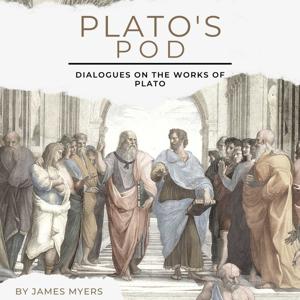
Welcome to Plato's Pod, a podcast of discussions on the dialogues of Plato, the philosopher and geometer who wrote nearly 2,400 years ago. Hosted by amateur philosopher James Myers, the first four…
We welcome your thoughts and suggestions for discussion topics, and please contact us if you or someone you know would be interested in being a guest on the podcast. We can be reached by e-mail to [email protected].
Episodes are lightly edited for clarity, with care to avoid compromising the contributions made by participants. Wherever our discussions take us, we gain knowledge from each other’s perspectives and Plato, without a doubt, would have imagined no better way than in dialogue for knowledge – which is the account of the reasons why – to find its home.
15,237 Listeners
3,424 Listeners
864 Listeners

3,236 Listeners
6,743 Listeners

111,799 Listeners
6,068 Listeners
50,432 Listeners
3,380 Listeners
15,702 Listeners