
Sign up to save your podcasts
Or



Was the cataclysmic disappearance of Atlantis and its wealth and beauty, nine millennia before Plato wrote about it, real? Or was Atlantis presented as a model and archetypical civilization, sending a humbling message to Plato's time and ours about disorder and discord that arises when the divine nature of the soul is diluted and obscured by lust for possessions and power? On May 2, 2021 participants from the Toronto Philosophy, Calgary Philosophy, and Online Rebels Meetup groups met in this live recorded discussion to consider these and other questions raised by Plato's Critias. We drew parallels to other dialogues of Plato, including Meno, Timaeus, and Phaedrus, as we considered the theory of forms, knowledge as recollection, time as a circular function, and other aspects of Plato's tale of Atlantis that has gripped the imagination since he presented the legend.
Does speech exist to provide direction to the soul, as Socrates asserts in the second part of The Phaedrus? How do we use the power of reason to interpret the general form of a spoken concept and apply that understanding to a particular purpose? In this live recording made on April 11, 2021 of a discussion of the Toronto Philosophy, Calgary Philosophy, and Online Rebels Meetup groups we explored these and other aspects of Plato's Phaedrus (from 257(c) to the end). Among the powers of speech we considered are its two-way nature in contrast to other forms of expression, and in the context of the legend of Thamus and Theuth the ability of speech to promote knowledge as recollection in the soul. A participant began by asking whether the people of Plato's time spoke of "the infinite" as we examined the geometry of the tetrahedron, and we ended with the words of Socrates at 277(c) that in speaking of a concept "you must how know how to divide it into kinds until you reach something indivisible". Between the beginning and end of our dialogue, many fascinating logical connections and ideas were raised.
How do we bring "many perceptions together into a reasoned unity" and does this require that we understand speech "in terms of general forms"? These are among the questions that Socrates invited us to consider, as we did in this March 28, 2021 live recording of a meeting of the Toronto Philosophy, Calgary Philosophy, and Online Rebels Meetup groups. During the course of our dialogue, covering the first part of The Phaedrus to 257(b), we explored the multifaceted nature of the soul and the language that the soul uses to communicate meaning, as we also explored Plato's theory of forms.
Is knowledge of all knowledge, including of that which is not knowledge, logically possible? This, among other questions, was the subject of discussion in this March 14, 2021 live recording of a discussion of the Toronto Philosophy, Calgary Philosophy, and Online Rebels Meetup groups. The range of our own dialogue covered the nature of self and of temperance, which Plato represents as the “science of self”, and Socrates’ words that “…it was not living scientifically that was making us fare well and be happy, even if we possessed all the sciences put together but that we have to have this one science of good and evil.”
In this live discussion of the Toronto Philosophy, Calgary Philosophy, and Online Rebels Meetup groups that occurred on February 28, 2021 we examined the nature of virtue and whether virtue can be taught, which is the opening question that Meno asks in Plato’s dialogue. Our own dialogue explored the nature of knowledge, which Socrates proclaimed to be “recollection” and the “account of the reasons why”, and the application of knowledge in the intelligent universe.
This recording of a live discussion of the Toronto Philosophy, Calgary Philosophy, and Online Rebels Meetup groups occurred on February 14, 2021. We continued our discussion of two weeks earlier by reviewing the logical construction of the intelligent universe from 28(a) to 33(d). Then we began to explore the shape of the physical universe that is observable by intelligence, bearing in mind as Timaeus suggests at 50(d) “three types of things: that which comes to be, that in which it comes to be, and that after which the thing coming to be is modeled, and which is the source of its coming to be.”
This recording of a live discussion of the Toronto Philosophy, Calgary Philosophy, and Online Rebels Meetup groups occurred on January 31, 2021. Our focus was on the first part of Plato’s Timaeus, to 47(e), discussing the creation of the intelligent universe. The logical flow that begins at 28(a) of the dialogue was reviewed early in our second episode.
From the publisher's feed
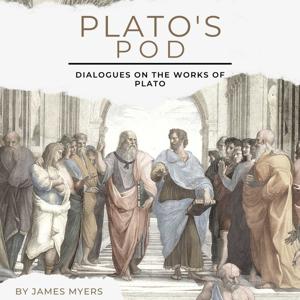
Welcome to Plato's Pod, a podcast of discussions on the dialogues of Plato, the philosopher and geometer who wrote nearly 2,400 years ago. Hosted by amateur philosopher James Myers, the first four…
We welcome your thoughts and suggestions for discussion topics, and please contact us if you or someone you know would be interested in being a guest on the podcast. We can be reached by e-mail to [email protected].
Episodes are lightly edited for clarity, with care to avoid compromising the contributions made by participants. Wherever our discussions take us, we gain knowledge from each other’s perspectives and Plato, without a doubt, would have imagined no better way than in dialogue for knowledge – which is the account of the reasons why – to find its home.
15,234 Listeners
3,425 Listeners
862 Listeners

3,237 Listeners

6,744 Listeners

111,766 Listeners

6,069 Listeners

50,430 Listeners
3,378 Listeners
15,683 Listeners