
Sign up to save your podcasts
Or



To today’s reader it may seem unusual that the philosopher’s first order of knowledge is number and calculation, yet that is what Socrates prescribes. On November 28, 2021 participants from the Toronto Philosophy and Calgary Philosophy Meetup groups discussed the reasons why, in our fifth session on Plato’s Republic. We continued the dialogue on the nature of time that began in episode 4, and considered the differences, uncertainties, and probabilities that exist in the changing present – the state of “coming to be” that never “is”, in contrast to the eternal being of the past and future. In the present, the philosopher is able to navigate the physical world of differences and distinguish truth from falsehood, when equipped first with knowledge of number and calculation, then plane and solid geometry, and finally astronomy. Unlike the Guardians and the prisoner in the cave whose knowledge is restricted by their teachers to the visible, the philosopher can summon reason and apply dialectic to understand invisible first principles. Is knowledge derived solely from sensory perception? How does our technology change perception, and how do we train the mind? These were among the questions raised that will help bring us to a conclusion on the nature of justice when we finish our six-part series on The Republic in two weeks.
To today’s reader it may seem unusual that the philosopher’s first order of knowledge is number and calculation, yet that is what Socrates prescribes. On November 28, 2021 participants from the Toronto Philosophy and Calgary Philosophy Meetup groups discussed the reasons why, in our fifth session on Plato’s Republic. We continued the dialogue on the nature of time that began in episode 4, and considered the differences, uncertainties, and probabilities that exist in the changing present – the state of “coming to be” that never “is”, in contrast to the eternal being of the past and future. In the present, the philosopher is able to navigate the physical world of differences and distinguish truth from falsehood, when equipped first with knowledge of number and calculation, then plane and solid geometry, and finally astronomy. Unlike the Guardians and the prisoner in the cave whose knowledge is restricted by their teachers to the visible, the philosopher can summon reason and apply dialectic to understand invisible first principles. Is knowledge derived solely from sensory perception? How does our technology change perception, and how do we train the mind? These were among the questions raised that will help bring us to a conclusion on the nature of justice when we finish our six-part series on The Republic in two weeks.
When Socrates declared that cities will have no rest from evils until philosophers rule, was he referring to a class of rulers different from the guardians? Examination of The Republic resumed with the question of a philosopher’s nature when members of the Toronto Philosophy and Calgary Philosophy Meetup groups met on November 14, 2021. Do all societies require a founding myth (or ‘noble lie’) as was provided to the guardians, and how would philosophers rule when they love the truth and hate falsehood? We considered the soul’s search for truth, guided by reason, from among the images of the constantly changing physical world that the soul receives from the five senses. How does the soul achieve knowledge of the eternal, continuous form of a thing, such as beauty, from the thing’s many varied depictions in the physical world? The challenges of finding knowledge in the present state of “coming to be”, when physical things are in motion and change, led to a fascinating dialogue on our perception of time. We will continue in two weeks by considering the knowledge required by the philosopher to locate truth, from one time to another.
Our examination of The Republic continued on October 31, 2021 as members of the Toronto Philosophy and Calgary Philosophy Meetup groups discussed parts of Books III and IV. In the passages from 412(b)-445(e), Socrates, Adeimantus, and Glaucon consider the features of the guardians and auxiliaries who will protect the city from external enemies and internal divisions. Next, they proceed to look for the four virtues first in the city and then in the individual soul. We began with Socrates’ definition of health at 445(d)-(e) as a state of self-regulation or balance in nature, a theme that is applied to the ruling class, the city’s virtues, and the soul’s unity. Is the guardian class necessitated by nature or is it unnatural? Is the imposition of a creation myth, sometimes now called the “noble lie”, that the guardians are born of the earth and contain metals, an illusion and is this an appropriate system to maintain in a healthy city? References were made to the allegory of the cave that featured in our first session on The Republic: are the guardians like the prisoner staring at images thinking them to be reality without knowing the source? If as Socrates suggests the city is a metaphor for the soul, in which justice consists of a community of three parts, how can one know harmony from disorder when there are many differing perspectives across the world? These and more fascinating questions and ideas were exchanged during our discussion that will lead, in our next episode, to consideration of the character of the philosopher ruler.
Continuing our discussion on The Republic, on October 17, 2021 participants from the Toronto Philosophy and Calgary Philosophy Meetup groups examined part of Book II in which Glaucon challenges his friends to seek the definition of justice in itself, without reference to outcomes. When Socrates proposes they look for justice first in a city and then in the individual, to observe the ways in which the smaller is similar to the larger, they proceed to create a theoretical society to examine its operation for evidence of justice. Our dialogue touched on many interesting points and raised some fascinating ideas and questions. We related some aspects of the theoretical city, which Socrates describes as unhealthy and feverish, to the allegory of the cave that was featured in our previous episode. One participant described the city of luxuries as a materialist civilization, and others asked whether shame or the desire for social acceptance drives us to justice. Is it in our nature to be unjust and labor to a state of justice? If we possessed the power of the Ring of Gyges, to make ourselves invisible, would we naturally be inclined to do injustice knowing that we could escape punishment – or would we find that justice itself is the reward for being just? Are we each suited to one skill in life and is justice to mind our own business? Do our guardians protect us from a sense of loyalty, or with a view to justice? We will resume our dialogue on The Republic in the next episode, with more on the guardians and then the four virtues and the nature of the soul.
Members of the Toronto Philosophy and Calgary Philosophy Meetup groups convened on September 26, 2021 to launch season two of Plato’s Pod with a discussion on Plato’s Republic. Our focus was on the famous allegory of the cave, and the related simile of the sun, nature of the good, and divided line of reasoning (in passages 502(d)-521(b).
Is the prisoner in the cave, unable to see the source of the images projected on the wall in front of him that he mistakes for reality, like us, as Socrates states? During our dialogue, participants weighed in with some fascinating thoughts. The restricted perspective of the cave was compared to being in a small town and not knowing its surroundings, while another raised the idea of the human capacity of differentiation in distinguishing that which is from that which is not.
Our discussion included questions on our perception of ordering in sequences of cause and effect, and our ability to distinguish original cause and final effect. The nature of the good was compared to that which is without cause, and we explored the properties of the divided line that Socrates set out by which we weigh and measure degrees of reality. Is man, however, the measure of all things? That was the question raised in Plato’s Theaetetus, with which we ended season one, and in The Republic Socrates provides a method which as – as one member observed – allows for inductive logic to be reconciled with deductive logic at a single point of knowledge. One participant went so far as to claim knowledge that all we think exists is an illusion, and perhaps the question of how such knowledge could be obtained, in such a state, is a matter that we may continue to explore in future episodes when we return to discuss more of The Republic.
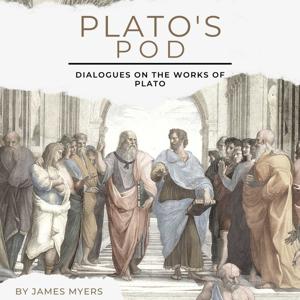
Welcome to Plato’s Pod – a podcast that brings you group discussions on the complete works of Plato, the great philosopher and geometer. I am your host, James Myers. I am an amateur philosopher with a passion for geometry, and it’s a privilege and honour to offer these free discussions for the increase in knowledge and sharing of new ideas and perspectives.
Each episode features one of Plato’s dialogues with a few selected passages to begin the discussion, which can go anywhere the group wants. We have the chance to highlight key themes, explore and share knowledge, and provide our own thoughts on some of the most important works from Plato. We did this during the first season of the show as we covered seven of Plato’s dialogues in ten episodes – so if you are new to the show I invite you to listen to the fascinating connections and new ideas from the perspectives of those who participated in season one.
We wrapped up season one in June, 2021 but season two is just around the corner! Starting in mid-September 2021, we will continue with Plato’s other dialogues and add a special focus on his longest work, The Republic, and also what is perhaps his most cryptic – Parmenides. Famous for never reaching conclusive endings, what are these and Plato’s other dialogues pointing us to?
Joining us on the podcast are participants from the Toronto Philosophy and Calgary Philosophy groups on Meetup.com, which are open to anyone. No special background or qualifications are required, just an interest in learning and sharing ideas, and you too can join in the discussion. If you are not a Meetup.com user, just send an e-mail to [email protected] and we will send you a link to our meetings every two weeks.
Anyone is welcome to participate and add their voice to the timeless themes that Plato presents. I have no doubt that Plato would be delighted with our dialogues on his dialogues!
So is there some new knowledge we can derive in our discussions? I think so! Plato, who was a one-time dramatist, has Socrates tell us many times that “knowledge is recollection” and he goes further in The Meno to say that knowledge is the “account of the reasons why”. Let’s see what we can make of that account in what I am sure will be a fascinating exploration of The Republic, Parmenides, and other dialogues in season two.
Along the way, we will aim to add some one on one interviews with interesting people whose work reflects the themes that Plato presents. And with a bit of effort, good fortune, and good times with the strength of our own bonds we will add to the account of the reasons why with some intriguing new connections.
Participants from the Toronto and Calgary Philosophy and Online Rebels Meetup groups met on June 13, 2021 to discuss themes in the second part of Theaetetus, Plato's dialogue on knowledge. We began by listening to part of a "Joy of x" podcast interview by mathematician Steven Strogatz of computer scientist Melanie Mitchell, addressing the challenges of generalizing the particulars of knowledge in computer algorithms when faced with an infinity of probabilities in everyday existence. We connected the discussion to the ideas in Plato's theory of forms, and to Socrates' challenge to the Protagorean belief that "man is the measure of all things".
Is each one of us equipped to determine the extent of being and non-being and all that comes to be between these two extremes? As the transmission of knowledge has altered over time from the spoken word to the written word and, in recent decades to digital bits soon to be geometrically quantized in the qubit of the quantum computer, do we understand what knowledge is and how its limits are determined - either by one or in combination? Do we distinguish between two types of motion, as Socrates does, and recognize that alteration of state and perception is motion like change in spatial position? Is knowledge and our own existence in a constant and unknowable flux, as Socrates presents the argument of Heraclitus, or is the contrasting position of Parmenides correct that all limits are the derivative of one eternal, changeless state? How will we encode the "account of the reasons why", as Socrates described memory of knowledge in The Meno, together with individual bits of knowledge in order to provide context and understanding?
While we did not reach definitive conclusions on these questions, our own dialogue raised so many interesting and thoughtful insights that shine a new light on the path of knowledge. We look forward to resuming regular meetings in September for the beginning of season 2 to consider The Republic and Parmenides, together with some of Plato's other dialogues not addressed in season 1. In between seasons we hope to podcast some interesting interviews and perspectives on themes discussed in our most fascinating first season, in the continual exchange and construction of knowledge.
In this live recorded discussion on May 30, 2021 we began by listening to an interview of physicist Richard Feynman recalling the paths that he and other explorers took to acquire and apply knowledge, the nature of which Plato explores in the dialogue Theaetetus. The way in which knowledge connects to memory was among the themes explored from individual and collective perspectives by participants from the Toronto and Calgary Philosophy and Online Rebels Meetup groups. In the present state of coming to be, becoming as we are in flux and motion, how do we tie down knowledge? When the known is the limit of the unknown, how do we distinguish between subject and predicate in our inquiries? In raising the geometry of the spiral of Theodorus, the geometer who together with the mathematician Theaetetus join in dialogue with Socrates, is Plato implying a relationship between geometry and knowledge? These and other questions were raised with a number of fascinating perspectives in the first part of our dialogue on Plato's Theaetetus, which we will continue on June 13 as we aim to form an account of knowledge and its "reasons why".
What does it mean to be pious, and how have changes in the meaning over time motivated those who have claimed to be acting piously and affected those accused of impiety? In this live recorded discussion on May 16, 2021 of the Toronto Philosophy, Calgary Philosophy, and Online Rebels Meetup groups we considered the case of Plato's Euthyphro who is about to prosecute his father for the impiety of murder. Upon hearing of Euthyphro's case, Socrates mentions his own accuser Meletus whose charges would eventually lead to Socrates' trial and death. We discussed other historical applications of piety's meaning, including that which misled the Inquisition to condemn Galileo for holding what later proved to be true knowledge of the ordering of the heavens and orbit of the planets around the sun. Are interpretations of piety universal, even among the gods? We investigated this question, and the "Euthyphro dilemma" of the eternal order of what "is" that Socrates raises in the question: "Is the pious being loved by the gods because it is pious, or is it pious because it is being loved by the gods?"
From the publisher's feed
Welcome to Plato's Pod, a podcast of discussions on the dialogues of Plato, the philosopher and geometer who wrote nearly 2,400 years ago. Hosted by amateur philosopher James Myers, the first four…
We welcome your thoughts and suggestions for discussion topics, and please contact us if you or someone you know would be interested in being a guest on the podcast. We can be reached by e-mail to [email protected].
Episodes are lightly edited for clarity, with care to avoid compromising the contributions made by participants. Wherever our discussions take us, we gain knowledge from each other’s perspectives and Plato, without a doubt, would have imagined no better way than in dialogue for knowledge – which is the account of the reasons why – to find its home.
15,234 Listeners
3,425 Listeners
862 Listeners
3,237 Listeners
6,744 Listeners

111,766 Listeners

6,069 Listeners

50,430 Listeners
3,378 Listeners

15,683 Listeners