
Sign up to save your podcasts
Or



What is the good? Why do we each measure the good differently, and what calculation do we apply to know the more from the less? Can we really know the good unless we fall in love with the good? These and other questions echoed many of Plato’s other dialogues throughout the first of three discussions on the Philebus, when members of the Toronto, Calgary, and Chicago Philosophy Meetup groups met on January 15, 2023. In Plato’s dialogue, Socrates and Protarchus quickly reach a conclusion that the good life consists of a mixture of knowledge and pleasure, not a life that is purely one or the other. The question then becomes the ratio of knowledge and pleasure in the ideal mixture, a matter in which the soul applies calculation, reason and memory to determine probabilities in time to come.
Time, and our understanding of sequences of cause and effect in the order of time, emerged as themes in our discussion of Plato’s Greater Hippias. Members of the Toronto, Calgary, and Chicago Philosophy Meetup groups began their December 11, 2022 dialogue by considering the difference between intelligence – that the character Hippias claims to possess – and wisdom, which in Plato’s Cratylus Socrates defined as “knowledge of motion”. Are the limits of motion the general parameters for intelligence of cause and effect, which are the products of motion? There are many fine dramatic elements in Plato’s dialogue that lead us to wonder. If intelligence requires an ability to measure the order of cause and effect in time, the conceited, boastful sophist Hippias demonstrates the problem with the notion that man is the measure of things. Hippias demonstrates an inability to define the limits of “fine” and its opposite “foul”, but nonetheless applies assumptions of their extent to measure the qualities of a number of physical objects. The results, as Socrates illustrates, are illogical. It seems that while humans can certainly cause things, our knowledge of effect is always and necessarily uncertain.
We concluded our 3-part series on Plato's Cratylus with another deeply insightful discussion that emerged as we joined thoughts on the nature of things - things being objects of thoughts. We explored the frontiers of thoughts and the motion of their limits, with a fascinating discussion on whether man is the measure of things, the question of what number is, and some thoughts on a logic in the geometry of things, together with many other thought-provoking observations. It seems one conclusion which might be drawn from the group's three discussions on the Cratylus is the truth of Socrates' assertion. Socrates observed what our discussion demonstrated, that making a proper account of the meaning of the complex ideas exchanged by language requires both knowledge of the the nature of the thing and knowledge of the thing's uses in different times of human convention. After all, without language, as Socrates asked, how would we instruct each other?
How do we perceive a thing – defined as an “object of thought” – both with limits and without limits? Socrates begins the second part of Plato’s Cratylus by examining our perception of being without limit in the names that we apply to the gods. Then he proceeds to consider differences when limits are applied to things in the continually changing state of becoming in the present. On November 13, 2022, members of the Toronto, Calgary, and Chicago Philosophy Meetup groups continued their discussion of the Cratylus and raised some fascinating ideas in relation to the universality of things. Does any thing have a permanent state of being, or are all things in a constant state of flux with no thing standing fast, as Heraclitus believed? One participant proposed that the becoming of a thing in the present is in an infinite state of difference between past and future. Another equated our perception of a thing to a synthesis of the thing’s two limits of thesis and antithesis. We tested understanding, supervision, and transcendence of rules that apply to our naming of things by examining the varying definitions over time of the word “democracy”. In our next episode we will conclude our discussion of the Cratylus and look for a consensus on the question of whether man is the measure of things by convention, or if nature provides a permanent record of things.
The focus of Plato's dialogue the Cratylus is the origin and use of names applied to things, and our understanding of their meaning in complex ideas exchanged by language. On October 30, 2022 members of the Toronto, Calgary, and Chicago Philosophy Meetup groups began by examining the meaning of the word "thing" as an "object of thought", to establish the very broad and crucial scope of Plato's work in the context of our perception. We debated whether words originate in nature or by human convention, and whether rules are set and supervised in the establishment of names. The question may be of great importance now that our technology is gaining the power to simulate human language. At the end of our discussion we began to consider whether "man is the measure of things" and if that is the case how wisdom would be distinguished from foolishness, as Socrates asks. It's a question we will pick up on at the beginning of our second episode on the Cratylus.
In this introduction to Plato's Cratylus and season 3 of the podcast, James Myers reviews the highlights of the first two seasons and the relevance of Plato's Theory of Forms. What are the Forms? The question plays a central role in the origin and meaning of the words that we apply to things, which is the subject of the Cratylus and a matter of particular importance to today's technological world. As "objects of thought", things are the basis of human perception. With recent powerful advances in machine language technology, do we have the knowledge to distinguish between our own words and the words of the machines that are learning to simulate us? In the group discussion on the Cratylus that will follow in the next episode, we will explore the Forms of things, the evolving perception of things from past to present, and the future relationship of technology to the objects of our thoughts.
James Myers and Lantern Jack, host of the Ancient Greece Declassified podcast, discuss the relevance of ancient philosophy to modern technology. We explore technological mindsets, communication and the meaning crisis, the linearity or circularity of time, and the importance of memory. As humanity's technological power increases, is there a fundamental role for ancient philosophy in answering the "why" questions as we become more knowledgeable about the "how"? Is there a common language that can reconnect science and philosophy? In The Republic, Socrates states that number and calculation are the first order of knowledge for a philosopher; it's a connection that may seem unusual today but we consider the consequences if Socrates' ideal were to become modern reality.
This episode is also featured on The Quantum Record, at https://thequantumrecord.com/.
Season two of group discussions on Plato’s Pod concluded on June 19, 2022, when members of the Toronto Philosophy, Calgary Philosophy, and Chicago Philosophy Meetup groups met to discuss the second half of Plato’s Parmenides and its conclusion that “if the one is not, nothing is.” In our minds, how do we distinguish one thing from another thing, and is it an absolute, universal truth that no thing in the universe would exist to us if the one is not?
For that matter, what, exactly, is “the one” that is the subject of the various hypotheses tested in dialogue between Parmenides and young Aristotle, and why does Plato leave us with no definition of the one if nothing would be without it? A proposition was made for our discussion, that Plato’s purpose in the Parmenides was that we consider our minds’ system of perception in time. Only in time, in the changing state of becoming, are we able to perceive, when all perception is of differences that stand in contrast to the unity of one. It was proposed that without reference to the unity of one, itself beyond the constraints of time as Parmenides claims, our perceptions of a thing itself – such as the large – and of the character of the thing’s parts, would always differ and lead to an infinite regress in thought.
Early in our discussion we considered Parmenides’ description of “the instant” of time when neither change nor rest exist but either is possible. Is “potential” another way of describing “the one”, in the instant in which either of two states is possible? We explored the relationship between this concept of the instant of time and current knowledge of quantum mechanics and the qubit, in particular the phenomenon of quantum superposition of states. Analogy was also used to consider the meaning of Plato’s words, and one participant connected the analogy of the circle to a balloon as a way of understanding the limitless capacity of the one in three dimensions of either state of change or rest. Does time associate itself with number, as Plato wrote in the Timaeus, and if so what are the consequences? What are the unique properties of the one, among numbers, limits, and the differences in perception that arise from limits?
We will consider these and other themes of Plato’s works in September, when Plato’s Pod will resume group discussions with an examination of the Cratylus. In the meantime, stay tuned to Plato’s Pod over the summer months for some fascinating interviews and more perspectives on the works of Plato, the philosopher and geometer who wrote nearly 2,400 years ago.
In the first of two sessions on the Parmenides, members of the Toronto Philosophy, Calgary Philosophy, and Chicago Philosophy Meetup groups met on June 5, 2022 to discuss the first part of Plato’s most enigmatic dialogue. What, exactly, is “the One” as the revered philosopher Parmenides describes universal being, and is it different from “not many” which are the words that Xeno attributes to all of existence. Does it matter, if there is a difference or not?
Numerous points of logic emerge as Parmenides and Xeno train the young Socrates in the art of dialectic, to identify the first principle of a thing. Parmenides advises Socrates to identify as distinct one thing, and then to test the distinction so made by hypothesizing the consequences of the many in relation to themselves and in relation to the one, and of the one in relation to itself and in relation to the many. Such is the only logical means to achieve a full view of the truth, Parmenides states, and in our discussion we explored the nature of logic itself in relation to being and non-being.
Do we think that we are part of one universe, or of a multiverse? Is logic ultimately a single universal form or, as Parmenides asks Socrates by analogy, is it like a sail covering many people who obtain either a part of the whole or the whole of the sail itself? This led to a discussion of what has become famously known as the “third man argument” arising in Plato’s Parmenides, referring the possibility of an infinite regress in logic as we attempt to identify the origin of a thing. Is there an absolute truth in the matter, as one participant asked, and can it ever be proven empirically? It’s an important question, among others, that we will explore in our second session on the Parmenides, as we ponder the possible universality of its conclusion that “if the one is not, nothing is.”
In the conclusion of Plato’s Statesman, the Visitor from Elea describes the role of time and the ruler who understands the consequences of time’s causes and effects (as both one and many) to maintain the harmony of the social fabric. But should such an ideal leader, whose role is to orchestrate but not participate in the administration of the state, be constrained by laws established in an earlier time? And how should such a ruler, whose mission is to harmonize both courage and temperance among the office-holders, be chosen?
Members of the Toronto Philosophy and Calgary Philosophy Meetup groups met on May 22, 2022 to consider these and other questions, in the third of three dialogues on The Statesman. We began by listening to a re-enactment of Abraham Lincoln’s Gettysburg Address and discussed the conditions of the civil war era during which the emancipator’s words were spoken. Given their times, was Lincoln in some ways a tyrant, and was Henry VIII foremost a tyrant? These and other questions were raised as we pursued the proposition that constitutions should not be fixed in time. Several current constitutional issues were brought into the discussion, and one participant suggested that we might consider the advantages of welcoming the Visitor’s ideal ruler, constrained by laws, under judges elected by the citizens. Could this be a better form of democracy? And what does democracy mean, when it is so widely and variably applied?
Perhaps then the key is to find the common ground in the mean of extremes, as we discussed in our previous episode, and to ensure the continuing harmony of the mean in its own derivative. Is this what the Visitor from Elea was trying to tell us, in so many words?
From the publisher's feed
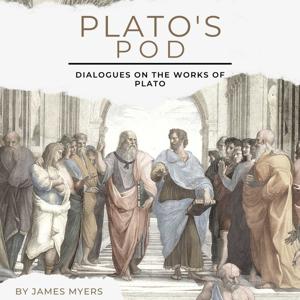
Welcome to Plato's Pod, a podcast of discussions on the dialogues of Plato, the philosopher and geometer who wrote nearly 2,400 years ago. Hosted by amateur philosopher James Myers, the first four…
We welcome your thoughts and suggestions for discussion topics, and please contact us if you or someone you know would be interested in being a guest on the podcast. We can be reached by e-mail to [email protected].
Episodes are lightly edited for clarity, with care to avoid compromising the contributions made by participants. Wherever our discussions take us, we gain knowledge from each other’s perspectives and Plato, without a doubt, would have imagined no better way than in dialogue for knowledge – which is the account of the reasons why – to find its home.
15,234 Listeners
3,423 Listeners
868 Listeners

3,233 Listeners
6,752 Listeners

111,814 Listeners

6,070 Listeners
50,388 Listeners
3,370 Listeners
15,606 Listeners