
Sign up to save your podcasts
Or



Based on Podcast App listening data
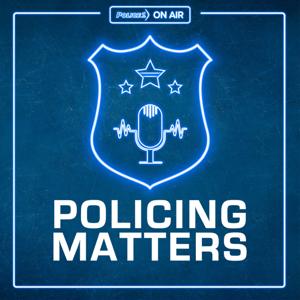
Training police officers for real-world encounters requires more than classroom instruction — it demands safe, repeatable and cost-effective tools that prepare officers for high-stress situations. This special episode of the Policing Matters podcast, part of Police1’s Police Training Week series, showcases how agencies can expand training opportunities that sharpen skills, strengthen readiness and fit within limited budgets.
In this episode, host and Police1 columnist Warren Wilson talks with Mike McCaslin, law enforcement and government channel manager for T4E – Training for Engagement. With more than 23 years of experience across municipal, county, tribal and federal policing, McCaslin brings a deep passion for officer readiness and less lethal training. Together, they discuss how realistic, affordable force-on-force platforms help officers train more often and with greater confidence.
T4E – Training for Engagement provides the industry’s most realistic training equipment to help professionals build skills with confidence and safety. From precision-engineered paintball markers that replicate duty firearms to high-quality gear for scenario-based training, T4E helps you prepare for real-world situations without real-world risk. Equip your team with tools that enhance muscle memory, accuracy, and decision-making under pressure. To explore the full line of training products, visit T4Eguns.com.
Fitness, training, discipline and communication are core to good policing, but sleep underpins them all. Quality sleep sharpens judgment, reaction time and restraint while buffering stress and trauma. For officers working long shifts, odd hours and high-stress scenes, better sleep is a practical readiness tool — not a luxury.
In this episode of the Policing Matters podcast, host Jim Dudley speaks with Dr. Leah Kaylor, an FBI clinical psychologist who provides trauma therapy and critical-incident debriefings. Kaylor’s new book, “If Sleep Were a Drug: Why Sleep Is the Ultimate Advantage — No Prescription Required,” breaks down common sleep myths, explains how REM restores emotional balance and offers field-tested strategies officers can use tonight. The episode also tackles shift work realities, caffeine and alcohol traps, and when to seek help for sleep apnea.
Flock Safety works with more than 5,000 law enforcement agencies nationwide, delivering real-time intelligence through a holistic ecosystem of technology designed to keep officers safe, reduce crime, and build stronger communities. And if you’re looking for real stories from the front lines — how your peers are using these tools to shape the future of safety in their cities — tune in to Flock’s “Real Time Policing” podcast, with new episodes dropping on Wednesdays. Watch episodes on YouTube or tune in wherever you get your podcasts. Click here to view.
Online threats amplified by AI — from doxxing and deepfakes to coordinated influence operations — are collapsing the time between rumor and real-world risk. Expect pressure points across campuses and big cities, immigration enforcement and politically charged events, with protests only one piece of the picture. For police leaders, the task is to detect signals sooner, verify and communicate faster, and protect officers and targets while safeguarding First Amendment rights.
On this week’s Policing Matters podcast, host Jim Dudley speaks with Alex Goldenberg, director of intelligence at Narravance, senior adviser to the Network Contagion Research Institute and a fellow at Rutgers University. He investigates online extremism, foreign influence and child safety threats, advises lawmakers and practitioners, and helps platforms and nonprofits remove threat actors at scale. His work translates narrative and behavioral intelligence into practical steps for protest preparedness and officer safety.
This episode of the Policing Matters podcast is sponsored by OfficerStore. Learn more about getting the gear you need at prices you can afford by visiting OfficerStore.com.
Resilience is no longer just a buzzword in policing — it’s an officer safety skill. In this episode of the Policing Matters podcast, host Jim Dudley talks with Dr. Stephanie Conn, a public safety psychologist, former dispatcher and police officer, and author of “Increasing Resilience in Police and Emergency Personnel: Strengthening Your Mental Armor.” Drawing from her unique perspective as both practitioner and researcher, Dr. Conn explains why resilience must be deliberately developed and how officers can use small, practical tools to safeguard their health and performance.
Dr. Conn was born into a police family, served as a dispatcher and later as a Fort Worth police officer before transitioning into psychology. After witnessing the lack of culturally competent mental health support for officers, she became a psychologist to fill that gap. Today, she works with public safety professionals across the U.S. and Canada, combining lived experience with research-based strategies to help officers and agencies build resilience, improve wellness and strengthen organizational support.
This episode of the Policing Matters podcast is sponsored by OfficerStore. Learn more about getting the gear you need at prices you can afford by visiting OfficerStore.com.
Drones as first responders (DFR) have quickly moved from experimental pilots to a central part of modern public safety response. In this episode of the Policing Matters podcast, host Jim Dudley talks with Rahul Sidhu, vice president of aviation at Flock Safety and co-founder of Aerodome, about how agencies can successfully launch, scale and sustain DFR programs.
Sidhu shares lessons from his own start at Redondo Beach PD, common pitfalls agencies should avoid, and what comes next as AI and automation redefine drone deployment in emergency response.
This episode is sponsored by Flock Safety. Discover the leading safety technology platform that helps communities thrive by taking a proactive approach to crime prevention and security. Empower your agency to solve crime faster with Flock's city-wide platform. Our full-service, maintenance-free solution helps you solve more crime to shape a safer future for thousands of communities across the country. Flock Safety provides best-in-class License Plate Readers (LPRs), audio detection, video cameras, RTCC software, and Drone as First Responder systems for law enforcement to solve crime and keep their cities safe.
For many officers, the stories they collect on the job remain within squad room walls. San Francisco Police Sergeant Adam Plantinga has turned his into the foundation of a second career, using two decades in patrol, investigations and specialized units to fuel both nonfiction accounts and gritty crime novels.
In this episode of the Policing Matters podcast, host Jim Dudley talks with Plantinga about his journey from Milwaukee patrol officer to SFPD sergeant, his acclaimed nonfiction titles “400 Things Cops Know” and “Police Craft,” and his crime series featuring a former Detroit officer. Plantinga explains how real-world policing — from bizarre street encounters to high-stakes cases — shapes his stories, why he moved from nonfiction to fiction, and the strategies he uses to carve out writing time alongside a demanding law enforcement career.
This episode of the Policing Matters Podcast is brought to you by Lexipol, the experts in policy, training, wellness support and grants assistance for first responders and government leaders. To learn more, visit lexipol.com.
As more women step into command roles, their leadership paths offer lessons for anyone moving up in the ranks. In this episode of the Policing Matters podcast, Capt. Michelle Tavarez of the Las Vegas Metropolitan Police Department shares how she built credibility, handled setbacks and now leads some of the agency’s most high-stakes units.
Captain Tavarez oversees LVMPD’s Safe Neighborhoods Bureau, including the gang, vice and narcotics units, and helped shape the department’s internal and community-facing mentorship efforts through the Women of Metro council. She talks about the value of diverse leadership, lessons from her own promotional journey and why support from agency leaders — including former Sheriff and current Governor Joe Lombardo — played a pivotal role in her advancement.
This episode of the Policing Matters podcast is sponsored by OfficerStore. Learn more about getting the gear you need at prices you can afford by visiting OfficerStore.com.
Are public perceptions of police shaped more by headlines than reality? In this episode of Policing Matters, host Jim Dudley speaks with entrepreneur and author Brandon Steiner about what he learned after spending six months embedded with NYPD officers.
With no law enforcement background, Steiner rode along in some of the city’s most violent precincts — gaining a front-row seat to the chaos, complexity and contradictions of urban policing. His new book, “The Ride-Alongs,” brings a street-level, unfiltered look at what officers face — and what the public needs to understand.
This episode of the Policing Matters podcast is sponsored by OfficerStore. Learn more about getting the gear you need at prices you can afford by visiting OfficerStore.com.
What happens when a split-second decision on the street becomes a media headline is stripped of context? In this episode of the Policing Matters podcast, retired LAPD Captain Greg Meyer joins host Jim Dudley on the Policing Matters podcast to discuss his new book, “Hard Cases: Police Use of Force in America.” Drawing from decades of experience and insider knowledge on some of the most controversial police incidents, Meyer shares why he wrote the book, the importance of addressing media misinformation and how law enforcement leaders can push back against false narratives.
This episode of the Policing Matters Podcast is brought to you by Lexipol, the experts in policy, training, wellness support and grants assistance for first responders and government leaders. To learn more, visit lexipol.com.
Many agencies still rely on legacy field training models that emphasize evaluation over education — often scoring recruits before they’ve had time to learn. Recognizing the limitations of this approach, law enforcement leaders are moving toward a more effective model grounded in adult learning science.
In this episode, Dan Greene, executive director of the National Association of Field Training Officers, and Sergeant Jason Devlin of the Scottsdale (Arizona) Police Department, discuss the development and implementation of NextGen Field Training. Designed to separate training from evaluation, this approach prioritizes coaching, accountability and cultural alignment. Devlin, who led the model’s creation and rollout, shares key insights on how agencies can strengthen recruit performance, improve retention and build a more resilient workforce.
This episode of the Policing Matters Podcast is brought to you by Lexipol, the experts in policy, training, wellness support and grants assistance for first responders and government leaders. To learn more, visit lexipol.com.
From the publisher's feed

227,406 Listeners

39,027 Listeners

41,356 Listeners
8,917 Listeners

30,703 Listeners
5,937 Listeners

28,075 Listeners

1,128 Listeners
11,008 Listeners

28,212 Listeners

46,068 Listeners

61,800 Listeners

3,339 Listeners
666 Listeners

15,917 Listeners