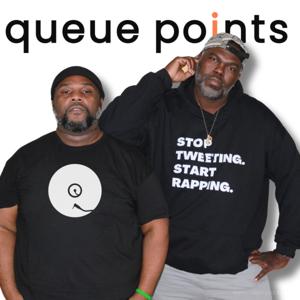
Queue Points
Download on the App Store

Queue Points episodes

  • Got That Oil: Gospel Roots of Black Music

    Black music has always had a spiritual center — and DJ Sir Daniel and Jay Ray dig into why that's not an accident. This episode traces the sacred roots of soul, R&B, hip-hop, and gospel through the lives of artists who grew up in the church, left it, returned to it, or never fully separated from it. From Aretha Franklin's Amazing Grace sessions to Vanity's conversion, from the prosperity gospel's influence on hip-hop to the question of whether gospel rap has ever truly landed, the conversation covers how faith has shaped Black music across generations — and how to tell the difference between genuine transformation and a hustle dressed up in scripture.

    Topics Covered
    • Why the church is the foundation of Black music's greatest voices — How the Jim Crow-era Black church produced Aretha Franklin and a generation of artists whose sound carries a spiritual authority that can't be manufactured
    • Gospel crossover, secular pull, and the cost of leaving the church — From Archbishop Carl Bean's deliberate move out of the gospel box to Bunker Hill hiding his identity to protect his gospel career, the historical tension between sacred and secular identity in Black music
    • The prosperity gospel's long shadow over hip-hop — How Reverend Ike's era laid the groundwork for rappers-turned-ministers like Mase, and why Sir Daniel and Jay Ray draw a line between artists who found faith through genuine crisis — Vanity, Kurtis Blow, Sparky D — and those whose conversions feel more performative
    • Kirk Franklin, Salt, Chance the Rapper, and the gospel rap debate — Whether gospel rap has ever truly worked, what Kirk Franklin got right that others missed, and how "Stomp" featuring Salt changed the trajectory of contemporary gospel

    Chapter Markers

    00:00 Intro Theme

    00:16 Intro & Episode Setup

    00:51 Do Musicians Who Find God Make You Roll Your Eyes?

    01:58 The Church Roots of Black Music Icons

    03:40 "Got That Oil" Spiritual Anointing in Music

    03:58 Why Do Gospel Artists Cross Over to the Secular World?

    08:46 Transition

    08:58 Faith Beyond Christianity ... Islam, Hebrew Israelites & More

    10:18 Artists Who Found God Through Crisis

    12:41 Sir Daniel's Story Growing Up Seventh Day Adventist

    17:02 Transition

    17:11 Jay Ray's Story A Catholic Kid's Spiritual Awakening

    19:37 The Prosperity Gospel & Hip Hop From Reverend Ike to Mase

    22:30 Old School Rappers Turned Ministers From Kurtis Blow & Beyond

    28:27 Is Gospel Rap Any Good?

    31:47 Transition

    31:47 Whitney, Fantasia & Avery Sunshine ... Artists With That Oil

    32:46 Closing Thoughts

    33:54 Outro Theme

    Get More From Us
    • Join The Queue Points Insiders: https://newsletter.queuepoints.com
    • Become A Member: https://link.queuepoints.com/membership
    • Support Us: https://buymeacoffee.com/queuepointspod
    • Everything else, including our store and socials: https://queuepoints.com
    • Instagram: https://instagram.com/queuepointspod
    • YouTube: https://youtube.com/@queuepointspod

    #BlackMusicHistory #GospelMusic #BlackChurch #SoulMusic #HipHopAndFaith

    35 min
  • 2 Live Crew: Pioneers of Miami Bass and Free Speech

    Listener discretion advised. This episode contains explicit lyric discussion intended for mature audiences.

    DJ Sir Daniel and Jay Ray mark the 40th anniversary of The 2 Live Crew Is What We Are by digging into what made 2 Live Crew one of the most consequential acts in hip hop history — not just for the music, but for what they were forced to defend. This conversation covers how a group that couldn't get signed to a major label ended up in federal court fighting for the First Amendment, and what that fight ultimately meant for hip hop's freedom to exist on its own terms. Along the way, Sir Daniel and Jay Ray trace the Miami bass scene's roots in car culture and teen clubs, talk about Uncle Luke's underrated genius as a showman and businessman, and reflect on the ongoing legal battle over the group's catalog — one that is still playing out right now.

    The Breakdown
    • The Miami sound and what made it different: Car culture, 808 bass, teen clubs, and the ecosystem that built 2 Live Crew's following before the rest of the country caught on
    • When a regional act becomes a national controversy: How As Nasty As They Wanna Be crossed over, what the federal obscenity ruling actually meant, and why record store owners were getting arrested
    • The First Amendment fight and who showed up: How Luther Campbell became the face of free speech in hip hop, what Dr. Henry Louis Gates argued on the stand, and how rock artists ended up in solidarity with a Miami bass group
    • The catalog fight that isn't over: How the 1995 bankruptcy cost the group their masters, and why a 2026 appeals court reversal leaves things unresolved for the surviving members and the families of those they've lost

    Chapter Markers

    00:00 Disclaimer

    00:14 Hook

    00:25 Intro Theme

    00:42 Intro & The Debut Album

    04:14 Who Is 2 Live Crew?

    04:59 Regional Music & How They Got Known

    10:29 2 Live Crew in the Tradition of Black Sexuality in Music

    13:31 Miami Bass, Car Culture & The Florida Scene

    18:15 Transition

    18:20 Giving Uncle Luke His Credit

    20:36 Going National with Me So Horny & As Nasty As They Wanna Be

    22:09 The First Amendment Fight

    23:33 Transition

    23:44 On Luke Campbell and Call & Response as Black Cultural Tradition

    26:25 Policing Black Bodies & Record Store Arrests

    29:31 Is Hip Hop in a Better Place Today?

    38:46 The Dissolution of 2 Live Crew

    40:25 Transition

    40:32 Remembering Fresh Kid Ice and Brother Marquis

    42:31 The Masters Fight & Unfinished Business

    44:58 2 Live Crew's Legacy, Hall of Fame & Southern Hip Hop's Roots

    49:13 Outro Theme

    Get More From Us
    • Join The Queue Points Insiders: https://newsletter.queuepoints.com
    • Become A Member: https://link.queuepoints.com/membership
    • Support Us: https://buymeacoffee.com/queuepointspod
    • Everything else, including our store and socials: https://queuepoints.com
    • Instagram: https://instagram.com/queuepointspod
    • YouTube: https://youtube.com/@queuepointspod

    #2LiveCrew #MiamiBass #HipHopHistory #BlackMusicHistory #QueuePoints

    50 min
  • Explicit Hip-Hop 1996: Akinyele, LL Cool J & Lil' Kim

    Listener discretion advised. This episode contains explicit lyric discussion intended for mature audiences.

    June is Black Music History Month, and DJ Sir Daniel and Jay Ray are rolling out their Summer of Sex series, pulling out three of 1996's most explicit hip-hop songs and rating them on a scale of 1 to 5 — 1 being "I could play this in front of my mom" and 5 being "absolutely not, change the station." The songs are 30 years old now, but the conversations they sparked about female agency, body shaming, and who gets credit in hip-hop are still very much alive. Sir Daniel and Jay Ray break down the full cultural context behind each track, the sample histories, the industry politics, and the moments these songs hit the radio and changed what was considered acceptable. This one is for the music heads who remember exactly where they were when they first heard these records.

    THE BREAKDOWN
    • Akinyele ft. Kia Jeffries — "Put It In Your Mouth": The Atlanta sample chain nobody talks about: The song that rated a unanimous 5. From Brick's "Fun" to India.Arie's "Video," Sir Daniel and Jay Ray trace the full Atlanta sample lineage, and both hosts revisit their first, floor-dropping reactions to this record.
    • Is "Put It In Your Mouth" still shocking in 2026? Thirty years later, Akinyele and Kia Jeffries showed back up on Cadillac Chronicles. Sir Daniel makes the case that culture has moved so far that what felt jaw-dropping in '96 barely registers today.
    • LL Cool J — "Doin' It": The underground 1988 original most people never heard: "Doin' It" is essentially a remake of 2 Much’s "Wild Thang", a record that ran late-night on DJ Red Alert's mix show before LL ever touched it. Sir Daniel breaks down the full pre-history, from Warlock Records to the Native Tongues connection to the Grace Jones sample.
    • Lil' Kim — "Not Tonight": Storytelling, Jermaine Dupri, and a KFC theory: Not the "Ladies Night" remix — the original Hard Core cut. Jay Ray calls it top-tier storytelling and a master class in female perspective. Sir Daniel drops a theory about the hook that connects Jermaine Dupri's production to a 1980s Kentucky Fried Chicken commercial, and it holds up.
    • Final Rankings + Your Turn: What's on your 1996 explicit playlist?: "Put It In Your Mouth" holds the top spot at a combined 10. "Not Tonight" locks in at 9. "Doin' It" sits at a comfortable, barbecue-safe 4. The hosts open the floor and ask listeners to name their own 1996 picks, with a playlist on the way.

    Chapter Markers

    00:00 Disclaimer

    00:14 Intro Theme

    00:31 Show Intro & Summer of Sex Premise

    02:01 Growing Up With Explicit Music

    03:36 The Rating System: 1 to 5

    04:21 Transition

    04:21 Song 1: "Put It In Your Mouth" — Akinyele ft. Kia Jeffries

    12:20 Is "Put It In Your Mouth" Still Shocking in 2026?

    13:57 Transition

    14:04 Song 2: "Doin' It" — LL Cool J ft. LeShaun

    21:00 LeShaun, Body Shaming & Being Erased from the Video

    23:45 Song 3: "Not Tonight" — Lil' Kim

    31:46 Outro & Call to Action

    33:08 Outro Theme

    Get More From Us
    • Join The Queue Points Insiders: https://newsletter.queuepoints.com
    • Become A Member: https://link.queuepoints.com/membership
    • Support Us: https://buymeacoffee.com/queuepointspod
    • Everything else, including our store and socials: https://queuepoints.com
    • Instagram: https://instagram.com/queuepointspod
    • YouTube: https://youtube.com/@queuepointspod

    #QueuePoints, #BlackMusicHistory, #HipHop1996, #LilKim, #NotTonight, #LLCoolJ, #DoinIt, #Akinyele, #PutItInYourMouth, #LeShaun, #JermaineDupri, #HardCore, #Nativetongues, #BlackPodcast, #SummerOfSex, #HipHopHistory, #FemaleRappers, #90sHipHop, #BlackMusicMonth

    34 min
  • Donwill on The Almanac of Rap & The Art of the Interview

    Disclosure: This episode of Queue Points is brought to you by Okayplayer’s Almanac of Rap. Subscribe by visiting https://qpnt.net/aorshow.

    There's a moment in this conversation where Jay Ray marvels at Donwill asking Raekwon why the Purple Tape was purple. And Raekwon's answer — "they didn't have green" — says everything you need to know about why Donwill is built differently as an interviewer. He's not chasing the headline. He's chasing the thing just outside the frame.

    Donwill — rapper, DJ, Webby Award-winning podcaster, and one half of Tanya Morgan — sits down with DJ Sir Daniel and Jay Ray to talk about the craft behind The Almanac of Rap, his Okayplayer-produced podcast series. This conversation covers what it takes to interview artists the right way, how hip hop journalism lost the plot to the algorithm, and what it meant to step on a comedy stage as a rapper after hiding in plain sight behind the DJ booth. Twenty years after Moonlighting, Donwill is still using history to build the future — and this episode shows exactly how he thinks.

    The Breakdown
    • What started as a Twitch rant about LL Cool J became a Webby Award-winning podcast — Donwill breaks down how The Almanac of Rap grew from pandemic-era Twitch streams and a nudge from a friend into one of the most respected hip hop interview series running today.
    • The art of the question nobody else is asking — From the color of Raekwon's tape to the wellness routines of artists in their fifties, Donwill explains why good interviewing means finding the thing just outside the frame of what everyone already knows.
    • "We're at the point where the clip is the whole thing" — A real conversation about hip hop journalism, algorithm dependency, and why the only honest answer to clip culture might be to let it burn.
    • Michelle Buteau told him to rap — and he listened — The story of how DJing her tour led to an opening set, a new audience, and a reminder that leaning into the craft you sidelined can open new doors.
    • Rob Base was never a one-hit wonder — he was a legendary artist — In the wake of Rob Base's passing, the conversation shifts into a meditation on legacy, bridge songs, and what we actually mean when we reduce an artist to a single chart moment.

    Drop your thoughts in the reviews and let us know — what's the question nobody's ever asked your favorite rapper?

    Find Donwill:

    🎙 The Almanac of Rap

    📰 Working Creative Weekly Substack

    📸 @donwill on Instagram

    Get More From Us
    • Join The Queue Points Insiders: https://newsletter.queuepoints.com
    • Become A Member: https://link.queuepoints.com/membership
    • Support Us: https://buymeacoffee.com/queuepointspod
    • Everything else, including our store and socials: https://queuepoints.com
    • Instagram: https://instagram.com/queuepointspod
    • YouTube: https://youtube.com/@queuepointspod

    #QueuePoints, #BlackMusicHistory, #Donwill, #AlmanacOfRap, #HipHopJournalism, #TanyaMorgan, #HipHopPodcast

    1 hr 2 min
  • The Quiet Storm Era & the Decline of R&B: Amani Roberts on What We Lost

    DJ Sir Daniel and Jay Ray sit down with music business professor, professional DJ, and USA Today bestselling author Amani Roberts to talk about what happened to R&B, and why it matters. Roberts, whose book, The Quiet Storm: A Historical and Cultural Analysis of the Power, Passion, and Pain of R&B Groups, traces the history of R&B groups through culture and business, connects the dots between corporate radio consolidation, advertising dollars, and the slow fade of the sound that used to fill every quiet night. This is a conversation about music, yes, but it's also about power, ownership, and what gets lost when the people who built a culture lose control of how it's shared.

    The Breakdown
    • The Telecommunications Act of 1996 didn't diversify radio. It did the opposite. Roberts explains how major companies bought up stations nationwide, pushed playlisting, and stripped away the local programming that gave cities like Atlanta, Philadelphia, and Houston the power to build their own stars first.
    • R&B groups once dominated the Billboard Hot 100. So what changed? In July 1997, 12 of the top 20 Hot 100 songs were from R&B groups. By the mid-2000s, that number had flipped toward hip hop, and then EDM took radio's ad-friendly lane. Roberts breaks down exactly how advertiser preferences quietly reshaped what got played.
    • The Quiet Storm radio format wasn't just a vibe. It was an education. Roberts credits WHUR's Quiet Storm with introducing him to Phyllis Hyman, rare Jodeci cuts, and music that never made it to main rotation. That kind of discovery is gone now, and listeners are only hearing the same narrowed playlist everywhere they go.
    • R&B used to take emotional risks that most artists won't take today. From Babyface's song structures to Prince's coded language, Roberts and the hosts dig into why today's R&B often plays it safe, and what it costs the music when artists stop writing from a vulnerable place.
    • Roberts flags a detail that didn't make it into the final book: across three major radio conglomerates, only two board members are Black. That fact does a lot of work in explaining why the business keeps moving the way it does.

    Purchase The Quiet Storm: A Historical and Cultural Analysis of the Power, Passion, and Pain of R&B Groups: https://link.queuepoints.com/quietstormbook (This is a Queue Points Amazon affiliate link, and purchasing something may earn us a commission. Read our affiliates disclaimer)

    Support Us

    Become A Member: https://link.queuepoints.com/membership

    Shop Our Store: https://store.queuepoints.com

    Buy Us A Coffee: https://buymeacoffee.com/queuepointspod

    Contribute: https://cash.app/$queuepointspod

    Get More From Us

    Pandora: https://qpnt.net/pandora

    Read Our Magazine: https://plus.queuepoints.com

    Follow Us On Social Media

    Facebook: https://facebook.com/queuepointspod

    Instagram: https://instagram.com/queuepointspod

    Linkedin: https://linkedin.com/company/queuepointspod

    Bluesky: https://bsky.app/profile/queuepointspod.com

    YouTube: https://youtube.com/@queuepointspod

    Get More From Us
    • Join The Queue Points Insiders: https://newsletter.queuepoints.com
    • Become A Member: https://link.queuepoints.com/membership
    • Support Us: https://buymeacoffee.com/queuepointspod
    • Everything else, including our store and socials: https://queuepoints.com
    • Instagram: https://instagram.com/queuepointspod
    • YouTube: https://youtube.com/@queuepointspod

    #QueuePoints, #RnB, #RnBHistory, #BlackMusicHistory, #QuietStorm, #TelecommunicationsAct, #AmaniRoberts, #TheQuietStorm, #RadioHistory, #BlackMusic, #RnBCulture, #MusicBusiness, #SlowJams, #LocalRadio, #BlackCulture, #MusicHistory, #RnBPodcast, #DJCulture, #MusicEducation, #SoulMusic

    31 min
  • From Schoolly D to N.W.A.: The N-Word in Rap

    ⚠️ This episode contains frank, unfiltered discussion about the N-word — its history, its use in hip-hop culture, and its cultural meaning. As two Black men exploring this word critically and with full context, we use it naturally as it appears in this conversation. Listener discretion is advised.

    Jay Ray and Sir Daniel sit down for a conversation that's been a long time coming — a direct, historically grounded look at how the N-word moved from a household taboo to a fixture of hip-hop's mainstream lexicon, and what that shift means right now in 2026. Drawing from memory, music history, and current events, they trace the word's journey from the comedy specials of Eddie Murphy and Richard Pryor to NWA's Straight Outta Compton to the Kevin Hart roast — asking hard questions about who holds the power to use it, who's been given a pass, and whether the "reclamation" argument still holds water. This is the kind of conversation your older cousins were having at the cookout — except with receipts.

    The Breakdown
    • From Curse Word to Lexicon: How We Got Here [00:01:30]
    • Two Gen X Black men map their own generational journey with the word — from households where it wasn't said to the moment NWA made it impossible to ignore in mainstream culture.
    • Schoolly D to N.W.A: The Songs That Opened the Door [00:04:30]
    • Jay Ray traces the word's early footprint in hip-hop — from “Scoopy Rap” (1979) to Philly's own Schoolly D and “PSK (What Does It Mean?)”, to NWA's Straight Outta Compton (1988) and Niggaz4Life — the albums that turned the word into a regular part of the pop culture vocabulary.
    • Respectability Politics & the "Public Lashing" Feeling [00:11:00]
    • Sir Daniel gets personal about his love-hate relationship with the term — and why hearing it used in mixed company always felt like a performance at his expense rather than a term of endearment.
    • Did We Really Reclaim It? Jay Ray Revisits His Own Position [00:18:00]
    • Jay Ray admits he might have made the reclamation argument 15 years ago — but says what's happening in the world right now tells a different story. The word hasn't lost its sting. It's found new ones.
    • White Entitlement, the Kevin Hart Roast & the Clock Being Rolled Back [00:13:30]
    • Sir Daniel connects the comfort level on display at the Kevin Hart roast to a broader cultural shift — one where white audiences raised on hip-hop are starting to feel like the music gave them a license that was never issued.
    • Fat Joe, Regional Politics & Who Gets a Pass at the Cookout [00:23:30]
    • The guys dig into why Fat Joe never stopped using the word, what New York's Black-Latino cultural kinship actually means, and why community accountability — not just geography — should determine what's acceptable in the booth.
    • Kendrick Pulled the Mic for a Reason [00:28:30]
    • Jay Ray uses the now-famous Kendrick Lamar concert moment as the template for what respect actually looks like from non-Black fans — and why it's possible to love the music fully without claiming every word in it.
    • The J.Lo Case Study: Jenny From the Block Gets No Pass [00:30:00]
    • Sir Daniel revisits Jennifer Lopez's verse on a Ja Rule record — and explains exactly why her Bronx roots and Puerto Rican heritage weren't enough to cover her when she stepped into territory that wasn't hers to claim.

    Get More From Us
    • Join The Queue Points Insiders: https://newsletter.queuepoints.com
    • Become A Member: https://link.queuepoints.com/membership
    • Support Us: https://buymeacoffee.com/queuepointspod
    • Everything else, including our store and socials: https://queuepoints.com
    • Instagram: https://instagram.com/queuepointspod
    • YouTube: https://youtube.com/@queuepointspod

    #QueuePoints #BlackMusicHistory #HipHopHistory #NWA #KendrickLamar #BlackCulture #MusicPodcast

    34 min
  • Cool C, Big Lurch & Kidd Creole: Behind Bars

    Content Warning: This episode contains discussion of murder, violence, substance use, and crimes against a minor. Please take care of yourself first.

    Episode Description

    Hip-hop has always told the truth about the streets, but sometimes the streets tell the truth right back. In this episode, DJ Sir Daniel and Jay Ray walk through the real criminal cases of artists whose careers and lives took turns that no fan could have seen coming. From Philly's Golden Era to the founding fathers of hip-hop to an ongoing case that's still all over your timeline, this conversation sits with the weight of each story without flinching. These aren't cautionary tales meant to lecture anyone. They're the kinds of conversations you have when you genuinely love the culture and refuse to look away from what it also contains.

    The Breakdown
    • Snoop Dogg as the baseline. Before getting into the cases that didn't end well, Sir Daniel sets the stage with Snoop's 1993 murder charge and his 1996 acquittal, because understanding who got out helps you feel the weight of who didn't.
    • Cool C & Steady B: When the Philly scene came crashing down. Between '86 and '89, Cool C, Steady B, and the Hilltop Hustlers crew were putting out classics. By January 2, 1996, they were involved in the bank robbery murder of Officer Lauretha Vaird. Cool C is currently the only rapper on death row. Steady B is serving life. Jay Ray and Sir Daniel unpack what it felt like to watch an entire era collapse in real time.
    • Big Lurch and the horrorcore connection. Texas-born, LA-based rapper Big Lurch was part of Cosmic Slop Shop, riding the early 2000s horrorcore wave. Under the influence of PCP, he killed his roommate Tynisha Ysais in their Los Angeles apartment. The conversation doesn't rush past her name, and it doesn't rush past the history of what PCP actually was, either.
    • Kidd Creole: A Furious Five founder, a copy shop overnight shift, and a fatal confrontation. One of the architects of hip-hop, convicted of first-degree manslaughter in 2022 for a 2017 stabbing in New York. Sir Daniel connects the dots between fleeting fame, financial reality, and the situations it can put you in.
    • D4vd: The case that's still unfolding. A younger generation artist, currently awaiting trial for the alleged murder of 14-year-old Celeste Rivas Hernandez. Jay Ray and Sir Daniel talk about the digital footprint, the Discord universe, and what it means when a relationship exists almost entirely in online spaces. D4vd has not been convicted. The hosts are careful with the language. And they don't lose sight of the fact that a little girl is gone.

    Chapter Markers

    00:00 Disclaimer

    00:46 Intro Theme

    01:03 Welcome to the show

    02:27 Snoop Dogg: Acquitted of Murder

    04:50 Cool C & Steady B: The Bank Robbery Murder

    11:22 Big Lurch: A Horrorcore Tragedy

    17:45 Kidd Creole: From Furious Five to Prison for Manslaughter

    23:09 D4vd: Fame, Youth & an Ongoing Case

    28:58 Closing Thoughts

    30:10 Closing Theme

    Get More From Us
    • Join The Queue Points Insiders: https://newsletter.queuepoints.com
    • Become A Member: https://link.queuepoints.com/membership
    • Support Us: https://buymeacoffee.com/queuepointspod
    • Everything else, including our store and socials: https://queuepoints.com
    • Instagram: https://instagram.com/queuepointspod
    • YouTube: https://youtube.com/@queuepointspod

    31 min
  • Dr. York, The Cult of NatureBoy & the Music Behind the Harm

    Content Note: This episode discusses child sexual abuse and sexual violence. If you or someone you know needs support, RAINN is available at 1-800-656-4673 or rainn.org.

    Music has always had the power to move people, and sometimes the wrong people know that better than anyone else. On this episode of Queue Points, DJ Sir Daniel and Jay Ray trace the through line between charisma, community-building, and real harm by connecting the recent The Cult of the NatureBoy documentary to the largely untold music history of Dr. Malachi York. From Brooklyn doo-wop and SoundCloud playlists to compounds in Eatonton, Georgia, this conversation is a reminder that the same frequencies that heal can also be used to manipulate. The hosts bring personal stories, honest analysis, and a clear-eyed look at the warning signs that showed up long before law enforcement ever did.

    The Breakdown
    • "The Cult of the NatureBoy" and the music nobody talks about: DJ Sir Daniel and Jay Ray break down the new documentary on Eligio Bishop (NatureBoy)and how his group Carbonation used music and community as tools for recruitment.
    • Why charismatic leaders keep finding their audience in Black music spaces: The hosts connect the dots between crack-era disillusionment, the crack era, Reaganomics, Ferguson, George Floyd, and why young people searching for a Black utopia were particularly vulnerable to the promises these men were selling.
    • Dr. Malachi York: the Brooklyn preacher who produced music and built a cult: Before his arrest and 135-year federal sentence, Dr. York ran Passion Studios, founded York's Records and Passion Records, produced the New Edition answer record "He's So Fine" by Petite, and directly influenced Afrika Bambaataa and the Universal Zulu Nation. Jay-Z, Jaz-O, and Prodigy of Mobb Deep all show up in this timeline.
    • Pyramids, sphinxes, and OutKast: the Nuwaubian Nation in Georgia: Sir Daniel connects the compound Dr. York built in Eatonton, Georgia, right to the Atlanta moment that gave the world the alien imagery on the ATLiens album cover.
    • The arrests, the charges, and what the numbers actually mean: Jay Ray reads the record straight. Dr. York was convicted in 2004 on multiple counts of child sexual abuse and RICO violations, sentenced to 135 years. Eligio Bishop is also serving a life sentence. The hosts close with a direct reminder rooted in a Maya Angelou quote: “When someone shows you who they are, believe them the first time.”

    Cultural Anchors

    The conversation moves through specific touchpoints that will spark recognition for anyone who came up in Black music: New Edition and the answer record tradition, Afrika Bambaataa and the Zulu Nation, the SoundCloud era of playlist discovery, the Helter Skelter TV movie and Jonestown as cultural entry points into cult fascination, and the way Atlanta in the OutKast years became a seedbed for both creative liberation and dangerous ideologies running side by side. The thread connecting all of it is the same one Queue Points always pulls: music is never just music, it is community, identity, and sometimes the door someone walks you through when you are at your most open.

    Chapter Markers

    00:00 Disclaimer

    00:53 Intro Theme

    01:10 Welcome To Queue Points

    04:52 Transition

    04:58 The Cult-Music Connection: Nature Boy, Carbonation, and How Music Moves People

    11:46 Dr. Malachi York: From Civil Rights Brooklyn to Cult Architect

    15:57 York's Cultural Fingerprints: Doo-Wop, Hip Hop, and the Zulu Nation

    19:08 Transition

    19:16 The Nuwaubian Nation: Building a Black Utopia in Georgia

    21:13 Arrest, Conviction, and the Warning Signs We All Must Heed

    25:35 Closing

    28:47 Outro Theme

    Get More From Us
    • Join The Queue Points Insiders: https://newsletter.queuepoints.com
    • Become A Member: https://link.queuepoints.com/membership
    • Support Us: https://buymeacoffee.com/queuepointspod
    • Everything else, including our store and socials: https://queuepoints.com
    • Instagram: https://instagram.com/queuepointspod
    • YouTube: https://youtube.com/@queuepointspod

    #QueuePoints, #DrYork, #MalachiYork, #NuwaubianNation, #NatureBoy, #Carbonation, #BlackMusicHistory, #HipHopHistory, #CultDocumentary, #AfrikaBambaataa, #ZuluNation, #BlackPowerMovement, #NewEdition, #OutKast, #ATLiens, #BlackHistory, #BlackPodcast, #CultLeaders, #MusicAndPower, #BlackCulture

    30 min
  • Seth Neblett on Parliament-Funkadelic Women & 'Mothership Connected'

    Think back to when you first realized a record you loved was built on somebody's sacrifice. Not the sacrifice of struggle-and-triumph that gets the Grammy speech. The quiet kind, where a woman gave everything to a machine and walked away with barely her name on it.

    That is the story Seth Neblett has been carrying his whole life. His mother, Mallia Franklin, was Parlet's front woman, the only member formally contracted by Casablanca Records, and the woman George Clinton's team privately described as the reason Parlet existed at all. She brought Bootsy Collins into the family. She recruited Walter "Junie" Morrison. She was, as multiple people in Seth's book confirm, the connective tissue behind nearly every P-Funk hit from 1975's "Give Up the Funk" through "Atomic Dog" in 1983. And she died in 2010 at 57 without the Rock and Roll Hall of Fame or the Grammys ever mentioning her name.

    Seth Neblett spent twenty years making sure that didn't stand. The result is Mothership Connected: The Women of Parliament-Funkadelic (University of Texas Press, 2025), a wide-ranging oral history that puts Mallia, Debbie Wright, Shirley Hayden, Dawn Silva, and Lynn Mabry center stage, finally.

    In this episode, Seth sits down with DJ Sir Daniel and Jay Ray to walk through what it was like growing up as an only child with Parliament rehearsing in the basement of his grandparents' house in Highland Park, Michigan. His godfather was Bootsy Collins. His babysitters were members of the Ohio Players. His grandmother was vice president of the city council and a close friend of Rosa Parks. He is, as Sir Daniel puts it, the best possible version of a nepo kid. But the book Seth wrote isn't a nostalgia trip. It's a reckoning. It documents how women, particularly Black women, were systematically frozen out of the money they made, the credit they earned, and the history they helped write.

    This episode covers the business mechanics that kept Parlet broke while their vocals were everywhere, the "space whorehouse" concept quietly embedded in Parlet's debut album art, how Mallia's advocacy for fair pay eventually got her and the group sidelined, and the chain of connections that runs from Mallia Franklin straight to "California Love." Seth doesn't theorize. He was there.

    You can get 30% off a copy of 'Mothership Connected: The Women of Parliament-Funkadelic' at University of Texas Press. Use the code: UTXPCA until May 31, 2026! Click here: https://qpnt.net/msconnectedut

    Links to Content Related To This Episode For Research and Context
    • Parliament-Funkadelic - Full Concert - 11/06/78 - Capitol Theatre (OFFICIAL)
    • Why P-Funk’s Women Never Got the Recognition They Deserved
    • Mothership Connected: The impact of the women of Parliament-Funkadelic

    Chapter Markers

    00:00 Intro Theme

    00:16 Welcoming Seth Neblett, Author of Mothership Connected

    01:45 Jay Ray Reads Seth Neblett's Full Bio

    04:00 What Was It Like For Seth Neblett Growing Up?

    07:16 Watching Mom Transform Into a P-Funk Superhero Backstage

    12:40 An Odd Seed Kid With Parlet Rehearsing in the Basement

    16:30 How the Industry Exploited Black Women in the 70s & 80s

    21:07 Mallia's Contract and the Hidden Business Behind Parlet

    27:42 Space Ships and Space Pimps: The Hidden Meaning in Parlet's Album Art

    32:45 How Streaming and Social Media Changed Power for Women Artists

    35:43 Famous But Broke: Songwriters Got Rich, Not the Artists

    37:00 Protecting Black Music History: The Book as a Permanent Record

    38:22 Bootsy Collins Told Seth: You Write It

    40:00 Finishing the Book After Mallia Passed Away in 2010

    42:17 Mallia Franklin Brought Every P-Funk Hit Maker Through the Door

    44:31 Mallia Connects Dr. Dre and Roger Troutman at Death Row

    48:24 The Stories That Didn't Make the Book: 100 Deleted Pages

    50:25 P-Funk Demons and Doubters Couldn't Stop the Book

    54:02 What Mallia and His Grandparents Would Say About the Book

    55:24 Where to Buy the Book and Follow Seth's Work

    57:31 Queue Points Sign-Off and Listener Resources

    58:51 Outro Theme

    Get More From Us
    • Join The Queue Points Insiders: https://newsletter.queuepoints.com
    • Become A Member: https://link.queuepoints.com/membership
    • Support Us: https://buymeacoffee.com/queuepointspod
    • Everything else, including our store and socials: https://queuepoints.com
    • Instagram: https://instagram.com/queuepointspod
    • YouTube: https://youtube.com/@queuepointspod

    #QueuePoints, #BlackMusicHistory, #PFunk, #MalliaFranklin, #FunkHistory, #MothershipConnected, #BlackWomenInMusic, #MusicArchaeology

    1 hr
  • Sade: Rock & Roll Hall of Fame 2026 Case & Artistic Legacy (Guest: Nick Bambach)

    We are joined by academic librarian and Rock & Roll Hall of Fame expert Nick Bambach to discuss the enduring legacy of Sade. From the slicked-back hair and red lips of the 1980s to the decade long gaps that build their mystique, we explore how this four-piece band redefined sophisticated soul. The conversation digs into the band's post-punk roots in London and why their commitment to artistic ownership is the very definition of rock and roll.

    • Is Sade a Band or a Solo Artist? - Dissecting the frequent debate regarding the four-person entity versus the iconic frontwoman.
    • The Case for the Rock Hall Class of 2026 - Nick Bambach explains why the Hall has a "dearth" of 1980s R&B superstars and how Sade fits the criteria for induction.
    • The Sade Universe: Sweetback and the 90s Soul Continuum - Revisiting the 1996 Sweetback project and its sonic overlap with Maxwell’s Urban Hang Suite.
    • Quiet Storm DNA: From Roberta Flack to Kate Bush - Analyzing the eclectic influences—from glam rock to neo-soul—that make the band uncategorically themselves.
    • The Power of the 10-Year Gap - How the band ignores industry pressure and maintains a devoted following while living in four different parts of the world.
    • The Essential Sade Mixtape - Our hosts and guest select nine tracks, from "Smooth Operator" to "Cherish The Day," that define the band's musical excellence.
    • "Smooth Operator" to "Cherish The Day," that define the band's musical excellence.

    Cultural Anchors

    This episode connects the dots between the Quiet Storm radio format, the British Invasion of the early 80s, and the Neo-Soul movement of the late 90s. We share personal memories of watching videos on BET and MTV, and discuss how Sade's "mystical" presence continues to influence modern heavyweights like Drake, SZA, and Frank Ocean.

    Want to listen to this episode with music? Visit Queue Points on Mixcloud: https://qpnt.net/show-220-mixcloud

    Want to see some of the visuals and deep cuts inspired by today's session on Sade? We’ve curated the 'Sade Universe' just for you. Check out this episode's Show Notes: https://qpnt.net/show-220-notes

    Guest Biography

    Nick Bambach is an academic librarian and the host of the podcast Rock in Retrospect. In each episode, he invites guests to discuss the careers and legacies of some of music’s most important figures. Since its inception in 2021, the show has consistently ranked in the top 100 music history charts in dozens of countries, including the U.S. He is also regarded as an expert on the Rock & Roll Hall of Fame and frequently appears as a guest on podcasts and other programs as an authority on the topic. He recently launched a second podcast with a group of friends, A24k Gold, in which they randomly select a film from A24’s catalog and explore its production, themes, and cultural impact.

    Chapter Markers

    00:00 Intro Theme

    00:16 Welcome to the Show

    01:41 Meet Our Guest Nick Bambach

    06:40 How Nick Bambach Became A Rock & Roll Hall of Fame Expert

    11:55 Stories About When We First Encounted Sade

    12:19 Nick Bambach's First Sade Memory

    13:08 DJ Sir Daniel's First Sade Memory

    15:48 Jay Ray's First Sade Memory

    18:50 Sade Influence and Mystique

    25:24 Revisiting Sweetback on the 30th Anniversary

    27:20 There Is A Sade Universe Continuum

    32:43 Nick Bambach Makes the Case For Sade To Be Inducted Into the Rock & Roll Hall Of Fame

    37:15 Three Songs By Sade Everyone Should Know

    46:52 Connecting With Rock In Retrospect and Queue Points & Closing Thoughts

    49:36 Outro Theme

    Get More From Us
    • Join The Queue Points Insiders: https://newsletter.queuepoints.com
    • Become A Member: https://link.queuepoints.com/membership
    • Support Us: https://buymeacoffee.com/queuepointspod
    • Everything else, including our store and socials: https://queuepoints.com
    • Instagram: https://instagram.com/queuepointspod
    • YouTube: https://youtube.com/@queuepointspod

    #QueuePoints #BlackMusicHistory #Sade #RockHall #QuietStorm #80sMusic #SophisticatedSoul #MusicHistory

    50 min

About Queue Points

From the publisher's feed

Queue Points is the Black Podcasting Award and Ambie Award-nominated music podcast that is dropping the needle on Black Music history and celebrating Black music through meaningful dialogue. The show…

More shows like Queue Points

The Right Time with Bomani Jones by Playmaker and iHeartPodcasts

The Right Time with Bomani Jones

12,852 Listeners

Code Switch by NPR

Code Switch

14,635 Listeners

The Daily by The New York Times

The Daily

112,173 Listeners

Where Should We Begin? with Esther Perel by Esther Perel Global Media

Where Should We Begin? with Esther Perel

14,914 Listeners

MURDERISH by Cloud10

MURDERISH

3,427 Listeners

Reality Hangover by The Ringer

Reality Hangover

5,080 Listeners

You Can’t Make This Up by Netflix

You Can’t Make This Up

1,024 Listeners

2 Black Girls, 1 Rose by Justine Kay and Natasha Scott-Reichel & Studio71

2 Black Girls, 1 Rose

2,586 Listeners

Here's The Thing by iHeartPodcasts and The Volume

Here's The Thing

7,767 Listeners

The Questlove Show by iHeartPodcasts

The Questlove Show

1,957 Listeners

Jess A Couple Things with Jessie Woo by Woohoo Media

Jess A Couple Things with Jessie Woo

764 Listeners

IMO with Michelle Obama and Craig Robinson by Higher Ground

IMO with Michelle Obama and Craig Robinson

13,012 Listeners

The Ezra Klein Show by New York Times Opinion

The Ezra Klein Show

16,184 Listeners

Dear Black Gay Men Podcast by Jai The Gentleman

Dear Black Gay Men Podcast

126 Listeners

What Now? with Trevor Noah by Trevor Noah

What Now? with Trevor Noah

4,236 Listeners