
Sign up to save your podcasts
Or



One of the biggest mistakes I see runners make is ignoring specificity in their training.
If you want to run a PB at your next event, you need to be ticking off event-specific workouts from two months out.
What most people do is a random mix of volume, ambiguous intensity often referred to as “speed”, some group runs (typically grey zone), and then a couple of workouts they found online from Strava, social media or a free plan… that they never followed.
The truth is…. You don’t need to work on your speed...
...because marathons aren’t fast.
Read the full blog - https://www.drwilloconnor.com/blog
Follow me on Instagram (DMs welcome) - https://www.instagram.com/drwilloconnor
Stalk my training on Strava - https://link.drwillo.com/strava-profile
Links and resources to help your running.
If you’re a moderately competitive cyclist, you HAVE to have a power meter. Power meters give you a more accurate representation of your work (energy) when you’re running.
Think about running uphill.
Can you look at your pace? Nope, it’ll be slow.
Can you look at your heart rate, maybe, but if the hills <5min, you probably won’t get a representative reading until you’re at the top.
Using a running power meter, you can accurately measure your effort from the bottom to the top of the hill.
When you’re in a race like a marathon that requires a precise distribution of effort, a running power meter can maximise your chance of success.
Do you NEED a power meter? No.
Runners have been successfully executing races for decades. Even before GPS and Strava 😱.
Running meters add an extremely useful tool to the runners’ toolbox. When you see Olympic Champions like Eluid Kipchoge and Kristian Blummenfelt with running power meters clipped to their shoes, you know the future is here.
If you have a coros, polar, or Garmin HR strap, it’s likely you already have access to running power. You just haven’t unlocked its powers yet.
Read the full blog - https://www.drwilloconnor.com/blog
Follow me on Instagram (DMs welcome) - https://www.instagram.com/drwilloconnor
Stalk my training on Strava - https://link.drwillo.com/strava-profile
Links and resources to help your running.
1. Steal my formula for smashing mind-blowing running PBs FOR FREE! https://link.drwillo.com/stealmyformula
2. Buy one of my $59 DONE-FOR-YOU Training Plans. https://link.drwillo.com/leadtrainingplans
3. Head to https://link.drwillo.com/reigniteyourrunning to apply for my group coaching program that hands intermediate runners the advanced level, personalised and scientifically-backed ‘here’s how you do it’ repeatable runner’s road map, so they can master the workout ‘why,’ consistently increase speed and leap towards their next PB in record time.
Speak the same language with training zones. It doesn’t matter if you’re using Strava’s default zones or an online Joe Friel calculator. Training zones can be equally beneficial to training prescription and training review.
When I onboard a new runner, I’ll look at their ‘time in zones’ over the last month. Typically, I’ll see their training time distributed as; 60% zone 1-2, 35% zone 3-4, and then 5% Zone 5+. This may be appropriate if you’re in the preparation phase for a marathon. However, most runners with this training style have no plan or “A race”. They’re just training…. and getting injured.
For a runner like this, I can target 90% in Zone 1-2 and 10% in zone 4-6 via some high-intensity interval training (HIIT) style Fartlek workouts. Reduced systemic metabolic and hormonal stress and increased neurological stimulus often increase training adaptations leading to greater performance improvements after a few weeks of structured training.
Read the full blog - https://www.drwilloconnor.com/blog
Follow me on Instagram (DMs welcome) - https://www.instagram.com/drwilloconnor
Stalk my training on Strava - https://link.drwillo.com/strava-profile
Links and resources to help your running.
Running your next PB depends heavily on your aerobic energy system.
From 5km upwards, 98% of your performance is fuelled by your aerobic energy system.
When you run your easy-aerobic runs too fast, you add unnecessary and nonspecific stress to your physiological system. More often than not, the result is that your races never align with your training. Due to a lack of aerobic development and chronically elevated systemic fatigue.
Using a heart rate monitor to control your aerobic runs, you can ensure that you’re training for maximal aerobic capacity. The ideal training zone for most runners is Zone 1 - Zone 2. Typically, 75 - 88% of your anaerobic threshold.
Most apps like Strava and Garmin will auto-calculate your threshold and zones, but it’s worth double-checking your threshold by finding your average heart rate from the last 20min of a 10km - half marathon race.
Read the full blog - https://www.drwilloconnor.com/blog
Follow me on Instagram (DMs welcome) - https://www.instagram.com/drwilloconnor
Stalk my training on Strava - https://link.drwillo.com/strava-profile
Links and resources to help your running.
HIIT is often associated with some form of “4-minute fat burner” workout, which IS NOT what I am talking about.
HIIT workouts consist of repeated bouts of high-intensity work performed above the lactate threshold (a perceived effort of “hard” or greater) or critical speed/power, interspersed by periods of low-intensity exercise or complete rest.
HIIT has the benefit of adding speed to your training without adding much fatigue when compared to traditional interval training.
Research shows that completing a workout of 3x {13x 30sec ‘fast’ - 15 sec ‘easy’} can increase your workout time above VO2max by an average of 54% when compared to traditional long intervals (4 x 5 min work-intervals, 2.5min rest) (Almquist NW, 2020).
Read the full blog - https://www.drwilloconnor.com/blog
Follow me on Instagram (DMs welcome) - https://www.instagram.com/drwilloconnor
Stalk my training on Strava - https://link.drwillo.com/strava-profile
Links and resources to help your running.
Pro runners don’t care about their weekly mileage. Lifting your weekly mileage by extending the duration of your runs or adding a weekly run could be ruining your chance of a new PB.
If you’re out there training without a structured plan, adding more Kms onto your weekly schedule is the LAST option on your list of ways to improve your fitness and speed. Running your next PB can be as easy as adding a couple of quality race-specific workouts to a structured training plan.
While pro runners are definitely running more than you, they aren’t chasing quantity, they are chasing QUALITY. A pro runners’ training program is centred around targeted quality workouts. If a pro runner is tired the day before a quality workout, they may rest or significantly reduce their effort in their training for that day.
Read the full blog - https://www.drwilloconnor.com/blog
Follow me on Instagram (DMs welcome) - https://www.instagram.com/drwilloconnor
Stalk my training on Strava - https://link.drwillo.com/strava-profile
Links and resources to help your running.
From the publisher's feed
How do I predict my marathon time? How long will my ultramarathon take? What are my heart rate training zones? How do I get started with running power? What workouts should I do to run a faster…
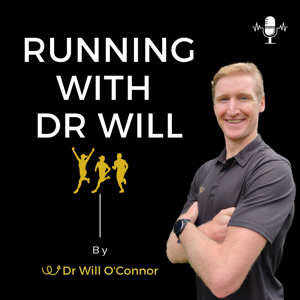
Welcome to Running with Dr Will. A show for runners who want to get faster using the latest in running science and technology. I break down the science and tech so you can run faster for less effort.
In each episode, you’ll get actionable, scientifically-backed tactics and strategies to teach you how to add structure, accountability, and specificity to your running using the latest in running science and running technology so that you can enjoy running and smash your next PB. Running faster doesn't have to be hard!
Hit subscribe now to be notified when new episodes go live.
To steal my secret formula to running mind-blowing PBs, head to https://link.drwillo.com/stealmyformula

377 Listeners

1,341 Listeners

136 Listeners

3,608 Listeners

52 Listeners

14 Listeners
5,773 Listeners

138 Listeners

186 Listeners

1,817 Listeners

3,023 Listeners

1,771 Listeners

165 Listeners

13 Listeners

0 Listeners