
Sign up to save your podcasts
Or

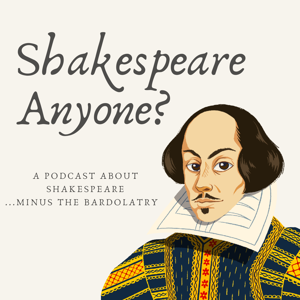


In today's episode we are joined by Carson Brakke to discuss how early modern concepts and anxieties about hospitality and cannibalism influenced early modern literature and drama, most explicitly in Shakespeare's Titus Andronicus.
Carson breaks down the early modern concept of hospitality and shares the cultural debates and dilemmas that centered around it and its inherent dangers. Join us as she guides us through the cognitive dissonance surrounding cannibalism for early modern Europeans, who simultaneously used it to other non-Europeans while possibly participating in cannibalism themselves!
We also explore how readers and theatre-makers today can use this knowledge to interpret scenes of hospitality and cannibalism in Shakespeare and other early modern works.
Content warning: cannibalism is discussed throughout this episode. Please listen with care.
Our guest: Carson Brakke is a PhD candidate at the University of Illinois at Urbana Champaign, and is writing her dissertation on representations of hospitality in early modern English literature. In addition to hospitality, her research interests include domesticity, food studies, and women's writing. To break up the solitary work of dissertating, Carson uses her TikTok platform to talk about early modern literature and the PhD experience. You can find her @glutenbergbible, where she's always looking to chat with more people about research, academia, and the weird and surprising sides of early modern English literature!
Shakespeare Anyone? is created and produced by Kourtney Smith and Elyse Sharp.
Music is "Neverending Minute" by Sounds Like Sander.
Follow us on Instagram at @shakespeareanyonepod for updates or visit our website at shakespeareanyone.com
You can support the podcast at patreon.com/shakespeareanyone
Works referenced:
Brakke, Carson. "The Dangers of Hospitality in Shakespeare: The Hostess in The Rape of Lucrece and The Winter's Tale." Journal of the Wooden O, vol. 21, 3 June 2022, pp. 1–12, https://omeka.li.suu.edu/ojs/index.php/woodeno/article/view/265.
Shahani, Gitanjali G. Tasting Difference: Food Race and Cultural Encounters in Early Modern Literature. Cornell University Press, 2021.
Join us on a literary journey through the transformative tales of Ovid's Metamorphoses and their profound impact on the works of William Shakespeare.
Ovid's Metamorphoses, a collection of mythological stories of change and transformation, serves as a rich source of inspiration for many of Shakespeare's most iconic plays and characters. Before diving into the Shakespearean connections, Elyse and Kourtney provide an overview of key stories in Ovid's Metamorphoses, ensuring that both enthusiasts and newcomers can appreciate the context.
Join us as we discover the clear parallels between Ovidian stories like Pyramus and Thisbe and Shakespeare's Romeo and Juliet and A Midsummer Night's Dream. Explore how a specific translation of Ovid's stories impacted Shakespeare and other early modern writers.
Shakespeare Anyone? is created and produced by Kourtney Smith and Elyse Sharp.
Music is "Neverending Minute" by Sounds Like Sander.
Follow us on Instagram at @shakespeareanyonepod for updates or visit our website at shakespeareanyone.com
You can support the podcast at patreon.com/shakespeareanyone
Works referenced:
Blake, Harriet Manning. "Golding's Ovid in Elizabethan Times." The Journal of English and Germanic Philology, vol. 14, no. 1, 1915, pp. 93–95. JSTOR, http://www.jstor.org/stable/27700642. Accessed 24 Sept. 2023.Britannica, The Editors of Encyclopaedia. "Metamorphoses". Encyclopedia Britannica, 14 Sep. 2023, https://www.britannica.com/topic/Metamorphoses-poem-by-Ovid. Accessed 16 September 2023.
Ovid. The. Xv. Bookes of P. Ouidius Naso, Entytuled Metamorphosis, Translated Oute of Latin into English Meeter, by Arthur Golding Gentleman, a Worke Very Pleasaunt and Delectable. 1567. . Translated by Arthur Golding. London: William Seres, 1567. Early English Books Online Text Creation Partnership, http://name.umdl.umich.edu/A08649.0001.001. Accessed 24 Sept. 2023.
Ovid. Ovid's Metamorphoses in fifteen books. Translated by the most eminent hands. Adorn'd with sculptures:. London: Jacob Tonson, 1717. Early English Books Online Text Creation Partnership, http://name.umdl.umich.edu/A08649.0001.001. Accessed 24 Sept. 2023.
"Ovid's Metamorphoses." British Library: Collection Items, British Library, www.bl.uk/collection-items/ovids-metamorphoses. Accessed 24 Sept. 2023.
Tosh, Will. "Shakespeare and Ovid's Metamorphoses." Shakespeare's Globe: Blogs & Features, Shakespeare's Globe, 22 Sept. 2021, www.shakespearesglobe.com/discover/blogs-and-features/2021/09/22/shakespeare-and-ovids-metamorphoses/#0.
In today's episode, we are joined by the brilliant Dr. Mia Escott to embark on a journey through the complex intersections of race, Shakespeare, and the early modern era.
Dr. Escott provides crucial context to help us understand how people of the early modern era were socially categorized based on nationality, religion, and social status. It's a crucial foundation for dissecting Shakespeare's approach to race.
Aaron, the enigmatic character from Titus Andronicus, takes center stage. Dr. Escott walks us through the complexities of this character, a Moor in a world where stereotypes and villainy are often intertwined. We explore key moments and lines that shed light on Aaron's character and the racial dynamics at play.
We also discuss Blackness and race within Shakespeare's broader canon, as Dr. Escott sheds light on how Shakespeare both humanized and socially othered his Black characters. Woven throughout our discussion are Dr. Escott's insights into how the worlds of academia and theatre can better approach race and discussions of race, especially when it comes to Shakespeare.
Dr. Mia Escott is an Assistant Professor of English, Rhetoric, and Writing at Berry College. She joined the faculty in 2022 after receiving her doctoral degree in English from Louisiana State University. An Alabama native, she has graduated from Auburn University and the University of Montevallo. Her research and teaching interests include early modern British Literature, Renaissance Drama, Shakespeare, Critical Race Theory, and Women's and Gender Studies. Dr. Escott is the 2022 recipient of LSU's HSS Diversity Committee— Excellence in Teaching Graduate Student Award, which highlights her commitment to making academia an inclusive and equitable learning space. Most recently she has been a guest speaker at various Berry College events, sharing her love for English and Shakespeare.
If you are not a Berry student then luckily you can find Dr. Escott on TikTok as @dr.shakesfeare, where she is making The Bard more accessible and comprehensible, in a humorous way.
Recommended Reading (may contain affiliate links):
White People in Shakespeare: Essays on Race, Culture and the Elite by Arthur L Litttle Jr.
The Great White Bard by Dr. Farah Karim-Cooper
Shakespeare Anyone? is created and produced by Kourtney Smith and Elyse Sharp.
Music is "Neverending Minute" by Sounds Like Sander.
Follow us on Instagram at @shakespeareanyonepod for updates or visit our website at shakespeareanyone.com
You can support the podcast at patreon.com/shakespeareanyone
In today's episode, we're peeling back the layers of a genre that not only fascinated audiences of the Early Modern period but also left an enduring mark on the works of the Shakespeare himself: Revenge Tragedies.
Join us as we journey through time to an era of dramatic tension, dark desires, and vengeful spirits. Revenge tragedies, a genre that flourished in the late 16th and early 17th centuries, paved the way for some of Shakespeare's most iconic plays. In this episode, Kourtney and Elyse will shed light on the defining features, influential playwrights, and societal factors that contributed to the allure of these gripping tales of retribution.
Delve with us into a world of poisoned chalices, secret plots, and enigmatic ghosts as we dissect the very essence of a classic revenge tragedy. We'll explore the groundbreaking works of playwrights like Thomas Kyd, whose play The Spanish Tragedy not only set the stage for the genre's popularity but also influenced Shakespeare's own exploration of vengeance on the stage.
Step into the shoes of Elizabethan and Jacobean theatergoers, and discover why themes of political intrigue, power struggles, and personal vendettas struck a chord during those tumultuous times. We'll discuss the psychological complexities of characters seeking revenge, as well as the societal undercurrents that resonated with audiences then and continue to captivate audiences today.
Shakespeare Anyone? is created and produced by Kourtney Smith and Elyse Sharp.
Music is "Neverending Minute" by Sounds Like Sander.
Follow us on Instagram at @shakespeareanyonepod for updates or visit our website at shakespeareanyone.com
You can support the podcast at patreon.com/shakespeareanyone
Works referenced:
Findlay, Alison. "Re-Marking Revenge in Early Modern Drama." Revenge and Gender in Classical, Medieval, and Renaissance Literature, edited by Lesel Dawson and Fiona McHardy, Edinburgh University Press, 2018, pp. 58–82. JSTOR, http://www.jstor.org/stable/10.3366/j.ctv7h0vqp.7. Accessed 26 Aug. 2023.
"The Maid's Revenge." Wikipedia, Wikimedia Foundation, 20 Aug. 2023, en.wikipedia.org/wiki/The_Maid%27s_Revenge.
"The Maid's Tragedy." Wikipedia, Wikimedia Foundation, 21 Aug. 2023, en.wikipedia.org/wiki/The_Maid%27s_Tragedy.
Preedy, Chloe Kathleen. "'Women's Weapons': Education and Female Revenge on the Early Modern Stage." Revenge and Gender in Classical, Medieval, and Renaissance Literature, edited by Lesel Dawson and Fiona McHardy, Edinburgh University Press, 2018, pp. 181–200. JSTOR, http://www.jstor.org/stable/10.3366/j.ctv7h0vqp.14. Accessed 26 Aug. 2023.
"Seneca His Ten Tragedies, 1581." British Library Collection Items, British Library, 2023, www.bl.uk/collection-items/seneca-his-ten-tragedies-1581.
"The Spanish Tragedy." Wikipedia, Wikimedia Foundation, 24 Mar. 2023, en.wikipedia.org/wiki/The_Spanish_Tragedy.
Tassi, Marguerite A. "The Avenging Daughter in King Lear." Revenge and Gender in Classical, Medieval, and Renaissance Literature, edited by Lesel Dawson and Fiona McHardy, Edinburgh University Press, 2018, pp. 111–21. JSTOR, http://www.jstor.org/stable/10.3366/j.ctv7h0vqp.10. Accessed 26 Aug. 2023.
"'tis Pity She's a Whore." Wikipedia, Wikimedia Foundation, 30 May 2023, en.wikipedia.org/wiki/%27Tis_Pity_She%27s_a_Whore.
Willis, Deborah. "'The Gnawing Vulture': Revenge, Trauma Theory, and 'Titus Andronicus.'" Shakespeare Quarterly, vol. 53, no. 1, 2002, pp. 21–52. JSTOR, http://www.jstor.org/stable/3844038. Accessed 26 Aug. 2023.
Introducing Play On! Podcasts: Love's Labour's Lost! Play On Podcasts are epic audio adventures that reimagine Shakespeare's timeless tales, featuring original music composition and the voices of award-winning actors. Each episode explores plays from Macbeth to A Midsummer Night's Dream, in a way that you can actually understand it and created specifically for the podcast form by some of America's most exciting playwrights, directors and composers, and performed by stage and screen's best.
Check out the first episode from their latest series: Love's Labour's Lost!
The King of Navarre gathers together with his best friends (Longaville, Dumaine and Berowne) in the library at Howard University where he gets them to agree that they will devote themselves entirely to their studies without dating or indulging in food, drink or sleep for three full years. Berowne protests and reminds the King that the Princess of France is going to arrive soon to plead a case on behalf of her ailing father. The King promises to handle the situation and Berowne agrees to stick with his vow despite his reservations. They decide they'll amuse themselves during their downtime by laughing at the antics of Don Adriano de Armado, a visiting scholar from Spain who is hilariously full of himself. Almost as soon as the King's proclamation is issued, Sir Anthony Dull delivers a letter from Armado accusing Costard, a groundskeeper at Howard, of having an affair with Jaquenetta, a young lady who lives nearby. The King punishes Costard with a week of fasting on bread and water. Meanwhile, Armado confesses privately to his young friend and confidante, a Custodial Assistant named Moth, that he is painfully in love with Jaquenetta and vows to win her affections.
The Play On Podcast series, "LOVE'S LABOUR'S LOST", was written by WILLIAM SHAKESPEARE and translated into modern English verse by JOSH WILDER. Each episode was directed by NELSON T. EUSEBIO the THIRD. The cast is as follows: RUSSELL G. JONES as THE KING OF NAVARRE and THE FORESTER MATTHEW ELIJAH WEBB as BEROWNE ASHLEY BRYANT as THE PRINCESS and JAQUENETTA TIFFANY RACHELLE STEWART as ROSALINE TONYA PINKINS as MARIA, HOLOFERNES, and HIEMS SHAWN RANDALL as COSTARD and DUMAINE BRANDON JONES as DON ADRIANO DE ARMADO and LONGAVILLE WALTER COPPAGE as MOTH, BOYET, DULL and MARCADE SARITA COVINGTON as LADY NATHANIEL and KATHARINE Casting by THE TELSEY OFFICE: KARYN CASL, CSA, and ADA KARAMANYAN. Voice and Text Coach: JULIE FOH Episode scripts were adapted and produced by CATHERINE EATON Original Music and Sound Design by LINDSAY JONES. Sound engineering by SADAHARU YAGI. Mix Engineer and Dialogue Editor: LARRY WALSH. Podcast Mastering by GREG CORTEZ at New Monkey Studio. Coordinating Producer: TRANSCEND STREAMING (KYRA BOWIE and LEANNA KEYES). Executive Producer: MICHAEL GOODFRIEND. The Managing Director of Business Operations and Partnerships at Next Chapter Podcasts is SALLYCADE HOLMES. The Play On Podcast Series "THE TEMPEST" is produced by NEXT CHAPTER PODCASTS and is made possible by the generous support of THE HITZ FOUNDATION. Visit ncpodcasts.com for more about the Play On Podcast Series. Visit playonshakespeare.org for more about Play On Shakespeare. Hear more about the Play On Shakespeare Podcast series by subscribing to Play On Premium at ncpodcasts.com, where you'll find interviews with the artists, producers and engineers who brought it all to life. And remember: "We are such stuff as Dreams are made on". Learn more about your ad choices. Visit megaphone.fm/adchoices
In today's episode, we will be discussing the portrayal of women in Shakespeare's Titus Andronicus and how it reflects the evolving concept of girlhood in Early Modern England as well as popular conceptions of one specific woman involved in early modern European politics: Catherine de Medici.
Step into the past and uncover how linguistic developments in the early modern era point to an evolving understading of womanhood and how these developments appear in Shakespeare's Titus Andronicus.
Discover the enigmatic Catherine de Medici's profound influence on Shakespeare's iconic tragedy. Unveil the parallels between her powerful legacy and the depecition of Tamora, offering fresh perspectives on the play's timeless themes. Join us for a captivating episode that delves into history, literature, and their echoes in our world today on "Shakespeare Anyone!"
Shakespeare Anyone? is created and produced by Kourtney Smith and Elyse Sharp.
Music is "Neverending Minute" by Sounds Like Sander.
Follow us on Instagram at @shakespeareanyonepod for updates or visit our website at shakespeareanyone.com
You can support the podcast at patreon.com/shakespeareanyone
Works referenced:
Carney, Jo Eldridge. ""I'll Find a Day to Massacre Them All": Tamora in Titus Andronicus and Catherine de Médicis." Comparative Drama, vol. 48 no. 4, 2014, p. 415-435. Project MUSE, doi:10.1353/cdr.2014.0034.
Higginbotham, Jennifer. "'A Wentche, a Gyrle, a Damsell': Defining Early Modern Girlhood." The Girlhood of Shakespeare's Sisters: Gender, Transgression, Adolescence, Edinburgh University Press, 2013, pp. 20–61. JSTOR, http://www.jstor.org/stable/10.3366/j.ctt20q22dc.6. Accessed 1 Aug. 2023.
In today's episode, we are joined by New York Times bestselling author Evelyn Skye to discuss her debut adult novel THE HUNDRED LOVES OF JULIET and her process for adapting one of Shakespeare's most famous stories into her own. THE HUNDRED LOVES OF JULIET is available now, wherever you get your books! Join us on our Patreon later this month as we dive deeper into the book (with spoilers!) with Evelyn.
THE HUNDRED LOVES OF JULIET is a modern reimagining of Romeo and Juliet, with a twist: Romeo has been cursed to live forever, Juliet to reincarnate and die soon after they meet. Sometimes they only have minutes together, sometimes they have years. But she always—no matter what they do to prevent it—perishes. Told in alternating dual perspectives, "this novel cleverly imagines the epilogue the lovers didn't get to have, and how curses can be blessings in disguise." (Jodi Picoult)
A STORY ORIGINATING FROM THE AUTHOR'S POIGNANT PERSONAL EXPERIENCE: In 2018, just ten months after they were married, Evelyn's husband Tom underwent an emergency double lung transplant—and since the moment he woke, they have lived with the knowledge that any day could be his last. In the years following Tom's surgery, Evelyn turned to her own writing to grapple with the uncertainty and anxiety of their future. She was drawn to the tragedy of Romeo and Juliet—but instead of immersing herself in the themes of desperation and senseless loss that mark Shakespeare's best-known play, she was inspired to reimagine the eponymous characters as two regular people fighting against the heartbreaking fate that bound them together… and instead for the unshakeable, transcendent love that fate dealt them.
EVELYN SKYE is the New York Times best selling author of eight novels, including The Crown's Game. A graduate of Stanford University and Harvard Law School, Skye lives in the San Francisco Bay Area with her husband and daughter. For more, follow her on Instagram at @evelyn_skye or visit evelynskye.com
Shakespeare Anyone? is created and produced by Kourtney Smith and Elyse Sharp.
Music is "Neverending Minute" by Sounds Like Sander.
Follow us on Instagram at @shakespeareanyonepod for updates or visit our website at shakespeareanyone.com
You can support the podcast at patreon.com/shakespeareanyone
Works referenced:
Skye, Evelyn. The Hundred Loves of Juliet. Del Rey Books, 2023.
In today's episode, we are starting off our discussions on Shakespeare's Titus Andronicus by discussing trauma and trauma theory and how trauma and trauma theory appear throughout the play.
We will discuss the cultural effect of Lavinia's trauma and the ethics involved in reproducing that trauma onstage in both Shakespeare's time and today.
Finally, we'll discuss how theatremakers and educators use trauma-informed practices to responsibly engage with early modern works that contain trauma. We reference The Pillars developed by Intimacy Directors International, which can be found here.
Content Warning: Titus Andronicus contains depictions and descriptions of acts of mutilation, graphic discussions of sexual assault and rape, overt racism, non-consensual cannibalism, and torture. Please listen with care. Shakespeare Anyone? is created and produced by Kourtney Smith and Elyse Sharp.
Music is "Neverending Minute" by Sounds Like Sander.
Follow us on Instagram at @shakespeareanyonepod for updates or visit our website at shakespeareanyone.com
You can support the podcast at patreon.com/shakespeareanyone
Works referenced:
BROCKMAN, SONYA L. "TRAUMA AND ABANDONED TESTIMONY IN 'TITUS ANDRONICUS' AND 'RAPE OF LUCRECE.'" College Literature, vol. 44, no. 3, 2017, pp. 344–78. JSTOR, http://www.jstor.org/stable/44504139. Accessed 11 July 2023.
Mendoza, Kirsten N. "Sexual Violence, Trigger Warnings, and the Early Modern Classroom." Teaching Social Justice Through Shakespeare: Why Renaissance Literature Matters Now, edited by Hillary Eklund and Wendy Beth Hyman, Edinburgh University Press, 2019, pp. 97–105. JSTOR, http://www.jstor.org/stable/10.3366/j.ctvrs912p.13. Accessed 11 July 2023.
Sina, Tonia, et al. "The Pillars - IDI." The Pillars, 2020, docs.wixstatic.com/ugd/924101_2e8c624bcf394166bc0443c1f35efe1d.pdf.
Smith, Charlene. "Staging Sexual Assault Responsibly." HowlRound Theatre Commons, 10 July 2019, howlround.com/staging-sexual-assault-responsibly.
Solga, Kim. "Rape's Metatheatrical Return: Rehearsing Sexual Violence among the Early Moderns." Theatre Journal, vol. 58, no. 1, 2006, pp. 53–72. JSTOR, http://www.jstor.org/stable/25069779. Accessed 19 July 2023.Willis, Deborah. "'The Gnawing Vulture': Revenge, Trauma Theory, and 'Titus Andronicus.'" Shakespeare Quarterly, vol. 53, no. 1, 2002, pp. 21–52. JSTOR, http://www.jstor.org/stable/3844038. Accessed 11 July 2023.
When we decided to name the episodes where we cover major themes, the main sources, and key background information for Shakespeare's plays, we definitely weren't thinking of the implications it would have for this play in particular.
But now we are here, and discussing stuff to chew on for Titus Andronicus!
Content warning: Titus Andronicus contains depictions and descriptions of acts of mutilation, graphic discussions of sexual assault and rape, overt racism, non-consensual cannibalism, and torture. Please listen with care.
Shakespeare Anyone? is created and produced by Kourtney Smith and Elyse Sharp.
Music is "Neverending Minute" by Sounds Like Sander.
Follow us on Instagram at @shakespeareanyonepod for updates or visit our website at shakespeareanyone.com
You can support the podcast at patreon.com/shakespeareanyone
Works referenced:
"Philomela." Wikipedia, 23 May 2023, en.wikipedia.org/wiki/Philomela.
Shakespeare, William, and Jonathan Bate. Titus Andronicus: Revised Edition. Bloomsbury Publishing Plc, 2018
It's time for a new play, which means a new synopsis! We are diving into Titus Andronicus today, and we will be breaking down this play scene by scene.
Content Warning: Titus Andronicus contains depictions and descriptions of acts of mutilation, graphic discussions of sexual assault and rape, overt racism, non-consensual cannibalism, and torture. Please listen with care.
Shakespeare Anyone? is created and produced by Kourtney Smith and Elyse Sharp.
Special thanks to Nat Yonce for guest-editing this episode.
Music is "Neverending Minute" by Sounds Like Sander.
Follow us on Instagram at @shakespeareanyonepod for updates or visit our website at shakespeareanyone.com
You can support the podcast at patreon.com/shakespeareanyone
Works referenced:
Shakespeare, William, and Jonathan Bate. Titus Andronicus: Revised Edition. Bloomsbury Publishing Plc, 2018.
From the publisher's feed
Ranked by our users in the last 21 days

37,994 Listeners

5,478 Listeners

823 Listeners

6,429 Listeners
1,122 Listeners
328 Listeners
743 Listeners

3,220 Listeners

3,597 Listeners
3,378 Listeners

1,897 Listeners
1,392 Listeners

9,377 Listeners
234 Listeners

580 Listeners