
Sign up to save your podcasts
Or

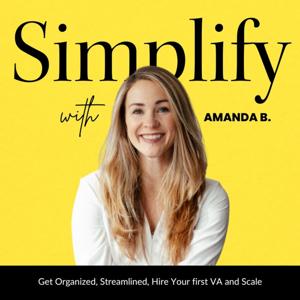


Hey friend, I hope your summer has been amazing so far! In this week’s podcast episode, I am sharing some of my favorite top digital productivity tools and systems I use in my business and life.
But before we dive in, I want to remind you that Attention Audit Academy is currently on pre-sale until July 31st and you can enroll for half off.
Attention Audit Academy is my self-paced course that teaches you how to effectively manage your time using your digital calendar. Whether you are someone who dabbles in using a digital calendar or you’re already using one but it isn’t that useful, I teach you my step-by-step system from goal planning, to creating categories, productivity tips and how to get better, faster results without sacrificing more time and energy.
Okay, let’s dive into today’s episode…
My goal when it comes to using systems, tech or tools is for it to make my life easier, not more complicated by having to manage multiple tools. The less tools we have to manage, the more likely we are to use them. The more things to manage, the more complicated things can be and this can lead to more overwhelm.
My favorite tools and systems:
Productivity Tools and systems I no longer use:
That’s all I have for you this week. I’d love to hear if any of these are new to you or which tools you find most (or even least) helpful so DM me over on Instagram @attentionaudit and make sure you take advantage of the Attention Audit Academy pre-sale offer happening now through July 31!
Talk to you next week!
Free Resources:
In today's fast-paced world, productivity is often associated with being constantly on the go, working tirelessly, and achieving endless goals. We live in a society that values busyness and often overlooks the importance of rest. However, rest is not just a break from productivity; it is an integral part of the productive process itself.
In today’s podcast episode I want to dive into the relationship between rest and productivity, highlighting why rest is important for our well-being and why we can't afford to neglect it. And practical steps you can take to start building a resting routine.
Free Resources:
Welcome back to the podcast. It is a new month, we are officially in the second half of 2023. I don’t know about you but I'm pumped. I’m excited. It feels like a chance to set the tone for the last half of the year.
Today’s episode I’m going to share with you a recap of…
Free Resources:
In a world filled with an abundance of choices, making decisions is an integral part of our daily lives. However, the inability to make timely and confident decisions can lead to a state of limbo called indecision. Indecision can be paralyzing, hindering progress and growth in both personal and professional domains. In this podcast episode, we will explore what indecision entails, the factors contributing to it, the costs it incurs, effective strategies to make decisions faster, and the remarkable benefits of decisive action. Tune in to hear how you can overcome indecision.
Free Resources:
Hello friends, welcome back to the Attention Audit podcast! This week we are going to dive into outsourcing. As a whole, this is something that I wholeheartedly believe in, and I’m always scanning and looking for new opportunities on where I can outsource, not only in my business, but also in my personal life.
So in this week’s episode, I’m going to walk you through how to start outsourcing using a checklist because I know how daunting it can be to simply get started. This is also something that we are covering in my midyear reset mastermind coming up and I’m so excited about it because we are going to take one area of the business and each of our own businesses and identify what we can outsource starting with what are the things that I no longer have the energy to do.
Start with a task that drained your energy and look for an underlying process. Look for the things that you find yourself thinking ‘oh my gosh I just don’t want to do this’ on a regular basis and start there. The goal here is to create a process so we can train someone to follow that process. It could be something as simple as checking and organizing emails. The person you hire can only go so far in terms of organization unless you hire someone specifically known to be really good at that task and has an established system, more likely than not however, you’re going to be hiring someone who is a generalist, and they will need a bit more direction. You can provide that direction through creating the process for them to follow because when there is a process, we can coach that process, we can train that process, and it makes it really easy for someone to plug up themselves into that process.
Take email, for example. Let’s say you typically check your emails in the morning and then again in the evening and you file certain things in different blocks. Maybe you have different email types that come in such as inquiries, speaking engagements, customer service, emails, etc. Really be specific about the different types of emails that come into your inbox and identify themes or categories of those that you can drop into particular buckets. The more specific you can be here, the simpler the training will be later on.
Once you list out all of the tasks and start breaking them into categories then refine those processes. At this point when it comes to refining, the processes step three is that you were going to look for template opportunities. What I mean by identifying template opportunities is a simple as creating a Google email template that you can rinse and repeat using for each of those email categories.
Step four is to choose a place that is centralized where you can map out and store your entire training process. It could be somewhere such as your Google Drive. You’re going to take all of those processes and templates that you’ve created, get them into one document, and store them where they will ‘live’.
Step five is a step that I often see people miss but it’s super important because it takes into account that everyone learns differently. Some people learn visually, some people learn by listening, some people learn tactfully, everyone is different. I know I personally learn by hearing and visually seeing steps. So this is where I want you to use a tool, such as Loom to record yourself doing the actual task. This will help to eliminate a lot of questions or steps that can easily get lost in translation, because the person can see it happen on real time which will also reduce the amount of back-and-forth.
All of these can be easily applied to tasks that you’re looking to outsource not only in your business, but in your personal life as well.
That’s all I have for you in this weeks episode. Come hang out with me on Instagram @attentionaudit and I look forward to chatting with you next week. Until then, take care.
Free Resources:
This week I want to talk to you about procrastination.
When I looked up the word ‘procrastinate’, the definition Google gave me was: “To put off doing something, especially out of habitual carelessness or laziness”.
I believe that procrastination it the act of putting something off and can be become a habitual behavior. I’m not sure I think it is from being lazy as much as it might be a lack of prioritizing. If procrastination is the act of putting something off, then that act is something that therefore requires to be done.
Take for example, taxes. Someone can put off taxes because they agree they must be done by a certain time.
So the question is why do we put things off?
The key is to bring awareness as to why you’re procrastinating so that you can decide ahead of time how you want to plan for it.
Let’s say you sit down to work one day and you’ve got your calendar blocked out with various tasks. You come upon a task that you’re not terribly excited about but know that it needs to get done.
In that moment you may find your brain trying to re-negotiate with yourself thinking ‘I’m wanting to move it to another day/time’. Did you know that procrastinating provides a dopamine hit which makes it more desirable to push off? Which, in turn, is what can make procrastination a habit.
Follow me over on Instagram @attentionaudit to hear more about procrastination and what you can do to overcome it.
See you next week, friends!
Free Resources:
Welcome back friends! This week I’m talking about something that I know we all have struggled with at one time or another, thought clutter.
But first, what is thought clutter?
Thought clutter is when your mind is filled with thoughts that don’t serve you and tend to make you feel overwhelmed or “all over the place”. Maybe you’re mentally compartmentalizing too many things and your brain is feeling like it is in overload mode. Thought clutter can slow you down when it comes to decision making and getting into action.
Just like how you want to clean or declutter your house of physical clutter, you may find yourself needing or wanting to declutter your thoughts and how you are choosing to think.
How do I know if I’m experiencing thought clutter?
You can tell if you have thought clutter by a few different ways.
How do I eliminate thought clutter?
Different ways you can go about reducing thought clutter and purge thought clutter:
That’s all for this week. I’d love to hear what you’ve taken away from this episode and how you are going to eliminate some of the thought clutter you’re experiencing in your life so DM me on Instagram @attentionaudit and share your favorite takeaway!
See you next week!
Free Resources:
Have you ever paid attention to the words you use on a daily basis, and what you speak out loud?
Did you know that the way we think influences the way we speak, and the way we speak influences the way we think?
When you speak out loud your subconscious hears what you are saying and will continue to reinforce that story. When you speak, even if you’re saying something that is a joke, your subconscious mind doesn’t know the difference between a joke and something you truly mean.
You might be thinking ‘what does this have to do with time management and productivity?’.
Well, the words we think and say can also make us feel a certain way. And how we feel is what either encourages us to take action or discourages us to take action.
For example if you’ve ever been on the hamster wheel of “I’m so busy”, you know that it can feel never-ending. Like you can’t catch a breath which feels very suffocating.
Versus if you said, “Life is full right now and that’s okay”. That phrase provokes a different feeling, an emotion inside of you.
What about “I don’t have time”?
Instead, maybe swap it with, “It isn’t a priority for me right now.” A simple phrase shift can be the difference from feeling like you’re at the mercy of all the things to feeling like you’re in control and have a choice.
Language can help focus our attention and thoughts on specific aspects that we want to focus on.
The words you speak become your reality.
Words possess energy in the form of vibrations.
If there’s something in your life you don’t like, pay attention to how you speak about it. Shift your language and see what happens.
For the rest of the day pay attention to the words that you use and what you say out loud. Remember your subconscious mind doesn’t know the difference between a joke and what you actually mean.
Pay attention to how you speak about time, your schedule, what needs to get done. Can you shift what you say to be more empowering, change the words to feel less heavy?
Until next time, take care my friend.
Free Resources:
Hi friend! Welcome back to another episode! This week we are talking about context switching. If you’re not familiar with what context switching is, it is one of the sneakiest energy drains and time sucks.
Context switching was originally used in computing to describe the switching of the CPU from one state of a process to another. Today, as it relates to efficiency and energy/time management you can think of context switching as going from one task to another that requires different type of energy, thinking and state of flow.
With context switching comes switch cost. There is a cost to switching and changing between different types of tasks. Whether that is time or energy or both.
Examples of context switching that can be costly:
When you switch between one task and another you will naturally expend energy but when you switch from doing one type of task to another you expend more which is why you can be strategic with how you schedule your days to help conserve energy and be more efficient.
Here’s what you can do to help reduce context switching:
That’s all for this week - I’d love it if you came to share what you will be implementing from this week's episode on Instagram @attentionaudit.
Until next week!
Free Resources:
This week on the podcast we’re going to talk about the power of starting small in relation to taking action.
Oftentimes our brain has a tendency to make things a bigger deal than they are and by doing so it causes us to freeze. It is almost as if we’re pole vaulting over ‘mouse turds’.
When should you start small?
What are the benefits of of starting small?
Ways to start small:
Remember, anytime your brain wants to go into overwhelm ask yourself…
Thank you for tuning in again, friends! If you are looking for more inspo, join me over on Instagram @attentionaudit.
Until next week!
Free Resources:
From the publisher's feed
8,787 Listeners

1,303 Listeners

2,086 Listeners

6,678 Listeners

12,079 Listeners

3,594 Listeners

927 Listeners

2,606 Listeners

673 Listeners

28,936 Listeners

3,462 Listeners

673 Listeners

18,814 Listeners

8,432 Listeners

31 Listeners