
Sign up to save your podcasts
Or



In this lecture, Kenyon explores “This Boy,” one of the Beatles’ earliest attempts at doo-wop-inspired songwriting. The session examines the track’s compound 12/8 meter, close vocal harmonies, and unusual pronoun construction, where Lennon opts for the ambiguous “this boy” instead of the more direct “I” or “me.” Kenyon breaks down the song’s harmonic structure, focusing on its use of appoggiaturas, minor-key resolutions, and the signature D-Bm-Em-A7 progression that anchors the verses. The lecture also highlights the intricate vocal layering, with George’s internal melody and Paul’s soaring high harmonies creating a tightly woven choral texture. Special attention is given to the middle eight, where the Beatles break from their usual rock formula with a series of unexpected chord shifts, lending the song a sense of longing and unresolved tension. This lecture provides a deep dive into one of the Beatles’ most harmonically ambitious early compositions.
Website: https://www.notebynoteseries.com
Patreon: https://www.patreon.com/cw/NoteByNoteSeries
Instagram: https://www.instagram.com/notebynoteseries
Hosted on Acast. See acast.com/privacy for more information.
What happens when a single song conquers two continents at once? “I Want to Hold Your Hand” wasn’t just a hit—it was the ignition switch for Beatlemania in America. In this episode, Peter and Kenyon break down the Beatles’ biggest early gamble: a song written specifically to win over U.S. audiences, composed “eyeball to eyeball” in the basement of Jane Asher’s house. They unpack the song’s explosive chord change, its international recording sessions, and the moment a teenage girl and a rogue DJ sparked a revolution by airing it early in Washington, D.C. You’ll also hear about the Beatles’ tension with their music publisher, Paul McCartney’s take-no-prisoners attitude in the studio, and how a phrase as simple as “I can’t hide” got misheard, mimicked, and mythologized. With 5 million U.S. sales and a continent-altering TV debut, this episode tells the story of a song that changed everything.
Website: https://www.notebynoteseries.com
Patreon: https://www.patreon.com/cw/NoteByNoteSeries
Instagram: https://www.instagram.com/notebynoteseries
Hosted on Acast. See acast.com/privacy for more information.
In this lecture, Kenyon offers a comprehensive analysis of “I Want to Hold Your Hand,” a track often celebrated for its cultural impact but rarely studied for its structural depth. Far from merely a straightforward pop song, Kenyon argues that its emotional resonance stems from a carefully balanced interplay between action and sentiment, mirrored in both its lyrics and harmonic choices. The lecture examines how Lennon and McCartney use alternating couplets to create tension between directness and vulnerability, supported by a harmonic pattern that moves fluidly between major and minor tonalities. Kenyon highlights the song’s use of the "two-bridge" form, deceptive cadences, plagal resolutions, and Paul McCartney’s rhythmic double-stop bass work. Special attention is given to the song’s harmonic ambiguity—especially in the B minor vs. B7 debate—and to George’s understated arpeggios buried in the mix. This session reframes “I Want to Hold Your Hand” as a masterclass in pop composition and emotional architecture.
Website: https://www.notebynoteseries.com
Patreon: https://www.patreon.com/cw/NoteByNoteSeries
Instagram: https://www.instagram.com/notebynoteseries
Hosted on Acast. See acast.com/privacy for more information.
How did one of the roughest, hardest-rocking Beatles performances come from a $800 loan in Detroit? In this episode, Peter and Kenyon dive into “Money (That’s What I Want),” tracing its wild origins at the dawn of Motown through Barrett Strong’s legendary first recording. They explore how the Beatles discovered this deep cut and transformed it into a ferocious album closer for With the Beatles, powered by John Lennon’s raw vocals, Ringo’s pounding toms, and George Martin’s driving piano. Along the way, they uncover tales of lost songwriting credits, apocryphal high school musicians, and chaotic recording sessions that left their mark on both Motown and Merseybeat. Plus, Peter and Kenyon unpack the track’s lasting influence—from early punk energy to John’s conflicted attitude toward fame and fortune. This isn’t just a Beatles cover—it’s a full-circle moment linking American soul to British rock.
Website: https://www.notebynoteseries.com
Patreon: https://www.patreon.com/cw/NoteByNoteSeries
Instagram: https://www.instagram.com/notebynoteseries
Hosted on Acast. See acast.com/privacy for more information.
What do Mahler, Stephen King, and John Lennon’s “Not a Second Time” have in common? More than you’d think. In this episode, Peter and Kenyon dig into one of the Beatles’ most misunderstood songs—praised by London Times critic William Mann for its so-called “Aeolian cadence,” a term Lennon would later call “exotic birds.” The hosts dissect the track’s odd structure, haunting piano solo, and emotionally unstable chord progressions, exploring why it stands apart on With the Beatles. From the lack of George Harrison’s guitar to the unusual melodic phrasing and brooding lyrics, “Not a Second Time” feels less like a Beatles song and more like a musical outburst. They also discuss the track’s cultural afterlife—including its cameo in a Stephen King book. Was Lennon aiming for Motown, Mahler, or something uniquely his own? This episode uncovers the messy brilliance buried in a song even the Beatles seemed unsure about.
Website: https://www.notebynoteseries.com
Patreon: https://www.patreon.com/cw/NoteByNoteSeries
Instagram: https://www.instagram.com/notebynoteseries
Hosted on Acast. See acast.com/privacy for more information.
In this lecture, Kenyon offers a critical and introspective analysis of “Not a Second Time,” a John Lennon composition from With the Beatles that has baffled fans, critics, and even the band themselves. Often cited as one of Lennon’s weakest early efforts, the song nonetheless presents a unique opportunity for study. Kenyon examines the track’s fragmented melodic development, harmonic aimlessness, and the infamous “Aeolian cadence” praised by The Times critic William Mann—an observation Lennon would later mock. The lecture explores the song’s disjointed middle eight, unresolved cadences, and jarring phrase structures, asking how such an unfocused piece ended up on a Beatles album. Yet, Kenyon argues that even flawed material can reveal much about the songwriting process. Through this lens, “Not a Second Time” becomes a case study in unrealized potential, artistic intuition, and the value of editorial rigor within collaborative composition. A must-listen for those interested in artistic misfires and how they inform musical growth.
Website: https://www.notebynoteseries.com
Patreon: https://www.patreon.com/cw/NoteByNoteSeries
Instagram: https://www.instagram.com/notebynoteseries
Hosted on Acast. See acast.com/privacy for more information.
How did one forgotten girl group from a Detroit suburb end up shaping one of the eeriest Beatles covers? In this episode, Peter and Kenyon uncover the story behind “Devil in Her Heart,” originally recorded as “Devil in His Heart” by the Donays—high schoolers who released only one single before disbanding. The Beatles discovered the track through Brian Epstein’s record shop and transformed it into a haunting George Harrison-led performance. The hosts break down the Beatles’ faithful arrangement, George’s call-and-response vocal dynamics, and how the track reflects the album’s larger theme of light and shadow. They also compare the Beatles’ version with the Donays’ original, arguing the latter may even surpass the Fab Four in raw emotional power. With its dark harmonies, subtle rhythmic tricks, and eerie atmosphere, “Devil in Her Heart” reveals just how deep the Beatles dug to find hidden gems—and how those gems sometimes outshined the band themselves.
Website: https://www.notebynoteseries.com
Patreon: https://www.patreon.com/cw/NoteByNoteSeries
Instagram: https://www.instagram.com/notebynoteseries
Hosted on Acast. See acast.com/privacy for more information.
Could the Beatles really match Smokey Robinson? That’s the challenge they set for themselves with “You Really Got a Hold on Me”—and, incredibly, they just might have pulled it off. In this episode, Peter and Kenyon break down one of the most vocally demanding songs the Beatles ever attempted to cover. Originally a B-side by the Miracles, the track became a soulful highlight of With the Beatles, driven by John Lennon’s searing vocal, George Harrison’s raunchy guitar bends, and subtle backing from George Martin on piano. The hosts explore how the Beatles' version holds its own against the Motown original—reproducing its emotional power while layering in their trademark vocal blend and tight studio polish. From failed intros to overdub edits and a shelved four-track remake, they unpack every twist in the Beatles’ journey to get this one right. This isn’t just a cover—it’s a statement of intent.
Website: https://www.notebynoteseries.com
Patreon: https://www.patreon.com/cw/NoteByNoteSeries
Instagram: https://www.instagram.com/notebynoteseries
Hosted on Acast. See acast.com/privacy for more information.
Was “Hold Me Tight” really the Beatles’ weakest link—or a hidden pivot point in their early sound? Peter and Kenyon dig into this overlooked track from With the Beatles, a song Paul McCartney began writing at age 18 and one that even John and Paul would later dismiss. But beneath its shaky reputation lies a revealing story: failed takes, scrapped sessions, and a frenzied remake that may have included the first-ever Beatles tape-speed manipulation. The hosts dissect Paul’s layered vocal performance, Ringo’s tom-heavy middle eight, and the call-and-response vocals that echo girl group influence and skiffle roots. They trace how “Hold Me Tight” bridges the Beatles’ early rock 'n' roll emulation with a more nuanced, emotionally layered sound—one hinting at their evolving ambition. Is it filler, or is it a case study in transition? This episode offers a surprisingly deep dive into one of the band’s most misunderstood recordings.
Website: https://www.notebynoteseries.com
Patreon: https://www.patreon.com/cw/NoteByNoteSeries
Instagram: https://www.instagram.com/notebynoteseries
Hosted on Acast. See acast.com/privacy for more information.
In this lecture, Kenyon unpacks Paul McCartney’s “Hold Me Tight,” a deceptively simple track from With the Beatles that reveals deeper structural and harmonic complexity on close inspection. Though the song was often dismissed by its creators, Kenyon explores how its repeated ostinato patterns, major-minor tension, and chromatic middle eight create an unsettled, almost adolescent emotional landscape. The lecture analyzes the use of anti-phrasing, call-and-response, and tonal ambiguity—particularly the unexpected shift to A-flat major in the middle eight, a jarring move that foreshadows later Beatles experimentation. Kenyon also questions the song’s rhythmic phrasing, noting its disorienting seven-bar structure and off-kilter cadences, which mirror the lyrical uncertainty and emotional immaturity at the song’s core. Far from being a throwaway, “Hold Me Tight” serves as a window into the Beatles’ transitional period, where conventional love-song tropes meet increasingly adventurous musical instincts.
Website: https://www.notebynoteseries.com
Patreon: https://www.patreon.com/cw/NoteByNoteSeries
Instagram: https://www.instagram.com/notebynoteseries
Hosted on Acast. See acast.com/privacy for more information.
From the publisher's feed
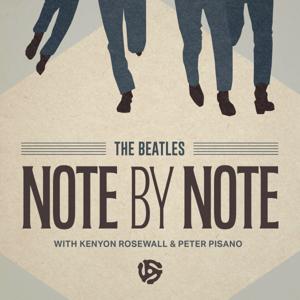
A Beatles podcast that goes song-by-song through every Beatles release in chronological order. We focus on the music itself, breaking down what you’re hearing and why it works.
Website:…
Patreon: https://www.patreon.com/cw/NoteByNoteSeries
Instagram: https://www.instagram.com/notebynoteseries
Hosted on Acast. See acast.com/privacy for more information.
Ranked by our users in the last 21 days
137 Listeners
84 Listeners
446 Listeners

3,180 Listeners

33 Listeners

1,008 Listeners
384 Listeners

360 Listeners

122 Listeners

85 Listeners

65 Listeners

12,713 Listeners

1,223 Listeners

6 Listeners
2 Listeners