
Sign up to save your podcasts
Or

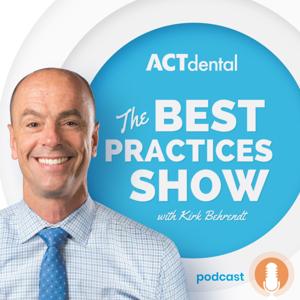


The Foundation of a Better Practice & a Better Life
Episode #470 with Dr. Tito Norris
To build a better practice, you need a key secret ingredient: the best people for your team. And to reveal how to find, hire, and keep a fantastic group of people, Kirk Behrendt brings back Dr. Tito Norris to help you set the foundation for your best possible practice. From self-care to core values, he shares how he created his better practice so he could enjoy a better life. To learn how you can achieve the same, listen to Episode 470 of The Best Practices Show!
Main Takeaways:
Core values are the foundation of your practice.
Don't get sucked into the growth mentality.
Care for your physical and mental self.
Balance your drive and your time.
Schedule a time to relax.
Quotes:
“It’s really easy to get sucked into this growth mentality and, ‘I've got to be bigger. I've got to be a better provider.’ There's competition with your colleagues and your classmates and your competitors, and all this kind of stuff. And all that stuff is good. It’s healthy because that's what drives us. Especially people who are in the dental profession, very often, tend to be very driven. They're very Type A. But you've got to balance that with sharpening the saw and with coming home at the end of the day and being able to give your family the best of you rather than just the rest of you.” (4:24—5:05)
“It’s really difficult to take care of everything else if you don't first take care of yourself.” (5:47—5:51)
“A lot of my friends ask me, ‘Tito, how do you do it? How do you take off that much time?’ And I say, ‘The answer is simple. I schedule it.’ I open up my 2022, 2023 calendar. It’s already done. So, all the meetings I want to go to, all the vacations I want to go on, it’s already done. It’s in the books. It’s in the calendar. And guess what? The time that's left over, that's when I see patients.” (7:41—8:07)
“Number one, take care of yourself. And part of that is the physical itself. But then, the other part is really taking that time off for your mental self as well and finding whatever it is that helps that mental balance.” (8:29—8:47)
“We whittled, and whittled, and boiled it down to seven things that are now the foundation of our practice. And I say foundation because now it’s like, ‘How on earth did we ever operate without them?’ Because now, we hire using our core values. We interview our new candidates, and we say, ‘Okay, does this person fit our core values?’ And we fire by our core values, and we discipline by core values, and we reward by core values. It’s a complete foundation of the people portion of our practice — which is our practice. Your practice is your people.” (11:27—12:12)
“Let me give you our [eight] core values: [I’M TO LEAD]. Innovative. That's the “I”. Mindset — having a positive mindset. Team before self. Having Ownership mentality in everything that you do. Being a Lifelong Learner. Being Efficient with your time, with your energy, with your resources. Attention to detail. And I would've said Disney-type service, but we upped it just a bit. It’s making Disney jealous.” (16:22—17:01)
“I love Tom Landry, the coach of the Dallas Cowboys. A legendary coach. And he used to always say, ‘Hire the athlete, not the position.’ That was his quote. So, if you can find someone who’s got the right stuff, whether that's a server at a restaurant — they're all over the place. You've just got to find them, and you've got to make them a better offer. Now, what does that mean? That's not always just money.” (22:34—23:02)
“The main thing is having the right person. If you've got the right person, they’ll basically find the right seat. Not always. Sometimes, they need a little guidance and direction and support. But that's the key, number one, because [you can have the] right person, wrong seat.” (30:01—30:19)
“What you can never resolve, really, is the wrong person, right seat. And when we say wrong person, literally, what that means is somebody who doesn't subscribe to the core values.” (30:56—31:11)
“If you are out in the world and living, then you're meeting and interacting with people. And when you interact with someone who makes you feel good, bring it up. Say, ‘Listen, I don't know if you know this, but I'm a dentist, and we have an amazing team. And I think you'd be a fantastic addition to the team.’ ‘But I don't have any experience.’ ‘Well, it’s no problem. We can train you. If we've got the right person, we can provide that training. You've got that special something that we’re looking for.” (34:22—34:52)
Snippets:
0:00 Introduction.
2:33 Dr. Norris’s background.
4:15 Advice for life balance.
9:06 Everything revolves around your core values.
12:16 Lessons learned from before and after core values.
14:09 Dr. Norris’s eight core values: I’M TO LEAD.
17:25 How Dr. Norris uses core values in his practice.
19:22 Hire the athlete, not the position.
25:12 What dentists get wrong about empowering their team.
27:34 The accountability chart.
29:30 How to handle difficult conversations with a team member.
33:38 Advice for finding the right people.
35:27 Prove that core values are alive.
39:03 Last thoughts on core values.
Reach Out to Dr. Norris:
Dr. Norris’s Facebook: https://www.facebook.com/tito.norris
Dr. Norris’s social media: @tito.norris
Resources:
The Norris Experience - October 21 to 22, 2022: https://www.dynaflex.com/the-norris-experience/
The Norris 20/26 Bracket System: https://www.dynaflex.com/norris2026/
Qlark: https://www.qlark.com/
Dr. Tito Norris Bio:
Dr. Robert Norris is devoted to creating smiles for a lifetime. His unique background in mechanical engineering provides him with a distinct advantage in mastering the forces, vectors, and movements inherent in performing orthodontic treatment.
• Dr. Norris attended The University of Texas at Austin where he received his bachelor’s degree with honors in Biology and a minor in Mechanical Engineering.
• He was salutatorian of his dental school class at the University of Texas Health Science Center at San Antonio Dental School.
• He completed a General Practice Residency at the V.A. Hospital in Washington, D.C.
• He completed his orthodontics specialty training at Howard University and graduated as valedictorian with the highest GPA in the Orthodontic Department’s 25-year history.
Dr. Norris joined the Air Force and served as Chief of Orthodontics at Misawa Air Base, Japan. Here, he provided orthodontic care to service members and their families.
In 2007, he began work to make his office completely “green.” The office is part of a volunteer renewable energy program with CPS known as Windtricity. In April 2008, he completed a solar energy project at his orthodontic practice with the installation of 80 solar panels, providing 16 kW of electricity.
In 2010, he completed his office expansion, making it the first LEED-Certified orthodontic office in the world. LEED is Leadership in Engineering and Environmental Design and is the U.S. Government’s stamp of approval on environmentally responsible office construction.
Dr. Norris is a resident of San Antonio, Texas, where he lives with his wife and three children. As a Texas native, he grew up in Kingsville. He enjoys snow skiing, cycling, swimming, strength training, boating, hiking, and kayaking. Dr. Norris has lectured throughout the United States, Europe, and Asia. His scientific papers have been published in the American Journal of Orthodontics and Dentofacial Orthopedics, Seminars in Orthodontics, as well as Clinical Impressions. To date, Dr. Norris and Simone are enjoying their proudest accomplishments, their three children.
A Tale of 2 Paths: DSO or Private Practice
Episode #469 with Dr. Barrett Straub
There's a better path to success than churn-and-burn dentistry. And to help you choose the best path for your career, Kirk Behrendt brings back ACT’s CEO, Dr. Barrett Straub, to explain the two paths you can take: DSO or private practice. They highlight the advantages, disadvantages, and everything else to consider when making your decision. For a roadmap to the dental practice you envision, listen to Episode 469 of The Best Practices Show!
Main Takeaways:
Understand the benefits and drawbacks of each path.
Choose the right dental career path for you.
Get a practice coach for guidance.
Have confidence. You can do it!
You control your destiny.
Quotes:
“One of the ingrained, great parts about this profession is we get to control our destiny. We get to choose how we want to practice, where we want to practice. And if you are in one segment of the industry, you can change it. Dentistry is wonderful for that aspect that we truly do control our own path.” (4:32—4:52)
“More and more dental graduates now are going into some sort of associateship, whether it’s with a DSO or another private practice. There are less and less that are as motivated getting a private practice, own their own practice, right away. I think that's a mistake — selfishly. I own my own practice. I think it’s the best. And there are lots of different reasons for that.” (7:16—7:39)
“Why would a dental graduate want to be an associate right away? There are some obvious ones. You have a lot of debt. You want to increase your clinical skills. You want to learn from more experienced dentists. You want to just get into the game a little bit. And that's totally valid.” (7:41—8:00)
“Think ahead 10 years and literally envision what your life looks like, what your practice looks like, what kind of dentistry you want to be doing. And if that is private practice, then make decisions that move you closer to that reality. And maybe your vision of that is to be an employee dentist with a corporate [dental practice]. Great. Make decisions that move you closer to that.” (10:13—10:39)
“If you're a graduating dental student and you're like, ‘I want to be like a Barrett Straub. I want to own my practice. I want to have that work-life balance. I want that,’ then I'm going to encourage you to, if possible, find your associateship. If you want to be an associate — totally agree. That's valid. Do it in private practice. Work for a private practicing dentist that's going to show you that life, that's going to sit down and show you the profit and loss statement, the cashflow statement, the balance sheet, and is going to teach you some of the business aspects, that's going to show you what it means to run a private care practice, versus a lot of graduates who go into corporate dentistry, go into DSO knowing that they're going to transition to private practice. And that's great. But there's a lost opportunity, I think, because it’s a different model.” (11:42—12:35)
“If your goal is over here in the private practice side, find an opportunity in private practice. It doesn't mean you have to buy that practice. It doesn't mean you can't, after your two-year agreement, find a different one or go buy your own practice. But you're going to learn so much more by knowing your vision and then making decisions that get you closer to that, versus just telling yourself this story, ‘All my classmates are going to work for X, Y, Z dental. I probably need to do it. It’s easy, and they're offering a sign-in bonus.’ Well, you don't have to do that.” (12:36—13:03)
“There will always be a huge need for great private practice.” (17:49—17:54)
“Have some confidence. You absolutely can do it.” (19:23—19:25)
“A private practice dentist that owns their own practice is going to make drastically more than an associate over the course of their career — twice as much, I've read, or average of $56,000 a year over the course of 25, 30 years. So, it’s a lot.” (23:13—23:26)
“When you're a dentist and you're working for a company that has non-dentist owners, especially, they’ve got to make money. So, how do they do that? They’re going to take a segment of that profit margin, as they should, to pay for owning and having equity in that company. And so, it’s obvious that if you own your own dental practice and you're in private practice, you're going to make more, and you have more control over your destiny.” (24:04—24:30)
“I'm going to make the hypothesis that a lot of dentists find themselves into their careers, without even knowing it, they're like, ‘I'm in the high-volume, low-margin world, and I didn't even want to.’ And how that happens is we believe that we have to be in the DSO. And DSO, by definition, is high-volume, low-margin, most of the time. Most DSOs are signed on with lots of insurances, as are most private practices. When you're signed on with PPOs, you are in the high-volume, low-margin game.” (28:13—28:53)
“If we find ourselves in the low-margin, high-volume game and we’re tempted to buy a practice, add a day, hire another doctor, add some operatories, I want to say — why would doing more of the same business model increase profitability? It’s not. You're going to work harder for the same low margin.” (30:31—30:55)
“Let's say you're doing pretty good. You've got 60% overhead; you've got 40% profit. But you're writing 30% of that off to PPOs. They’ve got this thin 10%. If you buy another practice, add another doctor, add chairs, that's not just an increase of 10% more effort. That's like 90%, 100% more effort. And the headaches — exponential. 300% more headaches.” (33:28—33:54)
“Single-unit crown, I schedule an hour. I'm only in there for like 25 minutes because my assistant does the scan and makes a temp, and I come in just at the end to check. Do I go to a different operatory and start humping another procedure? No. I go down and do some email. I go talk to my front desk, and I work on stuff. It’s really nice because I'm like, ‘A crown is an hour.’ And I love crowns because I get about a half-hour of my life back to do other stuff that is needed in the business — because it’s a low-volume high profit margin.” (37:16—37:55)
“You don't have to go full fee-for-service right away — or ever. You don't have to just hack off the PPOs. Our method is going to be, ‘There are some high-performing PPOs. Let's keep those for you. There are some low-performing PPOs. Let's cut those and replace that with some people that pay 100% of your fee. Now, what did you just do automatically? You increased your profit margin a little bit.” (44:19—45:42)
“A third party, unbiased, can see our flaws a lot easier than we can. And they can see the path to improvement sometimes a lot easier than we can . . . No one does this successfully on their own. We all need help.” (1:00:05—1:00:43)
Snippets:
0:00 Introduction.
3:16 The two paths.
5:05 Things to consider when choosing a path.
13:14 Mindsets to have as a dentist.
20:10 ACT’s upcoming Money Tool.
21:49 The real value in owning your own business.
27:16 High-volume, low-margin versus low-volume, high-margin.
31:13 Stop working one out of every three days for free.
41:58 How high-volume affects quality of care.
44:00 Make more money without working harder.
47:35 Special segment with producer Andy.
57:26 Why coaching is important.
1:06:28 Wisconsin Dental Entrepreneur Program.
1:09:33 Last thoughts.
Reach Out to Dr. Straub:
Dr. Straub’s Facebook: https://www.facebook.com/barrett.d.straub
Dr. Straub’s social media: @bstraub10
Producer Andy’s email: [email protected]
Resources:
ACT Dental’s To The Top study club: https://www.actdental.com/ttt
ACT Dental’s PPO Roadmap: https://form.jotform.com/221574987947173
ACT Dental’s Dental Entrepreneur Program: https://www.actdental.com/dental-entrepreneur-program?mc_cid=7862259343&mc_eid=UNIQID
Dr. Barrett Straub Bio:
Dr. Barrett Straub practices general and sedation dentistry in Port Washington, Wisconsin. He has worked hard to develop his practice into a top-performing, fee-for-service practice that focuses on improving the lives of patients through dentistry.
A graduate of Marquette Dental School, Dr. Straub’s advanced training and CE includes work at the Spear Institute, LVI, DOCS, and as a member of the Milwaukee Study Club. He is a past member of the Wisconsin Dental Association Board of Trustees and was awarded the Marquette Dental School 2017 Young Alumnus of the Year. As a former ACT coaching client that experienced first-hand the transformation that coaching can provide, he is passionate about helping other dentists create the practice they’ve always wanted.
Dr. Straub loves to hunt, golf, and spend winter on the ice, curling. He is married to Katie, with two daughters, Abby and Elizabeth.
How to Effectively Resolve Conflict
Episode #468 with Dr. Erin Elliott
Whether it’s with your team or your patients, resolving conflict may not be your strong point. But you can't avoid it forever! And to help you understand, prevent, and overcome your fear of conflict in your practice, Kirk Behrendt brings back Dr. Erin Elliott, lecturer at 3D Dental, for advice on being more direct and effective when dealing with frustrated patients and team members. For the best strategies to resolve conflict, listen to Episode 468 of The Best Practices Show!
Main Takeaways:
Don't always delegate conflict resolution to your team.
Figure out the source of frustration or anger.
Overcome your fear of conflict.
Address conflict right away.
Embrace bad reviews.
Be clear, not nice.
Quotes:
“I was an associate, so that kind of helped [in avoiding conflict]. And having a partner does help too, because I was like, ‘Oh. Well, my partner says we can't do that.’ You know, you have someone to blame it on. But I would just make a team member deal with it. I'd be like, ‘Oh, you go talk to them. I am too afraid.’ And part of it is that I want to be liked. Second is, I feel like patients shouldn't feel, if they treat us crappy, that they get to have direct access to the doctor. But what I soon realized is if I do get involved sooner, then we tend to resolve it sooner.” (5:57—6:37)
“Every time you point a finger at someone, you have three pointing back at you, if you think about it. And so, the first question I ask is, ‘What's my part in it?’ It’s a hard thing to do, especially if you have an employee that is not good. You're like, ‘Well, it’s the employee. What part do I have in this?’ Well, maybe you're not leading them correctly. Maybe you didn't give them a chance — whatever it is. I try to look at my part.” (8:37—9:06)
“When it comes to patients, I feel like most of [the conflict] is over miscommunication — a lot of it, finances. Maybe we didn't communicate their part properly, or the expectations of the treatment and what they were going to get out of it. And in the past, I just put a team member in charge of it. My office manager, she loves the challenge of, ‘By the end, this person and I are going to be friends.’ She likes that challenge. But I told her, ‘Get us involved sooner,’ because it’s amazing, when we get on the phone, all of a sudden, the demeanor of the patient changes. I don't know what it is about the “Dr.” in front of our name, but all of a sudden, they start behaving.” (9:08—9:59)
“Not being afraid of conflict and addressing it right on or directly and coming in and admitting your part of it, humbling yourself, I think that goes a long way.” (16:17—16:35)
“I would say I delegate the majority of [conflict]. [I intervene] just when after a couple phone calls, nothing’s being resolved. And I think dentists are a little wimpy. We want to be liked, most of us. And then, we go into a job where everyone hates you. Right? And then, we ask for money for doing all this stuff. So, we have to not be afraid of not being liked.” (19:40—20:12)
“We have this whole thing where patients like to hold us hostage with reviews. And you also can't be afraid of a bad review. If you look through mine — and I do have some — it’s mostly about insurance and money, and the people usually sound totally ill-informed and ignorant. And it makes [the reviews] more real, but it still is a dagger to the heart. And I respond to every good review and every bad review and address, ‘I'm sorry that you had this experience. We strive to be clear and the best, so if you would give us a call, maybe we could discuss further.’ But don't let the patient hold you hostage on a bad review.” (20:23—21:14)
“Don't automatically give the money back [to unhappy patients]. That's not always what they're after.” (21:15—21:20)
“What I basically do with employees, let's say they're talking too loud in the hallway, or on their cell phone too much, or whatever it is. Instead of just being about the rules and the policies, and I'm the big, mean ogre boss person, it’s bringing it back to the patients. And the patients are why we are there. We have this philosophy of PTS — patient, team, self — and bring it back to that.” (23:02—23:33)
“I love having civil conversations, even if they're uncomfortable. Just don't get emotional. And you may have to compromise, and that's okay. But it doesn't mean giving [patients] their money back.” (25:19—25:34)
Snippets:
0:00 Introduction.
3:33 Dr. Elliott’s background.
5:28 Why learning to resolve conflict is important.
7:15 Don't be nice.
10:14 Why patients get frustrated and how to prepare for it.
19:02 The sweet spot for delegating conflict.
21:24 Resolving team member conflict.
24:54 Last thoughts on conflict resolution.
26:36 More about 3D Dentists.
Reach Out to Dr. Elliott:
Dr. Elliott’s website: www.erinelliottdds.com
Dr. Elliott’s email: [email protected]
Dr. Elliott’s social media: @erinelliottdds
Resources:
3D Dentists: https://3d-dentists.com/
3D Dentists Events Calendar: https://3d-dentists.com/calendar/
Dr. Erin Elliott Bio:
Dr. Erin Elliott grew up in Southern California but went away to a small NAIA school in Western New York, where she played collegiate soccer and graduated summa cum laude. She graduated Creighton Dental School in the top five of her class. After school, she settled in North Idaho and began her dentistry career. She has a passion for Dental Sleep Medicine, Short-Term Orthodontics, and integrating CAD/CAM and cone-beam imaging into a general dentistry practice. She regularly lectures on these topics.
She is an active member of her local American Dental Association, the American Academy of Sleep Medicine, American Academy of Dental Sleep Medicine, and was the president and a diplomate of the American Sleep and Breathing Academy. She teaches two-day sleep apnea courses with 3D Dentists and Dr. Tarun Agarwal. She also privately coaches practices about sleep!
She spends her free time with her stay-at-home husband, Tom, and her two sons. She loves to spend time with friends, golfing, traveling, playing soccer, reading, and serving her community.
Dr. Elliott is dedicated to sharing the tools she has developed and honed over the years in the industry, and she knows these tools will help your practice succeed.
Are You Rested or Restless?
Episode #467 with Dr. Uche Odiatu
Health is wealth. It’s the prerequisite for everything we want in life. But while we want to be healthy, many of us struggle in getting started. So, to help us establish a foundation for overall wellness, Kirk Behrendt brings back Dr. Uche Odiatu, one of ACT’s favorite wellness gurus, with advice for head-to-toe care. We can all use a stronger health reserve! If you're ready for your holistic health journey, listen to Episode 467 of The Best Practices Show!
Main Takeaways:
Be equally passionate about your life and your practice.
Don't take your health for granted. It’s your wealth.
Breathe through your nose, not your mouth.
Stay focused on the positives.
Focus on self-care.
Quotes:
“Losing that “been there, done that” T-shirt keeps you young.” (2:29—2:33)
“We see stress show up in the mouth. So, patients love it when you start talking total head-to-toe care. And I'm not just trying to get them into the office more often for hygiene. But I do tell them, ‘If you have stress in parts of your life, not enough sleep, overeating, and it’s showing up in your mouth, one way to reduce your inflammatory burden is to not just come in twice a year for hygiene, come in three or four times.’” (9:52—10:11)
“It’s not just about changing amalgams to resin; it’s looking at stress and how it shows up in the mouth, and talking about sleep, and talking about nutrition at the same time.” (10:16—10:25)
“Knowledge is power. We have more. You can Google, ‘How to get a flat stomach,’ and you'll find it. You can Google, ‘What's the best source of magnesium?’ and you can get the result. But taking action on it is a whole other thing. It’s not just taking action. A lot of people are motivated. But three days in, they’ve lost the motivation.” (12:22—12:36)
“When people say, ‘I'm having a hard time translating my case presentations into treatment plans and production. I'm having a hard time getting patients to say yes,’ well, it’s because you don't have the conviction. Conviction sells.” (14:42—14:54)
“There's nothing like self-care to make you feel valuable.” (20:04—20:06)
“Most people go to see a physiotherapist when they have a problem. Go before you have a problem.” (20:13—20:17)
“[Have] equal passion for your personal life as your professional life.” (21:11—21:13)
“A lot of dentists, clinically, we’re incredible. We’re between Kois, Pankey, Dawson, and all these other programs. But the courses on clinical are packed at conferences. The ones on leadership and intangibles and communication, always lower in attendance because people say, ‘I want to know how to do a crown in eight minutes.’ But the fact that you have leadership issues, that you have self-regulation issues — that's where you should be. Most dentists have challenges in the intangibles, not the clinical.” (21:15—21:39)
“If someone has poor physical reserve, poor emotional reserve, and poor financial reserve, you can't weather any financial storm, any economic storm, any emotional storm, any physical storm. So, we need to rebuild our reserves so we can weather the storms — because the storm is coming.” (23:57—24:11)
“People talk about conversations with colleagues and peers and team members. The most important conversation we have is with ourselves. That self-conversation is numero uno.” (25:55—26:04)
“We’re always self-deprecating. Why can't we have that feeling, ‘Hey, I'm a healthcare provider. I'm in one of the top three professions on the planet that's resilient against recession’? Why can't our self-talk be stronger?” (26:35—26:48)
“Metacognition is catching yourself doing something you no longer want to do, and you set the tone for a new conversation. And that's where I think this starts. It’s the mindset of good self-care. It’s a mindset of resiliency.” (27:06—27:17)
“The brain is eavesdropping on your breath, up to 21,000 breaths we take. So, if we’re breathing shallow, the body thinks, ‘Hey, what's wrong? What's the problem?’ Any time your brain goes, ‘What's wrong? What's the problem?’ cortisol goes up. Blood sugar goes up. Blood pressure goes up.” (30:14—30:28)
“Most people are breathing shallow all the time. If your nervous system and your brain senses shallow breathing and mouth-breathing, the default is, ‘I wonder what the stress is. You'd better go eat. Food is cheap. Go to Uber Eats,’ and you do more anxiety-relieving things. Well, if you breathe in through your nose, it’s impossible to have your nervous system think negative, angry thoughts. It disconnects immediately. You go from sympathetic to parasympathetic. So, the more nasal breathing we do, the more we’re in the moment, the more we’re healing, the stronger our immune system, the more oxygen to our brain. And who doesn't want more oxygen to their brain? You think better, you have better wisdom, you tap into left and right brain.” (30:37—31:15)
“If you want access to both sides of your brain and all 85 billion neurons, nasal breathing will get you there. And you'll be a lot more fun to hang around, because mouth-breathing is a stressful angst state where people think, ‘Not approachable.’ You're breathing in through your mouth, not approachable. Nose breathing, ‘Hey, who’s that lady? Who’s that guy?’ So, forget Tinder — nose breathe!” (31:24—31:44)
Snippets:
0:00 Introduction.
1:35 Dr. Odiatu’s background.
2:57 Why this is an important topic.
5:50 The relationship between stress and food.
7:14 Stress shows up in the mouth.
10:25 Now is an opportunity to become a value provider.
12:00 Why people haven't been getting healthier.
13:50 The power of conviction.
18:56 Stress response and restlessness.
20:56 Have equal passion for your life and your practice.
21:50 Balance your different health reserves.
25:42 Last thoughts.
27:17 Focus on the positives.
29:45 The importance of breathing and breath.
31:50 More about Dr. Odiatu and how to get in touch.
Reach Out to Dr. Odiatu:
Dr. Odiatu’s website: http://www.druche.com/
Dr. Odiatu’s Facebook: https://www.facebook.com/UcheOdiatu
Dr. Odiatu’s social media: @fitspeakers
Resources:
Margin by Dr. Richard A. Swenson: https://bookshop.org/books/margin-restoring-emotional-physical-financial-and-time-reserves-to-overloaded-lives/9781576836828
Dr. Uche Odiatu Bio:
Dr. Odiatu has a DMD (Doctor of Dental Medicine). He is a professional member of the ACSM (American College of Sports Medicine), a Certified Personal Trainer (National Strength & Conditioning Association) NSCA, and the Canadian Association of Fitness Professionals (canfitpro). He is the co-author of The Miracle of Health (c) 2009 John Wiley (hardcover) & (c) 2015 Harper Collins, and has lectured in Canada, the USA, the Caribbean, the UK, and Europe. He is an invited guest on over 400 TV and radio shows, from ABC 20/20, Canada CTV AM, Breakfast TV, to Magic Sunday Drum FM in Texas. This high-energy healthcare professional has done over 450 lectures in seven countries over the last 15 years.
Connection and the Psychological Safety of Teams
Episode #466 with Dr. Jackie Kinley
Workplaces can be busy, unwelcoming, and stressful. And when people are stressed, they disconnect. So, how do you get your team to be a team? For some insight into team connection, Kirk Behrendt brings in Dr. Jackie Kinley, founder and CEO of AIR Institutes, to explain what true connection is, how it affects work performance, and ways to create a shared vision and mission. And all of this starts with you, the leader! To start creating a safe and welcoming environment for your team, listen to Episode 462 of The Best Practices Show!
Main Takeaways:
Understand what real connection is.
A lack of connection is harmful.
Real connection is hard work.
Life is all about relationships.
Instant pleasures are empty.
Be the master of yourself.
Quotes:
“When you don't get connection, when you don't get the warmth and the attention and the love, and you don't feel seen and understood, and you don't feel like you belong, it could be really harmful. It creates sadness and fear and anger.” (5:50—6:06)
“There are instant pleasures. You can get on Facebook and feel like you get a little hit of something. But they're empty pleasures. And a connection is not about that. It’s not about that little hit of whatever. It’s deeper than that.” (10:20—10:35)
“Real connection, you have to work at it. It doesn't just come. It doesn't just happen. That's why you say, ‘I've got one or two friends,’ because friendships aren't quick and easy. Connection is hard. And that's what makes it so rewarding, is that you have to work.” (10:40—10:58)
“Connecting and being part of a team, it’s not just going into the office and doing your job and leaving, it’s how do you actually connect with the other people in the office. Like, how do you become a team? How do you have a shared mission, a shared purpose? Those are things that are lacking. Everybody has their own agenda. What's our shared agenda? At the end of the day, what do we all want? And people, generally, want to feel happy, connected, secure, safe. And that's going to require us working together in different ways. And technology is not going to solve that.” (11:17—11:53)
“Sometimes, workplaces, not by intention but just by design, can be unwelcoming and busy. And so, it’s about being very deliberate in creating spaces where people can come together and support each other and care about each other — not care for each other, but about each other. And if we don't have places like that, people aren't going to feel safe. They're not going to feel open. They're not going to be willing to connect.” (12:53—13:22)
“Teams care about each other. They have a shared purpose. They're willing to sacrifice for other team members. Sometimes, you don't see that in offices. You see people, ‘I'm going to come in, I'm going to do my job. This is what it is,’ because people are doing the best with the resources they have. They're tired. And I think what we don't realize is, sometimes, the more we can slow down and connect with each other and become a team, then we’re all better as a result of that.” (14:11—14:41)
“Teams require leadership . . . You need leaders that help to promote connection, create a culture where people can feel engaged, and they're part of something, and they're making a difference, and they're not just foot soldiers. And so, there's a deliberate and intentional thing that has to happen at a leadership level to be able to create teams.” (14:46—15:07)
“Just having a job is not enough. People want more than that now. People want meaning in their life.” (15:28—15:33)
“When you create an environment which is safe and welcoming, your employees not only feel better, but they actually do better.” (17:07—17:17)
“It starts with you. Nothing grows from the outside in. It always grows from the inside out. So, it starts with knowing yourself.” (19:22—19:29)
“The more resilient the individuals are and self-aware they are, the whole team performs better.” (20:06—20:14)
“Relationships nourish us. People don't realize that they're like food for the soul.” (23:53—24:00)
“People haven't learned the difference between emotion and behavior. People get angry and they act out. You can get angry, and you can feel sad. But you're still accountable for your behavior. So, understand where the anger is coming from, and then use that energy in a positive way.” (24:17—24:34)
“Don't be a slave to your emotions.” (25:03—25:07)
“Resilience is the space between reaction and response.” (35:20—35:24)
“Life is relationships. Life is all about relationships. We are particle and wave. We are constantly in relationship with ourselves and with other people. Life is connection. So, if we don't have connection, we’re not going to survive.” (36:37—36:55)
Snippets:
0:00 Introduction.
2:15 Dr. Kinley’s background.
3:27 What is connection?
4:53 Connection before and during the pandemic.
6:47 How to bring back connection.
9:43 Connection is hard work.
11:53 The psychological safety of being in a team.
13:44 Having an office versus having a team.
15:40 The physiological effects and benefits of connection.
18:24 It starts with knowing yourself.
21:25 Happiness happens with effort.
23:12 Trends in connection since the pandemic.
25:45 Social media and mental obesity.
31:47 Become psychologically stronger with AIR.
36:17 Last thoughts on connection.
37:39 How to get in touch with Dr. Kinley.
Reach Out to Dr. Kinley:
Dr. Kinley’s Facebook: https://www.facebook.com/jackie.kinley.31
Resources:
Air Institutes: https://air-institutes.com/
Mental Fitness: The Game Changer by Dr. Jackie Kinley: https://www.abebooks.com/9781775358329/Mental-Fitness-Game-Changer-Key-1775358321/plp
Dr. Jackie Kinley Bio:
Dr. Jackie Kinley is a Psychiatrist, Associate Professor (Dalhousie University), and Honorary Fellow of the Canadian Association for Group Therapy, Training, and Facilitation, and a Fellow of the Canadian Psychiatric Association. Her expertise in psychiatry and research in the neuroscience of resilience was the inspiration behind AIR Institutes, which delivers programs to enhance mental fitness, performance, and resilience.
Dr. Kinley has provided resilience assessment, coaching, and training to corporate clients such as Emera, Air Canada, and Stewart McKelvey, as well as to professional associations such as The National Judicial Institute and Doctors Nova Scotia. She has worked with different departments in the public sector, including Health Canada and the NS provincial Public Service Commission. She has been providing resilience training for new recruits and the peer support team at Halifax Regional Fire Department and partnered with non-profits that include the Canadian Mental Health Association and NS Division, as well as the YMCA.
Dr. Kinley has published many research articles on the neurobiology of resilience, presents internationally on the subject of personal and organizational resilience, and has had multiple media appearances on CBC and CTV, and has been featured in popular magazines, including Atlantic Canada Business Journal and OptiMYze, a national women’s health periodical.
How to Set Your Fees Correctly
Episode #465 with Christina Byrne
You have control over your fees. But are you setting them the right way? If you're not sure, today’s guest will help you find out. Kirk Behrendt brings back Christina Byrne, ACT’s Director of Operations, to share where dentists go wrong in setting fees, how to get team support, and ways to respond to patients’ concerns. And remember, never apologize for the prices you set! If you're ready to confidently set your fees, listen to Episode 465 of The Best Practices Show!
Main Takeaways:
You and your team need to understand the value of your dentistry.
Communicate that value to patients with verbal skills.
Don't raise your fees in a reactionary way.
Compare your fees to other practices.
Never apologize for your fees.
Quotes:
“The inherent problem [with fee structures] is that we don't look at what it actually costs to provide that service to the patient, and we’re just picking a fee out of the air because it sounds good or looks good or we don't want the patient to complain about it. But we don't take into account all that is involved in that procedure.” (3:11—3:32)
“One day, the doctor might be sitting there, and the lab bill crosses his or her desk, and they're like, ‘Oh my gosh, the lab fee is so high! Let's raise our crown fee.’ That's such a reactionary way to do it and not really thinking about what's involved.” (5:46—6:04)
“Most of our doctors are doing high-end work. And you have to consider, ‘Am I spending time talking to specialists? Am I in the lab myself, in my own lab, in my office, articulating the models and doing all of this?’ So, all of that plays into it. And yes, the lab fee does too. But it shouldn't be a reaction to the lab fee. That shouldn't even be a part of it. That, you should have already thought of before and incorporated into the fee, and the time that's involved, all the materials, everything that you're doing, and also looking at what is appropriate in your area.” (6:08—6:48)
“Even if you tell me 50% of your practice is PPO, that still gives you 50% opportunity to get your full fee from the other patients who aren’t.” (7:42—7:51)
“If you think about your schedule, you have your highest-compensated team members doing the work for pennies, basically. I'm talking about your hygiene team. And oftentimes, what happens — even if you're completely fee-for-service, I will find this too — is that doctors are hesitant to raise their hygiene fees because they are fees that people see often. So, they are considered what we would say inflexible fees, where you don't want to raise them every other month, and you don't want to raise them by $20 or $30 for every exam, prophy, and bitewings. But you should do something to get them incrementally up to at least the 60th to 70th percentile because you're losing on that procedure.” (9:10—10:01)
“[An inflexible fee] means that you want to be careful about how you're increasing that fee because it is a fee that a patient sees every six months. So, you don't want to raise it every six months. Some fees, you can do that to get yourself up to a higher level. And you also have to be careful about how much you raise it. Because let's say your hygiene fees, you raise each one of them by $20. That could be a $60 to $80 increase for the patient, and we have to be mindful of that. We have to think about, ‘What is that going to look like to the patient?’ So, I'm all for doing those inflexible fees incrementally. And again, that's your exam, it’s your prophy, it’s your bitewings, it’s your fluoride, the things that patients see on an every-six-months basis or so.” (10:12—11:01)
“Your flexible fees, that's where you have room to really make some tangible differences and really increase the potential impact to your practice. So, if my crown fee is in the 40th percentile today at $900 and I want to get to the 60th percentile, that means increasing it to $1,199. I would say go for it because, chances are, your patients are not having a crown every six months.” (11:02—11:31)
“[Patients don't run when you raise a flexible fee]. And if they do, then those patients are probably not a good fit for you anyway.” (12:24—12:31)
“You have to have your team behind you. Because ultimately, what's going to happen is they're going to hear the fee, the patient is, and then they're going to ask, ‘That's a lot of money. Why is it so much money? Why did Doctor raise his fees?’ So, your team has to be equipped with that verbal skill to answer the question confidently and not just say, ‘I don't know.’” (13:20—13:42)
“One of the biggest pieces that we can change immediately, and it’s not even just a word, it’s a mindset, is don't even say “fee” anymore. Call it an investment. The patients are making an investment in their health, and I think that's a huge, huge shift that your team can pick up immediately and start using.” (14:55—15:16)
“Patients don't know what a beautiful crown is supposed to look like. They wouldn't even know when they're looking at the X-ray if there's a huge opening in the margin. So, we need to tell them that. We need to explain, ‘The reason that this crown is so beautiful and it’s going to last so long is because I used the best lab, who uses the best material, and I have that scanner where I can get pretty close to perfect match on what your prep looked like, and how we’re making this crown fit.’” (15:45—16:14)
“One thing I like to show teams is showing the fees and where you actually fall. So, when you fall in the 40th percentile, I will ask the team, ‘Okay, so, are you providing 40th percentile procedures and care for your patients and services?’ And oftentimes, the answer is, ‘No, we’re giving a lot! We’re doing a lot.’ ‘Okay. So, what percentage do you feel like you're providing?’ And that's a good way to get the team to understand, ‘Oh, now, I get it. We are investing in the best technology. We are using the more expensive lab. But we use them because they're better. And Doctor did send us to that course. So, yeah, it is worth it. We are worth 80th percentile.’” (18:18—19:07)
“As the coach, we hear, ‘I'm really frustrated. My team doesn't understand. I wish that they would do X, Y, Z.’ But you haven't told them. You haven't sat down in a team meeting, and discussed it, and given them that why. You know the patient needs the why to accept the treatment, and your team needs the why to be able to present it. So, we have to give them that benefit and give them all the tools so that they feel confident having those conversations.” (25:01—25:32)
Snippets:
0:00 Introduction.
1:38 Christina’s background.
2:47 The inherent problem with fee structures.
5:16 Why fees tend to be messy.
8:25 Inflexible and flexible fees.
11:59 Equip your team with verbal skills.
13:44 Create value for your patients.
17:24 Change your team’s mindset about value.
19:44 Fee breakdown and response exercises.
23:28 Train your team to deal with obstacles.
26:26 Keep your team up to date with regular meetings.
28:51 Last thoughts.
30:24 Why you need a coach.
Reach Out to Christina:
Christina’s email: [email protected]
Christina’s social media: @actdental
Resources:
National Dental Advisory Service: https://wasserman-medical.com/shop/product/national-dental-advisory-service-2022-fee-report-book/
Beat the Heart Attack Gene by Dr. Bradley Bale and Amy Doneen: https://bookshop.org/books/beat-the-heart-attack-gene-the-revolutionary-plan-to-prevent-heart-disease-stroke-and-diabetes-9798200045747/9781681620220
Christina Byrne Bio:
Christina Byrne has been involved in dentistry since 1985. Over the years, she has held many positions on the dental team, including dental assistant, business office, and dental hygienist. Christina’s extensive knowledge of the front office and clinical procedures is a great asset, and she loves to impart her knowledge to guide dental teams do the best they can to achieve a Better Practice, Better Life!
A Better Year in 90 Days
Episode #464 with Jenni Poulos
Having big goals may be exciting. But if you don't have a plan, you won't have progress! A 90-day plan is the best way to focus on your priorities, and Kirk Behrendt brings back Jenni Poulos, one of many amazing coaches at ACT, to share the best way to strategically organize your time. You can have a better year in just 90 days! To take your practice from good to great, listen to Episode 464 of The Best Practices Show!
Main Takeaways:
A better year can happen in 90-day segments.
Collective energy can only go for 90 days.
Don't only focus on what's broken.
Have less than five priorities.
Take time to celebrate.
Quotes:
“We have realized and really embraced a strategic planning cycle that we execute every 90 days. And by breaking our year into these chunks, we’re able to focus, give our best effort, to the things that matter now and make real progress, versus having this long, spread out plan that we never really complete because we lose steam, and we don't reevaluate. So, 90 days works for human nature, works for our brains, and it works for teams of two or 20.” (3:15—3:59)
“The great thing about this strategic planning every 90 days, first of all, you have to intentionally pause. When you go into this 90-day strategic planning cycle, you have to say, ‘We’re going to stop. We’re going to talk about what we did, the successes that we had, what do we need to keep doing, what are we changing, and build new plans.’ And it really helps team members reflect on what's working, reflect on what's not working, and continue to improve as we move forward.” (5:52—6:29)
“When we step back, sometimes we realize, ‘Hey, what we were focusing on, maybe it wasn't the most important thing. Maybe we need to shift it,’ and we build these executable plans with steps that everyone can get engaged in. When we build things over a year, it’s hard to say, ‘Hey, we’re going to do these steps over 365 days.’ Oh my gosh, you get so lost in that. But if I say, ‘Hey, I'm going to focus for six weeks on something,’ I can really give my attention to that for six weeks.” (6:30—7:03)
“One of the quickest ways that you can kill motivation for yourself and for your team members is to never complete things. And if you have these huge, huge, huge, huge tasks or huge goals that you say, ‘We’re going to do this, and we don't really have a set plan for it. We’re just going to start going,’ it becomes demoralizing to the team, eventually, because they feel like, ‘Oh my gosh, we just can't get anywhere.’” (10:19—10:54)
“If you have a bigger group, as a leadership team, say, ‘Hey, let's focus in on what's important. Then, let's bring it to the team. Let's get their input. Let's get them to weigh in so they will buy in. Then, we’re going to develop the 13-week plan, and we’re going to see success because it’s something that we can concentrate on and execute from start to finish, and then reevaluate.’” (11:17—11:43)
“I want to give you a good tip about the 13-week plan. When you establish your 13-week plan, I would like you to plan to finish it in 10 weeks.” (11:43—11:54)
“If I told you I can have you do this one thing that will reenergize your team every 13 weeks, would you not jump all over that?” (15:47—15:58)
“When we focus just on what's broken, we miss half or more of the picture and we miss the opportunity to look at things that are working and take them from good to great.” (16:22—16:34)
“Our brains are hard-wired to go to the negative. So, we have to be very intentional about celebrating and saying, ‘What's working, and how can we utilize the things that we’re doing really well in other areas? What can we learn from them? How can we grow and build upon the things that are working?’” (17:01—17:28)
“We spend so much time highlighting what's broken that that's also demoralizing. We have to learn from our celebrations.” (17:29—17:41)
“As a dentist, as a business owner, you can't do it all on your own. It’s impossible.” (19:04—19:10)
“Consensus can be a dangerous thing. What we’re looking for is collaboration. We’re looking for people to come together around a common goal, to share their thoughts, to share their beliefs.” (19:57—20:10)
“We’re looking for collaboration. You don't need everyone to be in consensus and say, ‘I 1,000% agree with everything.’ Because if you have that, you have what we call artificial harmony, and you don't have people voicing what they believe. But you really want them all buying in and contributing.” (20:50—21:08)
“When we say, ‘This is what we’re going to focus on,’ and we break it into tasks and we say, ‘This is how we’re going to get there,’ everyone can see the road ahead. Everyone can see where we’re going, and how we’re going to get there, and work together. When they can say, ‘I see what you're saying,’ you're going to get there.” (29:56—30:17)
Snippets:
0:00 Introduction.
1:50 Jenni’s background.
2:59 Why you should plan every 90 days.
5:28 Pause and reflect as a team.
8:38 How to plan the 90 days.
16:34 Why it’s important to first celebrate.
18:38 Get weigh-in for buy-in.
21:32 Have a planning day.
24:20 Don't coach your own team.
26:13 Summary of the 90-day plan.
29:24 Last thoughts.
Reach Out to Jenni:
Jenni’s email: [email protected]
Jenni’s Facebook: https://www.facebook.com/jenni.poulos
Jenni’s social media: @actdental
Resources:
Traction by Gino Wickman: https://benbellabooks.com/shop/traction/
Jenni Poulos Bio:
Jenni brings to dental teams a literal lifetime of experience in dentistry. As the daughter and sister of periodontists and a dental hygienist, she has been working in many facets of the dental world since she first held a summer job turning rooms and pouring models at the age of 12. Now, with over 10 years of experience in managing and leading a large periodontal practice, she has a firm grasp on what it takes to run a thriving business. Her passion for organizational health and culture has been a driving force behind her coaching career. She has witnessed firsthand how creating an aligned and engaged team will take a practice to levels of success that they never believed possible!
A Big “Key Word” for Your Future Success
Episode #463 with Heather Crockett
How often do you say yes to something, only to regret it for days, weeks, or even months? Sometimes, you just need to say no! And to help you say it effectively, Kirk Behrendt brings back Heather Crockett, one of many great Lead Practice Coaches at ACT, to remind you that saying no is okay, and that “no” is a key to your success. Stop saying yes to the wrong things! To learn how, listen to Episode 463 of The Best Practices Show!
Main Takeaways:
Stop saying yes to everything.
Be courteous but firm when saying no.
Saying no will free up your time and energy.
If you can't say no, find alternative ways to say it.
Know what you're giving up every time you say yes.
Quotes:
“The word “no” feels kind of icky when you say it. And you regret saying it, like, ‘Ugh.’ But . . . you can regret saying no for a few moments, or you can regret saying yes for days and weeks.” (5:43—6:05)
“If we say yes to too many things or the wrong things, then we’re going to regret it for a lot longer. And when we say no, we might regret it for just a little bit, but not quite as long as if we said yes to it.” (6:09—6:23)
“There are so many good things that we can say yes to. And we need to pause and reflect on all of the things in our life, including our company practices, our work life, what are we giving up by saying yes to something good? Are we giving up something great in its place?” (10:33—10:59)
“What are you saying no to if you are saying yes to having weekend and evening hours for your patient?” (11:37—11:44)
“There's such a gray area, sometimes. There are good things that we’re saying yes to that might be affecting other people. For example, if we’re saying yes to a patient to same-day treatment, but we haven't taken into consideration our team — which comes before the patient — consult with your dental assistants first, doctors. Have a system in place for when you're going to do that same-day treatment, because your assistants will be very upset if you do same-day treatment for this patient and you're saying yes to the patient, but you might be saying no to your team.” (14:39—15:14)
“Those core values have to be there. Your leadership team and all the dental partnerships that you're talking about, that is really going to get so much easier when your core values are in place because they help you to make decisions.” (19:54—20:10)
“It’s crazy important to take time for yourself, for your family, for your leadership team, and for your entire team. Reflect on the decisions that you need to make, vet them against your core values, and get a little bit more comfortable with saying no or, ‘I'd love to. Can't.’” (22:39—22:59)
Snippets:
0:00 Introduction.
2:25 Heather’s background.
3:13 The big key word.
5:27 What you need to know about saying no.
6:48 An alternative to saying no.
7:25 How saying no will change your life.
10:18 Reflect on what you're giving up by saying yes.
14:29 Talk to the people your decisions will affect.
15:28 Be clear on your systems and shared agreements.
20:34 Love/loathe/no homework.
22:36 Last thoughts on saying no.
Reach Out to Heather:
Heather’s email: [email protected]
Heather’s Facebook: https://www.facebook.com/heather.r.crockett
Heather’s social media: @actdental
Resources:
The EOS Life by Gino Wickman: https://benbellabooks.com/shop/theeoslife/
Traction by Gino Wickman: https://benbellabooks.com/shop/traction/
Heather Crockett Bio:
Heather Crockett is a Lead Practice Coach who finds joy in not only improving practices but improving the lives of those she coaches as well. With over 20 years of combined experience in assisting, office management, and clinical dental hygiene, her awareness supports many aspects of the practice setting.
Heather received her dental hygiene degree from the Utah College of Dental Hygiene in 2008. Networking in the dental community comes easy to her, and she loves to connect with like-minded colleagues on social media. Heather enjoys both attending and presenting continuing education to expand her knowledge and learn from her friends and colleagues.
She enjoys hanging out with her husband, three sons, and their dog, Moki, scrolling through social media, watching football, and traveling.
How to Treat the 5 Most Difficult Patients
Episode #462 with Dr. Bill Robbins & Dr. Jim Otten
As a dentist, you want to help everyone. But sometimes, it’s okay to just say no. And to help you handle the impossible-to-satisfy patients, Kirk Behrendt brings back Dr. Bill Robbins and Dr. Jim Otten, instructors for the Global Diagnosis Education study club, to reveal the common types of difficult patients and how they’ve learned to treat them over decades of practice. Even masters make mistakes. And now, you can learn how to avoid them! For more wisdom from the best in dentistry, listen to Episode 462 of The Best Practices Show!
Main Takeaways:
Understand the types of difficult patients.
Learn to read red flags for difficult patients.
Avoid elective aesthetic dentistry on strangers.
It’s okay to say no. Learn how to do it effectively.
Quotes:
“The first [type of difficult] patient that I'm going to talk about briefly is the one that I figure out ahead of time is a wack job, or at least that I can't meet their expectations. And the older I get — I'm not great at this — I'm better than I used to be at reading the red flags.” (16:17—16:34)
“One thing I do not do is refer a wacky patient to one of my friends. It just doesn't make any sense.” (16:52—16:58)
“One easy fallback as a general dentist is to say, ‘Mrs. Jones, I'm sorry. I just don't believe I've got the skillset to meet your needs.’ And I'm not saying whether it’s emotionally meet them or technically meet them. I'm just saying I don't have the skillset. And they can't really argue with that. I mean, there's not much to say when a dentist says, ‘I'm not the one for you. I don't have the skillset to treat you.’” (17:05—17:29)
“Being able to say no is not one of my great strengths. But I have gotten better at it.” (18:11—18:15)
“We’re seekers and we’re healers. And we want to help everyone. We really want to help everyone. And we’ve got to realize that our skillsets are limited. No matter how talented, educated, developed, experienced we are, we all still have limited skillsets.” (18:23—18:41)
“Whether it’s a behavioral skillset, a psychological skillset, a technical skillset, they're all limited. And we’ve got to know ourselves well enough to say, ‘This isn't something that I could be comfortable doing my best.” (18:47—19:02)
“The second [type of difficult] patient is the one where I put the veneers in, the value is too low, they call back tomorrow. They go home thinking they're great, but they call back the next day and they tell the front office, ‘I'm not happy with the veneers. I'll need to speak with Dr. Robbins.’” (21:09—21:24)
“My standard line when I'm seeing a patient that I know is unhappy is, I say to them before we get started, ‘Mrs. Jones, may I say something before we get started?’ And she goes, ‘Sure.’ She’s sitting here like this because she knows I'm going to fight with her about the veneers. And I say, ‘I know you've thought a lot about this over the last 24, 48 hours. And here’s the deal. I promise you that I'm going to listen to what you say because I know you've thought a lot about it. And I'm going to do whatever I need to do to make you happy again.’ And that diffuses all the anxiety in the room.” (21:31—22:05)
“The second [type of difficult] patient is the one that I see what needs to be done, and I just do it. It’s no fun. But if you do anterior dentistry, you're going to cut some of your own anterior dentistry off. It is part of the deal.” (22:32—22:47)
“The third patient is the more difficult one, and the one I've probably had to deal with the most. And that is when they call up and say, ‘I'm not happy,’ and I didn't expect it. I thought they looked like a million bucks, and they don't.” (23:04—23:16)
“The problem is when they are unhappy with the results — sometimes they know why and sometimes they don't — but I can't see it. And that's when I think the difficulty occurs. And that's the patient that's unhappy with something that I can't improve by removing it and doing it over again. So, my classic way of dealing with this is to say, ‘Mrs. Jones, I just don't see what you're saying. And if I don't see it, I can't fix it. So, remember I told you ahead of time that I would do whatever I needed to do to make you happy? So, I'm asking you, what can I do to make you feel good about this appointment?’ So, I'm putting it back in her lap.” (23:25—24:10)
“What makes the difference is the relationship you have with that individual. Things don't always go the way you want them to. And everyone knows in complex cases, one thing can go sideways and derail the entire experience. Now, hopefully, once it starts going sideways, you catch it so you don't miss it too badly. But if you have a good relationship with someone, they understand. They're willing to work with you.” (27:35—28:03)
“What I've found through the years is this patient that is not happy with the dentistry commonly gives me a lot of hints along the way that they may be that patient. And the longer I've been at this, the more I'm paying attention. So, one of the pieces of advice I would give to everybody — not just young, but everybody — you've always heard, ‘Don't treat a stranger.’ And we learned in oral medicine, ‘Know about their health history.’ I would propose to you, don't do elective — especially elective aesthetic dentistry — on a patient you don't know really well.” (30:12—31:44)
“It’s okay to say no. You're not obligated to treat everyone that walks into your office. What you are obligated to do is to take the time to understand their problem and their needs and try to see if there's something you can do to help.” (33:17—33:32)
“The [fifth type of difficult patient] is the dishonest patient. And that's the one that came in ahead of time with the premise that they were going to walk out with free dentistry.” (33:45—33:55)
“I don't really know how to figure out who [the dishonest] patient is, because dishonest people are commonly clever, and they have probably done this before, and they’ll probably do it again. So, it’s a small subset, but it’s one that you have to be willing to accept. And then, you have to decide how you're going to deal with it. Are you going to fight with them, or are you going to write the check?” (34:36—34:56)
Snippets:
0:00 Introduction.
2:47 Dr. Otten and Dr. Robbins’ backgrounds.
6:18 How their study club came to be.
10:45 Fulfillment in solving complex problems.
12:57 Think differently about treating difficult patients.
13:35 The first type of difficult patients.
17:30 The importance of saying no.
19:28 The second type of difficult patients.
23:04 The third type of difficult patients.
25:50 Learn to master risk assessment.
29:09 Your relationship with patients is the key.
30:10 The fourth type of difficult patients.
33:43 The fifth type of difficult patients.
35:04 Set expectations correctly.
35:56 More about the Global Diagnosis Education Symposium.
42:17 Last thoughts.
Reach Out to Dr. Robbins and Dr. Otten:
Dr. Robbins’s Facebook: https://www.facebook.com/bill.robbins.79656
Dr. Robbins’s social media: @billrobbins91
Dr. Otten’s Facebook: https://www.facebook.com/james.otten.71
Dr. Otten’s social media: @jamesottendds
Resources:
Sign up for The Global Diagnosis Education First Annual Symposium: Why Not You? September 9-10, 2022: https://www.eventbrite.com/e/global-diagnosis-education-first-annual-summit-live-september-9-10-2022-tickets-333598661577
Sign up for the Global Diagnosis Education study club: https://www.actdental.com/gde-home
Best Practices Show Episode 5 - Confessions of a (Former) Single-Tooth Dentist with Dr. Brian Schroder: https://www.youtube.com/watch?v=TIszrmByd_g
Dr. Bill Robbins Bio:
Dr. J. William Robbins, D.D.S., M.A., maintains a full-time private practice and is an Adjunct Clinical Professor in the Department of Comprehensive Dentistry at the University of Texas Health Science Center at San Antonio Dental School. He graduated from the University of Tennessee Dental School in 1973. He completed a rotating internship at the Veterans Administration Hospital in Leavenworth, Kansas, and a two-year General Practice Residency at the V.A. Hospital in San Diego, California.
Dr. Robbins has published over 80 articles, abstracts, and chapters on a wide range of dental subjects and has lectured in the United States, Canada, Mexico, South America, Europe, the Middle East, and Africa. He co-authored a textbook, Fundamentals of Operative Dentistry – A Contemporary Approach, which is published by Quintessence, and is in its 4th edition. He recently co-authored a new textbook, Global Diagnosis – A New Vision of Dental Diagnosis and Treatment Planning, which is also published by Quintessence.
He has won several awards, including the Presidential Teaching Award at the University of Texas Health Science Center, the 2002 Texas Dentist of the Year Award, the 2003 Honorary Thaddeus V. Weclew Fellowship Award from the Academy of General Dentistry, the 2010 Saul Schluger Award given by the Seattle Study Club, the Southwest Academy of Restorative Dentistry 2015 President’s Award, and the 2016 Academy of Operative Dentistry Award of Excellence. He is a diplomat of the American Board of General Dentistry. He is past president of the American Board of General Dentistry, the Academy of Operative Dentistry, the Southwest Academy of Restorative Dentistry, and the American Academy of Restorative Dentistry.
Dr. Jim Otten Bio:
Dr. James F. Otten is a 1981 graduate of the University of Missouri-Kansas City School of Dentistry. He completed a one-year residency in hospital dentistry with emphasis on advanced restoration of teeth and oral surgery at the Veterans Administration Medical Center in Leavenworth, Kansas. He taught crown and bridge dentistry as an Associate Professor at UMKC before entering private practice in 1982, where he served as Chief of Staff of a large group practice in Fayetteville, Arkansas, before opening his practice in Lawrence in 1984.
Dr. Otten has pursued rigorous post-graduate education since 1986, accumulating thousands of hours in advanced continuing education that he has intentionally applied to his practice in order to develop its personalized care philosophy. He has completed the rigorous curriculum at two prestigious institutions – The Pankey Institute for Advanced Dental Education and the Dawson Center for Advanced Dental Education. Dr. Otten lectures nationally and internationally, and he has recently been asked to join the faculty at the Newport Coast Orofacial Institute in Newport Beach, California.
Dr. Otten has been named a Fellow of The American College of Dentists and an active member of The American Academy of Restorative Dentistry.
In pursuit of excellence, Dr. Otten has gained a considerable reputation, both regionally and nationally, for his expertise in disorders of the jaw joints, as well as crown and bridge dentistry, implant restorations, complex bite problems, removable and partial dentures, and naturally beautiful esthetic dentistry.
Why Dental Marketing Works
Episode #461 with Xaña Winans
It’s not that marketing doesn't work — you just need a solid plan to make it work. And to help you create that strategic plan, Kirk Behrendt brings back Xaña Winans, founder and CEO of Golden Proportions Marketing, to reveal why marketing is important for a dental practice, what makes it work, and how to not get in your own way. If you're frustrated with marketing and ready to make it work, listen to Episode 461 of The Best Practices Show!
Main Takeaways:
Understand your marketing DNA (direction, needs, and attributes).
Every practice is different. Marketing is not one-size-fits-all.
Create a solid, predictable, consistent marketing plan.
You need to participate in the marketing process.
Marketing is effective when it’s done right.
Quotes:
“What makes [marketing] work? A plan . . . Because when you have a plan, you know where you're going, you know what direction you're headed in, and it really forces you to follow a step-by-step process. That's how marketing works.” (5:04—5:22)
“I think people think of marketing as this super creative, people walking around in black turtlenecks, the Apple kind of minds of the world, that it’s super creative. But honestly, a lot of marketing really comes down to numbers. It’s very scientific.” (5:23—5:41)
“The thing that works the best in marketing is having a plan, tracking what you're doing, reacting to the numbers. It’s really the boring side of marketing, but that's what makes it work, is being able to measure it. And from there, then you continue to adjust and adjust and adjust your strategies till you find that perfect sweet spot.” (5:41—6:00)
“The supercool marketing videos and the flashy website, all of that stuff looks really good, which is why it has our attention in the first place. And every doctor does it, and you can burn through a lot of money just chasing that next shiny object because it looks good. And then, they end up frustrated with marketing, ‘Marketing doesn't work,’ when in reality, it’s just that you're taking this shotgun approach and there are just ideas all over the place instead of following one, solid, predictable plan.” (6:58—7:30)
“Marketing is incredibly effective if it’s done right.” (7:33—7:36)
“What makes a patient pick you? It’s understanding your [marketing] DNA.” (10:51—10:54)
“Right now, I think most doctors tend to approach it completely backwards. They go for that shiny object, ‘I need a new website. I need to be doing something on social media,’ without knowing what direction they're headed in, and is that the right strategy, and how to use that strategy the right way to actually get them there.” (14:23—14:41)
“Everybody can use the same tactics. It’s more about how you put them together that makes a patient stop and say, ‘I want this practice versus this one.’” (16:11—16:19)
“[Understand your] underlying personality and that it’s okay to tap into it, because that's what patients are buying. They're not walking in the door buying somebody who is just trying to get them in and out as quickly as possible and just collect as many insurance dollars as they can. When they're spending elective dollars on implants, Invisalign, and full-mouth, they're buying the person in the practice as much as they're buying the work that you're doing for them.” (18:32—19:01)
“What makes marketing work once the phone starts ringing is what happens in the practice.” (21:26—21:30)
“We get so caught up in getting it perfect that we never get started on it in the first place.” (22:10—22:15)
“Practices look at their marketing as though they're supposed to get that perfect patient . . . That's what they want right out of the gate instead of looking at, ‘Let's bring people in. Let's find out how this experience goes. How do we continue to refine it? How do we tweak our messaging so that we get an even better patient?’ Some practices, they put the brakes on too quickly instead of that consistency.” (23:25—23:52)
“Marketing is a process of optimization. Frankly, everything that we do in life is a process of optimization.” (23:56—24:01)
“The first thing [dentists] get wrong is the shiny object. They have heard, ‘I've got the perfect solution,’ from a friend of theirs. Somebody did a postcard, a Facebook campaign, a whatever, and that is the silver bullet strategy, ‘That's the only thing that's going to work. I need to follow what this guy did.’ And they think they know the answer to their problem, and they just need somebody to build it for them. And that's one of the biggest things they get wrong, because your practice and somebody else’s practice is completely different.” (24:27—24:59)
“The second thing [dentists get wrong], and this is the easiest thing in the world, how they answer the phone. Do they answer the phone? What kind of conversations do they have with patients on the other end of the line? You go to all this effort to make the phone ring, and then we put up another obstacle for people and make it hard for them to get in and see you and find out what you're like.” (25:08—25:30)
“The other big thing that doctors do that makes marketing bad or ineffective is they divorce themselves from the process. They hand it off to somebody else in the practice. Well, that's your business. It is supposed to reflect who you are, and you can't just assign that to an assistant and hope they're going to get it right. You've got to participate in the process and be passionate about what it is you're doing, because every decision you make is a reflection of what you want and where you want to be going. You can't put that in somebody else’s hands.” (26:21—26:54)
Snippets:
0:00 Introduction.
2:29 Xaña’s background.
3:37 Why marketing is so important in a dental practice.
7:37 Identify your marketing DNA.
10:56 Understand your direction and vision.
13:35 Understand your needs.
17:24 Understand your attributes.
19:04 How long it takes to get through the DNA process.
19:49 What makes it work or not work.
21:30 Consistency is the key.
24:07 What most dentists get wrong about marketing.
27:12 Analytics to pay attention to.
28:58 Smart Market Dental software.
33:17 Xaña’s marketing course, September 15 -16.
36:30 Last thoughts on marketing in dentistry.
Reach Out to Xaña:
Xaña’s email: [email protected]
Xaña’s social media: @xanaathena
Resources:
Golden Proportions Marketing: www.goldenproportions.com
Traction by Gino Wickman: https://benbellabooks.com/shop/traction/
Smart Market Dental: https://smartmarketdental.com/features/practice-analytics/
Register for Xaña’s course, The Ultimate Marketing Seminar September 15 -16: https://lu.ma/zgjx1tev
Xaña Winans Bio:
Xaña Winans is Golden Proportions Marketing’s CEO, founder, resident visionary, and lead strategist. As one of the industry’s most sought-after dental marketing consultants, she collaborates with our team on a diverse group of clients to create strategic marketing solutions with measurable results. Her passion for dentistry is evident in the work that she does and in the award-winning products GPM produces to help your practice thrive.
Around the office, we all know that Xaña’s knowledge and drive extend well beyond GPM’s walls. You’ll often find her lecturing at some of dentistry’s biggest conventions and study groups as a recognized expert and international speaker on dental marketing. Couple that with over 20 years’ experience of marketing dentistry, and it’s easy to say that she’s pretty much seen it all.
Xaña’s been married to an accomplished cosmetic and restorative dentist, Dr. Larry Winans, for over 25 years. Their two incredible children, Ryder and Savannah, regularly remind their parents that they are successful adults, so now all parenting attention is delivered to two furry companions. She may also turn up courtside with Jen Bernstein at any number of Bucknell basketball games, helping cheer the Bison on to victory.
From the publisher's feed

183 Listeners
298 Listeners
230 Listeners
147 Listeners
557 Listeners
225 Listeners
38 Listeners
54 Listeners

7,997 Listeners

46 Listeners
147 Listeners

27,851 Listeners

264 Listeners

29,187 Listeners

19,271 Listeners