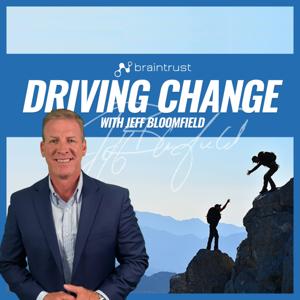
The Braintrust "Driving Change" Podcast

The Braintrust "Driving Change" Podcast

By Evergreen PodcastsBusiness
Download on the App Store

The Braintrust "Driving Change" Podcast episodes

  • How Soldiers, CEOs, and Athletes Stay Calm Under Fire with Brittany Loney
    Podcast Summary
    What does it really take to perform under pressure—when everything is on the line? In this episode, Dr. Brittany Loney shares her powerful journey from Division I basketball player to brain injury survivor to cognitive performance expert. She and Jeff Bloomfield explore the neuroscience of deliberate practice, flow states, and how elite performers—from soldiers to CEOs—build mental and emotional resilience that holds up when stakes are high.
    If you’ve ever wondered why some people thrive under pressure while others crumble, this conversation will show you the science—and the habits—behind high-performance consistency. You’ll learn how to reverse-engineer your best mental state, train your brain to operate with intention instead of intuition, and apply “elite cognition” frameworks to your daily work, leadership, or personal growth.
    Deliberate Practice Builds Capacity — True excellence comes from structured, effortful, deliberate practice, not motivation alone.
    Flow Requires Preparation — You can’t access flow without first training your brain for automaticity.
    Inner Excellence Drives Outer Excellence — Character and mindset shape all high performance, regardless of domain.
    The Four Attributes of High Performers: Radical humility, relentless fortitude, adaptability, and extreme ownership.
    Habits Define Character — Under pressure, you don’t rise to the occasion; you fall to the level of your habits.
    Optimal State is Task-Specific — The right neurochemical mix depends on the demands of the moment; calm clarity and peak focus require balance.
    Reverse Engineer Your Performance — Identify your physiological “sweet spot” (1–10 scale) and emotional ingredients for consistent results.
    Train Intention Over Intuition — Make what works repeatable; transform “good sometimes” into “great consistently.”
    Resilience is Built Through Adversity — Early life challenges often forge grit; parents and leaders must allow measured struggle.
    Compassion and Grit Coexist — True resilience blends empathy with accountability.
    00:00 – Introduction: The science of performing under pressure
    03:30 – Brittany’s story: From D1 athlete to brain injury survivor
    10:30 – Discovering performance psychology and neuroscience
    14:00 – The Four Attributes of High Performers
    18:00 – Habits, flow, and the fallacy of “rising to the occasion”
    26:00 – The brain on flow vs. unconscious competence
    27:00 – Neurochemistry: What helps and what hurts under stress
    30:00 – Reverse-engineering optimal states for sales, sport, or leadership
    38:00 – Emotional intelligence and self-mastery under pressure
    42:00 – Training elite performance when practice isn’t possible
    43:00 – The psychology of discipline vs. motivation
    47:00 – Resilience, parenting, and building grit
    50:00 – Where to find Dr. Loney and Elite Cognition
    Website: https://elite-cognition.com (include the dash)
    LinkedIn: Dr. Brittany Loney 
    Why You Should ListenTop 10 TakeawaysChapter Markers🔗 Links Mentioned
    51 min
  • The A.I. Rebel Protecting Humanity with Christopher Brock
    Christopher Brock, founder of Primary Hosting and Quantum Proof, joins Jeff Bloomfield for a mind-bending conversation on the rise of sovereign AI, post-quantum encryption, and how generative AI is reshaping both business and personal life. As Chief Information Security Officer for the Piqua Shawnee Tribe of Alabama and creator of the 300,000+ member Facebook group AI for Business and Life, Brock bridges ancient wisdom, advanced math, and cutting-edge tech to explore how AI can protect—not exploit—human identity, culture, and data.
    AI isn’t just changing business—it’s redefining the boundaries of human intelligence, creativity, and security. Christopher Brock shows us the future where AI meets quantum computing, tribal sovereignty meets technology, and cybersecurity meets consciousness. Whether you’re a CEO, creator, or just curious about the next tech revolution, this episode will change how you see data, privacy, and possibility itself.
    Sovereign AI is about protection—of identity, culture, and innovation, not just efficiency.
    Quantum computing could crack modern encryption in seconds, forcing an urgent rethinking of cybersecurity.
    Quantum Proof aims to make data “unhackable” using a new mathematical model that predicts prime numbers.
    AI and quantum together are “steroids on steroids”—powerful but potentially perilous if not ethically guided.
    Ransomware-as-a-Service (RaaS) has become an organized dark-web industry with customer support desks.
    Data harvesting is happening now—hackers store encrypted data today, waiting for quantum tools to unlock it later.
    The AI learning curve starts with usage—use the tools yourself before delegating to a tech team.
    LLMs (like ChatGPT, Claude, Grok, Gemini) are modern-day PhDs in your pocket—only valuable if you engage them daily.
    SEO is dead—AI ranking is here. Businesses must adapt to “AI discoverability” instead of traditional Google search.
    If you ignore AI, you’ll be left behind. Brock says plainly: “Use it—or miss where the world’s going.”
    Time
    Topic
    00:00
    Opening banter: building AI platforms and UX importance
    03:36
    Introduction: Christopher Brock and his work
    07:41
    Speaking at MIT, launching Quantum Proof
    09:21
    The rise of AI for Business and Life community (300k+ members)
    17:09
    Brock’s background: from student government to tech startups
    23:50
    COVID pivot, tribal leadership, and founding Primary Hosting
    25:47
    The birth of Quantum Proof and post-quantum encryption
    28:06
    Quantum computing explained (for humans!)
    34:58
    The math and philosophy behind Brock’s new algorithms
    35:53
    Why today’s encryption—and even blockchain—isn’t safe
    41:19
    Ransomware-as-a-Service: the digital mob economy
    45:51
    How everyday people should start using AI
    49:03
    Building personalized AI agents and data ecosystems
    52:24
    The death of SEO and the rise of AI discoverability
    54:31
    Where to find Chris and what’s next in AI & Quantum tech
    🌐 Primary Hosting
    🌐 QuantumProofAI
    💬 Facebook Group: AI for Business and Life
    🔗 Connect on LinkedIn: Christopher Brock
    42 min
  • The Manager Tax- Stop Paying it! With Jack Skeels
    CEO/author Jack Skeels flips conventional management on its head. He explains the hidden “manager tax,” why meetings crush output, and how to replace control-heavy habits with lightweight leadership using two practical frameworks: ACE (Authority–Control–Empowerment) and Why → What → Go → Grow. You’ll hear how five-person teams can self-manage, why communication pace matters (“the speed of knowing is faster than the speed of understanding”), and how small AI pods are beating top-down AI rollouts.
    In this episode, Jack reveals how to cut that hidden “manager tax,” empower teams to self-manage, and even make AI work where most companies fail. If you lead people—or want to escape being led badly—you’ll walk away with a playbook to boost performance, reduce burnout, and unlock growth.
    The Manager Tax is real: More managerial intensity → lower intrinsic productivity (especially via meetings).
    Meetings are expensive: A single manager’s calendar can quietly remove dozens of productive hours from the org each week.
    Lead, don’t over-manage: Replace “control” with framing + empowerment.
    ACE model: Leaders provide Authority (facts, constraints) and Empowerment (resources). Teams own Control (how work gets done).
    Why/What before Go: Nail shared context (Why) and clarity of outcomes (What) to minimize management during Go.
    Grow is ongoing: Managers coach skills and opportunities; they don’t micromanage tasks.
    Socratic unfolding: Let teams pull information via questions to build true, shared understanding.
    Communication velocity trap: You can explain faster than others can understand; slow is smooth, smooth is fast.
    Promote generalists to manage: “Best specialists” often over-control; strong generalists tend to under-manage (good!).
    AI works in pods: Small, empowered cross-functional teams adopting AI beat big top-down programs (faster cycle time, less labor).
    00:00 – Setup & intention of the show
    03:25 – Jack’s origin story: from robotics to reluctant manager
    12:58 – The Manager Tax: why more management = less output
    17:24 – Leadership vs management; where to draw the line
    20:14 – ACE (Authority–Control–Empowerment) explained
    29:35 – Why → What → Go → Grow and real span-of-control numbers
    34:34 – Generations, role design, and promoting the right people
    38:28 – Communication as the #1 success factor
    40:29 – “Speed of knowing vs speed of understanding”
    42:27 – AI Pods: structure-first AI (time & labor cuts)
    46:54 – Where to find Jack + closing
    Book: Unmanaged: Master the Magic of Creating Empowered and Happy Organizations — available on Amazon
    Website: bettercompany.co (rebrand; also reachable via agencyagile.com)
    Why You Should ListenTop 10 TakeawaysChapter Markings (topic-based)Links Mentioned by the GuestLinkedIn: Jack Skeels (connect & follow his posts)
    48 min
  • Observe, Engage, Adapt, Persevere - Life’s Recipe with Matt Garretson
    From BMX tracks to the Iditarod trail, and from Yale Law to global justice reform, Matt Garretson’s life is a masterclass in resilience, curiosity, and purpose-driven innovation. In this episode, Jeff Bloomfield sits down with Matt to explore how his unique blend of risk-taking, compassion, and intellectual rigor led him to reshape the legal services sector, build businesses that impact thousands, and embark on extreme adventures that test the limits of human endurance. Whether it’s resolving billion-dollar settlements, pioneering AI in the legal industry, or pedaling 1,000 miles across frozen Alaska, Matt’s story is proof that the best results come from observing, engaging, adapting, and persevering.
    His daily formula:  “My guiding mantra each day was that I must be methodical about observing (all data re terrain, weather, gear, etc.), engaging (with the underlying assumptions derived from those observations), adapting (because everything changes constantly when executing in an unpredictable/uncontrolled environment), persevering (having faith/confidence that i have the body, mind and spirit to accomplish the daily goals if i stay methodical about this loop). I broke each day into hour segments meaning for instance i didnt plan for 60 miles or 15 hours each day….i just needed to make it for instance from 9 AM to 10AM…then i can make it to 11 and if I made it to 11 then certainly 12 was possible etc. 18 days later I was in Nome!!!”
    This isn’t just a story about legal innovation or adventure sports — it’s a blueprint for high-stakes decision-making in life and business. Matt’s “Observe, Engage, Adapt, Persevere” framework, forged in the crucible of both courtroom battles and Arctic winds, is a practical leadership model for anyone navigating uncertainty. Leaders, entrepreneurs, and high-performers will walk away with actionable insights on risk management, building trust in complex negotiations, integrating AI into human-centered processes, and maintaining clarity when the stakes are high and the variables keep changing.
    Origin shapes destiny — The combination of his father’s risk-taking spirit and his mother’s intellectual curiosity formed the foundation of Matt’s worldview.
    Unconventional paths have power — Yale undergrad + night law school created a rare blend of elite theory and gritty pragmatism.
    Faith in action — Matt’s theology degree grew out of reconciling the good and harm he saw in organized religion.
    Neutrality is a business model — Creating fair, transparent systems for complex legal settlements can transform entire industries.
    AI accelerates trust — Tools like Pattern Data and Jane are reshaping how the legal profession processes and shares information.
    Adventure as a leadership lab — Extreme endurance events sharpen decision-making and adaptability.
    Observe, Engage, Adapt, Persevere — A simple yet powerful framework for survival and success.
    Moisture management matters — Small, counterintuitive habits can make or break long-term success in any high-stakes environment.
    Find the middle ground — In negotiations, you’ve likely reached fairness when both sides are slightly unhappy but see the logic.
    Impact over income — Matt’s latest venture in Guatemala proves that business growth and social good can be inseparable.
    00:00 – Intro & guest setup
    05:35 – Matt’s origin story: risk-taking father, intellectual mother
    09:00 – Discovering law as a second-phase career
    11:55 – Theological studies: reconciling faith and harm
    17:28 – The birth of a neutral legal administrator
    21:11 – World Trade Center, BP Oil Spill, and mass tort work
    27:39 – Truth, accountability, and finding reliable sources
    31:44 – AI’s role in transforming the legal industry
    39:23 – Epic adventures: Great Divide, Baja Divide, Iditarod
    45:58 – The Observe–Engage–Adapt–Persevere model
    53:48 – Burnbright: blending business, social impact, and job creation
    57 min
  • Are You Coachable Enough To Win? With Tony Shipley
    Tony Shipley, a seasoned entrepreneur and founder of Queen City Angels, joins Jeff Bloomfield to share his journey from a Tennessee farm to building one of America’s fastest-growing tech companies and mentoring over 125 startups. Tony reveals the timeless lessons from his upbringing, the importance of intellectual curiosity and critical thinking in entrepreneurship, and why being coachable is the most underrated trait for founders. This episode is a roadmap for anyone seeking to build a meaningful business while leaving a lasting legacy.
    This isn’t just a conversation about startups—it’s a masterclass on building something that matters. Whether you’re a founder, executive, or aspiring leader, Tony’s wisdom will challenge how you think about success, decision-making, and leadership. If you’ve ever wondered how to turn ideas into impact—or how to avoid the mistakes that sink early-stage companies—this episode is a must-hear.
    Entrepreneurship is simple, not easy: Businesses succeed when they focus on customer problems, not just clever ideas.
    Coachability trumps confidence: Founders who “know it all” rarely get funded or scale successfully.
    Fail fast, learn faster: Quick iteration saves time, money, and credibility.
    Every founder is first selling themselves, not just their product.
    Networking is a superpower: Mentors and advisors are everywhere if you’re willing to ask.
    Intellectual curiosity and critical thinking are the twin engines of progress.
    Predictive programming drives unconscious decision-making—be aware of yours.
    Fractional expertise beats lone hero syndrome—hire where you lack skills.
    Legacy is built on people and memories, not exits or net worth.
    Ideas aren’t fragile—if you’re afraid to share them, they’re not strong enough.
    00:00 – Opening & Tony’s $1B startup impact
    03:45 – Growing up on a Tennessee farm: lessons for life and business
    12:30 – The stages of entrepreneurship (idea → MVP → scale)
    20:30 – Networking and the power of asking the right questions
    23:30 – Fear, pride, and the failure coin in entrepreneurship
    28:40 – Intellectual curiosity and critical thinking as superpowers
    31:00 – Predictive programming and founder patterns
    35:30 – Building a lasting personal and professional legacy
    Why You Should Listen Top 10 Takeaways Chapter Markings
    39:35 – Resources and how to get started in entrepreneurship
    44 min
  • The 4-Step Code to Influence with Chase Hughes
    "The Hidden Scripts Controlling Your Life – And How to Take Them Back"
    What if the way you parent, sell, lead, or even love… isn’t really you? In this episode, Jeff Bloomfield is joined by Chase Hughes—former military interrogation trainer turned behavioral profiling expert—who reveals how your subconscious has been running scripts written when you were 8 years old. These hidden programs, designed for survival, are still dictating your daily decisions—unless you learn to rewrite them.
    Chase has trained Navy SEALs, Fortune 500 executives, and intelligence agencies on how to read, decode, and influence behavior ethically. From cult recruiters to AI that detects caregiver intent, Chase has seen—and built—it all.
    This conversation isn’t just mind-opening. It’s mind-reclaiming.
    If you’ve ever:
    walked away from a conversation, wondering why you said yes
    felt manipulated by media, leadership, or even your own emotions
    wanted to become more influential without being manipulative
    ...then this episode is your playbook. Chase reveals the tools used by cult recruiters, elite interrogators, and behavioral AI—and flips them for ethical everyday use. From leadership to parenting to sales, this episode is a masterclass in reclaiming your mental autonomy and becoming unhackable.
    Scripts Run You—Until You Rewrite Them Most adults live on autopilot, following behavioral programs formed between ages 2–12.
    Focus → Authority → Tribe → Emotion (F.A.T.E.) This 4-step behavioral model explains why people obey, comply, or conform—even against their own interests.
    Authority Is Internal, Not Hierarchical Real influence doesn’t come from titles. It comes from confidence, discipline, leadership, gratitude, and joy.
    Tribalism Is Natural—and Dangerous Belonging keeps us alive. But when weaponized, it becomes a tool of division and manipulation.
    Micro-Tribes Shape Macro Decisions Social media is training us to mistake attention for connection and pleasure for happiness.
    You’re More Suggestible Than You Think From cult recruiters to Kirby vacuum sales reps, Chase reveals how identity agreements are subtly formed—and exploited.
    Negative Dissociation = Identity Hack Labeling others (“those sheep”) makes you unconsciously adopt the opposite identity. It’s how cults recruit—and how sales are made.
    AI Can Detect Intent in Caregivers Chase’s latest work uses behavioral coding and neuroscience to teach AI how to detect malintent in caregivers with 98.4% accuracy.
    Novelty Creates Focus. Authority Seals Influence. The brain responds to the perception of authority—lab coats, titles, or confidence can all hijack trust.
    Ethical Persuasion Starts With Intent If someone could peek inside your mind and see your true motives—would they still say yes?
    00:00 – Military roots, neuroscience passion, and Jeff’s “Junk in the Brain Trunk”
    06:00 – From high school failure to Navy to bestselling author
    14:00 – Why childhood scripts control your adult life
    22:00 – Tribalism and the dangers of digital identity traps
    30:00 – Obedience: The terrifying truth behind the Milgram experiment
    36:00 – The F.A.T.E. model and how behavior is truly shaped
    44:00 – Cult recruiters and identity agreements explained
    49:00 – Training AI for suicide hotlines and caregiver risk
    53:00 – YouTube’s Behavior Panel & Dr. Phil’s surprising email
    57:00 – The PsyOp Pandemic & why Chase’s work exploded
    59:00 – Real connection in an AI-generated world
    1:00:00 – Final thoughts & where to find Chase's tools
    🌐 Website: https://nci.university
    📘 Books: The Ellipsis Manual, Behavior Ops Manual, EXIT
    📺 YouTube Series: The Behavior Panel
    🔬 Training Programs: Neurocognitive Intelligence University (NCI)
    Why You Should ListenTop 10 TakeawaysChapter Markings🔗 Links Mentioned by Guest

    59 min
  • Flourishing > Surviving with Dr. Chris Laszlo
    In this episode, Jeff Bloomfield sits down with Dr. Chris Laszlo—professor, author, and co-founder of the Global Consciousness Institute—to explore a transformative new approach to business leadership. Drawing on decades of research and deep personal reflection, Dr. Laszlo challenges the narrow focus on profit and “sustainability” in favor of something richer: human and organizational flourishing. He introduces concepts from his book Quantum Leadership and shares why a leader’s inner world—how they connect with self, others, nature, and transcendence—may hold the key to long-term impact, innovation, and success.
    If you're a business leader or executive struggling to align purpose with performance, this episode is a must. Laszlo unpacks how emotional connectedness and daily practices rooted in neuroscience, not spreadsheets, create the foundation for true, regenerative leadership. His insights are especially valuable for C-suite leaders, coaches, and culture builders who want to move beyond compliance checklists and unlock real transformation.
    Sustainability ≠ Flourishing: Laszlo distinguishes between surviving (sustainability) and thriving (flourishing), calling for a more ambitious goal for business.
    Origin in Philosophy: His father, renowned systems philosopher Ervin Laszlo, sparked 
    early reflections on systems, ethics, and purpose.
    Early Wake-Up Call: As a teen at a wealthy boarding school, Laszlo realized the disconnect between privilege and global inequality—igniting a lifelong purpose.
    Economics with a Conscience: Frustrated by ethics being an afterthought in business, he asked: “Why can’t doing good be profitable?”
    Flourishing Requires Inner Transformation: Real change in organizations must begin with how leaders are, not just what they do.
    Four Connections Matter: Lasting impact comes from daily practices that connect leaders to self, others, nature, and the transcendent.
    It’s Not About Time—It’s About Intent: You don’t need more hours—just more awareness in how you run meetings, lead conversations, and engage others.
    Quantum Science Meets Leadership: Emerging science supports the interconnectedness of all things, providing a scientific foundation for humanistic leadership.
    Daily Practices Matter: Laszlo identified over 110 “connectedness practices”—from running to music to mindful meetings—that enhance leadership capacity.
    The Future Is Conscious: Through his nonprofit (GCI.Earth), Laszlo works to scale practices that elevate global consciousness in business and beyond.
    00:00 – Jeff sets the stage: leadership, communication, and purpose
    04:24 – Chris’s intro and worldview on business as a force for good
    06:17 – Chris's origin story: systems philosophy and a call to make a difference
    12:00 – Economic education vs. ethical purpose: the inner conflict
    18:28 – Redefining “sustainability” as “flourishing”
    23:00 – Neuroscience of emotions: positive attractors, stress, and connectedness
    26:00 – Leadership research: over 100 practices of connected CEOs
    32:00 – 4 types of connectedness: self, others, nature, transcendence
    39:00 – Quantum leadership and global consciousness
    43:00 – AI, consciousness, and humanity’s next frontier
    46:00 – Resources, books, and ways to connect with Chris
    📘 Quantum Leadership (Stanford University Press, 2019)
    📄 Business and Society Review (2025 Open Source Article)
    🌐 Global Consciousness Institute – https://gci.earth
    Why You Should ListenTop 10 TakeawaysChapter MarkingsMentioned Resources & Links💼 Contact Chris on LinkedIn or via email: [email protected]
    46 min
  • Why Most Founders Flame Out with Dr. Mohamed F. Ahmed
    In this compelling episode, Jeff Bloomfield sits down with tech executive, entrepreneur, and resilience coach Mohamed F. Ahmed. From the moment a curious mistake with a floppy disk nearly wrecked his dad’s $10,000 PC—and unexpectedly ignited a lifelong passion for computers—to launching and selling a successful startup, Mo shares the deeper, human story behind innovation and leadership. You’ll hear how emotional intelligence, mindset, and adaptability outweigh strategy in both startups and big corporations, and why conditioning your inner world may be the most important skill for the future of work and AI.
    This isn’t your typical tech talk. Mo opens up about the moments that nearly broke him—and how emotional conditioning, not strategy, got him through. Whether you're launching a startup, innovating inside a big company, or just trying to stay sane in the chaos, this episode is a masterclass in mindset, resilience, and the real inner game of success.
    Entrepreneurship starts inside: Your mindset and emotional conditioning matter more than your business model.
    Corporate vs. startup = Pool vs. ocean: Corporate feels like a swim lane; startups are like the Atlantic Ocean at night—no map, no guardrails.
    Emotional regulation is a learned skill: Mo went from 4 weeks of emotional paralysis to 2 hours of recovery by learning to process feelings fast.
    Identity ≠ job title: Don’t let your business define your worth.
    Purpose fuels resilience: Your “why” is your survival kit when things go wrong.
    AI is a collaborator, not a competitor: The winners will be those who use AI to think, plan, and act faster—not those who fear it.
    Use AI to reflect: Mo journals daily and uses Claude or ChatGPT to analyze his week and optimize decisions.
    Sales is psychology, not just pitching: Reframe rejection as feedback and stay emotionally neutral.
    Curiosity trumps control: Mo’s career began when his dad turned a moment of anger into a shared learning journey.
    The next wave is “AI-native entrepreneurs”: Founders using AI as a creative partner are building faster, smarter companies.
    00:00 – Intro and Seattle weather joke
    02:45 – Jeff explains show format and target audience
    05:00 – Corporate innovation vs. entrepreneurship
    08:00 – Mo’s origin story: From floppy disks to a PhD
    13:00 – Lessons from Mo’s dad: 10X thinking and 20,000 books
    17:00 – First emotional crash in startup life
    20:45 – Resilience in action: From panic to pitch in 2 hours
    23:30 – The Entrepreneurial Conditioning Framework
    26:00 – Identity, mindset, and daily mental practices
    30:50 – Making time for thinking in the chaos of leadership
    34:00 – Sales psychology and rejection reframing
    35:15 – Startups vs. big corporations: Speed and chaos
    41:00 – The future of AI: From compression to companion
    46:00 – Mo’s son + AI = 2-month project done in 1 week
    49:00 – Will AI steal jobs or create new ones?
    52:00 – Boundless Founder and The Inside Out Entrepreneur
    Boundless Founder Community: https://boundlessfounder.co
    Why You Should ListenTop 10 TakeawaysChapter MarkingsLinks MentionedBook – The Inside Out Entrepreneur: Available now on Amazon
    51 min
  • Emotional Resilience with Dr. Robin Hills
    In this episode, Jeff Bloomfield sits down with Dr. Robin Hills, founder of EI4Change and a global thought leader in emotional intelligence. From his early career in pharmaceuticals to building a digital platform with over 500,000 students across 200+ countries, Robin shares how emotional intelligence—once a mystery to him—became his life’s work. The conversation covers everything from emotional regulation and workplace behavior to the neuroscience behind EQ and practical ways to build it.
    If you’ve ever wondered why intelligent people struggle with relationships or leadership—or how to better manage your own emotions under stress—this episode offers clear, science-backed answers. Robin’s insights are not just theoretical; they’re rooted in real-world application and made accessible to anyone. Whether you’re a leader, coach, or just someone who wants to stop reacting and start responding, this conversation is for you.
    Emotional Intelligence (EQ) is Trainable – Unlike IQ, EQ can grow with effort, even into your 70s.
    Anger is Often a Signal of Violated Values – Recognizing this can turn outbursts into constructive conversations.
    Mobile Devices Are Killing Situational Awareness – EQ begins with being present.
    Motivation Is the Missing Middle in the EQ Model – Without it, self-awareness and social skills fall flat.
    Smart People Can Lack EQ – And often unknowingly sabotage their influence.
    High EQ Leaders Inspire Loyalty – People follow emotionally intelligent leaders, not just intelligent ones.
    Use “I Feel” Statements – Emotions can’t be argued with; judgments can.
    Self-Awareness Starts with Daily Habits – Like avoiding your phone until after breakfast.
    The Best Leaders Coach, Not Command – Questions build connection; instructions don’t.
    EQ in the Age of AI Is More Important Than Ever – Human skills like empathy and emotional regulation will differentiate us.
    00:00–07:00 | Intro & Robin’s Background
    07:00–13:00 | Early Career & Discovery of Emotional Intelligence
    13:00–17:00 | Starting EI4Change & The Power of Niche Focus
    17:00–21:00 | IQ vs. EQ—Why One is Fixed and the Other is Fluid
    21:00–26:00 | Can Low-EQ Leaders Still Succeed?
    26:00–31:00 | Smart People & the Phone Addiction Problem
    31:00–37:00 | Technology, Dopamine, and Relationship Erosion
    37:00–42:00 | The Emotion That Causes the Most Trouble at Work
    42:00–47:00 | How to Regulate Anger and Build Healthier Relationships
    47:00–52:00 | The EQ Spectrum & Unconscious Competence
    52:00–54:00 | Practical EQ Habits & Where to Learn More
    EI4Change Website
    Robin’s Courses
    Free Course: Insights into Emotional Intelligence (via link above)
    Monthly Coaching Bundle (mentioned: June 2025 focus is on coaching)
    🔍 Why You Should Listen:🧠 Top 10 Takeaways:⏱️ Chapter Markings:🔗 Links Mentioned:
    52 min
  • Anxious? Angry? Your Brain’s Just Trying to Tell You This… with Angus Fletcher
    In this episode of Driving Change, neuroscientist and storytelling expert Dr. Angus Fletcher returns to share insights from his latest book, Primal Intelligence. Drawing from his research with the U.S. Army Special Operations, Fortune 50 companies, and education systems, Fletcher unpacks how the brain’s ancient systems—emotion, imagination, intuition, and common sense—shape the way we think, lead, and connect. This isn’t just theory; it’s actionable neuroscience that rewires how we respond to stress, how we plan, and how we grow. Jeff and Angus explore everything from battlefield psychology to parenting to sales conversations, all through the lens of primal brain power.
    This episode will change how you view intelligence. If you’ve ever struggled with anxiety, leadership under pressure, communication breakdowns, or helping others grow, this conversation delivers practical tools rooted in science—not self-help fluff. Learn how elite military units build confidence, how to tap into your brain’s imagination for clearer decision-making, and why the stories you tell yourself matter more than any strategy. Whether you're a parent, leader, coach, or entrepreneur, this episode offers real techniques to become more grounded, resilient, and effective in how you show up.
    Emotion is the First Intelligence – Fear and anger aren’t enemies—they’re signals telling us how many plans we have.
    Four Primal Brain Powers – Imagination (planning), Intuition (opportunity spotting), Emotion (threat signaling), and Common Sense (choosing the best plan).
    Plan-Making Beats Panic – People freeze not from danger, but from having no plan. Teaching people how to plan reduces fear and anger.
    Storytelling is Neural – The brain organizes information through action-based narratives. It’s not once-upon-a-time—it’s how we think.
    Teach Planning, Not Just Plans – The goal of leadership is to develop planners, not just manage plans.
    Practice Under Low Stress – Communication habits formed in calm moments will show up under pressure.
    Authenticity Over Evasion – People can’t always detect truth, but they immediately sense evasiveness. Share what you fear.
    Counterfactual Thinking Builds Vision – Asking "what if" about small changes with big outcomes activates the brain’s default mode network.
    Kids (and Adults) Need Imperfect Practice – Tolerating messy planning helps grow initiative, resilience, and brain power.
    Sales = Story Anticipation – Great salespeople help others discover their own story faster and with more clarity than they could alone.
    00:00 – Welcome + Book Launch Tease
    01:45 – Ohio's Hidden Intelligence + Emotional Evolution
    10:00 – Primal Intelligence Framework
    13:00 – Special Ops and the Power of Plans
    19:00 – Childhood Programming and Brain Plasticity
    24:30 – Imagination as Thinking Tool
    29:30 – Youth, Screens & Neural Pathways
    33:00 – Leadership, Weird Ideas & Innovation
    38:45 – Storytelling as Internal Narrative
    43:00 – Relationships & Communication Needs
    46:00 – Communicating Under Pressure
    50:00 – Neurocentric Questions & Sales
    54:30 – Authenticity, Fear, and Trust
    58:00 – What Led to Primal Intelligence
    1:00:00 – How to Learn More (Book, Quiz, Site)
    Primal Intelligence book page (Penguin Random House) – Available August 19
    Free Quiz & Diagnostic: OperationHuman.com
    Why You Should ListenTop 10 Takeaways⏱️ Chapter Markings (by topic)How to find more from Dr. FletcherDr. Angus Fletcher on LinkedIn: LinkedIn Profile
    58 min

About The Braintrust "Driving Change" Podcast

From the publisher's feed

This podcast is dedicated to help you better understand the biology, psychology and physiology of human decision making in order to help you become a more impactful communicator and a driving force…

More shows like The Braintrust "Driving Change" Podcast

The Joe Rogan Experience by Joe Rogan

The Joe Rogan Experience

227,470 Listeners

REAL AF with Andy Frisella by Andy Frisella

REAL AF with Andy Frisella

32,759 Listeners

The Daily by The New York Times

The Daily

112,106 Listeners

Front Row Seat with Ken Coleman by Ramsey Network

Front Row Seat with Ken Coleman

2,574 Listeners

The Diary Of A CEO with Steven Bartlett by DOAC

The Diary Of A CEO with Steven Bartlett

8,326 Listeners

Worklife with Molly Graham by TED

Worklife with Molly Graham

9,053 Listeners

The Peter Attia Drive by Peter Attia, MD

The Peter Attia Drive

7,932 Listeners

All-In with Chamath, Jason, Sacks & Friedberg by All-In Podcast, LLC

All-In with Chamath, Jason, Sacks & Friedberg

10,107 Listeners

A Bit of Optimism by Simon Sinek

A Bit of Optimism

2,192 Listeners

The Adversity Advantage with Doug Bopst by Doug Bopst

The Adversity Advantage with Doug Bopst

352 Listeners

PBD Podcast by PBD Podcast

PBD Podcast

4,226 Listeners

The Megyn Kelly Show by SiriusXM

The Megyn Kelly Show

39,447 Listeners

The Ezra Klein Show by New York Times Opinion

The Ezra Klein Show

16,123 Listeners

Money For Couples with Ramit Sethi by Ramit Sethi

Money For Couples with Ramit Sethi

3,463 Listeners

The Tucker Carlson Show by Tucker Carlson Network

The Tucker Carlson Show

15,947 Listeners