
Sign up to save your podcasts
Or



Talk about doomscrolling. In the past week, our timelines have been full of dark predictions of our imminent demise, including one by a Silicon Valley engineer who puts the chances of artificial intelligence wiping out humanity at better than 10 percent. The recent breach of the machine-learning programmers' site Hugging Face by AI machines is also triggering panic. In this edition, we ask: can machines destroy the planet on their own? In the age of technology, does problem-solving always override safety?
US President Donald Trump has indicated that the AI race will not be paused. Meanwhile, the tech titans of Silicon Valley are sending mixed messages. They are asking for more regulations, guard rails and kill switches but are wary of any that could stymy innovation during the mass construction of data centres and upscaling. How do we put safety first?
Produced by François Picard, Maya Yataghene, Juliette Laffont, Ilayda Habip, Charles Wente.
Once in a generation – sometimes once in a lifetime – a singular event blindsides the entire planet. 25 years on, does the memory of the 9/11 attacks on New York's Twin Towers, the Pentagon and in Pennsylvania fade into history, or is it still as raw and vivid as on that sunny September morning?
Back then, the world was still processing the end of the Cold War. Western spies who had learned Russian suddenly had to take Arabic lessons. There was also the element of surprise compounded by the shock of non-state actors killing thousands on US soil. Each big anniversary since has been a marker of its own time.
Ten years ago, it was in the wake of the Paris attacks and Isis' bid to establish a caliphate in Syria and Iraq. Five years ago, it was during Covid when the whole planet faced a whole new unforseen common challenge.
We ask our panel how the present informs the past and the past informs the present – one that is more connected and plugged in, but also more fractured, with the balance of power between old allies and rivals currently in flux. What can we learn from September 11th?
Produced by François Picard, Maya Yataghène, Juliette Laffont, Ilayda Habip, Andrew Hilliar.
With the digital age came the scramble for minerals below and to master the heavens above. US President Donald Trump wants a thousand rocket launches per year and with SpaceX’s reusable modules leading the way. The United States towers over the competition – which is why Ukraine’s president has to beg Elon Musk to use his Starlink low orbit satellite system to take out the Russian cruise missile launchers.
Europe is late to the space race. Only around 10 launches are planned for its Ariane rocket next year. In this edition, we look at Norway’s first private launch of a German satellite this past weekend and more broadly, whether there’s room for everyone in an orbit already littered with debris. Those hoping for global cooperation on managing the skies above may be disappointed. Germany dropped out of co-hosting the Paris International Space Summit and the White House reportedly influenced US aerospace leaders to stay away. We ask: Does space need regulating? How urgently? And if not, what are the consequences?
Produced by François Picard, Maya Yataghène, Juliette Laffont, Ilayda Habip, Andrew Hilliar.
Ukraine’s momentum on the battlefield was a primary focus at July’s NATO summit in Turkey. Kyiv’s long-range drones and US President Donald Trump’s surprise announcement that the Washington would allow Ukraine to produce Patriot missiles on in the country. However, Trump's deal has yet to materialize. Moreover, Russia has ramped up cruise missile launches and Ukraine has run out of air defenses to stop them. Moscow is also failing to stop incoming missiles. In today’s edition we ask: What happens in war when offense proves better than defense for both sides?
Could this lose-lose situation make mediation efforts like the one undertaken in the past days by Donald Trump’s emissaries more relevant? When Russia is still calling the war a ‘special military operation’, what will it take for Moscow and Kyiv to get serious about a lasting settlement? The Kremlin is looking beyond the battlefield to the momentum enjoyed by Putin-friendly populists in France and Germany, as well as the US midterm elections and NATO. In that context, we look at Berlin’s calibrated response to a drone attack at Leipzig Airport. Is war in Ukraine about to wind down or escalate a whole further?
Produced by François Picard, Andrew Hilliar, Juliette Laffont, Ilayda Habip, Charles Wente.
The result was not enough to win outright, but certainly enough to shake Germany and Europe to their core: the far-right Alternative für Deutschland (AfD) trounced the ruling conservatives in the impoverished former East German state of Saxony-Anhalt in Sunday's election. We ask about the consequences of voting for an anti-immigrant, pro-Russian party that wants schools to teach less about the ills of Hitler and more about the glory of Bismarck.
Will Sunday's result further fuel the momentum of the far right in places like Sweden, which votes next Sunday or here in France, where the far right is currently the odds-on favourite in next spring's presidential elections?
After dropping in on Nigel Farage's Reform UK party, French far-right leader Jordan Bardella was invited to speak to Italian business leaders at a weekend forum. Are we seeing a further normalisation of parties that once seemed fringe?
As for the mainstream, be it France or Germany, what does it need to offer to win back voters from MAGA and Putin-backed formations? You might ask: between Germany's Chancellor Friedrich Merz and France's outgoing leader Emmanuel Macron, who is on shakier ground?
Produced by François Picard, Andrew Hilliar, Juliette Laffont, Ilayda Habip, Charles Wente.
Could Europeans awaken next Monday to another shock bellwether moment? German voters could for the first time since World War II give an outright majority to a far-right party in regional elections. We ask about the AfD's push in Saxony-Anhalt and a charismatic lead candidate whose campaign strives to put charm above the vitriol usually associated with a party with pro-Nazi roots.
Saxony-Anhalt has a familiar tale: that of a former East German state rattled by globalisation with declining industry and an ageing population. Contrast its dying towns and villages with the dynamism of not-so-far-off cities like Berlin and Leipzig.
Speaking of Leipzig, the German government this week directly accused Russia over last month's drone attack on a Ukrainian cargo plane at Leipzig airport. Do German voters care that we're talking about the same Russia that's actively aligned with Moscow and a Trump administration that claims immigrants are a bigger threat to Europe than Russian hostility?
These questions may be the warmup for next spring's French presidential poll, where Marine Le Pen's party this week floated the idea of banning the Muslim headscarf in public.
Both the far-right National Rally and Germany's AfD oppose a more federal Europe. What happens if they win?
Produced by François Picard, Rebecca Gnignati, Juliette Laffont, Juliette Brown, Charles Wente.
What can an 11th-century comic strip about the Norman Conquest of England tell us about the spectre of sea change in 2026 Europe? France’s president is on hand for the hottest ticket in London, the first-ever cross-Channel visit of the Bayeux Tapestry, which, for the record, is not a tapestry but a delicate scroll of embroidered cloth that chronicles a radical turning point in our continent’s history. Should France’s outgoing president and the British monarch who welcomes him be likened more to the defending Saxons or the invading Normans?
Fast forward to the present and Europe has got plenty of ramparts to man, sandwiched between a hostile Russia and a withdrawing United States. How fast can Emmanuel Macron and new Prime Minister Andy Burnham level up to spearhead an alternative to an unravelling NATO? They're already leading a coalition of the willing for Ukraine.
And why is the momentum with far-right populists with friends in Moscow and Washington, one of whom is currently favoured to become Macron's successor in eight months' time? Is it too late for mainstream forces to change the course of history?
Produced by François Picard, Rebecca Gnignati, Juliette Laffont, Juliette Brown, Charles Wente.
A lot happened during summer recess: France's constitutional council struck down the core of a new law to ban social media for under-15s, but it did validate the extension to high schoolers of a phone ban already in effect for younger pupils. Why one but not the other? On the first day of school across this country and others, we size up what's best for future citizens, parents and teachers, all grappling in this age of distraction with the lure of screens.
Over in the US last week, state attorneys general succeeded where legislators have not, forcing the parent group of Instagram and Facebook to put curbs on screen time for teens. Meta opted to settle for $17 billion rather than face the prospect of its boss Mark Zuckerberg answering questions under oath about encouraging addiction to his products. But social media is just one challenge.
Teaching, homework and grading is increasingly happening in the virtual world. What's the impact on humanity’s ability to hone its reading, writing and arithmetic skills, and to learn critical thinking? How to learn and to clear enough mind space to reflect? It's quite the learning curve for all of us.
Produced by François Picard, Rebecca Gnignati, Juliette Laffont, Juliette Brown, Charles Wente.
It may well be one of the tragic consequences of global warming. Scientists will tell us whether receding glaciers are to blame for last Wednesday’s ice shelf collapse that triggered a catastrophic flood, cascading down more than 3,000 metres from the Chinese border into Nepal.
We get the latest and draw consequences for Nepal and its Himalayan superpower neighbours China and India, and for the rest of humanity, as we gauge rescue and recovery in an area that not only boasts the world's tallest mountains but also serves as Asia's water tower.
How do we prepare for the next big emergency and the drastic long-term changes to our natural habitats?
Produced by François Picard, Rebecca Gnignati, Daniel Whittington, Juliette Brown, Charles Wente.
After a stunning performance in Argentina’s come-from-behind win against England, 39-year-old Lionel Messi secured the defending World Cup champions their second final in a row – much to the delight of organizers. Taking note of Messi’s star power, the US bent the rules to include him on the Inter Miami side in the Club World Cup last year. In this edition we ask: what legacy will there be for the biggest World Cup ever, with its three countries, 64 teams and record-smashing ticket pricing?
What will the world remember from World Cup 2026? Will it be the on-field drama or the American-style packaging of the spectacle: commercial breaks disguised as water breaks, TV cutaways to celebrities during the action and red cards overturned to please the host country's leader? What will the final bring? Will US President Donald Trump be flanked by his Argentinian counterpart and far-right ally Javier Milei? Will they pose with Pedro Sanchez, the prime minister of a left-led Spain Trump has threatened to cut ties with?
Produced by François Picard, Rebecca Gnignati, Juliette Laffont, Ilayda Habip, Riham Mahir, Andrew Hilliar.
From the publisher's feed
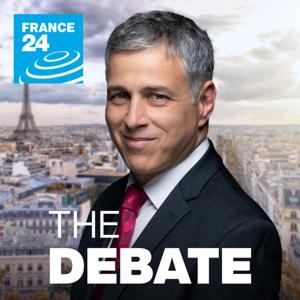
A live debate on the topic of the day, with four guests. From Monday to Thursday at 7:10pm Paris time.

7,580 Listeners

10,709 Listeners

3,369 Listeners
762 Listeners

1,046 Listeners
1,024 Listeners

1,802 Listeners

348 Listeners

4 Listeners
0 Listeners

0 Listeners
2 Listeners
1 Listeners
21 Listeners

181 Listeners
5 Listeners
0 Listeners
4 Listeners
6 Listeners
5 Listeners
39 Listeners

815 Listeners
3 Listeners
4 Listeners
5 Listeners

1 Listeners

16,143 Listeners

0 Listeners
0 Listeners

361 Listeners

0 Listeners

476 Listeners

378 Listeners