
Sign up to save your podcasts
Or

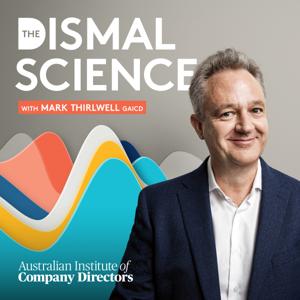


We're taking a break from our usual format to look at some of the big technological and economic themes of 2024, and where they are going in 2025 and into the future.
We will be back with our regular episodes in February.
If you enjoyed or hated this episode, we'd love to hear your feedback! Send us an email:
This week we are joined by Su-Lin Ong, Managing Director, Chief Economist & Senior Corporate Relationship Manager of RBC Capital Markets. Together Mark and Su-lin reflect on Australia's economic conditions and the RBA's 2024 performance.
They unpack why the RBA has held interest rates steady for so long – and what this means for Australia's economic outlook, including a (mild) disagreement on the outlook for interest rates. Plus, they discuss the impact of a new US administration, the RBC's unique projections, the global easing cycle, and how Australia stacks up against the rest of the world.
Subscribe to Mark's weekly column here: https://www.aicd.com.au/news-media/economic-weekly.html
The RBA keeps interest rates on hold, but the big news is a change in tone that suggests Mark's long predicted February rate cut is back on the table.
Also, Mark looks back at his predictions from a year ago, revisiting his forecasts for inflation, unemployment, and economic growth.
Get your ticket to AGS: https://www.aicd.com.au/events/australian-governance-summit.html
Subscribe to Mark's weekly column here: https://www.aicd.com.au/news-media/economic-weekly.html
This week, we examine Australia's latest soft GDP figures. The headline number is a weak 0.3% quarterly expansion, the lowest rate of annual growth since the pandemic with private sector demand contributing nothing to this meager growth figure.
Will the RBA stay the course with rates on hold in the face of a deepening per capita recession and falling living standards?
We also look at what's driving Australia's poor economic performance relative to other OECD nations. Get your ticket to AGS: https://www.aicd.com.au/events/australian-governance-summit.html
Subscribe to Mark's weekly column here: https://www.aicd.com.au/news-media/economic-weekly.html
This week, the Dismal Science turns its attention to Europe's economic powerhouse - Germany.
We examine the country's recent economic struggles, exploring the reasons behind its faltering performance, including the war in Ukraine, rising energy costs, and the rise of Chinese manufacturing.
We discuss whether these challenges are merely cyclical or point to deeper structural issues with the German economic model.
With a shrinking workforce, rising fiscal pressures, and declining global trade, is "Germanification" a cautionary tale for other advanced economies, including Australia?
We also examine the impact of China's growing dominance in key industries, particularly the automotive sector, where Chinese companies are now leading the world in EV production. Can Germany adapt and compete, or is its era of economic dominance over?
Read more from Mark on the AICD website: https://www.aicd.com.au/news-media/economic-weekly.html Send feedback to: [email protected]This week on the Dismal Science, Mark and Raph take a look at the latest Australian labour market figures and what it means for Mark's increasingly shaky call for a February rate cut.
Is the RBA being too pessimistic about what the unemployment rate associated with full employment needs to be?
Plus, the Dismal Science takes a metaphorical visit to Baku for COP 29 and finds "upside-down geopolitics" at play.
And will President Trump's reelection derail the action items out of COP29?
Read more from Mark on the AICD website: https://www.aicd.com.au/news-media/economic-weekly.html
Send feedback to: [email protected]
Join Mark and Raph to unpack the potential economic implications of the US election result.
We examine some of the key economic policy pledges that President Elect President Donald Trump made during the campaign, from tariffs to taxes, and discuss the possible ramifications for interest rates, inflation, growth, and other economic variables.
President Trump's proposals could send US average tariff rates to their highest level since the 1934 Great Depression. What would this mean for inflation, the US dollar, and the global economy?
We also explore the potential impact of tax cuts and deregulation on growth and profits, as well as the implications for the Federal Reserve and US debt and deficits.
And is this a sign of a broader global shift away from neoliberalism?
Tune in to find out.
Read more from Mark on the AICD website: https://www.aicd.com.au/news-media/economic-weekly.html
Send feedback to: [email protected]
This week on The Dismal Science, we examine the latest economic data releases, including wage growth figures, consumer and business sentiment surveys, and the AICD's Director Sentiment Index.
The Wage Price Index showed annual growth slowing to 3.5%, a welcome development for the RBA in its fight against inflation. But with productivity growth stalling, will this be enough to see interest rate cuts in the near future?
Consumer sentiment surged in November, reaching its highest level since the first half of 2022, fuelled by optimism about the interest rate outlook and a strong labor market.
However, this optimism was tempered by the results of the US election, with sentiment declining sharply following the outcome.
Businesses also reported improved confidence in October, but the AICD's survey of directors painted a much bleaker picture, with concerns about inflation, interest rates, and a looming recession weighing heavily on sentiment.
Will the recent positive economic data prove to be a fleeting reprieve, or are we finally turning a corner?
Read more from Mark on the AICD website: https://www.aicd.com.au/news-media/economic-weekly.html
Send feedback to: [email protected]
The big news this week is the US presidential election. Markets are reacting in real time as results come in - we look at the volatility and what it means for Australia.
Closer to home, the Reserve Bank of Australia (RBA) left interest rates unchanged for the eighth consecutive month.
We examine the RBA's latest forecasts, which suggest a slightly softer economic outlook than previously predicted, with lower GDP growth, higher unemployment and slower inflation.
But is this bad or good when it comes to taming inflation?
Mark explains why this could actually be good news for those hoping for an interest rate cut.
Also on the agenda: the role of government spending in keeping the economy afloat, and whether now is the time for businesses to start investing.
Read more from Mark on the AICD website: https://www.aicd.com.au/news-media/economic-weekly.html Send feedback to: [email protected]This week we look at the latest Australian inflation figures.
The September quarter CPI figures came in slightly better than expected, with the headline numbers showing a decrease in inflation. This was largely driven by government rebates and falling fuel prices. However, services inflation remains stubbornly high.
Additionally, some commentators are suggesting a December rate cut is possible...will Mark hold firm to his February prediction?
Read more from Mark on the AICD website: https://www.aicd.com.au/news-media/economic-weekly.html
Send feedback to: [email protected]
From the publisher's feed
20 Listeners

10 Listeners

19 Listeners
21 Listeners
15 Listeners
82 Listeners
49 Listeners

19 Listeners
45 Listeners
25 Listeners

8 Listeners
47 Listeners
23 Listeners

28 Listeners

4 Listeners