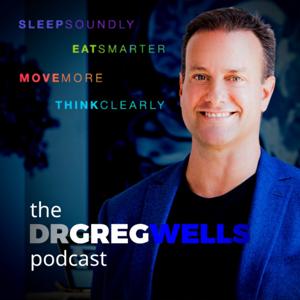
The Dr. Greg Wells Podcast
Download on the App Store

The Dr. Greg Wells Podcast episodes

  • #28 - The Coping Crisis: Dr. Bill Howatt on Building Mental Health
    Most people — and most organizations — confuse mental health with mental illness, so they miss early signals, underinvest in daily coping skills, and end up with preventable distress, disability, and burnout. Bill’s mission is to teach people and workplaces how to build mental health on purpose before it becomes mental illness.
    In today’s conversation Bill Howatt explores how his own lived experience with dyslexia, ADHD, anxiety, and shame became the engine for a 30-year career in mental health — and why he now focuses on helping employers create psychologically safe, health-promoting workplaces. He and Dr. Wells map the crucial distinction between mental health and mental illness, walk through the “awareness → accountability → action” pathway, and show why coping skills must be trained like oral hygiene. They also unpack the role of managers, stress, and fast-brain autopilot in the current “coping crisis.” The through-line: mental health is trainable, but only if we make it intentional.
    You will learn how Bill separates mental health (daily emotional weather) from mental illness (clinical criteria) — two axes, not one spectrum; how small, teachable “developmental coping skills” (locus of control, emotional regulation, self-efficacy) protect you from sliding into distress; how chronic stress, if unrecognized, quietly rewires behaviour and physiology; why managers and workplaces carry half the accountability for employee mental health; and how to create your own daily sustainability plan — the mental-health equivalent of brushing your teeth.
    You will discover that there is no finish line for mental health — just a repeatable loop: get a baseline → learn micro-skills → practise them daily → ask for help early. That loop is what keeps stress from becoming illness.
    Lots of high performers “renormalize” feeling lousy — they stay in emotional coping, add more stress, then wonder why they can’t recover. Bill gives a way to spot that slide and a language leaders can use with teams to intervene early.
    57 min
  • #27 - “Get Off the Sidelines”: Orlando Bowen on Forgiveness and Leadership
    He’s tackling this: how do you respond to injustice and betrayal without becoming the very thing that hurt you? Orlando’s answer is to turn trauma into service through forgiveness, community, and courageous leadership.
    In today’s conversation Orlando Bowen explores how a promising CFL career, a life of community service, and a single night of police brutality collided — and how he chose forgiveness instead of bitterness. He walks Dr. Wells through the assault, the false charges, and the six-year legal battle, and then the turn: seeing that the real purpose was to stand in the gap for the people who wouldn’t have had a voice. Orlando explains how that experience birthed his youth-leadership work and his “get off the sidelines” message for corporations. The result is a raw, hopeful conversation about justice, healing, and showing up for others.
    You will learn how to keep moving when the system is against you; how to build a tight circle that talks possibility, not pity; how forgiveness is a performance skill — it frees energy for the work ahead; how he turned his story into One Voice One Team, the youth-leadership charity that now empowers thousands of young people every year; and how leaders can create workplaces where every person’s contribution is honoured.
    You will discover that pain isn’t the end of the story — it can be the assignment. When you decide “this happened, so now I help,” you stop being a victim and start being a catalyst.
    Most people get stuck in resentment after a wrong, and resentment burns the energy you need to lead, parent, or build. Orlando shows a path to process the hurt, forgive, and return to service so you don’t lose years to bitterness.
    41 min
  • #26 - All about Spark - Your Brain on Exercise with Dr. John Ratay
    We know exercise is “good,” but most people — parents, schools, workplaces — still undervalue movement as a brain tool. John is fixing that gap: he shows that physical activity is not optional wellness, it’s primary neurobiology for mood, learning, stress regulation, and healthy aging.
    In today’s conversation John Ratey explores the revolutionary science behind Spark — how movement changes brain chemistry in real time and why it should sit beside therapy and medication for depression, anxiety, ADHD, and even addiction. He tells the Naperville District story, where daily fitness flipped academic outcomes, then connects it to what we now know about BDNF, endocannabinoids, and neurogenesis. John and Dr. Wells go deep on stress reactivity, GABA, and why fitter people are harder to panic. They finish with a vision for a future where we move more, together, outside — because connection and nature amplify everything exercise does.
    You will learn how exercise acts like a “smart drug” for the brain — increasing dopamine, norepinephrine, serotonin, endorphins, and endocannabinoids — and why that cocktail can rival meds for mild-to-moderate depression. You will learn how BDNF (brain-derived neurotrophic factor) fertilizes neurons so we can learn faster, remember more, and age better, and why daily movement is the strongest known stimulus for it. You will learn how fitness dampens the stress response by building more GABA-producing cells in the hippocampus, making you less reactive to threat. You will also learn why doing activity with people and in nature multiplies the health effect — the “Spark + Go Wild” equation.
    You will discover that exercise doesn’t just make you healthier — it makes you a better learner and a more stable human the very same day you do it. Movement prepares the brain for input.
    Leaders, educators, parents, and even clinicians often treat physical activity as the first thing to cut when life gets busy. Ratey’s work shows that’s backward: if you want calmer kids, sharper teams, and more resilient brains, exercise has to go first, not last.
    54 min
  • #171. Bevan Eyles on Falling in Love with Exercise

    Welcome back!

    This week I’m excited to share my conversation with Bevan James Eyles on Sharpen Your Edge Live.

    Bevan is an Award-Winning Fitness Professional who is driven by one question: How can we help more people fall in love with exercise? Especially those that aren’t currently exercising.

    In creating products that have helped thousands of non-exercisers win with exercise, he has learnt the key lessons needed for success.

    ‘I fundamentally believe your life is better if you have exercise in it. Unfortunately, most people fail in this area, so I have created a model that someone who is currently inactive and doing absolutely nothing can succeed with’

    Tune in to learn how to get started with exercise and how to be more consistent with your activity routine!

    You can learn more about Bevan and his new book, “I Will Make You Passionate About Exercise”, at www.bevanjameseyles.com.

    20 min
  • #25 - Overcome Any Challenge And Come Out Stronger with Chris Norton
    When life hits you with something you didn’t choose — injury, trauma, partner’s depression, viral attention plus private pain — how do you keep moving forward and make it meaningful? He shows that you can reject other people’s predictions, build progress from tiny daily actions, and turn your story outward to give hope.
    In today’s conversation Chris Norton explores what it really takes to come back from a catastrophic spinal cord injury — from nodding his head in a hospital bed to walking across his college graduation stage and, years later, seven yards down the aisle with his wife. He and Dr. Wells unpack the moment he refused the doctor’s prognosis, the midnight conversation with his dad about “doing all the little things,” and the later, quieter season when his wife Emily struggled with depression even while their video was going viral. Chris shows how purpose, faith, and accountability can turn suffering into service through speaking, his foundation, and foster/adoptive parenting. It’s a masterclass in radical hope.
    You will learn how to shift from “why me?” to “what now?” after a life-altering event; why refusing a prognosis can ignite years of disciplined rehab; how micro-wins (a toe wiggle) become the fuel for massive goals (walking across a stage); how to support a partner who’s battling an invisible challenge like depression; and how Chris and Emily use their story to raise money, foster kids, and run a foundation for others with spinal cord injuries.
    You will discover that you don’t control the circumstance — you control the response. Focusing on the 3% possibility instead of the 97% limitation unlocks energy, action, and hope.
    Most people think they have to feel ready before they act; Chris shows you can act while scared, grieving, or exhausted — and that action itself is what creates momentum and meaning.
    41 min
  • #170. Dr. Deborah Gilboa on Turning Stress into Resilience

    Welcome back!

    This week I’m excited to share my conversation with resilience expert, Dr. Deborah Gilboa.

    Dr. Gilboa works with families, educators, executives, and businesses to identify the mindset and strategies to turn stress to an advantage.

    Whether she is speaking on stage giving a keynote, sharing advice on shows like TODAY, Good Morning America, The Doctors, and Rachael Ray, or contributing to outlets like Washington Post, The New Times, Huffington Post, her message is straightforward and essential: Do stress better. Be resilient.

    We had a really great conversation about navigating stress and the importance of stress for positive adaptation.

    You can learn more about Dr. Gilboa and her new book at askdoctorg.com.

    Enjoy!

    19 min
  • #24 - The Power of Music and Crafting Creativity with Tim Nichols
    How do creative people keep making great work day after day — not just once? Tim’s answer is: show up, honor the idea, and build a repeatable co-writing process so inspiration has somewhere to land.
    In today’s conversation Tim Nichols explores the craft behind hit songs and why “must be present to win” is the real secret of Nashville. He tells the origin story of “Live Like You Were Dying” — casual coffee, two stories about mortality, and then a line that changed country music — and explains how he balances art and commerce without selling out. Tim and Dr. Wells dig into courage, collaboration, and why songs sometimes “choose” the artist (as Tim McGraw did in the middle of his dad’s illness). He also reflects on what’s next after the Nashville Songwriters Hall of Fame: keep growing, keep giving, keep creating.
    You will learn how Nashville’s co-writing rhythm actually works (come in with an idea, fish for a better one, write it that day); why most writers have to “write a lot of bad songs” to get to a great one; how to stay true to the song even when radio wants something different; how one honest story can become a global anthem; and why Tim still invests in personal growth, events, and speaking even after Hall-of-Fame status.
    You will discover that creativity is a discipline more than a lightning bolt — show up, protect the idea, and the day that changes your life will look exactly like every other day… until it’s not.
    Writers, founders, and leaders all face the same friction: “What if today’s idea isn’t good enough?” Tim’s approach replaces that anxiety with a system — write daily, co-create, let the song be what it wants to be — so the breakthrough can actually happen.
    30 min
  • #23 - Dr. Greg Wells on The Power of Flow
    Most high performers stay stuck in tension — fatigue, stress, anxiety, tension— and never make the final pivot into flow, where performance feels effortless and output is highest. This episode shows how to move from challenge → focus → flow using physiology, environment, and deliberate practice.
    In today’s presentation Dr. Wells explores how the nervous system can be guided into a state of flow — not by wishing for it, but by setting the conditions. He walks through his 3-step progression: adopt a meaningful challenge, focus relentlessly on the one thing that matters, and then release tension so the body and brain can do what they’re designed to do. Greg tells the Dawn Wall story — seven years of prep, public failure, and finally flow — to show exactly what happens when an athlete stops forcing and starts flowing. He finishes with a “Titan toolkit” you can use tomorrow morning.
    You will learn why focus is the primary prerequisite for flow (you can’t flow if you’re distracted), what the “ideal performance state” is and why being too amped or too flat knocks you out of it, how world-class performers use morning capture, movement, and fueling to prime the brain, how to lower sympathetic tone so tension doesn’t choke performance, and how stories — like Bob Marley pulling 60,000 people into flow — prove that one person in flow can move an entire room or organization.
    You will discover that flow isn’t magic — it’s the result of great setup: a clear challenge, deep focus, relaxed body, and the right energy on board. Get the setup right and flow becomes repeatable.
    When you’re always “trying harder,” tension rises, technique drops, and you underperform in public — the exact moment you wanted to shine. This episode gives you a science-backed way to pivot out of tension and into flow so effort feels smooth and results go up.
    9 min
  • #22 - Dr. Greg Wells on The Power of Focus
    We live in an era of constant, unrelenting distraction that keeps the nervous system in low-grade fight-or-flight, blocks learning and creativity, and quietly erodes health and performance. This episode shows people how to shift from distraction → deliberate focus using physiology, environment, and language.
    In today’s presentation Dr. Wells explores how to protect your attention in a world that’s engineered to steal it. He tells the story of climbing Chimborazo in Ecuador—with no cell service—and how immersion in nature, altitude, and risk forced him to focus on the only thing that mattered: getting safely off the mountain. Greg connects that moment to the science of distraction, the “compulsion loop” of our devices, and the sympathetic overactivation that kills problem-solving and creativity. Then he lays out practical focus practices—nature exposure, tech boundaries, single-tasking—that leaders, athletes, and parents can use today.
    You will learn how constant notifications keep the brain in a sympathetic state and why that suppresses learning, memory, and innovation; how even looking at images of nature drops blood pressure and how weekly “green time” boosts immunity through phytoncides; the difference between threat focus (“everything’s urgent”) and task focus (“the single next step”); why removing tech friction (phone basket, no-phone hikes, scheduled deep work) restores attention; and how challenge + focus + recovery triggers physiological supercompensation—more red blood cells, more capacity, more performance.
    You will discover that focus is not a personality trait—it’s a physiological state you can build by changing your inputs (breath, nature, tech). Control the inputs and your brain will give you the deep work.
    Most high performers are trying to do world-class work with a brain that’s half-distracted and half-stressed. Greg’s approach shows you how to clear your mind so your best ideas, best writing, best decisions, and best relationships can actually happen.
    15 min

About The Dr. Greg Wells Podcast

From the publisher's feed

Healthy High Performance for a Limitless Life

More shows like The Dr. Greg Wells Podcast

This American Life by This American Life

This American Life

90,991 Listeners

Pivot by New York Magazine

Pivot

9,620 Listeners

The Rich Roll Podcast by Rich Roll

The Rich Roll Podcast

11,782 Listeners

48 Hours by 48 Hours

48 Hours

10,714 Listeners

10% Happier with Dan Harris by 10% Happier

10% Happier with Dan Harris

12,708 Listeners

Money For Couples with Ramit Sethi by Ramit Sethi

Money For Couples with Ramit Sethi

3,457 Listeners

The Mel Robbins Podcast by Mel Robbins

The Mel Robbins Podcast

19,271 Listeners