
Sign up to save your podcasts
Or



Based on Podcast App listening data
Brian Cox and Robin Ince are joined on stage by guests Ed Byrne, Adam Rutherford and Philip Ball to talk about science's quest to create life. From the medieval alchemists' recipe for creating an homunculus through to IVF, cloning and the current cutting edge science working on creating artificial DNA, the quest to create life is an age-old one, but with modern scientific techniques now a reality. Viewed by many as deeply suspicious, even heretical, creation of life is one of the key ideas that generates distrust in science, but is this fair and are we really entering a brave new world where life is no longer in nature's hands.
Producer: Alexandra Feachem
Will science ever understand the human mind? Brian Cox and Robin Ince are joined on stage by comedian and former psychiatric nurse, Jo Brand, and neuroscientists Sophie Scott and Brian Butterworth. With ever more sensitive brain scanning techniques and advances in brain science, how close are we to understanding the inner workings of the human mind - or is this a quest that still remains in the hands of the philosophers?
Producer: Alexandra Feachem
Robin Ince and Brian Cox are joined on stage by comedian Dave Gorman, author and Enigma Machine owner Simon Singh and Bletchley Park enthusiast Dr Sue Black as they discuss secret science, code-breaking and the extraordinary achievements of the team working at Bletchley during WWII.
Brian Cox and Robin Ince discuss some of the more unlikely and odd avenues of research travelled down in the name of science. For example, the British physicist who calculated the optimal way to dunk a biscuit into a cup of tea without it disintegrating too quickly. Or the brain researchers who demonstrated that they could detect meaningful brain activity... in a dead salmon. All these academics share something in common, not just a slightly quirky application of the scientific method. They have also been a recipient of the now infamous Ig Nobel prizes, awarded each year as a parody of the Nobel Prize, to research that seems at first glance, entirely improbable, and possibly pointless. Robin and Brian are joined on stage by the organiser of the Ig Nobels, Marc Abrahams, comedian Katy Brand and biologist Professor Matthew Cobb, from the University of Manchester, to ask whether all scientific exploration is valid, no matter how ridiculous it may seem at first glance, or whether there is genuinely something to be learned from observations that to many, may seem pointless.
Producer: Alexandra Feachem
The Infinite Monkeys are back and in the first of the new series Brian Cox and Robin Ince boldly go where no science programme has been before, as they discuss space exploration with Captain Jean Luc Picard himself, actor Sir Patrick Stewart; former quantum physicist Ben Miller; and Professor of Planetary Sciences, Monica Grady. They'll be discussing whether space really is the final frontier and whether, with the development of ever more sophisticated robotic space missions, do humans need to go to space at all? Are un-manned missions more cost effective and ultimately more efficient in terms of the scientific knowledge they generate, or is the need to explore unknown worlds, on this planet, or any other, the key to driving the progress of science?
Producer: Alexandra Feachem
Brian Cox and Robin Ince transport the cage of infinite proportions, to the slightly more confined space of the Latitude Comedy Arena. They will be joined on stage by a panel of guests, including Al Murray, for a witty, irreverent and unashamedly rational look at the world according to science. Given Latitude's artistic, musical and literary credentials, they'll be taking a huge risk by staging the ultimate show down, as they pitch Art against Science and ask which has more to offer and whether the two cultures might ever make a happy union. To help them battle it out, and alongside comedian Al Murray, they'll be joined by cosmologist Andrew Pontzen, comedian and actor Sara Pascoe and CERN scientist Jonathan Butterworth. Let battle commence!
Brian Cox and Robin Ince stretch the cage of infinite proportions this week to encompass not just our own universe, but any others that might be lurking out there as well. They'll be joined by QI creator John Lloyd, the Astronomer Royal, Professor Sir Martin Rees, and solar scientist Dr Lucie Green to talk about one of the most tantalising ideas of cosmology, that of parallel universes. Are we inhabiting a universe that is just one of a possibly infinite number of others and how would we ever know? Is this an idea that is destined to remain one of the great scientific thought experiments, and a staple of science fiction, or will science ever progress enough to truly put the idea of multiverses to the test.
Producer: Alexandra Feachem.
Brian Cox and Robin Ince are joined by mathematician Marcus Du Sautoy, science journalist Adam Rutherford and comic book legend Alan Moore to discuss why symmetry seems such a pervasive phenomenon throughout our universe, and possibly beyond. The world turns on symmetry -- from the spin of subatomic particles to the structure of the natural world, through to the molecules that make up life itself. They'll be asking why symmetry seems so ubiquitous and whether the key to Brian's large female fanbase is down to his more than usually symmetrical face.
Producer: Alexandra Feachem.
Robin Ince and Brian Cox are joined on stage by comedian Andy Hamilton to discuss whether size matters? Material scientist Mark Miodownik and bioengineer Eleanor Stride also join the panel to discuss the advantages and disadvantages of being really huge, or extremely small, and why if you wanted to be a truly effective super hero, then being really really tiny is probably the greatest superpower you could have.
Producer: Alexandra Feachem.
Brian Cox and Robin Ince take to the stage at this year's Cheltenham Science Festival to discuss science mavericks. They are joined by comedian Marcus Brigstocke, medic and broadcaster Dr Kevin Fong, evolutionary biologist Aoife McLysaght and Nobel Laureate Professor Barry Marshall. Marshall, an Australian physician, famously experimented on himself to prove his theory that a bacterium was responsible for most peptic ulcers. He drank the bacterium he suspected was the cause, and as a result reversed decades of medical doctrine. He and the rest of the panel discuss the role of mavericks in science, how new theories get accepted and whether you have to go to such extreme lengths to truly push the frontiers of our scientific understanding.
Presenters: Robin Ince and Brian Cox
From the publisher's feed
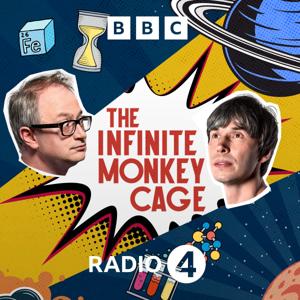
A witty, irreverent look at the world through scientists' eyes, guest hosted by Prof. Adam Rutherford and Jess Fostekew.
Ranked by our users in the last 21 days

7,586 Listeners

522 Listeners

873 Listeners

1,043 Listeners

287 Listeners

5,514 Listeners

2,103 Listeners
4,820 Listeners

490 Listeners

384 Listeners

407 Listeners

824 Listeners

238 Listeners

475 Listeners

347 Listeners

233 Listeners

309 Listeners

3,226 Listeners

110 Listeners

77 Listeners

78 Listeners

806 Listeners

518 Listeners

628 Listeners

186 Listeners

380 Listeners

233 Listeners

60 Listeners

73 Listeners
431 Listeners

72 Listeners