
Sign up to save your podcasts
Or



The general election of 2024, the Scottish, Welsh and local elections of May 2026 and the by-election in Makerfield show that the UK is now firmly in an era of multi-party politics. That has led to renewed calls, from across the political spectrum, for a change to the first-past-the-post electoral system that is used to elect MPs at Westminster.
Jonathan Freedland and guests compare the political landscape now to 1884, when the Proportional Representation Society was founded by a campaigning Liberal MP called John Lubbock, a man who kept a pet wasp and taught his poodle how to read. They also revisit the highly-contested 1918 Representation of the People Act, which enfranchised women for the first time - and almost included proportional representation too.
Guests: Dr Robert Saunders, reader in modern British history at Queen Mary, University of London; Lucy Fisher, Whitehall Editor of the Financial Times and host of their Political Fix podcast. Reader: Ben Crowe.
Producer: Tim Bano
The number of deepfakes shared online rose from around half a million in 2023 to eight million by 2025. While much of this material is seen as humorous or satirical, deepfakes are increasingly used for scams, misinformation, and political manipulation, exploiting a long-standing human weakness: our tendency to trust what we can see. The Long View explores a striking historical parallel — the Cottingley Fairies affair of 1917–1921.
In post-First World War Yorkshire, two young cousins, Elsie Wright and Frances Griffiths, produced photographs that appeared to show real fairies. The images were crude cut-outs, but photography was then a new “truth machine”, imbued with cultural authority. The photographs were believed not only by many in the public but by the famous writer and creator of Sherlock Holmes, Sir Arthur Conan Doyle, who championed them as evidence of spiritual reality. At the same time, rationalist sceptics weighed in, dismissing the photographs as fake and a polarised debate ensued. The girls did not fully admit the images were fake until the 1980s.
Cottingley shows us not only that images can be faked but that - from early photography to today’s generative AI - every era over-trusts its latest representational technology before learning its limits. Jonathan Freedland is joined by Dr Merrick Burrow from the University of Huddersfield and Marianna Spring, the BBC’s disinformation specialist to explore the Cottingley Fairies story and ask what lessons can be learned from it in today’s age of digital deception.
Guests: Dr Merrick Burrow, Head of English and Creative Writing at the University of Huddersfield; Marianna Spring, BBC Disinformation Specialist
Producer: Neil McCarthy
President Trump says he's considering options to intervene in Iran, amid ongoing protests. The threat comes hot on the heels of a dramatic US intervention in Venezuela, and threats to take over Greenland. Together, they suggest a shift in US foreign policy towards more open interventionism. Jonathan Freedland takes the Long View of US intervention abroad, exploring revealing parallels between current foreign policy and a covert American intervention in Guatemala in 1954.
Guests: Dr Grace Livingstone, Affiliated Lecturer at the Centre of Latin American Studies, University of Cambridge; Jon Lee Anderson, staff writer, The New Yorker
Producer: Dan Hardoon
The news headlines in recent weeks have featured one recurring story: prisoners mistakenly released from prison due to bureaucratic errors and a prison system under strain. After three men were mistakenly released in quick succession, official figures confirmed this was no anomaly: 91 prisoners were wrongly released between April and October 2025, around three a week.
But these fears of criminals "on the loose" are hardly new. In the mid-19th century, the country was preoccupied by similar concerns. As transportation to Australia came to an end and a new system of penal servitude took its place, the press and public became alarmed that violent offenders who ought to have been behind bars were instead back on the streets.
Jonathan Freedland takes the Long View of prison crises past and present, tracing the parallels between Victorian anxieties and today’s concerns over mistaken releases, early release, and the pressures facing the criminal justice system.
Guests: Helen Johnston, Professor of Criminology at the University of Hull; John Podmore, former prison governor and inspector.
Producer: Dan Hardoon
What does raising a Union Jack or drawing a flag of St George on a street sign signify? As flags appear across England and now Wales, Jonathan Freedland and his guests look back to a street gathering in 1780 which also used flags to get a message across. Organisers of "Operation Raise the Colours" say it's about promoting patriotism and is non-partisan but the appearance of flags on mini-roundabouts, motorway bridges and lamposts has been met by opposition from anti-racist groups and by differing responses from some local authorities. Eleanor Lawson is a BBC News reporter in the West Midlands where flags began appearing earlier in August. Ian Haywood is Emeritus Professor in English at the University of Roehampton and he has studied the initially peaceful protest and petition which became known as the Gordon Riots. The reader is Django Bevan.
Produced by Jayne Egerton
The Netflix series, Adolescence, which featured a boy who killed a female classmate, provoked widespread debate about the causes of his crime and the possible influence of the online 'manosphere'. Jonathan Freedland takes a long view of the way in which new media has been implicated in male violence. 19th century, cheap sensational fiction, in the form of the Penny Dreadful, was often blamed for juvenile delinquency, rape and even murder. In the 20th century, cinema, the first true mass medium, was held to blur the line between fantasy and reality, encouraging young men to emulate what they saw on the screen. But is this too simplistic a view and what's the historical evidence? With Chas Critcher, Emeritus Professor of Communications at Sheffield Hallam University and Judith Rowbotham, Visiting Professor in the Law Department at the University of Plymouth.
Producer: Jayne Egerton
As Donald Trump raises a 25% levy on all imports of steel and aluminium into the USA, as well as other tariffs on trade with friends and competitors alike, Jonathan Freedland looks back to the Corn Laws, measures introduced to protect British farmers and land owners from competition following the end of the Napoleonic Wars in 1815. The Corn Laws and the campaign to repeal them transformed British politics and economics. How do events then compare to Donald Trump's policies and actions today?
Producer: Luke Mulhall
Following the recent floods in Valencia, Jonathan Freedland looks at the politics of natural disasters, with
Producer: Jayne Egerton
Mob violence breaks out across the country, with an explosion of hatred directed at minority communities who feel under siege. As British courts process hundreds of those involved in the riots of August 2024, Jonathan Freedland looks back more than 800 years ago when hatred was directed at a different group of outsiders. In the late 1180s, Britain's small Jewish community was targeted by violent mobs in the wake of the coronation of Richard I. The worst incident was the York Massacre of 1190 in which 150 people died. What are the historical parallels with today's race riots against British Muslims and asylum seekers, and what can be learnt about how to heal communities?
Guests: Miri Rubin, Professor of Medieval and Early Modern History, Queen Mary, University of London; Joe Mulhall, Director of Research, Hope Not Hate; Hina Bokhari, Liberal Democrat Member of the London Assembley and Founder, Naz Legacy Foundation
Producers: Dan Hardoon and Luke Mulhall
As French President Emmanuel Macron calls a snap election to address the political threat to his government posed by the Far Right, Jonathan Freedland and guests discuss Louis XVI's decision in 1789 to call an Estates General, a meeting of representatives of all sections of French society. Louis' gamble in 1789 started a chain of events known as the French Revolution. What are the stakes of President Macron's gamble today?
With
Clare Siviter, Associate Professor in French Theatre at the University of Bristol
Emile Chabal, Professor of Contemporary History at the University of Edinburgh
The reader is Ewan Bailey
Producer: Luke Mulhall
From the publisher's feed
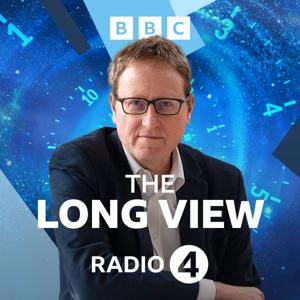
Jonathan Freedland presents the series in which stories from the past are compared with current events.

7,585 Listeners

1,042 Listeners

5,486 Listeners

1,789 Listeners

3,197 Listeners

1,835 Listeners

1,042 Listeners

2,097 Listeners

1,937 Listeners
152 Listeners

63 Listeners

3,206 Listeners

701 Listeners
99 Listeners

1,005 Listeners

15,577 Listeners

3,043 Listeners
193 Listeners

1,135 Listeners

836 Listeners

177 Listeners

2,229 Listeners
60 Listeners