
Sign up to save your podcasts
Or



Donald Trump has made history by becoming the first former US President to be criminally charged, facing 91 felony charges across four separate cases. As he heads towards an election rematch with Joe Biden, he has promised to continue his campaign even if he is convicted or sent to prison. What impact could this have on his campaign and has a prisoner ever run for President before?
Eugene V Debs (1855-1926) was one of the best-known Socialists in the United States. He ran for president five times – the final time from prison. Though his politics were rather different from Trump’s, his performance – he won almost a million votes – suggests how a criminal conviction can in fact add momentum to a presidential campaign.
Guests: Adam Smith, Professor of US Politics and Political History at the University of Oxford; Quinta Jurecic, Fellow in Governance Studies, Brookings; Kathleen Hall Jamieson, Professor of Communication at the University of Pennsylvania.
Producer: Dan Hardoon
The Post Office Scandal has gripped the nation’s attention – but only truly captured the public's imagination following the popular ITV drama of the postmaster’s ongoing quest for justice. As the government takes steps to legislater and offer further compensation, Jonathan looks at two important factors from the Post Office inquiry – a drama making all the difference to overturning a scandal, and a miscarriage of justice being righted to make permanent and impactful change.
Professor Rosalind Crone looks back at the curious case of Adolf Beck, whose wrongful conviction and fight for freedom ended in the Court of Criminal Appeal being founded. Dr Ella Dzelzainis shines a light on writer Charlotte Elizabeth Tonna, whose novels were integral in bringing the plight of child factory workers to public attention and resulted in the Factory Acts being passed.
In both cases, it took notable storytelling in the press and popular literature of the day and the outcry of the British public for meaningful change to be made.
Producers: Olivia Sopel and Mugabi Turya
If Donald Trump is elected to a second term as President of the United States he would be 82 at the end, if Joe Biden is re-elected he would be 86. Age has become a campaign weapon. How effective have the octogenarian leaders of the past been shown to be?
One was William Ewart Gladstone who was Prime Minister four times, the last when he was 82. Dr Ruth Windscheffel Head of Teaching and Learning Enhancement at York St John University and author and editor of a number of books and articles about Gladstone discusses how his advanced age affected his final administration.
Emperor Gordian I acceded to Rome's Imperial throne in 238 AD in his early eighties. Dr James Corke-Webster is Reader in Classics, History and Liberal Arts at King's College London. He discusses with Jonathan Freedland the events surrounding Gordian's rise to power in ancient Rome's most turbulent year.
Reader: Josh Bryant-Jones
Producer: Harry Parker
Two of Britain’s ruling political parties find themselves without the strong, charismatic leaders who won them a handsome election victory – and now they’re struggling. At Westminster, it’s the Tories who are emerging, with difficulty, from the shadow of Boris Johnson. At Holyrood, it’s the Scottish National Party getting used to life without Nicola Sturgeon. Both were once riding high – yet this month, both the Conservatives and the SNP lost closely-watched byelection contests to Labour, those Tory defeats coming in Tamworth and mid-Bedfordshire just a few days ago. But the hole left after a once-dominant leader departs the stage is not new – not in Westminster and not in Edinburgh.
.Jonathan Freedland takes The Long View of the void left by once-dominant leaders - to the fall-out from the demise of Sir Robert Peel in the middle of the 19th century and the way Tory politics was upended by the exit of the man who had all but created the modern Conservative Party; and the power vacuum that was left by the sudden death of King James V of Scotland in 1542.
The Guests
Readers
Assistant Producer: Olivia Sopel
Producer: Mohini Patel
Elon Musk made his money leading and shaping the latest advances in society but now he’s dabbling in politics on the global stage – unelected and unaccountable but with the power to hold one-to-one meetings with world leaders as he did just last week with the Israeli Prime Minister Benjamin Netanyahu who flew to California to meet the tech billionaire in person.
Historians:
Reader:
Producer:
The notorious Wagner group of mercenaries marched for Moscow after calls from its leader to 'end this disgrace’. Yevgeny Prigozhin insisted it was a ‘march for justice’ and not a coup, but for 24 hours Russia’s future seemed uncertain and the political impact of the brief uprising remains to be seen.
The Roman general, Sulla, was the first leader of the Republic to seize power by force, marching twice on Rome – first in 88 BC, and the Streltsy uprising of Russian soldiers in 1698 proved a decisive moment in the rule of Peter the Great.
Jonathan Freedland takes the long view of marches of mutiny.
Contributors:
Readings:
Producer:
Jonathan Freedland takes The Long View of attempted state assassinations.
Russia claimed it foiled an attack by Ukrainian drones on the Kremlin just last week, calling it an unsuccessful assassination attempt against President Vladimir Putin. The Ukrainian president, Volodymyr Zelenskyy, denied it, saying: “We don’t attack Putin or Moscow.” The Russian authorities said the purported attack occurred overnight but there was no independent verification of it and no evidence has been presented to support it. Questions have arisen as to why it took the Kremlin hours to report the incident and why videos of it also surfaced so late in the day. Yet accusations abound in the Kremlin as to which state was the perpetrator - Ukraine or the US. As the threat of Russian retaliation for what it termed a “terrorist” act hangs in the air, Jonathan is joined by two historians. Professor Rory Cormac, Professor of International Relations at University of Nottingham, looks back to the United States' Central Intelligence Agency’s (CIA) many and varied unsuccessful attempts to assassinate Cuban leader Fidel Castro in the 1960s. And Dr Elizabeth Norton, who specialises in the queens of England and the Tudor period, takes us back to 1586 and the Babington Plot to assassinate Queen Elizabeth I, a Protestant, and put Mary, Queen of Scots, her Catholic cousin, on the English throne. The facts of the plot are far from straightforward, and very much tied up with the extensive spy networks created by Sir Francis Walsingham, arguably the first state spymaster. In both cases espionage and politicking lie just below the surface.
The Readers are Leah Marks and Ewan Bailey
The Producer is Mohini Patel
Jonathan Freedland takes The Long View of Spring Offensives.
As Ukraine prepares for what is anticipated will be a Russian Spring Offensive, Jonathan is joined by two historians. Dr Michael Jones looks back at the spring offensive of 1356 in the Hundred Years War, which would lead eventually to the Battle of Poitiers and the capture of the French King. Professor Heather Jones of University College London discusses the German offensive of 1918 at the end of the First World War.
In both cases the winter season forced the conflict to pause and allowed both sides to prepare for the Spring to come. The transition to spring is a time too for anxiety and tension.
The actors Roger Ringrose and Leah Marks provide illustrative readings.
The Producer is Tom Alban
Jonathan Freedland sheds light on current events through stories from the past.
As Donald Trump announces he's running for President a second time Jonathan takes the Long View of political leaders who made a comeback. The 7th century Byzantine Emperor Justinian II generated enormous opposition during his first reign from 685 to 695 with unfair tax rises, military defeats and ultimately ordering mass murder in Constantinople. He was overthrown, had his nose cut off by way of punishment and banished in exile to modern day Kherson, in Ukraine. Now known as 'Slit Nose' he declared he would become emperor again and slipped back into Constantinople with a military consort and retook power. He then embarked on an even more despotic and bloodthirsty reign meting out vengeance on his enemies past and present, until his own life was brought to a violent end, abandoned by his troops.
And the only US President to ever gain office in two non consecutive terms, Grover Cleveland. In the 1880's and 1890's, the Democrat won each time on tight margins. Although he was seen as a hard working, upstanding politician of probity, scandal surrounding extra-marital relations and I child out of wedlock dogged his presidential campaign. He declared 'Reform!' on the bloated Civil Service but when the vote went against him after his first term he vowed to his support base that he may have lost the battle, but not the war and he would be back. Four years later, he was. But the second term was even less successful than the first.
With Professor Adam Smith from Oxford University and Associate Professor Rebecca Darley from University of Leeds
Readings by David Hounslow, Chloe Sommer and Roger Ringrose
Producer Neil McCarthy
As Liz Truss resigns after 44 days in office, the shortest serving Prime Minister in UK history, Jonathan Freedland takes the Long View of short-lived leaders; from Emperor Didius Julianus in AD 193 to Prime Minister Lord Goderich in 1827.
Contributors:
Producer: Sarah Shebbeare
From the publisher's feed
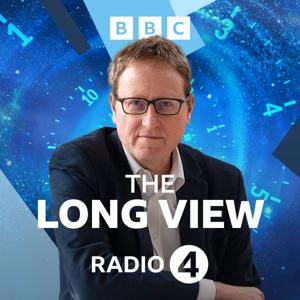
Jonathan Freedland presents the series in which stories from the past are compared with current events.

7,585 Listeners

1,042 Listeners

5,486 Listeners

1,789 Listeners

3,197 Listeners

1,835 Listeners

1,042 Listeners

2,097 Listeners

1,937 Listeners
152 Listeners

63 Listeners

3,206 Listeners

701 Listeners
99 Listeners

1,005 Listeners

15,577 Listeners

3,043 Listeners
193 Listeners

1,135 Listeners

836 Listeners

177 Listeners

2,229 Listeners
60 Listeners