
Sign up to save your podcasts
Or

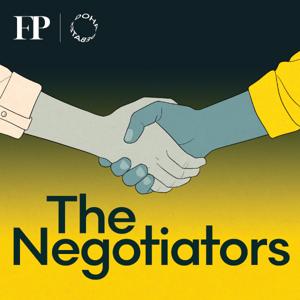


Based on Podcast App listening data
President Vladimir Putin recently announced that Russia would suspend its participation in the New START agreement with the United States. Putin’s move puts the last remaining nuclear arms deal between the two countries into question.
Last season, we spoke with the chief U.S. envoy to the New START talks, Rose Gottemoeller. She shares the grueling process of negotiating that treaty—which was finally signed in 2010. Even as Putin threatens to use nuclear weapons in Ukraine, Russia continued to abide by that same New START deal. Till now.
In case you missed it the first time, here is an encore presentation of that episode.
Earlier this year, a British Pakistani man took several people hostage at a synagogue in Colleyville, Texas—including the congregation’s rabbi, Charlie Cytron-Walker. During the 11-hour saga, FBI negotiators posted outside tried to persuade the gunman to come out quietly. Meanwhile, another kind of negotiation was happening inside the temple’s walls: between the rabbi and the hostage taker.
This week on our podcast The Negotiators, Rabbi Cytron-Walker describes how he tried to humanize himself and the other congregation members in order to stay alive. Cytron-Walker told his story to our show’s senior producer, Laura Rosbrow-Telem.
This is our last episode of the season. We’ll be back soon with more negotiator stories. If you have an idea for a Negotiators episode, feel free to email us at [email protected].
The Negotiators is a partnership between Doha Debates and Foreign Policy.
The negotiations that led to the United Kingdom’s withdrawal from the European Union lasted more than four years. During that grueling process, three different prime ministers came and went in Britain, shifting positions and occasionally roiling the talks. The one constant was Michel Barnier, the European Commissioner in charge of Brexit talks.
This week on our podcast The Negotiators, Barnier tells host Jenn Williams about challenges he faced in the talks, including one that couples often confront in divorce proceedings: how to dismantle the partnership and still retain a measure of goodwill.
Barnier has published a diary he kept during Brexit. For his full story, we recommend reading My Secret Brexit Diary: A Glorious Illusion.
The Negotiators is a partnership between Doha Debates and Foreign Policy.
The uprising in Libya that ended Muammar Qaddafi’s long reign in 2011 was supposed to provide a path to stability. Instead, the country descended into civil war, with regional powers vying for influence and resources. An election brokered by the United Nations last year was called off at the last moment and the sides to the conflict remain at an impasse.
But while official negotiations have stalled, one peace group decided this past summer to bring opponents together in Norway, where they would try to find a way forward. The group, Together We Build It, has been working on peace and security issues since 2011, in part by engaging more women and young Libyans in the process. While the Norway talks were held largely behind closed doors, reporter Amira Karaoud attended the conference and interviewed the participants.
Karaoud, who is originally from Tunisia, is featured in the latest episode of The Negotiators, a collaboration between Doha Debates and Foreign Policy.
Criminal justice advocates have tried for decades to pass legislation to reduce the United States prison population. Yet somehow, at a moment when the United States felt more polarized than ever, lawmakers managed to agree on a bipartisan criminal justice reform bill during Donald Trump’s presidency. It was called the First Step Act and it reduced the sentences of thousands of incarcerated people in federal prisons.
This week on our podcast The Negotiators, we talk to Jessica Jackson, a lawyer and one of the key advocates for the First Step Act. She and political commentator Van Jones co-founded the group #Cut50, which helped advocate for the legislation. In this episode, Jackson tells host Jenn Williams how she convinced politicians from both parties to support the bill.
For the full story on the First Step Act negotiations, we recommend watching the upcoming documentary The First Step, out in U.S. theaters in early 2023.
When Chileans were asked in a referendum in 2020 whether they wanted a new constitution, the response was overwhelming. The current one dated back to the rule of Augusto Pinochet, the military dictator who had stepped down more than three decades earlier. Nearly eighty percent of the population voted in favor of a negotiation that would lead to a new charter for the country.
But the negotiation process—which included representatives from the left and right side of the political map, along with dozens of independents—was rocky from the start. Delegates introduced many lofty ideas but the actual give-and-take required to produce a consensus was missing. Voters rejected a draft of the new constitution in September—by a large margin.
This week on our podcast, The Negotiators, we examine what went wrong, with the help of John Bartlett, a reporter based in Santiago, Chile. Bartlett covered the constitutional convention and interviewed many of the key players.
The Negotiations is a collaboration between Doha Debates and Foreign Policy.
In 2009, the last nuclear arms control treaty between the United States and Russia was about to expire. The START agreement, and others like it, had helped protect people around the globe from the possibility of a nuclear confrontation between the world’s two superpowers. Barack Obama, who became president that year, was eager to get a new deal in place.
On the latest episode of The Negotiators podcast, we hear from the chief U.S. envoy to the New START talks, Rose Gottemoeller, about the grueling process of negotiating that treaty—which was finally signed in 2010. Even now, as President Vladimir Putin threatens to use nuclear weapons in Ukraine, Russia continues to abide by that same New START deal. Gottemoeller was interviewed by our senior producer, Laura Rosbrow-Telem.
The Negotiators is a collaboration between Doha Debates and Foreign Policy.
Military officers in Burkina Faso seized power last month, in the country’s second coup this year. In both cases, the main justification was leadership’s failure to curb violence from groups linked to the Islamic State and Al-Qaeda. The insurgency has killed tens of thousands of people and displaced about 10 percent of the population.
This week on our podcast, The Negotiators, we tell the story of one community leader in Burkina Faso who set out to negotiate with the insurgents so that members of his community can return to their homes. His story might be familiar to people who follow conflicts in other areas—including Afghanistan—where, in the absence of a broader peace process, people at the local level engage in their own small-scale diplomacy.
Journalist Sam Mednick, who covered these community-led negotiations in Burkina Faso for The New Humanitarian, reports this episode with us.
The Negotiators is a partnership between Doha Debates and Foreign Policy.
For decades, Canadian activists have criticized the government in Ottawa for underfunding Indigenous communities, leading to various harms and hardships. The activists, led by Cindy Blackstock of the First Nations Child and Family Caring Society, sued the Canadian government in 2007, claiming that federal underfunding prompted First Nations children to end up in foster care in large numbers once residential schools were closed. The court battle dragged on for 15 years.
But in January of this year, the federal government offered to pay C$40 billion to Indigenous children and families harmed by the child welfare system. It was the largest-ever proposed class action settlement in Canadian history—which some people are now calling a form of reparations.
This week on The Negotiators podcast, Blackstock sits down with host Jenn Williams to discuss the tactics used in negotiations with the government and the conditions that led to a successful settlement.
From the publisher's feed
Ranked by our users in the last 21 days

90,399 Listeners

23,712 Listeners

25,947 Listeners

601 Listeners

209 Listeners
58,962 Listeners

112,271 Listeners

56,588 Listeners

12,814 Listeners

18,978 Listeners

16,335 Listeners

2,720 Listeners

27 Listeners

1,008 Listeners
38 Listeners
204 Listeners

356 Listeners

75 Listeners

800 Listeners
11 Listeners
0 Listeners
13 Listeners

8 Listeners

3 Listeners

0 Listeners

0 Listeners

849 Listeners
0 Listeners

119 Listeners
181 Listeners

2 Listeners