
Sign up to save your podcasts
Or



Based on Podcast App listening data
Since taking power, the Taliban have cracked down on human rights and deprived Afghan women and girls of fundamental freedoms. The outlook for productive engagement is dim. Yet there may have been a window, in the early months after the fall of the republic, to do things differently. Researcher Ashley Jackson speaks to aid workers and activists involved in direct negotiations with the Taliban as well as representatives from the U.S. and Taliban governments. And she takes a look at two intertwined questions: What might have been done differently then? And what should, or could, be done now?
Once it became clear that U.S. troops were leaving Afghanistan, the situation on the ground turned to panic. In August 2021, radio reporter Shirin Jaafari found herself in the middle of the effort to find safe passage for Najiba Noor, a 27-year-old Afghan policewoman who was the target of threats and harassment by the Taliban. For this episode, Shirin reconnects with Noor and speaks with other people directly involved in Digital Dunkirk—a mostly online, grassroots effort to help vulnerable Afghans get to safety.
When a diplomatic deal goes bad, the blame usually falls on the politicians. Often, we don’t even remember the names of the negotiators. But in the wake of the return of the Taliban, a lot of people have blamed one man: Zalmay Khalilzad, the U.S. special representative for Afghanistan reconciliation. Khalilzad was born in Afghanistan but had served in the U.S. government since the 1980s. He was at Bonn, and he later served as the U.S. ambassador to Afghanistan, Iraq, and the United Nations. Khalilzad sat down with reporter Andrew North to discuss what went wrong—and right—during the negotiations for peace in Afghanistan.
As soon as the Doha Agreement was signed, the clock started counting down to May 1, 2021—the day the United States had agreed to withdraw all troops. That gave the Afghan Republic and the Taliban 14 months to negotiate a power-sharing deal. That’s not a lot of time, even under the best of circumstances. Afghan American reporter Ali Latifi has an insider’s look at how friction within Afghan President Ashraf Ghani’s administration delayed and derailed the negotiations. But there’s enough blame to go around, with the Taliban playing a waiting game and Washington refusing to intervene.
As a candidate for the U.S. presidency, Donald Trump vowed to end the war in Afghanistan. But seven months after his inauguration, he changed his mind, saying that the United States should “fight to win.”
A year later, with the Taliban controlling or contesting more territory than at any point since 2001, representatives from the Trump administration traveled to Doha, Qatar, to open direct negotiations with the Taliban. Finalized in February 2020, the Doha agreement was hailed by the Taliban as a victory. The Afghan government called it a historic betrayal.
Veteran Middle East correspondent Sebastian Walker has the story.
By 2006, the United States and the Afghan Republic had been fighting the Taliban for five years. Neither side was poised to win. That’s when U.S. political scientist Barnett Rubin received a phone call from a Taliban intermediary that would mark the beginning of a four-year, clandestine process of “talks about talks”—even as fighting was intensifying on the ground and as U.S. troops found and killed Osama bin Laden in Pakistan. Veteran Afghanistan reporter Andrew North talks to some of the key players involved for a behind-the-scenes look at the negotiations.
All manner of the rich and powerful have passed through the doors of the mountaintop Hotel Petersberg in Bonn, Germany. But perhaps never as motley a cast as the one that arrived on November 27, 2001 to negotiate an end to the wars in Afghanistan. Warlords, exiled monarchists, intellectuals, and enemies so fierce, some had already been trying to kill each other for decades. But a key element was missing; The Taliban was not invited. Australian Iranian investigative journalist and author Soraya Lennie got the story from some of the negotiators who were in the room.
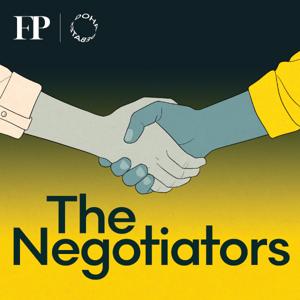
We all remember how the story ends, with the fall of Kabul and the return of the Taliban. But in this special seven-episode season of The Negotiators, we’re going back to the beginning, to try to understand why some of the world’s smartest and most experienced negotiators failed for 20 years to mediate a peace deal in Afghanistan.
William Ury is one of the most famous negotiation experts in the world. He co-wrote the classic book Getting to Yes and co-founded Harvard’s Program on Negotiation.
On today’s episode of the Negotiators, our last of the season, Ury describes his role in mediating some of the world’s most difficult conflicts.
His forthcoming book, Possible, includes lessons from a long career as an international troubleshooter.
The Negotiators is a partnership between Doha Debates and Foreign Policy.
After nine years of war in Yemen, a peace deal finally seems at hand. Representatives of the Houthis met with the Saudis in Riyadh in September, in their first official visit since the war in 2014 began.
On today’s episode of The Negotiators, we talk to Yemeni mediators about how they have advanced the peace process and what they think is needed to end the war. First, host Jenn Williams speaks with Maeen Al-Obaidi, one of the most successful local negotiators in Yemen, about how she has helped facilitate hundreds of prisoner exchanges. Then we hear from Farea Al-Muslimi, a Gulf regional expert at Chatham House and co-founder of the Sana’a Center for Strategic Studies.
From the publisher's feed
Ranked by our users in the last 21 days

90,399 Listeners

23,712 Listeners

25,947 Listeners

601 Listeners
209 Listeners

58,962 Listeners

112,271 Listeners

56,588 Listeners

12,814 Listeners

18,978 Listeners

16,335 Listeners

2,720 Listeners

27 Listeners

1,008 Listeners
38 Listeners
204 Listeners

356 Listeners

75 Listeners

800 Listeners
11 Listeners

0 Listeners
13 Listeners

8 Listeners

3 Listeners

0 Listeners

0 Listeners
849 Listeners
0 Listeners

119 Listeners
181 Listeners

2 Listeners