
Sign up to save your podcasts
Or



Get in touch to share sheeping stories or questions anytime!
So what did we learn from lambing 2022 - well lots! Mistakes there's been a few but also lots of good things have occurred too.
Have a listen and share your top lambing tip from 2022 on socials!
#HVF
#thesheepshowpodcast
Support the show
Thank you for supporting our pod! Sign up via our sheep supporters tab !
https://www.buzzsprout.com/954910/supporters/new
Get in touch to share sheeping stories or questions anytime!
Meet this wonderful shepherd and my nephew Bryan in this volume 3.1 of The Lambing diaries.
Sheep are a big thing in our family and they always have been and Bryan is carrying on our sheep legacy in his expert tips which he shares with us in episode. Bryan has recently finished high school in Ireland and has been over in Australia for a few weeks. It's been a great experience for us both spending time doing sheep stuff together especially as half of my ewes lambed nice and early!
Let us know what your favourite tip from Bryan is and enjoy this episode!
Support the show
Thank you for supporting our pod! Sign up via our sheep supporters tab !
https://www.buzzsprout.com/954910/supporters/new
Get in touch to share sheeping stories or questions anytime!
Possibly one of the most famous butchers in the country Lochie Waters from Uniplaza Meats is very passionate about his work and helps us get a clearer picture of what butchers are looking for in a lamb carcase.
A career as a butcher and an impressive recent win at Meatstock
Lochie started his career in the meat industry in 2013 in country Qld as a wash up boy at the age of 14. Starting the very afternoon his Grandma had been in the shop and was asked by the butcher if she knew anyone suitable for the job. He was there for 12 months and was then offered a school based apprenticeship which he did through to year 12.
Then things became quite tough in rural Qld and the butcher he was working for closed down which led him to move to Toowoomba and complete the apprenticeship with Uniplaza meats in 2018. He then managed the shop for 2 years. In 2020 he purchased the shop at 21 years of age.
Lochie says they’ve built a reputation for supplying high quality products, all sourced within 100km of the shop front door.
What are the benefits for you and other butchers in participating in Butcher Wars and Meatstock?
What do you look for in a carcase of a lamb?
What can you tell about the lamb from their carcase?
What about some butcher terms like blue back, fat cover, eye muscle size, colour, hot carcase weight, on the hooks, shrinkage, trim – what other terms do we as lamb producers need to understand?
What are your thoughts on weighing lambs or condition scoring when selecting a n animal for slaughter? Should producers put their hands on their animals or just focus on weight?
What can/should we be looking for or feeling for when we put our hands on the live animal?
Can you tell different breeds of sheep from their carcases – for example can you tell if the animal is an African breed, a wool breed or a British breed sheep by looking at the carcase?
We seem to be focused on generic lamb in Australia, where as beef is marketed as Angus or Highland – should we as a producers be moving away from generic lamb and marketing specific breeds like Southdowns or Wiltshire Horn?
How come lamb looks so pale when you see it on supermarket shelves?
What about the colour of the lamb fat – should it be white or yellow, should the fat be hard or soft – what do these things tell us about the production environment of the lamb?
What else can you tell about the production environment when you see a carcase hanging in your cool room?
What about the age of despatching – is it different for different breeds?
Should we eat milk fed lamb like they do in Europe? What are the pros and cons of this?
When you buy lamb carcases for your shop what are you looking for – for example uniformity, consistently, breed, age, size?
Support the show
Thank you for supporting our pod! Sign up via our sheep supporters tab !
https://www.buzzsprout.com/954910/supporters/new
Get in touch to share sheeping stories or questions anytime!
So I love a good sheep shopping splurge and I thought you might like to join me on a shopping trip! So here is what I have bought recently to prepare for the lambing, lactating and weaning season ahead - Happy shopping!
Support the show
Thank you for supporting our pod! Sign up via our sheep supporters tab !
https://www.buzzsprout.com/954910/supporters/new
Get in touch to share sheeping stories or questions anytime!
What is all this short day breeding, estrus, heat stuff all about? What to know how long your ewes cycle for and how different their cycles are from a human's cycle? In this episode we explore what happens when we work with nature to aid in sheep reproduction.
Support the show
Thank you for supporting our pod! Sign up via our sheep supporters tab !
https://www.buzzsprout.com/954910/supporters/new
Get in touch to share sheeping stories or questions anytime!
So what mistakes do you need to be aware of when it comes to introducing your sheep to new feed like grain or pellets? We can end up killing our sheep with kindness by introducing too much too soon.
In this episode we explore how to start your sheep on a new feeding regime and even if you need to do this at all. How much to give each type of sheep and what can you do to ensure they transition to a new feed well.
What are the signs of a sheep who has had too much grain and what can you do about it if it happens.
Links and products mentioned:
Berg oil
https://www.iahp.com.au/animal-products/berg-oil
https://www.business.qld.gov.au/industries/farms-fishing-forestry/agriculture/livestock/animal-welfare/sheep-health/supplementary-feeding/grain
https://www.agric.wa.gov.au/feeding-nutrition/supplementary-feeding-and-feed-budgeting-sheep
Support the show
Thank you for supporting our pod! Sign up via our sheep supporters tab !
https://www.buzzsprout.com/954910/supporters/new
Get in touch to share sheeping stories or questions anytime!
Sheep Infrastructure design tips
Sheep yards are the main sheep handling complex on a farm and need to be designed and built to provide efficient sheep handling. Sheep need to move well in the yards and we all want to handle our sheep safely.
Good sheep yards confine and control the movement of sheep. Good yard set up helps us to achieve a high quality work rate with a minimum of physical effort.
This should be done in a pleasant and safe working environment for humans and animals alike!
So where do you start with setting up or improving your sheep yard infrastructure?
Your site selection consider these factors:
• ease of access from all parts of the property including access to power for muscle or pregnancy scanning
• slope of land to assure good drainage
• effect of prevailing winds on working conditions and dust control
• situation of the yards in relation to existing trees which can provide shade and protection
• access to a water supply for livestock drinking, dust control, and cleaning.
Yard size
The main yards should be large enough to handle the biggest mob on the property. Yard size is determined by a combination of the selected design, the capacity of the working race and the size of the flock to be handled. The holding yards should be large enough for mobs of ewes and lambs at weaning. Adjoining mini-paddocks including a water point increase the number of mobs that can be handled in a set of yards.
Provide 1 m2 per three sheep in forcing areas and at least 1 m2 per sheep in holding areas.
Design
When designing sheep yards keep the following points in mind:
• Sheep have wide angled vision – they can detect movement behind them without moving their heads.
• Sheep should have a clear, unobstructed view towards where they are meant to move.
• Whenever possible use wide gates to maintain good sheep flow.
• Ideally sheep should take a familiar route and direction through the yards for all handling operations.
• Entrances to sheds, loading ramp should be placed along the route sheep usually take through the yards.
• Sheep move better on the flat than up or down hill. If the land slopes, the direction of movement should be across the slope rather than up or down hill.
• Sheep can cope well with one change of status at a time –go up a ramp; go onto the flat landing; go through a gate; go around a corner; go into a shed or a truck. Do not try to get sheep to do more than one change of status at a time or they will have trouble and cause a blockage in movement pathways.
• Sheep move readily towards light and avoid dark areas, shadows and dead ends.
• Sheep move willingly around curves and corners into narrow races. Sheep follow one another, and the use of see-through panels may encourage them to move.
• Take sheep behaviour into account when positioning handling facilities – generally sheep will move towards the yards in anticipation of escape or release to their paddock.
• Oncoming sheep must not see the operator. The sheep in the race focus on the sheep in front of them and in the direction of movement without distract
Support the show
Thank you for supporting our pod! Sign up via our sheep supporters tab !
https://www.buzzsprout.com/954910/supporters/new
Get in touch to share sheeping stories or questions anytime!
Technology and good biosecurity practices can protect you from big losses when it comes to Ovine Brucellosis. Colin Chapman, Professor and Dorset Downs stud breeder leads us through the best ways to tackle and prevent this mostly hidden from view infection.
What is Ovine Brucellosis?
It’s caused by a bacteria called Brucella Ovus, which is one of several different types of Brucella. “It lives only in sheep, it doesn’t live on the ground or in the water. It spends it’s entire life cycle in sheep, which fortunately makes it easier to control because you don’t have to eradicate it in the environment as well” he explains.
Ovine Brucellosis (OB) quite different to Bovine Brucellosis, which causes the cow to become sick and abort their calf. The cow and calf are both infected with this type of Brucellosis, and it’s also infectious to humans. Bovine Brucellosis has now been eradicated in Australia.
What problems does it cause in sheep?
When Brucellosis is in your flock of sheep you don’t notice it. “The sheep are not unwell What you do notice is that you will have a drop in fertility and the ewes don’t have as many lambs as expected. A reduction in lambing percentage over time could indicate that it is present in your flock”, says Colin.
Colin goes on to explain that on closer inspection you may find that the rams have lumps and bumps in the testicles, but apart from palpating the testicles of the rams there is nothing to see. It is mostly invisible except for the records which show a reduction in lambing percentage.
How does it reduce lambing percentages?
OB reduces fertility in the rams by causing a blockage in the tubules from the testes up to the penis. In the two testicles one side might be blocked but the other side may be open. So a ram can be partially infertile or totally infertile, which you can’t tell by the palpation. Once OB gets into the reproductive tract it stays there. All rams that are sexually active regardless of age are vulnerable.
What about the ewes and wethers?
Colin explains that ewes that are mated with infected rams will possibly have the bacteria present in the vagina and uterus for a brief period of time but normally with no adverse affect. It does not cause any blockage as ewes or wethers don’t have testes. It may cause local inflammation in a ewe but that will pass. The ewe is not a carrier Colin assures. The presence of the bacteria in a ewe will be resolved usually in a day or two. So unless there is more than one ram around the same ewe in a short period of time the bacteria would not be passed from the ewe to another ram. This would be considered an unlikely way for it to be transmitted, it is usually ram to ram transmission through homosexual activity.
OB comes onto a property when someone buys a new ram that is infected and puts it in with their ram flock. Doing this without prior quarantine and testing can infect a whole flock of rams within days or weeks.
Teasers can in theory be at risk or a source of infection, as they still have the testes in tact.
How do I check my flock for Brucellosis?
If you have had a reduction in lambing percentage then the next step would be for your rams to be checked. This involves palpating the testes to feel for lumps and bumps. If there is any on the testes or around the tubes, pea size or bigger, then that would prompt a further investigation. The next step would be to take a blood test which tells us if that ram has ever been exposed to the Brucellis Ovus bacteria, which shows up by the presenc
Support the show
Thank you for supporting our pod! Sign up via our sheep supporters tab !
https://www.buzzsprout.com/954910/supporters/new
Get in touch to share sheeping stories or questions anytime!
What are the issues with overweight sheep? Can it cause animal welfare issues, reproduction issues and health issues?
In this episode we explore what happens when sheep get fat, what is the impact for ewes and wethers and what to do about this.
Sheep well!
Support the show
Thank you for supporting our pod! Sign up via our sheep supporters tab !
https://www.buzzsprout.com/954910/supporters/new
Get in touch to share sheeping stories or questions anytime!
Meet Jon Hickford a Professor at Lincoln Uni and learn about gene testing in sheep and what benefits it can offer us as sheep breeders.
Smart Shepherding with Science
How technology can help sheep breeders reduce and even almost eradicate devastating diseases in their flock. In this article we talk with Jon Hickford, a Professor at Lincoln University in New Zealand, about gene testing to breed better animals that are naturally resistant and are more productive.
WHY ARE GENES SO IMPORTANT?
The basis of breeding is knowing that something has some degree of heritability says Jon Hickford. Jon is an acclaimed researcher and lecturer in Science and Agriculture with over 30 years of experience. We know that highly heritable traits can be bred for easily and vice versa for low heritability traits. We've now come to a better understand that that's all driven by the genes, by the DNA of an animal, or plant or human. So Jon and his team at Lincoln University in New Zealand aim to understand how DNA affects the performance of livestock, and has a big impact on livestock productivity and performance.
Jon and his team’s research looks for those genes that underpin diseases or other characteristics that can severely diminish the performance of an animal or cause it some sort of health or welfare effect. For some of the diseases of livestock it is a single gene defect. A lot of the research has been done in Australia with Australian stud breeders, focusing on eradicating particular forms of genes that are really quite devastating to the sheep industry.
WHICH DISEASES ARE THESE?
Microphthalmia in Australian and New Zealand Texel sheep - This was a real success story. This disease was a problem for the Texel stud breeders about 15-20 years ago. The condition causes blindness. So the researchers developed a new gene test based on some science done in Germany that allowed breeders to identify their Microphthalmia carrying sheep. And they've been using that tool ever since.
‘We can never be absolutely sure of eradication, but there is an ongoing dialogue about not letting Microphthalmia ever show its head again in Australia and New Zealand’ says Jon. ‘There are still some Texel-cross genetics out there that make us suspicious’, he suggests. It is a risk using unregistered genetics and not tracking pedigree when you’re dealing with a disease like this.
Dermatosparaxis a skin condition in White Dorpers – This disease impacts young lambs, their skin is like tissue paper and if you pick the lamp up the skin just rips. It was rampant within New Zealand and Australia.
This disease is also seen in cows, dogs, humans and cats Jon advises. ‘That gave us a good clue on the genetics. We looked at the gene that was implicated, in all those other species, and it was faulty in sheep, and specifically in white Dorper sheep. So we again, developed a gene test probably 10 years ago now and worked with the Australian and New Zealand Dorper breeders. We put about five years in working with the Dorper Stud Sheep Association of Australia. We probably worked with about 70 of the Dorper studs. I'd like to be able to say we eradicated it, but I suspect it's still there too. There are people that don't follow good breeding practices or don't record and are not associated with the various breeding associations” says Jon.
Gaucher disease in Southdowns – This is a neurodegenerative disease, which is similar to Gaucher disease in humans. Eventually the sheep fall over and die. ‘We found what t
Support the show
Thank you for supporting our pod! Sign up via our sheep supporters tab !
https://www.buzzsprout.com/954910/supporters/new
From the publisher's feed
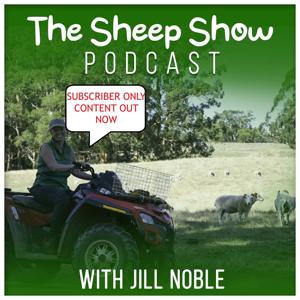
All things ovine, sheep farming and learning more about sheep and shepherding. Learn about breeding animals and being a sheep farmer. Brother and sister team across two hemispheres explore sheep…

56,445 Listeners
436 Listeners
520 Listeners

10,186 Listeners
117 Listeners
10 Listeners
62 Listeners

15,948 Listeners
21 Listeners
36 Listeners
14 Listeners

1,121 Listeners
7 Listeners