The Why? Curve

The Why? Curve

Download on the App Store

The Why? Curve episodes

  • Work in Progress
    In the 1930’s John Maynard Keynes predicted that, with automation and new ways of working, we’d all be working a 15 hour week. Many of us grew up being told that there would be more time for leisure. Yet, here we are, working as hard as ever. Except those who saw the pandemic as an opportunity to leave the workforce altogether. For many, we might be working harder, but spending more time working from home, without the drudgery of the daily commute. So, are we finding a new, more balanced way of working? How are companies adapting to this shift in behaviour? And are some of the fundamental issues of work, like bad management, ever going to shift. Phil and Roger have a barrage of questions for Clare Kelliher, Professor of Work and Organisation at Cranfield School of Management, Cranfield University, and author of several books on the subject, including ‘New Ways of Organising Work’ and ‘Flexible Working In Organisations’

    Hosted on Acast. See acast.com/privacy for more information.

    44 min
  • Hong Kong - Is the Shine Coming Off The Pearl Of The Orient?
    Hong Kong is re-emerging from almost two years of COVID isolation, but can it resume its place an Asia’s leading financial hub? Or has Beijing’s imposition of strict security laws made it little different from China’s other economic dynamos like Shanghai or Shenzhen? It’s taken a massive hit over the last year- GDP down by 3.5% - and suffered a brain-drain as some of its brightest and best have left for freer environments in the UK or Taiwan. Dr Yan-ho Lai of the Dickson Poon School of Law at King’s College London and a co-conveyor of the Hong Kong Studies Association gives Phil and Roger his view of the prospects of his home city 25 years after it was handed back to China.

    Hosted on Acast. See acast.com/privacy for more information.

    33 min
  • Shaken. Can science predict the next big earthquake?

    The earthquakes that rocked southern Turkey and northern Syria seemed to come from nowhere - an instant of catastrophic destruction that killed around 50,000 people, demolished hundreds of thousands of homes and left a legacy of loss and poverty that will last for generations.


    But could it have been avoided? Could we, at least, have known it was coming and been prepared? Or do we just have to shrug and accept the risks of living in quake-prone areas?


    Mark Allen, Professor of Earth Sciences at the University of Durham, talks to Phil and Roger about the challenges of earthquake forecasting and prediction, and the chances of science ever being able to provide accurate warnings in good time of what our planet may be about to do to us.

    Hosted on Acast. See acast.com/privacy for more information.

    40 min
  • Going Wild
    Is it a good idea for big areas of Britain to be returned to nature? The idea of re-wilding is spreading fast - that allowing some land to go back to its wild state is good for the environment, and works economically, too, in a country that has lost so much of its biodiversity and woodland. The case seems to be gaining support in government. But what about the need for food-production and housing? And do we really want to return to some kind of primeval Britain with wolves and lynxes roaming huge forests? Alastair Driver is director of ReWilding Britain, former Head of Conservation for the Environment Agency - he leads Phil and Roger through the case for letting and helping nature rebuild our countryside.

    Hosted on Acast. See acast.com/privacy for more information.

    42 min
  • Whatever happened to COVID?

    Is it over?

    It’s just three years since the global pandemic began to take hold, and now we’re back to a sort-of normal - few wear masks any more, and most have had vaccines and boosters. But people are still being infected and some are dying, while a few have long-term conditions that mean they have to keep isolated. And then there is long COVID, affecting millions with life-changing debilitation. So what’s the current status of this disease, and is it with us forever? Professor Paul Hunter of the University of East Anglia, one of the leading medical voices during the height of the pandemic, tells Phil and Roger where we now are with COVID-19 

    Hosted on Acast. See acast.com/privacy for more information.

    41 min
  • Ukraine - the Endless War?

    Spring is coming to Ukraine along with the prospect of new offensives in the war that began almost a year ago. Kyiv is getting new weapons from the West, and Russia has hundreds of thousands of freshly-trained mobilised reservists as well as a new commander. But will the stalemate end? Will Ukraine be able to push Russia back nearer to its borders, or will Russia regain the initiative and march on Kyiv once more? Will Ukraine’s long night of horror and death come to an end anytime soon? Not very likely, Stefan Wolff, professor of International Security at the University of Birmingham, tells Phil and Roger - this, he says, is a war without an obvious conclusion.


    The Why Curve is brought to you with the help of Wigmore Associates Wealth Management, providing portfolio management services on both a discretionary and advisory basis, together with pension, tax planning and inheritance tax advice to Individuals, Trusts, Pension Schemes, Family Offices, and Charities. Visit https://www.wigmore-associates.co.uk/

    Hosted on Acast. See acast.com/privacy for more information.

    41 min
  • Should the government spend its way out of the doldrums?
    This week we learnt that the government racked up its highest December budget deficit on record. In fact, there have only been a few months which were higher, and all during the throws of the COVID pandemic. So, does the government need to cut back on spending and give the country another dose of austerity? Or can it keep spending. Modern Monetary Theorists say a government with its own sovereign currency can keep spending so long as there are resources that can be put to productive use. Are they right? Frances Coppola is a financial writer, who knows from the inside the workings of banks and governments. She says she is a 90% advocate of MMT. So, is it the right answer for Britain right now?

    Hosted on Acast. See acast.com/privacy for more information.

    43 min
  • Up the workers!
    Picket lines, placards and disruption - strikes have returned to British life and almost-forgotten trade unions are back in the headlines in a way they haven’t been since the 1970s. Membership is up - though still nothing like the levels when union leaders were regular visitors for beer and sandwiches in Number 10. But is the cost of living crisis empowering the unions again, to fight for those, especially in the public sector, who can barely afford the basics? Gregor Gall, Professor of Industrial Relations at Glasgow University and editor of the Scottish Left Review, tells Phil and Roger why organised labour is back on the scene of UK politics

    Hosted on Acast. See acast.com/privacy for more information.

    43 min
  • Conservative Blues
    Is the party over? After 13 years in power, are the Conservatives looking at more than just electoral failure sometime between now and 2025? Has something fundamental shifted in UK politics post-Brexit and post-COVID? Are the Tories looking at an existential crisis as their support base shrinks or dies off? Paul Whiteley, Emeritus Professor at Essex University’s Department of Government has been crunching 70 years of polling data and he shares it with Phil and Roger. It won’t be happy listening for Number 10 

    Hosted on Acast. See acast.com/privacy for more information.

    41 min
  • Cyber War - Lost In Action?
    Whatever happened to cyber-wars? Wasn’t the future of fighting supposed to be keyboard warriors and hacks of government systems? Yet, in Europe’s first major war since 1945, we’re back to trenches and tanks, missiles and mines. So was all the talk of online offensives overblown? Is it still hardware and flying metal that rules the battlefield? Ciaran Martin was the first CEO of the UK’s National Cyber Security Centre, now professor at Oxford University’s Blavatnik School of government - he guides Phil and Roger through what computers can and can’t yet do in modern warfare.

    Hosted on Acast. See acast.com/privacy for more information.

    39 min

About The Why? Curve

From the publisher's feed

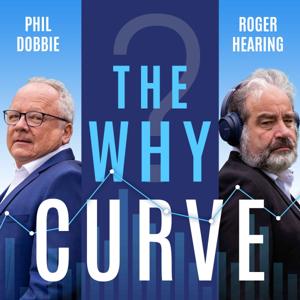
Each week Phil Dobbie and Roger Hearing get to grips with one issue that impacts our lives. It could be economic, social, technological or geopolitical. Whatever the subject, they'll talk to the…

More shows like The Why? Curve

Economist Podcasts by The Economist

Economist Podcasts

4,119 Listeners

More or Less by BBC Radio 4

More or Less

869 Listeners

The Politics Show by The New Statesman

The Politics Show

126 Listeners

Novara Media by Novara Media

Novara Media

168 Listeners

Today in Focus by The Guardian

Today in Focus

968 Listeners

The Blindboy Podcast by Blindboyboatclub

The Blindboy Podcast

1,803 Listeners

Debunking Economics - the podcast by Steve Keen & Phil Dobbie

Debunking Economics - the podcast

40 Listeners

Americast by BBC News

Americast

763 Listeners

Ones and Tooze by Foreign  Policy

Ones and Tooze

359 Listeners

The Rest Is Politics by Goalhanger

The Rest Is Politics

3,101 Listeners

Empire: World History by Goalhanger

Empire: World History

2,417 Listeners

The Rest Is Money by Goalhanger

The Rest Is Money

157 Listeners

The Rest Is Politics: US by Goalhanger

The Rest Is Politics: US

2,403 Listeners

The Economics Show with Soumaya Keynes by Financial Times

The Economics Show with Soumaya Keynes

137 Listeners

The Rest Is Classified by Goalhanger

The Rest Is Classified

1,076 Listeners