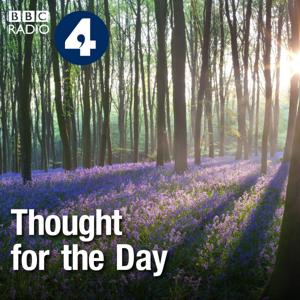
Thought for the Day

Thought for the Day

By BBC Radio 4Religion & Spirituality
Download on the App Store
  • Favorites

    42

    Followers

  • Typical duration

    3 min

    per episode

Based on Podcast App listening data

Thought for the Day episodes

  • Canon Angela Tilby

    Good morning. If you’ve ever seen the musical ‘Godspell’ – and yes, it’s still in the repertoire for colleges and theatre companies round the world – you’ll remember the catchy opening chorus: ‘Pre…ee, pare ye, the way of the Lord…’ – I’m tempted but I’m not going to sing it – the point of the chorus is to accompany the arrival of John the Baptist, the herald, of Jesus.

    Today, the 24th June, the Church celebrates the birth of this extraordinary figure of Jewish history, who appears not only in the Gospels but in the writings of the first century Jewish historian, Josephus. John’s birth is traditionally the 24th June, 6 months before Christmas, and it also comes just after the Summer Solstice – and that has symbolic meaning too, because John reportedly said of Jesus Christ. ‘He must increase but I must decrease’. However bright the sun is in today’s sky and however long the day, we’re on the way down to long nights and shorter days. John the Baptist is known as the forerunner, the one who, as the chorus insists, prepared the way of the Lord. Yet he did not see his hopes fulfilled, at least not in the way he expected. He was arrested by the local puppet King, Herod Antipas, and beheaded in prison in a macabre episode when Herod’s niece, Salome, danced so fetchingly before Herod that he offered her any reward she would like – and she asked for the prophet’s head on a platter. Yuk. Oscar Wilde wrote a one-act play about it, and I remember playing Salome’s evil mother who had prompted the request.
    So John the forerunner, the herald, ended up disgraced, confused, betrayed – and was never quite sure whether Jesus was the one whose coming he had prophesied or whether it would turn out to be someone else.
    John’s story makes me realise how little we understand the significance of our own lives. We’re all part of a stream of history, we come and go, but the stream goes on. There’s so much in society that tells us we can be who we like and achieve what we want, that our sole purpose is to maximise our own significance. The story of John comes as a corrective. We are not Messiahs, World Kings, or even as one world leader puts it, ‘Very Stable Geniuses’. Yet we all have some capacity for discernment. We can practise truthfulness and generosity and be humble before God and one another. What comes after us we cannot know but all of us we can hope and pray the days ahead will bring flourishing and peace to ourselves and our overheating planet.

    3 min
  • Chine McDonald

    Good morning,

    There’s much discussion over flags and marches and what it means to be British at the moment. This has meant the legitimate concerns of some have led to my own legitimate concerns for my family’s safety. As an immigrant and a visible ethnic minority in the town in which I live, I can feel a sense of dis-ease and fear about whether or not I’m welcome in the nation which I have called home my whole life.
    It’s within this climate of hyper-vigilance that I boarded a local bus and braced myself for some racist words from one particular man – someone I had judged based on the colour of his skin. To me, he looked like the type of person who might not like me. I thought he might shout some abuse, or tell me to go back to where I came from.
    Instead he showed me kindness. He held my son’s buggy for me as I struggled with mine and my kids’ belongings, giving up his seat so we could sit down. I could have wept at the simple humanity of it. And the shame of me pre-emptively judging another based on a perceived difference.
    All around us we see evidence that our society is fractured and fragmented and polarised. The horror of the scenes in Northern Ireland, and the sadness as we remember MP Jo Cox’s murder 10 years ago this week.
    We’re told time and again that we have more in common than what divides us. But I wonder whether this suggests we need to find our commonality before feeling a shared humanity. Maybe it’s recognising our difference and choosing decency, kindness, and even love despite those differences that we should value. The Christian tradition can help us here in the example of the early Church – people from many different backgrounds and cultural and religious traditions – came together, sharing everything they had, not because they were the same, but because of a commonality found outside their individual circumstances and characteristics. Their differences were the point.
    This week, I attended the Sandford St Martin awards honouring the best in religious broadcasting, where a special award went to the BBC’s Pilgrimage. The show takes well-known figures in British life with different beliefs – the devoutly religious, the agnostic, and the vehemently atheist – on a journey towards sacred sites including Santiago de Compostela, Holy Island and the Vatican. Perhaps the show’s beauty lies not in the pilgrims’ sameness, but in their difference. The commonality is not in their beliefs, but in their shared purpose, getting through a gruelling journey; spiritual and personal transformation taking place along the way.
    I find this a beautiful metaphor for this moment in which we find ourselves - One which might help us to meet the challenges ahead of us, where we might see our differences, and choose kindness and togetherness, anyway.

    4 min
  • Mona Siddiqui

    The headline simply says: ‘All I have left is a burnt bag.’ These are the words of a parent in a recent Sky News investigation. The report has identified the faces of most of the children and teachers who were killed in Iran when a US missile struck a primary school in Minab at the start of the US-Israel war in Iran. At the time, the world reacted with shock, leaders made statements, but then the cameras moved on, and another tragedy replaced the last. That these children never returned home was a reality lost in the politics of war.

    As we hopefully reach an agreement to end the conflict this week, the photos of these school children are a poignant reminder that while deaths are reported as numbers in the news headlines, behind every face is a name, behind every name is a family and behind every family is a world that changed forever when that child was killed.
    Whether it’s news of a school shooting in America, children killed in war and conflict or the thousands dying from the slow tragedy of famine, I sometimes wonder whether too often children’s deaths have become headlines we just ignore or scroll past – they are over there, far away, someone else’s problem. Because we live in a time where tragedy can appear on our screens, compete for attention, and disappear within hours.
    But I think that if religious faith means anything it demands that we ask ourselves what happens to our own humanity when another person’s suffering no longer moves us. Faith shouldn’t make us complacent; it should make us care. If as Islamic thought tells us children are an amanah, a trust from God, the moral weight of this trust is that it can be broken not only by violence but also by silence. As adults, we don’t own their future but we are responsible for protecting it. Seeing children as evidence of hope, the Indian poet and writer Rabindranath Tagore once said: ‘Every child comes with the message that God is not yet discouraged of humanity.’
    Perhaps that’s the hope we can all hold onto, that however terrible war is, we don’t reduce or dismiss the deaths of children to collateral damage. Good journalism can’t explain everything but it can refuse to let everything be forgotten. And yes, at a time when so much of the news media is contested, this story shows us that the world depends on journalists to turn distance into attention and hopefully attention, at its best, into conscience.

    3 min

About Thought for the Day

From the publisher's feed

Reflections from a faith perspective on issues and people in the news.

Best of Thought for the Day

Ranked by our users in the last 21 days

More shows like Thought for the Day

Global News Podcast by BBC World Service

Global News Podcast

7,570 Listeners

From Our Own Correspondent by BBC Radio 4

From Our Own Correspondent

372 Listeners

More or Less by BBC Radio 4

More or Less

870 Listeners

Newshour by BBC World Service

Newshour

1,045 Listeners

The Reith Lectures by BBC Radio 4

The Reith Lectures

155 Listeners

In Our Time by BBC Radio 4

In Our Time

5,519 Listeners

The Documentary Podcast by BBC World Service

The Documentary Podcast

1,807 Listeners

In Our Time: History by BBC Radio 4

In Our Time: History

1,873 Listeners

6 Minute English by BBC Radio

6 Minute English

1,799 Listeners

Learning English Conversations by BBC Radio

Learning English Conversations

1,025 Listeners

The Infinite Monkey Cage by BBC Radio 4

The Infinite Monkey Cage

2,003 Listeners

Desert Island Discs by BBC Radio 4

Desert Island Discs

1,977 Listeners

Great Lives by BBC Radio 4

Great Lives

489 Listeners

Profile by BBC Radio 4

Profile

111 Listeners

Last Word by BBC Radio 4

Last Word

47 Listeners

The Week in Westminster by BBC Radio 4

The Week in Westminster

27 Listeners

BBC Inside Science by BBC Radio 4

BBC Inside Science

408 Listeners

Thinking Allowed by BBC Radio 4

Thinking Allowed

296 Listeners

Moral Maze by BBC Radio 4

Moral Maze

59 Listeners

The Audio Long Read by The Guardian

The Audio Long Read

834 Listeners

Start the Week by BBC Radio 4

Start the Week

161 Listeners

The Briefing Room by BBC Radio 4

The Briefing Room

68 Listeners

Political Thinking with Nick Robinson by BBC Radio 4

Political Thinking with Nick Robinson

106 Listeners

You're Dead to Me by BBC Radio 4

You're Dead to Me

3,223 Listeners

The Bomb by BBC World Service

The Bomb

1,006 Listeners