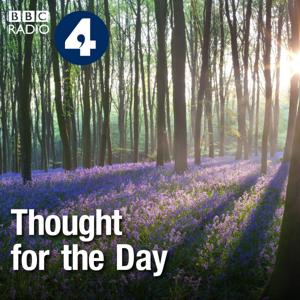
Thought for the Day

Thought for the Day

By BBC Radio 4Religion & Spirituality
Download on the App Store
  • Favorites

    42

    Followers

  • Typical duration

    3 min

    per episode

Based on Podcast App listening data

Thought for the Day episodes

  • Michael Hurley

    Good morning. “Do not be so open-minded that your brains fall out.” I was reminded of that quip from G. K. Chesterton last week, when I visited The Old Ferryboat Inn in Cambridgeshire, which not only claims to be the oldest pub in England (serving ale since 560AD, apparently), but also to have a resident ghost.

    A young woman took her life for love almost a thousand years ago and local legend has it she’s haunted the place ever since, appearing each year on the anniversary of her death: the 17th March. That date also happens to be St Patrick’s Day, which is perhaps not the ideal occasion for sober eyewitness testimony. But it’s easy to be sceptical….
    According to a recent National Folklore Survey, more than a third of people in England believe in ghosts, and many like the idea of them too. “A haunted house at the top of your street is fantastic,” said Caroline Gibson from Pontefract in Yorkshire, speaking to the BBC about a poltergeist who is currently trending on social media, after featuring on the paranormal podcast, Uncanny.
    The occult does not sit easily with mainstream Christianity. The Church warns against séances, spirit-hunting and attempts to conjure the dead. Yet in an age inclined to explain everything materially, Christianity insists that the world does indeed have a spiritual dimension.
    A problem remains, however, of how to discern between spiritual reality versus superstition — or for that matter, between good versus evil spiritual forces.
    “Do not be so open-minded that your brains fall out” doesn’t really help us with that discernment, but Chesterton, himself a Christian, followed up with another one-liner that might be more useful. “The object of opening the mind, as of opening the mouth, is to shut it again on something solid.”
    That gets us closer. Open the mind, just not endlessly, to no purpose: open it up to close it again.
    The risk of being open-minded is that you may sometimes look foolish or naïve. But there is risk too in being so determined never to be gulled, or seemingly unscientific, that you refuse in advance the richness that comes with leading a spiritual life.
    Ghost stories challenge us to believe that there’s more to the world than what we can understand in purely physical terms. Christianity goes further still, teaching that we ourselves are more than merely physical beings.
    If a haunted house in your street can be called fantastic, then why shouldn’t a church be called the same – in both meanings of the word? Fantastic in the modern sense of being great, but also in the older sense of being extra-ordinary. A place for open minds to shut down on something solid.

    4 min
  • The Rev Canon Dr Jennifer Smith

    Good morning.

    As the sun finally begins to coax flowers into bloom, the Chelsea Flower Show will open its gates today. The Royal Horticultural Society’s annual event sees organisations create beautiful planted spaces, which inspire and educate visitors. With our news headlines full of unremitting contempt and calamity, millions of us will tune into coverage of Chelsea this week for relief. I’d like to think this is more than just a comforting distraction.

    Christian writer CS Lewis wrote about his vision of hell in the novella ‘the great divorce’. Hell was a place of continual twilight where people moved further and further apart into infinite space, driven by mutual suspicion and a sense of time ticking down. Paradise, by contrast was a place of colour, fruitfulness, and sunshine – open to anyone bold enough to stay. In paradise, people were unafraid of each other or the future. They sought out newcomers, working to convince them to remain.

    The show gardens at Chelsea may be sanctuaries of beauty, but they are also about shared spaces and living well together. Many, like the Trussell ‘together’ garden, are inspired specifically by the way communities deal with hardship – the Trussel Trust’s foodbanks tackle food poverty. Like Lewis’ paradise, communal gardens like this one combat the notion that safety and solace can only be had by building walls and retreating from the world.

    John Wesley, the founder of Methodism, wrote a collection of health remedies based on what people could grow or source themselves. Titled ‘Primitive Physick’ and published in 1747 it would run to 23 editions during his life. Although his remedies were of their day, his commitment to people’s access to healthcare and use of what was readily available still bears weight. Today, the rooftop garden of the national Methodist offices in London is planted with herbs and flowers used in Primitive Physick, recognising the importance of gardens to our collective mental and physical well-being.

    A reality of life in Britain today is that access to outdoor space is not equal: many do not have gardens. A Christian vision for good community still resists the notion that beautiful outdoor spaces are only the preserve of private wealth.

    After the show, all of the Chelsea gardens will find their way out into communities around the country – plants will go to balconies, windowsills and neglected urban spaces, gardens to hospices, schools, and the verges of motorways. They will join many other community gardens schemes, allowing even those of us who live surrounded by pavement, to put our hands in soil and see something grow. These gardens are places of retreat, yes: but also places of truth telling about the quiet work of living peacefully together.

    3 min
  • Martin Wroe

    Good morning. Reed Hoffman, one of the founders of Linked In, tells us that typing is over and voicepilling is here.

    This is the word he has coined to capture the way, he says, we are set to bypass keyboards.

    After the quill the pen, then the typewriter, the text, the voice note… but in voicepilling entire articles, essays or books - everything actually - is spoken directly to the machine for production. Hands-free.

    Is voicepilling a word that will stick? Sounds unlikely but who knows? New words seem to be invented more rapidly than ever but then language is always being born again.

    At an open mic event I was at this week one poet used the beautiful expression ‘sonder’ - the kind of neglected word from Chaucer or Shakespeare which etymologists and crossword compilers love to rediscover.

    Sonder is defined as one’s realization that each person you pass by ‘is the main character in their own story, in which you are just an extra.’

    The definition comes from John Koenig in his Dictionary of Obscure Sorrows, a collection of words he created to capture emotions that he says, ‘we feel but don’t have the words too express’.

    Some words or phrases disappear, some morph into new meaning… while others stick around for ever.

    Few writers have had more stickability than William Tyndale. The 500th anniversary of his English New Testament is currently being celebrated in an exhibition at the British Library and, from next month, at St Paul’s Cathedral.

    Tyndale believed it shouldn’t only be priests who could access the Bible, but that everyone should hear it in everyday English.

    His translation, published in 1526, was so popular that when King James commissioned his 'Authorized Version’, nearly a century later, the royal translation team ripped ninety percent of their text straight out of Tyndale.

    His phrases continue to haunt the language: 'from strength to strength’; ‘for better or worse’; ‘lead us not into temptation but deliver us from evil’; ‘salt of the earth’ and ‘fight the good fight’.

    Tyndale was after a poetic language understood by ordinary people and was so successful that, as someone said, ‘No Tyndale, No Shakespeare’.

    Or as playwright David Edgar put it: ‘No Tyndale, No Kindle’.

    But in democratizing religion, in translating the divine into the human, he was branded the ‘most dangerous man in England’ and burned at the stake.

    The political powers could see, to use another of his phrases, ‘the writing on the wall’.

    Words are dangerous.

    Once you can speak the divine in your own tongue then you can bring god down from heaven onto earth and decide for yourself what your religion means for your life.

    You can, as Tyndale wrote, ‘let there be light'

    3 min
  • Catherine Pepinster

    Sometimes, digging into the origins of a word can help with real insights into a contemporary issue.

    Take the meaning of the word person. The ancient Greeks used the word for face – prosopon – to mean a person, while in Latin, the word persona, from which we get the English person, owes its origins to sonare, which means to sound. So ideas about a person in these ancient languages focused on what can be seen and heard – the face and the voice. They’re integral to how people connect with one another.
    This importance of the person came to mind when I read reports this week that the revamped NHS app, sold to the public as providing patients with a doctor in their pocket by digitising services, has had a distressing unforeseen drawback. Some patients, according to these reports, discovered test results for serious illnesses, such as cancer, by them being uploaded on the app. The NHS has said it has reissued guidance to stop this happening, confirming the importance of the soothing voice of a doctor breaking bad news. As one patient who says this happened to them, put it: “Seeing someone face to face is so important”.
    Technology can speed life up and be super-efficient, but there are clearly alienating, impersonal drawbacks too. When Pope Leo was elected a year ago, he said he was going to make artificial intelligence a key priority of his work. He’s about to release his first encyclical, or teaching document on AI, focusing on the importance of human dignity as the world undergoes such profound technological change. He’s also released a message on AI for the Catholic Church’s annual World Communications Day, being marked this Sunday. It warns AI can erode people’s ability to think analytically and creatively.
    Not that Pope Leo is a Luddite opposed to change. He’s comfortable with technology. One of his brothers told a reporter that when he got locked out of his computer recently, he phoned the Pope who quickly told him what to do to get back in.
    But Leo’s concern is that if AI takes over areas of life where human interaction used to be essential, it damages the deepest levels of human communication.
    People of faith, like Pope Leo, believe that faces and voices are sacred because God created humanity in his image and likeness. Back in the fourth century, St Gregory of Nyssa said that preserving human faces and voices means preserving an indelible reflection of divine love. It’s as true today as it was then. For a patient facing bad news, a gentle voice and a consoling look can mean the difference between what you can bear and what you cannot.

    4 min
  • Chine McDonald

    Good morning,

    In Monday’s speech, Prime Minister Sir Keir Starmer used the word ‘hope’ 14 times. He said the country would see hope reflected in government policy, and that “people need hope.”
    Today, faith groups and civil society organisations have launched a week-long initiative called A Million Acts of Hope – a nationwide invitation to celebrate the everyday acts of kindness, care and connection happening across the UK to combat the growing sense of division and polarisation so many feel.
    Many of us in Britain today can’t help but sense a growing hope-lessness.
    Perhaps it’s long been there and it’s the ever-present drum of social media and a 24-hour news cycle that have made it feel like it’s taken root.
    Politicians of all parties have long employed the language of hope in their speeches. It’s an appeal to the very human instinct to believe there’s a future state or condition that will be better in some way.
    But as a Christian, I believe hope is something much deeper than optimism, more than a sometimes blinkered decision to always look on the bright side. When in the book of Jeremiah God speaks of giving “a hope and a future”, it’s a profound promise of what’s to come, regardless of current circumstances.
    Hope itself is also active and not static. As Emily Dickinson described in her 1861 poem, it’s like a bird, a thing with feathers, that “perches in the soul” and “never stops at all”.
    As a nation – and as a world – we’ve been through so much in recent years: the worsening climate crisis, a pandemic, economic instability and turbulent politics. It feels like the nation can’t catch a break, and that we are breaking apart.
    But by engaging in these million acts of hope, those participating are offering an alternative narrative.
    As American episcopal priest Fleming Rutledge said this week, stories of acts of kindness across political divides help foster hope. For her, such illustrations “arouse feelings of neighbourliness where there might otherwise be only estrangement”. The sense of us all being in this together needs to be supported “not with morality lectures but with examples”. Don’t tell me! Show me!”
    There’s an active selflessness to these hopeful acts of kindness – the millions we see and experience every day. A reminder that we as a nation are capable of acting beyond our own self-interest to look at the needs of those around us, to participate in hope-making.
    In these turbulent times, I find hope when I encounter others who show profound kindness. I feel most hopeful when those acts come from a group I’ve been told are ‘other’ to me in some way.
    None of us should put our hope in politics alone, but perhaps each of us might see the face of God in the million small kindnesses of others that together point to a hope that’s much bigger, and much more profound.

    4 min
  • The Rev Dr Michael Banner

    Good morning.

    A German holiday maker has successfully sued his tour operator alleging that he had spent 20 minutes every morning trying, without success, to find sun loungers by the pool. He was on the case at 6 a.m. but the loungers were already covered in towels, though they often remained unoccupied through the day whilst he and his family lay on the ground. The Court awarded him damages. Another tourist commenting on this story gleefully recalls an alternative solution to the problem: 'it soon stopped when some lads were going down in the middle of the night and throwing all the towels into the pool.' But our more law abiding litigant hopes that the fear of legal action will spur tour operators and hotels to devise fair and rational allocation systems for these highly contested spaces.
    As far as I know, Thomas Hobbes never took a package holiday, but having lived through the turmoil of the English civil war and its aftermath, he would not have been surprised by stories of so called 'sunbed wars': 'during the time men live without a common power to keep them all in awe' so he tells us in his great work Leviathan, 'they are in that condition called war'. Hobbes' father was a vicar, and his relationship to Christianity is complicated, as is perhaps not uncommon in such circumstances. But Hobbes' views are not so different from Augustine's, who was in the habit of noting that just as divine history begins with the story of Cain killing Abel, so world history begins with the story of Romulus killing Remus. For Augustine, it is 'every man against every man' as Hobbes puts it, and not just poolside.
    I know nothing about the personal beliefs of our German litigant, but I think he is a bit of a hero for spurning two obvious but unhelpful responses to this gloomy diagnosis of the human condition. One is to take the law into your own hands - throwing the towels in the pool - which could end rather badly of course. The other is just to grumble - and who doesn't enjoy a good grumble?
    Of all the things in the world which are unfairly and irrationally distributed, sun loungers are by no means the most significant. Houses lie empty, while children sleep on the streets. Food goes to waste while there is hunger. Medicines expire on shelves, and diseases go untreated. Christians have never needed to be told that humans can be deeply selfish, but everywhere the faith is truly alive there have been dreamers and prophets, from St Francis to Martin Luther King, who have contended that the world doesn't have to be determined by our flawed natures, even if we need to reckon with their existence and character. Who knows whether the sunbed wars will come to an end, but Mr Eggert - let's give him his name and due credit – by pushing the tour operators and hotels into action has given us hope for bloodless revolutions.

    3 min
  • The Right Reverend Dr David Walker

    Good morning.

    Ocean transport has rarely left our news headlines over these last few weeks. The ongoing efforts of the USA and Iran to block or open up the Strait of Hormuz now being joined by the plight of passengers on a virus struck cruise ship, finally docked in Tenerife.

    It’s tempting then, to think of the world’s oceans primarily as means of transporting travellers and goods. Yet, as ocean naturalists, from Rachel Carson to David Attenborough, have repeatedly reminded us, the seas are home to a vast array of amazing species.

    The wonders of our oceans are however, now at significant risk from two direct consequences of human activity, climate change and pollution. Indeed, it’s widely argued by scientists that, for the seas to recover, a minimum of 30% of the world’s oceans will need to be protected by 2030.

    The challenge, as so often with regard to environmental damage, is our human reluctance to take short term sacrifices for longer term gain. Or else we so frame the actions required by way of sacrifice that they fall disproportionately on the poorest among our communities and nations. It is here that two core aspects of my own faith come together.

    First, as Psalm 95 in the Hebrew Scriptures asserts, “The sea is his, and he made it”. That tells me, our human accountability to God extends to our treatment of the oceans just as much as it does the dry land.

    Second, those of us with greater wealth or assets are expected to shoulder the heavier burden. As Jesus says in Luke 12: 48, “From everyone to whom much has been given, much will be required; and from the one to whom much has been entrusted, even more will be demanded.”

    Governments have a vital part to play. The High Seas Treaty, which came into force earlier this year, and the UK Parliament has now legislated to ratify, affords opportunity for safeguarding large swathes of the oceans. The Sargasso Sea, surrounding the Island of Bermuda, and home to a rich and diverse range of species, is a prime candidate for environmental protection measures that avoid destroying the livelihoods of local fishing communities

    I’m grateful too for the work of campaigning organisations, such as Greenpeace, whose ship Witness, I was privileged to visit, with other parliamentarians, recently. Along with sister vessels, it monitors biodiversity and plastic pollution in sensitive areas, exposing behaviours that jeopardise the seas and challenging us all to do better.

    Together, treaties and campaigners offer me hope that we can yet treasure the world’s oceans for their true value, a value far far beyond their immediate usefulness as means to transport the world’s supplies of oil. But, as Jesus stated so bluntly, our own individual practices matter too.

    4 min

About Thought for the Day

From the publisher's feed

Reflections from a faith perspective on issues and people in the news.

Best of Thought for the Day

Ranked by our users in the last 21 days

More shows like Thought for the Day

Global News Podcast by BBC World Service

Global News Podcast

7,570 Listeners

From Our Own Correspondent by BBC Radio 4

From Our Own Correspondent

372 Listeners

More or Less by BBC Radio 4

More or Less

870 Listeners

Newshour by BBC World Service

Newshour

1,045 Listeners

The Reith Lectures by BBC Radio 4

The Reith Lectures

155 Listeners

In Our Time by BBC Radio 4

In Our Time

5,519 Listeners

The Documentary Podcast by BBC World Service

The Documentary Podcast

1,807 Listeners

In Our Time: History by BBC Radio 4

In Our Time: History

1,873 Listeners

6 Minute English by BBC Radio

6 Minute English

1,799 Listeners

Learning English Conversations by BBC Radio

Learning English Conversations

1,025 Listeners

The Infinite Monkey Cage by BBC Radio 4

The Infinite Monkey Cage

2,003 Listeners

Desert Island Discs by BBC Radio 4

Desert Island Discs

1,977 Listeners

Great Lives by BBC Radio 4

Great Lives

489 Listeners

Profile by BBC Radio 4

Profile

111 Listeners

Last Word by BBC Radio 4

Last Word

47 Listeners

The Week in Westminster by BBC Radio 4

The Week in Westminster

27 Listeners

BBC Inside Science by BBC Radio 4

BBC Inside Science

408 Listeners

Thinking Allowed by BBC Radio 4

Thinking Allowed

296 Listeners

Moral Maze by BBC Radio 4

Moral Maze

59 Listeners

The Audio Long Read by The Guardian

The Audio Long Read

834 Listeners

Start the Week by BBC Radio 4

Start the Week

161 Listeners

The Briefing Room by BBC Radio 4

The Briefing Room

68 Listeners

Political Thinking with Nick Robinson by BBC Radio 4

Political Thinking with Nick Robinson

106 Listeners

You're Dead to Me by BBC Radio 4

You're Dead to Me

3,223 Listeners

The Bomb by BBC World Service

The Bomb

1,006 Listeners