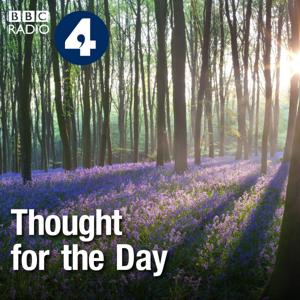
Thought for the Day

Thought for the Day

By BBC Radio 4Religion & Spirituality
Download on the App Store
  • Favorites

    42

    Followers

  • Typical duration

    3 min

    per episode

Based on Podcast App listening data

Thought for the Day episodes

  • Professor Tina Beattie

    Good morning.

    They say that religion and politics don’t mix, but it’s impossible to separate the two when the Pope and the American President have gone head-to-head over the war in Iran. In a social media post, President Trump accused Pope Leo of being weak and advised that he should “focus on being a Great Pope, not a Politician”. Pope Leo responded by insisting that he’s not a politician, but that the message of the Gospel, “‘Blessed are the peacemakers’, is a message that the world needs to hear today”.
    This confrontation has catapulted the Pope onto the front pages of the world’s media, but he’s not the first modern pope to speak out against war. In 2003, when then Cardinal Ratzinger, later Pope Benedict XVI, was asked to comment on the Iraq war, he said that “There were not sufficient reasons to unleash a war against Iraq.” He went on to ask “if it is still licit to admit the very existence of a ‘just war’.”
    St Augustine gave a Christian interpretation to the idea of the just war in the early 5th century. He argued that, terrible though war always is, it is sometimes necessary to defend the innocent and preserve peace. However, it must seek the future well-being of the enemy, and be free from the lust for power or desire to dominate.
    These ideas were developed by St Thomas Aquinas in the 13th century, and they continued to shape western politics and international law long after Christianity ceased to be a major political influence. However ineffectual it might sometimes have become in the heat of battle, just war theory provided a restraining influence on the waging of war, especially with regard to the need to avoid the intentional targeting of non-combatants. Today, the nature of modern weapons and the bombing of densely populated areas means that civilian casualties, including children, usually far outnumber military deaths.
    This is the context in which the Catholic Church’s opposition to war must be interpreted. Pope Leo is continuing a tradition set by all modern popes since the 1960s. In his Palm Sunday address, he quoted the prophet Isaiah when he said that Jesus “does not listen to the prayers of those who wage war, but rejects them, saying: ‘Even though you make many prayers, I will not listen: your hands are full of blood’.” This is religious language, but it holds politicians accountable for shedding innocent blood. How could it do otherwise, when Christians worship a crucified God?

    3 min
  • The Right Reverend Dr David Walker

    Good Morning.

    Resilience has been the watchword of the last few days, politicians across the parties choosing to follow up the Prime Minister’s recent focus on the idea. For some, the key dilemma is military resilience - how should Britain defend itself in an age when the USA is no longer a certain ally? For others, the question is energy resilience, shielding ourselves from the volatility of world oil prices. Both are important questions. But for me there is a deeper dimension to this word of the moment, one that requires urgent attention. Put simply, how do nations, including the UK, shore up, and indeed improve, their moral resilience?
    Moral resilience is the willingness and ability to hold on to core ethical values under pressure. In his passage on love, often read at weddings, St Paul enumerates some of the qualities that I see lying at its heart: patience; kindness; lack of rudeness, boastfulness, envy or arrogance; delighting in truth. Sadly, these are qualities I and many others now find lacking, not least at international level. Few, if any, moral constraints appear to inhibit the actions of those who have both unrestricted power and the willingness to use it. Meanwhile, within nations, the so-called Overton window, describing what ideas and opinions are considered acceptable in society, has shifted dramatically towards anger, hatred and abuse.
    Yet, despite institutions of all types falling short, there are examples to the contrary. I saw moral resilience vividly on a recent visit to Manila with the global Anglican Mission agency I chair. Over the last 125 or so years, what began as a small working people’s church has not only survived but thrived. At the same time, it has continued to speak up boldly against the abuse of human rights so endemic among the Philippines ruling classes. Bishops have been murdered, church workers imprisoned without trial, but the Iglesia Filipina Independiente has not only remained resilient in the face of all its trials but has grown to a six million strong denomination.
    From its motto, “Love our God and love our country”, emerges a theology that is fiercely inclusive of sexual and gender identities, alongside roundly rejecting the racial and social hierarchies it was founded to resist. Its social projects are among some of the most inspiring I have seen on my travels. If it sounds like Christian Nationalism, then it springs from a very different foundation from what those words often describe elsewhere. Faith is not the excuse to reject and demean others, but rather to embrace and affirm them. For me, this is what love of Christ and love of one’s country should be about. Well beyond churchgoers, this is the moral resilience that I believe Britain as a nation now needs more than ever.

    4 min
  • Mark Vernon

    Good morning.

    The strike by resident doctors highlights the severe tensions faced by the National Health Service. The tragedy of the dispute, and any disruption experienced by patients, is that all sides involved no doubt very much want health services to improve. So as resolution is sought can this also be a moment to ask again an increasingly pressing question. What exactly is health?
    The issue often came to the fore when I worked in the NHS. My role was as a psychotherapist in a psychiatric hospital. We worked with older adults who had often suffered for not just years but decades. Their pain was substantial and entrenched. What could be offered to such folk? What did we mental health professionals think we were doing?
    There were no easy answers. Suffering is hard. But a light might flicker in the darkness when a patient felt heard. They realised, even momentarily, that they were with someone who didn’t have any immediate remedy but did appreciate the depth of their torment.
    Many doctors will know such moments. There is a glimpse of connection that is potentially healing and powerful. But why?
    The answer provides a clue to a notion of health that is not only about an absence of symptoms, valuable though that most certainly is. With a patient who feels heard, you together enter a field of existence that is wider than the previously isolated, suffering soul knew was possible. A dimension of life, not determined by having solutions, is discovered as a release or expansion.
    The word “health” itself recognises the possibility as it comes from the old English for “whole”. Believers in God will recognise that wholeness as an intuition: our existence as individuals is actually a sharing in the existence of God. We are as many reflections of the one divine light.
    A shift of perspective, a kind of conversion, is required for this transcendent awareness to become a steady part of life. The difference with this fuller notion of health or wholeness is that you don’t privately possess it, let alone control it, but rather it holds you and you might collaborate with it more fully.
    The NHS will likely continue to struggle with the demands it faces, even as - and perhaps because - remarkable improvements in treatments will continue, too. In this context, a cultural and spiritual conversation about the wider nature of health is crucial. Like the patient who feels better because they are heard, a more expansive vision of what health entails, and indeed what it is to live well, will alleviate stresses on us all.

    4 min
  • The Rev Canon Dr Jennifer Smith

    Along with joy, there’s a lot of fear in the days after Easter – no less for Jesus’ disciples than in our news today. It has made me think about doors. The door behind which Jesus’ disciples hid after his death, the heavy stone that blocked the tomb where he’d been laid, the doors today that keep people out, or in, or protect property or borders. And symbolic doors – to peace or security – that still feel so definitely closed.

    This morning the metal-shuttered door at the Whitechapel Mission in the east end of London opened as it always does at 6 AM – exactly on time so guests can count on it. Breakfast service will start in a few minutes at 8, and it’s likely over 200 will eat a full English, complete with mushrooms and bacon, sausage, egg and hashbrowns. Today these homeless guests will be served by wonderful volunteers who left their own doors well before dawn.
    Having a key to open my front door and a safe place to live is a real blessing – I like being safe. And yet I think about the women who went up to Jesus’ tomb to anoint his body on Easter morning: wisdom would say stay home hiding with the men. And having left the safety provided by one door, they didn’t know how they’d get through the next. The Gospel records their conversation: who would move the stone to open the tomb ? Yet, they went.
    We might think of Jesus’ resurrection as a miracle, but it was actually just what he said would happen, even if no one had understood. God will redeem the world. However these women going out while the danger was still present - that feels to me a miracle no less real, hiding in plain sight.
    And it gives me hope. Easter is not about things being safe, but about things being different. Doors open where we do not expect. The power to do miracles given to people forgotten by headlines – women and men who go out in faith and change history.
    On Saturday I heard the BBC’s Lyse Doucet speculate about one possible turn of events in Iran: ‘…God help the world,’ she said with real emphasis. …God help the world indeed … because, I fear, nothing else has.’
    Maybe, this Monday, the beginnings of the miracles we hope for are in our power already. Long term solutions to intractable problems – they are not cost free. But in the end real safety doesn’t come from bigger doors or stronger locks.

    3 min

About Thought for the Day

From the publisher's feed

Reflections from a faith perspective on issues and people in the news.

Best of Thought for the Day

Ranked by our users in the last 21 days

More shows like Thought for the Day

Global News Podcast by BBC World Service

Global News Podcast

7,570 Listeners

From Our Own Correspondent by BBC Radio 4

From Our Own Correspondent

372 Listeners

More or Less by BBC Radio 4

More or Less

870 Listeners

Newshour by BBC World Service

Newshour

1,045 Listeners

The Reith Lectures by BBC Radio 4

The Reith Lectures

155 Listeners

In Our Time by BBC Radio 4

In Our Time

5,519 Listeners

The Documentary Podcast by BBC World Service

The Documentary Podcast

1,807 Listeners

In Our Time: History by BBC Radio 4

In Our Time: History

1,873 Listeners

6 Minute English by BBC Radio

6 Minute English

1,799 Listeners

Learning English Conversations by BBC Radio

Learning English Conversations

1,025 Listeners

The Infinite Monkey Cage by BBC Radio 4

The Infinite Monkey Cage

2,003 Listeners

Desert Island Discs by BBC Radio 4

Desert Island Discs

1,977 Listeners

Great Lives by BBC Radio 4

Great Lives

489 Listeners

Profile by BBC Radio 4

Profile

111 Listeners

Last Word by BBC Radio 4

Last Word

47 Listeners

The Week in Westminster by BBC Radio 4

The Week in Westminster

27 Listeners

BBC Inside Science by BBC Radio 4

BBC Inside Science

408 Listeners

Thinking Allowed by BBC Radio 4

Thinking Allowed

296 Listeners

Moral Maze by BBC Radio 4

Moral Maze

59 Listeners

The Audio Long Read by The Guardian

The Audio Long Read

834 Listeners

Start the Week by BBC Radio 4

Start the Week

161 Listeners

The Briefing Room by BBC Radio 4

The Briefing Room

68 Listeners

Political Thinking with Nick Robinson by BBC Radio 4

Political Thinking with Nick Robinson

106 Listeners

You're Dead to Me by BBC Radio 4

You're Dead to Me

3,223 Listeners

The Bomb by BBC World Service

The Bomb

1,006 Listeners