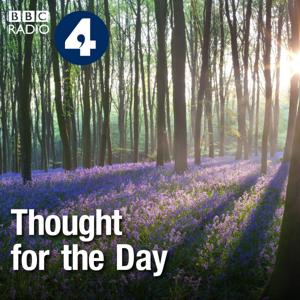
Thought for the Day

Thought for the Day

By BBC Radio 4Religion & Spirituality
Download on the App Store
  • Favorites

    42

    Followers

  • Typical duration

    3 min

    per episode

Based on Podcast App listening data

Thought for the Day episodes

  • The Rev Lucy Winkett

    In an interview on this programme yesterday, the former national security adviser Peter Ricketts; was asked ‘what about that old thing…. Wisdom’? it was in the contemporary context of the war between the US, Israel and Iran. It’s a modern question that echoes the question in the Book of Proverbs: Where can wisdom be found?

    Good question. Difficult question. The search for wisdom today is in the context of the escalation of violence in the Middle East, and in the counting of over 60 active state-based conflicts and wars worldwide, the highest number since (records began in) 1946. And in the context of another escalation; the exponential growth in the capability and reach of artificial intelligence, which scientists are now calling the ‘Intelligence Explosion’ predicted back in the 1960s, when human beings cede control of the growth and development of AI.

    In both of these enormous endeavours, the speed and scale of revolutionary action is disorientating for many populations around the world. And in both the prosecution of global war, and the ceding of the growth of AI to AI itself, the illusion of human control over events is both inaccurate and has the potential to be ultimately destructive for, well, everyone.

    In short: it’s easier to light the spark of AI than to control the spread of its flames. And it’s easier to start a war than to end it.

    It is a question for our time – what is it in human beings that is served by our need for speed and escalation? As a species, we seem to give free reign to these instincts, sometimes useful of course, but also with the capacity to brutalise and crush us. These instincts leave little room for creativity, kindness and selflessness that take more time than we seem to think we have. But the search for wisdom in Scripture is characterised by the taking of time, by a commitment to restraint, self-discipline, and closely linked not so much to the acquisition of more knowledge but a desire to understand.

    Tomorrow, the first woman to be Archbishop of Canterbury will begin her public ministry with prayer, music, silence and the gathering of community in a house of prayer that has stood for 1400 years. In gathering to sing and pray, it might look as if the church is fiddling while Rome is burning. But the ancient liturgies and symbolic actions form a different sort of public statement: that wisdom matters. And that even in the perilous times that we are in, humility and grace point the way to another vision of what it is to be human before God.

    4 min
  • Chine McDonald

    Good morning,

    The words of Jessie Buckley dedicating her Oscar win to ‘the beautiful chaos of a mother’s heart’ have been echoing in my mind throughout this week. She picked up the Best Actress award for playing a grieving mother in Hamnet. The film reimagines the lives of William Shakespeare and his wife Anne Hathaway as they cope with the tragic death of their 11-year-old son.
    This idea of the beautiful chaos of a mother’s heart moves us beyond the saccharine pinks and yellow flowers of Mother’s Day to the reality that motherhood is wild and earth-shattering and terrifying. My goodness can it be joyous, too. But for many mothers, it is all those things – sometimes all at once.
    Sometimes the chaos of a mother’s heart has to deal with the worst things imaginable: the death of a child.
    On Thursday night, I hosted an event in conversation with Gee Walker at Chester Cathedral, exploring black motherhood and grief. Gee’s 18-year-old son Anthony was murdered in a racially aggravated attack while walking near his home in Merseyside 20 years ago.
    In the book by Maggie O’Farrell upon which the film Hamnet is based, are these words: “Never take for granted that your children’s hearts beat, that they sup milk, that they draw breath, that they walk and speak and smile and argue and play. Never forget that they may be gone, snatched from you, in the blink of an eye, borne away from you like thistledown.”
    I had planned to ask Gee Walker at the end of our event what gives her hope, but I couldn’t bring myself to. I resisted the urge to wrap her grief up in a tidy bow, to end on a glib message so we could all go away feeling better.
    This Easter, Christians will celebrate Jesus’s resurrection – the great story at the heart of my faith. But perhaps what many of us also take from Holy Week is that resurrection doesn’t erase the reality of the brutality of Christ’s crucifixion. His mother watching it all at the foot of the cross.
    Gee Walker told me she finds solidarity in “Mamma Mary”, as she describes Jesus’s mother”: a mother who – just like her – experienced the nightmare of watching her son die and not being able to do anything to help, not even be able to hold him. Gee described doing the little that she was able to –while Antony lay dying- holding tightly to his feet while police and paramedics intervened.
    In the months following Anthony’s death, Gee’s family started the Anthony Walker Foundation, raising aspirations of schoolchildren and providing comfort to other grieving families. For her, it’s through this work that Anthony lives on. So too did Mary mother a movement that took her son’s message to the ends of the earth.
    Perhaps the “beautiful chaos of a mother’s heart” is that even when it is broken, it can speak life.

    4 min
  • Rabbi Charley Baginsky

    Good morning.

    When societies argue about definitions, it can sound technical, the sort of debate lawyers or policymakers care about. But definitions are about something deeper. They show what a society is prepared to recognise, and what it refuses to ignore.
    This week the government introduced a non-statutory definition of anti-Muslim hostility. Predictably, the conversation has turned to questions of free speech and its limits.
    Those are important questions. But definitions of prejudice carry another purpose. They tell us whose dignity we are prepared to defend.
    As a rabbi, I hear these debates with particular sensitivity. Jewish history contains long periods when hostility towards Jews was so normal it barely needed a name. The word antisemitism only entered common language in the nineteenth century, though the prejudice itself was far older.
    Naming something does not solve it. But it does change the silence around it.
    I was thinking about that while sharing an Iftar meal during Ramadan. Around the table were Muslims, Jews and others, gathered to break the fast together.
    Among them was Maoz Inon, an Israeli peace activist whose story carries immense grief. On October 7th his parents were killed when Hamas attacked their home in southern Israel.
    Many people in his position might understandably turn inward. Instead Maoz has chosen something more demanding: continuing to work for a shared future between Israelis and Palestinians, insisting humanity must survive even deep violence .What struck me that evening was the atmosphere in the room. Everyone arrived with a strong sense of who they were, Muslim, Jewish, secular. No one was asked to soften their identity in order to sit together.
    In Jewish tradition there is a phrase, b’tzelem Elohim, that every human being is created in the image of God. If every person carries that divine imprint, dignity is not something we negotiate depending on who we agree with. It becomes something we are bound to protect in one another.
    The debate about anti-Muslim hatred is therefore not only about Muslims. It is about the kind of country we are still trying to become.
    A Britain confident enough to protect open debate, but serious enough to recognise when prejudice corrodes our common life.
    Around that Iftar table it felt possible to glimpse that Britain. Not one where difference disappears, but one where faith and identity are brought honestly into the room.
    Because perhaps the real contribution of religion in public life is this: the insistence that dignity is not a limited resource. And that a confident Britain will be built not by setting identities aside, but by bringing the best of them into the same room.

    4 min

About Thought for the Day

From the publisher's feed

Reflections from a faith perspective on issues and people in the news.

Best of Thought for the Day

Ranked by our users in the last 21 days

More shows like Thought for the Day

Global News Podcast by BBC World Service

Global News Podcast

7,570 Listeners

From Our Own Correspondent by BBC Radio 4

From Our Own Correspondent

372 Listeners

More or Less by BBC Radio 4

More or Less

870 Listeners

Newshour by BBC World Service

Newshour

1,045 Listeners

The Reith Lectures by BBC Radio 4

The Reith Lectures

155 Listeners

In Our Time by BBC Radio 4

In Our Time

5,519 Listeners

The Documentary Podcast by BBC World Service

The Documentary Podcast

1,807 Listeners

In Our Time: History by BBC Radio 4

In Our Time: History

1,873 Listeners

6 Minute English by BBC Radio

6 Minute English

1,799 Listeners

Learning English Conversations by BBC Radio

Learning English Conversations

1,025 Listeners

The Infinite Monkey Cage by BBC Radio 4

The Infinite Monkey Cage

2,003 Listeners

Desert Island Discs by BBC Radio 4

Desert Island Discs

1,977 Listeners

Great Lives by BBC Radio 4

Great Lives

489 Listeners

Profile by BBC Radio 4

Profile

111 Listeners

Last Word by BBC Radio 4

Last Word

47 Listeners

The Week in Westminster by BBC Radio 4

The Week in Westminster

27 Listeners

BBC Inside Science by BBC Radio 4

BBC Inside Science

408 Listeners

Thinking Allowed by BBC Radio 4

Thinking Allowed

296 Listeners

Moral Maze by BBC Radio 4

Moral Maze

59 Listeners

The Audio Long Read by The Guardian

The Audio Long Read

834 Listeners

Start the Week by BBC Radio 4

Start the Week

161 Listeners

The Briefing Room by BBC Radio 4

The Briefing Room

68 Listeners

Political Thinking with Nick Robinson by BBC Radio 4

Political Thinking with Nick Robinson

106 Listeners

You're Dead to Me by BBC Radio 4

You're Dead to Me

3,223 Listeners

The Bomb by BBC World Service

The Bomb

1,006 Listeners