
Sign up to save your podcasts
Or

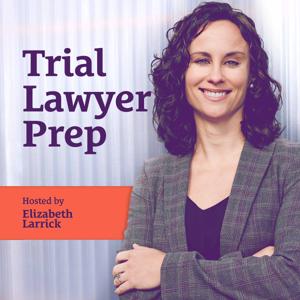


You've learned about the impacts of attention deficits and cognitive friction on juries, now, how do you structure your presentation so that jurors can follow it?
In part two of our series on working memory and case presentation, we focus on making the story easier to remember, reducing confusion, and using visuals that support persuasion instead of competing with it.
We look at three practical techniques lawyers can apply immediately: chunking their information together, sequencing, and the three-second rule for visuals.
Capture your jurors' attention and keep them with you from start to finish, leaving them with just enough mental energy to understand and grasp your argument. It's better for them, but it also makes your work more focused and efficient too!
If you want more trial prep strategies just like this, but in more depth and delivered straight to your inbox, grab my email newsletter I send out each month:
https://www.larricklawfirm.com/newsletter
In this episode, we cover:
You can also watch today's episode on my YouTube Channel:
Structuring Your Story and Your Case for the Jury's Brain [Ep 177]
And refer to part one (Why Jurors Stop Listening Even IF You Grab their Attention [Ep 176]) and Episode 169 (Juror Attention Spans: The Science Every Trial Lawyer Needs to Know)for more fascinating insights on brain science and juries!
Follow and Review:
We'd love for you to follow us if you haven't yet. Click that purple '+' in the top right corner of your Apple Podcasts app. We'd love it even more if you could drop a review or 5-star rating over on Apple Podcasts. Simply select "Ratings and Reviews" and "Write a Review" then a quick line with your favorite part of the episode. It only takes a second and it helps spread the word about the podcast.
Have a trial or mediation coming up and want to test with a focus group? Book a free consultation call with Elizabeth to learn more:
Don't miss out on the Trial Lawyer Prep Newsletter that is delivered right to your email with extra tips and 'how to' information. Join the newsletter here:
Why do jurors lose track of a trial presentation even when the evidence is strong?
In part one of this two-part series, we look at how attention deficits, mental fatigue, and working memory shape what jurors can absorb.
We find practical ways to reduce cognitive friction in openings, direct examinations, and cross-examinations. And we discuss the idea of a juror's limited cognitive budget, how to build in cognitive breaks, and a simple 20-minute rule for pacing testimony and presentations.
The goal: make complex material easier to follow, so jurors can stay with the story and make a better connection with you.
And stay tuned for part two, where we'll focus on structuring presentations that are designed for short-term memory.
Have a trial or mediation coming up and want to test with a focus group? Book a free consultation call with Elizabeth to learn more:
In this episode, we cover:
You can also watch today's episode on my YouTube Channel:
Why Jurors Stop Listening Even IF You Grab their Attention [Ep 176]
And refer to Episode 169 (Juror Attention Spans: The Science Every Trial Lawyer Needs to Know) for more fascinating insights on brain science and juries!
Follow and Review:
We'd love for you to follow us if you haven't yet. Click that purple '+' in the top right corner of your Apple Podcasts app. We'd love it even more if you could drop a review or 5-star rating over on Apple Podcasts. Simply select "Ratings and Reviews" and "Write a Review" then a quick line with your favorite part of the episode. It only takes a second and it helps spread the word about the podcast.
Have a trial or mediation coming up and want to test with a focus group? Book a free consultation call with Elizabeth to learn more:
Don't miss out on the Trial Lawyer Prep Newsletter that is delivered right to your email with extra tips and 'how to' information. Join the newsletter here:
Make your next focus group actually reveal the weaknesses, blind spots, and sticky points in your case, before the defense does!
These are just some of the detailed tips we cover in today's episode, which helps you make the most of a focus group to get accurate, realistic data and feedback.
The greatest strength of focus groups is their ability to reveal real weaknesses, not just reinforce what you already believe.
So give your groups the tools to deliver what you need, and remember: set aside that lawyer's instinct to advocate and instead, just listen.
Focus groups can change how you build a case, and build a case frame. Book a free call with me and learn more about my online focus groups for plaintiff personal injury lawyers:
https://www.calendly.com/elizabethlarrick
In this episode, we cover:
You can also watch today's episode on my YouTube Channel:
How to Get Better Feedback From Your Focus Groups [Ep 175]
Follow and Review:
We'd love for you to follow us if you haven't yet. Click that purple '+' in the top right corner of your Apple Podcasts app. We'd love it even more if you could drop a review or 5-star rating over on Apple Podcasts. Simply select "Ratings and Reviews" and "Write a Review" then a quick line with your favorite part of the episode. It only takes a second and it helps spread the word about the podcast.
Have a trial or mediation coming up and want to test with a focus group? Book a free consultation call with Elizabeth to learn more:
Don't miss out on the Trial Lawyer Prep Newsletter that is delivered right to your email with extra tips and 'how to' information. Join the newsletter here:
How does a small law firm evaluate whether to conduct a focus group?
The expense, the planning and organization, the time it takes: the stakes feel higher when you have a more nimble organization.
Vishal Shah is a plaintiff-side employment lawyer in Boston, MA, who left big law to open his own boutique firm in 2023. He thus knows first-hand the importance of balancing the bottom line and making smart choices for how his firm operates.
And he's here to tell you: you rarely get a better bang for your buck than through a focus group. Because it's not just about the value to that particular case, but the strategies, language, vocabulary, and human insight that can be applied to future cases and situations.
The feedback from focus groups helps Vishal and his team spot hidden assumptions, shape depositions, and improve mediation strategy.
Best of all, Vishal walks us through his own process of running a focus group from start to finish: the logistics, planning, advertizing, expenses and implementation.
If you've been on the fence about whether a focus groups are worthwhile, today's conversation presents a very compelling case.
Are you ready to learn more about how focus groups can improve your firm's efficiency and case presentation? Book a free consultation through the link below:
https://larricklawfirm.com/litigation-consulting/trial-consulting/focus-groups/
In this episode, we cover:
You can also watch today's episode on my YouTube Channel:
Focus Groups Before Discovery: Vishal Shah on Case Development Strategy [Ep 174]
Learn more about my guest Vishal Shah:
https://shahlitigation.com/
Email: [email protected]
LInkedIn: https://www.linkedin.com/in/shahlitigation/
Follow and Review:
We'd love for you to follow us if you haven't yet. Click that purple '+' in the top right corner of your Apple Podcasts app. We'd love it even more if you could drop a review or 5-star rating over on Apple Podcasts. Simply select "Ratings and Reviews" and "Write a Review" then a quick line with your favorite part of the episode. It only takes a second and it helps spread the word about the podcast.
Have a trial or mediation coming up and want to test with a focus group? Book a free consultation call with Elizabeth to learn more:
Don't miss out on the Trial Lawyer Prep Newsletter that is delivered right to your email with extra tips and 'how to' information. Join the newsletter here:
Perhaps a short trial can be better?
When you had planned for a five day trial, and then the first morning in the courtroom, the judge announces that the case will be completed in three days. Hard stop. No exceptions.
Is it a scramble and a panic?
Or maybe, could it be a blessing?
In this day and age especially, the last thing we want to do is bore our jurors, throw too much information at them and expect them to keep up. Attention spans are shorter and people are easily distracted, but even when looking at it objectively, can we really expect someone to hear and absorb each and every sentence over the course of multiple days?
Which in turn means, why not plan and strategize around keeping information clear, logical and structured in the first place?
Less is more.
And there is a time and place for more expansive detail, testing out ideas and arguments, and gauging the impact of your words: focus groups.
That's what I bring to a trial consult. It's not just running a focus group specific to your case, it's pairing it with everything else I've learned across more than a thousand focus groups:
I help you craft the strongest case possible with the strongest presentation. If you have an upcoming trial, use the link below to schedule a free consultation!
https://larricklawfirm.com/litigation-consulting/trial-consulting/
In this episode, we cover:
You can also listen to today's episode on my YouTube Channel:
Trial Prep Under Pressure: 3 Days to a $3.4M Verdict [Ep 173]
Follow and Review:
We'd love for you to follow us if you haven't yet. Click that purple '+' in the top right corner of your Apple Podcasts app. We'd love it even more if you could drop a review or 5-star rating over on Apple Podcasts. Simply select "Ratings and Reviews" and "Write a Review" then a quick line with your favorite part of the episode. It only takes a second and it helps spread the word about the podcast.
Have a trial or mediation coming up and want to test with a focus group? Book a free consultation call with Elizabeth to learn more:
Don't miss out on the Trial Lawyer Prep Newsletter that is delivered right to your email with extra tips and 'how to' information. Join the newsletter here:
Judge rules can make or break your trial, and most lawyers are looking at the wrong document first.
If you are headed to trial, this episode shows why the judge's trial rules, schedule, and persona matter more than simply memorizing jury instructions.
I talk about how a trial consultation exposed major surprises in a judge's courtroom procedures, including half-day sessions, skipped Fridays, limited jury-selection time, and strict expectations that could completely reshape the order of proof, witness strategy, and expert costs.
This episode previously aired on the podcast in 2024, and I'm bringing it back today because it's the perfect refresher ahead of an upcoming episode where I'll walk you through a recent trial consult of mine and the verdict. So keep that one in mind, and you can always refer back here for more context!
If you want more trial prep strategies just like this, but in more depth and delivered straight to your inbox, grab my email newsletter that I send out each month:
https://www.larricklawfirm.com/newsletter
In this episode, we cover:
You can also listen to today's episode on my YouTube Channel:
Identify a Judge's Trial Persona Before you Walk into the Courtroom [Ep 172]Follow and Review:
We'd love for you to follow us if you haven't yet. Click that purple '+' in the top right corner of your Apple Podcasts app. We'd love it even more if you could drop a review or 5-star rating over on Apple Podcasts. Simply select "Ratings and Reviews" and "Write a Review" then a quick line with your favorite part of the episode. It only takes a second and it helps spread the word about the podcast.
Have a trial or mediation coming up and want to test with a focus group? Book a free consultation call with Elizabeth to learn more:
Don't miss out on the Trial Lawyer Prep Newsletter that is delivered right to your email with extra tips and 'how to' information. Join the newsletter here:
In our last episode, we learned about Michelle Gessner's recent trial in North Carolina, where she was forced to pivot from a regular audio/video presentation, using modern technology, to a courtroom with no microphones, no TVs, no projectors and a single power outlet (already claimed by the clerk and the court reporter!).
Click here to catch Episode 170 and hear the back story for today's episode.
Michelle used AI to help adapt to this unexpected turn of events, asking it how to craft a visual presentation under these unique circumstances.
Today, we learn how it unfolded.
You could feel the courtroom change as the case progressed, and this was a quick trial: starting on a Monday, verdict by the end of day Tuesday. Literally two days.
In fact, there were some assets to the old-school, analogue approach: better eye contact with jurors, fewer distractions, and more movement.
Using what was learned from the focus groups before the trial, and the creative AI suggestions for presenting evidence, Michelle was able to correctly anticipate the jury's emotional reactions as the witnesses unfolded.
With AI helping between trial days to make sure she'd met her burden of proof, Michelle then gave her closing argument with foam boards instead of any PowerPoint slides or technology.
And the result: she won.
If you want more trial prep strategies just like this, but in more depth and delivered straight to your inbox, grab my email newsletter that I send out each month:
https://www.larricklawfirm.com/newsletter
In this episode, we cover:Remember to check out Episodes 128 & 129, featuring Michelle Gessner and her $21 million dollar verdict against Wells Fargo:
You can also watch today's episode on my YouTube Channel:
AI During Trial: Jury & Verdict. Part Two with Michelle Gessner [Ep 171] Learn more about my guest Michelle Gessner:Michelle Gessner is one of the few lawyers, if not the only lawyer, in North Carolina who has both Big Law and Big Company defense experience, as well as 10 years of employee-side employment litigation experience, which she has been nearly exclusively handling since 2015.
Michelle possesses a deep understanding of the many challenges employees face dealing with wage theft and other illegal employment practices.
Prior to its formation, Michelle gained extensive experience in all legal issues facing the retail, restaurant, and hospitality industries by serving as the Chief Litigation and Employment Law Counsel for publicly traded companies such as Family Dollar Stores, Inc. (FDO), Darden Restaurants, Inc. (DRI), Big Lots Stores, Inc. (BIG) and TriNet (TNET). Michelle also served as the SVP, General Counsel, and Chief Administrative Officer for Ovation Brands, a privately held $1 billion restaurant company.
Follow and Review:
We'd love for you to follow us if you haven't yet. Click that purple '+' in the top right corner of your Apple Podcasts app. We'd love it even more if you could drop a review or 5-star rating over on Apple Podcasts. Simply select "Ratings and Reviews" and "Write a Review" then a quick line with your favorite part of the episode. It only takes a second and it helps spread the word about the podcast.
Have a trial or mediation coming up and want to test with a focus group? Book a free consultation call with Elizabeth to learn more:
Don't miss out on the Trial Lawyer Prep Newsletter that is delivered right to your email with extra tips and 'how to' information. Join the newsletter here:
My guest today, Michelle Gessner, joined the podcast back in December of 2024, where we discussed her $21 million verdict against Wells Fargo.
Today she's back with the story of a recent verdict success in North Carolina, which suddenly hit an unexpected twist.
The case was planned out to make use of high tech video equipment and software, as you would find in a standard, modern equipped court room.
But then, it was moved to courtroom that had no technology; in fact, only a single outlet with extension cords.
No microphones, no TVs, no projectors. Just old-school visual tools: easels, display boards, pen and notepads, and the projection of your own voice.
So how does one pivot, and still incorporate the planned visuals and presentation? AI to the rescue! What was already a useful tool was now needed to address the extra challenge of creating courtroom visuals in a no-technology courtroom.
Michelle and I explore how she started by using focus groups to find out weaknesses, then identified what needed to be visual, how to be visual under these unique circumstances, and ultimately AI's creative suggestions. And the focus groups were the key, providing critical demonstratives to bring to life the evidence very early in the case.
If you want more trial prep strategies just like this, but in more depth and delivered straight to your inbox, grab my email newsletter that I send out each month:
https://www.larricklawfirm.com/newsletter
In this episode, we cover:Remember to check out Episodes 128 & 129, featuring Michelle Gessner and her $21 million dollar verdict against Wells Fargo:
You can also watch today's episode on my YouTube Channel:
AI for Winning Courtroom Visuals: Case Study with Michelle Gessner [Ep 170] Learn more about my guest Michelle Gessner:Michelle Gessner is one of the few lawyers, if not the only lawyer, in North Carolina who has both Big Law and Big Company defense experience, as well as 10 years of employee-side employment litigation experience, which she has been nearly exclusively handling since 2015.
Michelle possesses a deep understanding of the many challenges employees face dealing with wage theft and other illegal employment practices.
Prior to its formation, Michelle gained extensive experience in all legal issues facing the retail, restaurant, and hospitality industries by serving as the Chief Litigation and Employment Law Counsel for publicly traded companies such as Family Dollar Stores, Inc. (FDO), Darden Restaurants, Inc. (DRI), Big Lots Stores, Inc. (BIG) and TriNet (TNET). Michelle also served as the SVP, General Counsel, and Chief Administrative Officer for Ovation Brands, a privately held $1 billion restaurant company.
Follow and Review:
We'd love for you to follow us if you haven't yet. Click that purple '+' in the top right corner of your Apple Podcasts app. We'd love it even more if you could drop a review or 5-star rating over on Apple Podcasts. Simply select "Ratings and Reviews" and "Write a Review" then a quick line with your favorite part of the episode. It only takes a second and it helps spread the word about the podcast.
Have a trial or mediation coming up and want to test with a focus group? Book a free consultation call with Elizabeth to learn more:
Don't miss out on the Trial Lawyer Prep Newsletter that is delivered right to your email with extra tips and 'how to' information. Join the newsletter here:
What if our assumptions about modern attention spans aren't accurate?
We are all used to hearing that people have much, much shorter attention spans these days, thanks to social media, clickbait, algorithms, and a constant barrage of information.
While those things certainly represent a major shift in our day to day reality over the past 15+ years, that doesn't necessarily mean that we're paying less attention than we used to.
In fact, it's more of a rewiring of our brains, thanks to technology, leading to a state of continuous partial attention.
Why is this important to trial law, case framing, focus groups and understanding juries? Because understanding how our brains have changed will then help you package and present your case in a more intentional, and effective way.
When I work with lawyers and focus groups, we work very hard on your presentations to make sure that they're fitting our attention spans. To learn more about this process, book a free call with me: https://www.calendly.com/elizabethlarrickIn this episode, we cover:
Remember to check out Episode 144 of Trial Lawyer Prep, The 8 Second Rule That's Costing You Verdicts, to learn more about the brain science behind attention spans:
The 8 Second Rule That's Costing You Verdicts [Ep 144]
You can also watch today's episode on my YouTube Channel:
Juror Attention Spans: The Science Every Trial Lawyer Needs to Know [Ep 169]
Follow and Review:
We'd love for you to follow us if you haven't yet. Click that purple '+' in the top right corner of your Apple Podcasts app. We'd love it even more if you could drop a review or 5-star rating over on Apple Podcasts. Simply select "Ratings and Reviews" and "Write a Review" then a quick line with your favorite part of the episode. It only takes a second and it helps spread the word about the podcast.
Don't miss out on the Trial Lawyer Prep Newsletter that is delivered right to your email with extra tips and 'how to' information. Join the newsletter here:
For an effective discovery, case framing should start as early as possible. But be ready to pivot!
Don't let the other side get the jump on you in framing a case, and put you in catch-up mode from the start. You need to start framing a case at intake, especially for higher-value cases.
But, as our guest points out today, you also need to be ready and willing to pivot, should new facts arise, or if a new framing will in fact strengthen your case.
Tony Edwards is a personal injury lawyer in Oklahoma, and shares stories and wisdom from his decades of experience. We talk about a trucking case where digging into personnel records uncovered that the driver had previously been fired for on-the-job drug use, convincing Tony and his team to pivot to a stronger employer-focused theory, and a settlement at trial for the prior demand.
Focus groups are a great help for this kind of shift, since you'll instantly receive feedback on what works and what doesn't, and particularly what may go against your own assumptions and expectations. You then just need to be willing to adjust!
Early focus groups change how you build a case, and build a case frame. Book a free call with me and learn more about my online focus groups for plaintiff personal injury lawyers: https://www.calendly.com/elizabethlarrick In this episode, we cover:You can also watch today's episode on my YouTube Channel:
Using Case Framing in Discovery with Guest Tony Edwards [Ep 168]
Learn more about my guest Tony Edwards:
Tony Edwards was born and raised in McAlester, Oklahoma and has devoted himself to serving the legal needs of the people in his home area. He received his undergraduate degree in sociology and psychology from East Central University in Ada and then went to Oklahoma University College of Law, receiving his J.D. in 1982.
In 2006, Tony decided to that he wanted to create a smaller firm that would give him an opportunity to provide more personal service. The Edwards firm was born that year, and he has continued to concentrate on plaintiff's civil litigation. His practice today encompasses cases involving motor vehicles, nursing homes, defective products, and oil-field injuries. He has been involved in numerous mass-tort cases involving defective products.
Edwards and Patterson began in 2015 when he became partners with Matt Patterson. His efforts have resulted in numerous significant verdicts and settlements for his clients.
Follow and Review:
We'd love for you to follow us if you haven't yet. Click that purple '+' in the top right corner of your Apple Podcasts app. We'd love it even more if you could drop a review or 5-star rating over on Apple Podcasts. Simply select "Ratings and Reviews" and "Write a Review" then a quick line with your favorite part of the episode. It only takes a second and it helps spread the word about the podcast.
Have a trial or mediation coming up and want to test with a focus group? Book a free consultation call with Elizabeth to learn more:
Don't miss out on the Trial Lawyer Prep Newsletter that is delivered right to your email with extra tips and 'how to' information. Join the newsletter here:
From the publisher's feed

227,520 Listeners

87,157 Listeners

111,841 Listeners
193 Listeners

69,503 Listeners
129 Listeners
42 Listeners
134 Listeners

5,740 Listeners
28 Listeners

29,171 Listeners

15,905 Listeners
48 Listeners

6 Listeners