
Sign up to save your podcasts
Or



Based on Podcast App listening data
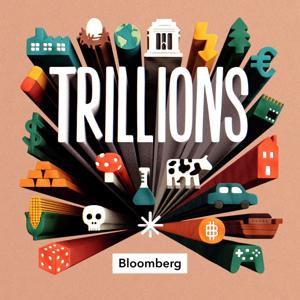
There’s been roughly 10 billion individual ETF trades in the past 25 years with almost no issues. This McDonald’s-esque track record of happy customers is one of the reasons ETFs have become so popular. One of the main reasons behind the stellar track record of trading is the important role played by ETF market makers, who provide liquidity for popular ETFs but also lesser traded ones— stepping in to be a buyer or a seller when there are none.
On this week’s Trillions, Eric and Joel speak with veteran ETF market maker Chris Hempstead of Deutsche Bank as well as Annie Massa of Bloomberg News, who just wrote about the secretive market maker Susquehanna in the latest issue of Bloomberg Markets. The discussion covers ETF mechanics, liquidity, and poker. Yes, poker.
See omnystudio.com/listener for privacy information.
What if there were a rolling paper that let you put the entire marijuana industry into a tightly packed joint? There is, and it's called an exchange-traded fund.
While more and more states legalize medical and recreational marijuana in the U.S., the federal government still classifies it as an illegal controlled substance. But that certainly doesn't make it illegal to invest in the industry, and certain publicly traded companies in the sector have seen their valuations soar of late. Most of these companies also happen to be based in Canada, a country that just legalized recreational marijuana last month.
Bloomberg News reporter Rachel Evans takes a field trip to Toronto for a closer look of the nascent industry and a better understanding of the ETFs investors are using to gain exposure. She also joins Eric and Joel to discuss why investors should proceed cautiously in such a seductive space.
See omnystudio.com/listener for privacy information.
What’s the most sure-fire way to get a flight upgrade? How can you find the best, secret local restaurants by asking just one question? What's the first thing you should do when you get into a hotel room? On Bloomberg's new podcast Travel Genius, we'll give you those answers—and plenty more—as hosts Nikki Ekstein and Mark Ellwood quiz the world’s most experienced globetrotters for their tried-and-true travel hacks. Listen weekly, and even your work trips will go from a necessary evil to an expert art form. Plus, you'll be padding out your bucket list with dreams of amazing future vacations.
See omnystudio.com/listener for privacy information.
Where does a medical cure come from? 100 years ago, it wasn't uncommon for scientists to test medicines by taking a dose themselves. As medical technologies get cheaper and more accessible, patients and DIY tinkerers are trying something similar—and mainstream medicine is racing to catch up. Prognosis explores the leading edge of medical advances, and asks who gets—or should get—access to them. We look at how innovation happens, when it fails, and what it means to the people with a disease trying to feel better, live longer, or avoid death.
See omnystudio.com/listener for privacy information.
Acronyms are a popular way to shorthand especially promising emerging markets. Take the BRICs: Brazil, Russia, India and China. Or how about MIST: Mexico, Indonesia, South Korea and Turkey. And here's a new one from Bloomberg Intelligence: Africa's CUTEs, for the Democratic Republic of Congo, Uganda, Tanzania and Ethiopia. These catchy terms tend to make buzz because investors see such vast economic potential in these countries -- but where there's potential, you'll also find risk.
Ahead of Bloomberg's New Economy Forum in Singapore on Nov. 6-7, Joel and Eric take a tour of these potential growth engines with VanEck emerging market analysts Patricia Gonzalez and Ola El-Shawarby. They share how they approach investing in countries such as Brazil, Peru, South Korea, Nigeria, and Egypt and give their thoughts on why active investing can outperform passive. Eric also highlights ETFs that can give investors single-country exposures.
See omnystudio.com/listener for privacy information.
Bloomberg’s head of economics Stephanie Flanders calls on Bloomberg's worldwide network of reporters and expert commentators to cast a fresh eye on looming challenges for the world economy which affect us all.
This 6 part podcast combines on the ground reporting with expert discussion on the future of cities, finance and technology, trade, global governance and making growth more inclusive. It's the start of a global conversation on how to confront these issues which will continue in Singapore in early November, when around 400 top business leaders and thinkers from across the globe will gather in Singapore for the first New Economy Forum.
See omnystudio.com/listener for privacy information.
The creation story of the first exchange-traded fund is actually the best way to understand how they work. And it's not just educational, it's entertaining. Like the PC and the MP3, the story of the creation of SPY -- which turned 30 this year -- is full of characters, twists and turns, and subplots. In the end, the product launched an industry that's reshaping not just investing but the entire financial ecosystem. This six-episode miniseries will weave together interviews with the founding fathers and other key players that help investors better understand the ETF and how we got here.
See omnystudio.com/listener for privacy information.
With many of the world's stock markets in turmoil, and interest rates on the rise in the U.S., it can be hard to spot investment opportunities. A popular Bloomberg article asks six experts where they would invest $10,000 right now. Some of those areas include Asian countries, tobacco stocks, companies profiting from the mobile payment trend as well as just a plain ol' broad market allocation.
On this week's Trillions we speak to the author of the story, Suzanne Woolley, and personal finance writer Ben Steverman about these picks as well as the ETFs that can be used to play them. We also discuss what they are hearing from retail investors outside the financial bubble about the recent selloff and investing in general.
When you’re done listening, you can read the article at https://www.bloomberg.com/features/2016-how-to-invest-10k/
See omnystudio.com/listener for privacy information.
Neeeeeeerrrrrrddsss! The term used to be an insult but now it’s (mostly) a compliment. At least that's the case in the world of ETFs, where passions run high for these low-cost, liquid funds. Used by long-term retail investors and institutional traders, there's a wide range of opinion on which Exchange Traded Funds are best, which trends are smart and what the future may hold.
On this week’s Trillions, Joel and Eric spar with a colorful gang of ETF pundits in a McLaughlin Group-style roundtable. They discuss 20 hot issues in the ETF world, including whether fees are overrated, when a zero-fee ETF will arrive, whether ESG funds can ever find an audience, where innovation will come from and what ETF our panelists would use for their life savings.
See omnystudio.com/listener for privacy information.
While the rise of ETFs has been good for ETFs, it has come at the expense of many mutual fund managers -- humans who have seen about $1 trillion in outflows over the past four years. The situation has confounded many active fund companies and fueled consolidation in the industry. Now, a prominent active fund advocate and ETF critic says he’s found a better strategy: mutual funds with performance-based fees.
On this episode of Trillions, Joel and Eric speak with Peter Kraus, former CEO of Alliance Bernstein, who discusses his new endeavor, Aperture Investors; also joining the conversation is Sonali Basak, a finance reporter with Bloomberg News. Kraus plans to offer actively managed mutual funds that cost about the same as a passive ETF -- unless his portfolio managers outperform their benchmarks and generate alpha. Aligning compensation with performance, Kraus says, is a better incentive than charging a fee based on assets under management. The episode also covers shortcomings of the ETF, why active management needs a dose of creative destruction and how a portfolio might benefit from performance-linked fees.
See omnystudio.com/listener for privacy information.
From the publisher's feed
Money goes where it’s treated best. That simple truth is a big reason why more and more money (trillions, in fact) flows into a powerful, low-cost tool that’s quietly transformed investing.…
Ranked by our users in the last 21 days

403 Listeners

1,161 Listeners

2,173 Listeners

1,965 Listeners

422 Listeners
192 Listeners

2,330 Listeners

948 Listeners

970 Listeners

797 Listeners

2,029 Listeners

2,142 Listeners

62 Listeners
83 Listeners

30 Listeners

425 Listeners
342 Listeners

5 Listeners

58 Listeners

233 Listeners

229 Listeners

60 Listeners

71 Listeners

84 Listeners

404 Listeners

19 Listeners

12 Listeners

7 Listeners

2 Listeners

115 Listeners