
Sign up to save your podcasts
Or

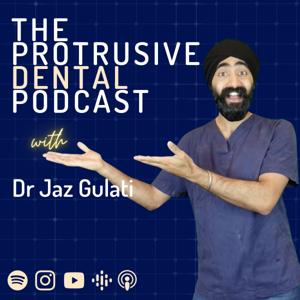

Get ready for the best summary of bridges you ever heard, including diving deep in to this mystical design of bridgework called ‘fixed-movable’ bridge.
You cannot search about Bridge Design on Google without landing on the great content that Prof Paul Tipton has released.
Protrusive Dental Pearl: where to place your grooves for crowns and bridges?
Crowns: place grooves mesial or distal, or mesial AND distal. Ideally in tooth and not in core material (we elaborate in the episode). Why mesial and distal for crowns and bridges? The forces will be transmitted bucco-lingually on a crown – therefore grooves perpendicular to this force vector to resist it would be mesial/distal.
How about for bridges then?
For conventional bridges the grooves are placed buccal or lingual, or buccal AND lingual.
This is because the forces are now acting antero-posteriorly on the bridge via forces on the pontic(s). The buccal/lingual grooves will resist antero-posterior forces.
Prof Tipton and I discuss:
If you enjoyed this episode, you will like the complete denture tips given by Dr Mark Bishop – check it out!
To learn more about Tipton Training, check out their website for courses.
 View all episodes
 By Jaz Gulati

4.7
2020 ratings
Get ready for the best summary of bridges you ever heard, including diving deep in to this mystical design of bridgework called ‘fixed-movable’ bridge.
You cannot search about Bridge Design on Google without landing on the great content that Prof Paul Tipton has released.
Protrusive Dental Pearl: where to place your grooves for crowns and bridges?
Crowns: place grooves mesial or distal, or mesial AND distal. Ideally in tooth and not in core material (we elaborate in the episode). Why mesial and distal for crowns and bridges? The forces will be transmitted bucco-lingually on a crown – therefore grooves perpendicular to this force vector to resist it would be mesial/distal.
How about for bridges then?
For conventional bridges the grooves are placed buccal or lingual, or buccal AND lingual.
This is because the forces are now acting antero-posteriorly on the bridge via forces on the pontic(s). The buccal/lingual grooves will resist antero-posterior forces.
Prof Tipton and I discuss:
If you enjoyed this episode, you will like the complete denture tips given by Dr Mark Bishop – check it out!
To learn more about Tipton Training, check out their website for courses.
392 Listeners

403 Listeners

8,876 Listeners

3,903 Listeners

4,025 Listeners

4 Listeners

2 Listeners

267 Listeners

262 Listeners
1 Listeners

29,272 Listeners
4 Listeners

1,314 Listeners

647 Listeners

195 Listeners