
Sign up to save your podcasts
Or

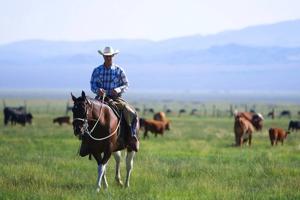

Welcome back to Genetics & the Gavel, powered by American Cattlemen Media. Just ahead, we have Gale McKinney, he's the owner of American Cattlemen Media, and he chats with Buttons York, Owner of Webo Angus. In this episode, Buttons and Gale will dive into the Webo Angus Turning Grass Into Greenbacks 19th Annual Bull Sale, held on April 7th, 2026, at 2PM CDT, in Lusk, Wyoming.
Webo Angus continues to view fertility as their very first selection criteria; their cow herd calves in 45 days. They apply intense pressure on feet; bulls must cover the country and need good feet to do so. They have a common-sense carcass, with additional selection to improve PAP scores. They continue to strive for balance with maternal traits and maternal indexes as additional scorecards, while keeping an eye on the same value indexes that their buyers do.
Buttons explains that her family has been in the ranching business for six generations, most of that time with Angus cattle. Webo Angus, started years ago by Buttons and her late husband Walden, is now operated by Buttons alongside her daughters Ellie and Odessa and her son-in-law, Colby Eddy. Their program is deeply rooted in a commercial cattle mindset, shaped by generations of experience as commercial producers themselves.
Buttons emphasizes that fertility is the primary selection criterion. Cows are expected to calve within a 45-day window, on time, raise a big calf, walk on four sound feet, and maintain good dispositions. She stresses that they do not make excuses for poor-performing cows or bad temperaments. Their environment in eastern Wyoming is restricted in terms of feed and often very dry, so cattle must breed up and perform under limited resources without excess feed.
The program avoids single-trait selection, instead prioritizing maternal merit, structural soundness, and practicality, while still maintaining solid carcass traits. Sire groups include bulls like Flat Top, Jamison Keystone, Congress, and North Star, along with home-raised sires such as a feed-efficient More Big Check bull and a highly efficient Confidence 035 son.
All bulls are third-party feed-efficiency tested at the University of Wyoming’s SAREC facility in Lingle, with a large proportion testing negative for residual feed intake. Ultrasound data for ribeye and marbling is collected on all bulls and made available through their website and online auction platform.
For previous episodes of the American Cattlemen Podcast, please visit: www.americancattlemen.com.
American Cattlemen Podcast is Sponsored By:
Moly Manufacturing
Central Life Sciences
 View all episodes
 By galesz
5
33 ratings
Welcome back to Genetics & the Gavel, powered by American Cattlemen Media. Just ahead, we have Gale McKinney, he's the owner of American Cattlemen Media, and he chats with Buttons York, Owner of Webo Angus. In this episode, Buttons and Gale will dive into the Webo Angus Turning Grass Into Greenbacks 19th Annual Bull Sale, held on April 7th, 2026, at 2PM CDT, in Lusk, Wyoming.
Webo Angus continues to view fertility as their very first selection criteria; their cow herd calves in 45 days. They apply intense pressure on feet; bulls must cover the country and need good feet to do so. They have a common-sense carcass, with additional selection to improve PAP scores. They continue to strive for balance with maternal traits and maternal indexes as additional scorecards, while keeping an eye on the same value indexes that their buyers do.
Buttons explains that her family has been in the ranching business for six generations, most of that time with Angus cattle. Webo Angus, started years ago by Buttons and her late husband Walden, is now operated by Buttons alongside her daughters Ellie and Odessa and her son-in-law, Colby Eddy. Their program is deeply rooted in a commercial cattle mindset, shaped by generations of experience as commercial producers themselves.
Buttons emphasizes that fertility is the primary selection criterion. Cows are expected to calve within a 45-day window, on time, raise a big calf, walk on four sound feet, and maintain good dispositions. She stresses that they do not make excuses for poor-performing cows or bad temperaments. Their environment in eastern Wyoming is restricted in terms of feed and often very dry, so cattle must breed up and perform under limited resources without excess feed.
The program avoids single-trait selection, instead prioritizing maternal merit, structural soundness, and practicality, while still maintaining solid carcass traits. Sire groups include bulls like Flat Top, Jamison Keystone, Congress, and North Star, along with home-raised sires such as a feed-efficient More Big Check bull and a highly efficient Confidence 035 son.
All bulls are third-party feed-efficiency tested at the University of Wyoming’s SAREC facility in Lingle, with a large proportion testing negative for residual feed intake. Ultrasound data for ribeye and marbling is collected on all bulls and made available through their website and online auction platform.
For previous episodes of the American Cattlemen Podcast, please visit: www.americancattlemen.com.
American Cattlemen Podcast is Sponsored By:
Moly Manufacturing
Central Life Sciences
147 Listeners
130 Listeners
439 Listeners
122 Listeners
125 Listeners
398 Listeners
46,368 Listeners
792 Listeners
116 Listeners
236 Listeners
79 Listeners
1,706 Listeners

201 Listeners
173 Listeners
6 Listeners