
Sign up to save your podcasts
Or

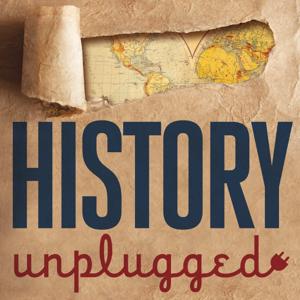

The medieval world – for all its plagues, papal indulgences, castles, and inquisition trials – has much in common with ours. People living the Middle Ages dealt with deadly pandemicsmass migration, and controversial technological changes, just as we do now.
Today’s guest, Dan Jones, author of POWERS AND THRONES: A New History of the Middle Ages looks at these common features through a cast of characters that includes pious monks and Byzantine emperors, chivalric knights and Renaissance artists.
This sweep of the medieval world begins with the fall of the Roman empire and ends with the first contact between the Old World and the New. Along the way, Jones provides a front row seat to the forces that shaped the Western world as we know it. This is the thousand years in which our basic Western systems of law, commerce, and governance were codified; when the Christian Churches matured as both powerful institutions and the regulators of Western public morality; and when art, architecture, philosophical inquiry and scientific invention went through periods of seismic change. We discuss:
• The height of the Roman empire and its influential rulers, as well as the various reasons it fell, including climate change pushing the Huns and so-called “barbarian” tribes to the empire’s borders.
• The development of Christianity and Islam, as well as the power struggles and conflict ignited in the name of religion, chivalric orders such as the Knights Templar, and the rise of monasteries as major political players in the West.
• The intimate stories of many influential characters of the Middle Ages, such as Constantine I, Justinian, Muhammad, Attila the Hun, Charlemagne, El Cid, Leonardo Da Vinci, Genghis Khan, Marco Polo, Martin Luther, and many more.
• The development of global trade routes and commerce across Europe, Asia, and Africa and the expanding map during the Age of Exploration.
• The Black Death, which decimated up to sixty percent of the local population in the fourteenth century and led to widespread social unrest and the little Ice Age, the period between 1300-1850 triggered by volcanic activity that created a climate so regularly and bitterly cold that it contributed to the Great Famine of 1315-21.
See omnystudio.com/listener for privacy information.
 View all episodes
 By History Unplugged

4.2
38383,838 ratings
The medieval world – for all its plagues, papal indulgences, castles, and inquisition trials – has much in common with ours. People living the Middle Ages dealt with deadly pandemicsmass migration, and controversial technological changes, just as we do now.
Today’s guest, Dan Jones, author of POWERS AND THRONES: A New History of the Middle Ages looks at these common features through a cast of characters that includes pious monks and Byzantine emperors, chivalric knights and Renaissance artists.
This sweep of the medieval world begins with the fall of the Roman empire and ends with the first contact between the Old World and the New. Along the way, Jones provides a front row seat to the forces that shaped the Western world as we know it. This is the thousand years in which our basic Western systems of law, commerce, and governance were codified; when the Christian Churches matured as both powerful institutions and the regulators of Western public morality; and when art, architecture, philosophical inquiry and scientific invention went through periods of seismic change. We discuss:
• The height of the Roman empire and its influential rulers, as well as the various reasons it fell, including climate change pushing the Huns and so-called “barbarian” tribes to the empire’s borders.
• The development of Christianity and Islam, as well as the power struggles and conflict ignited in the name of religion, chivalric orders such as the Knights Templar, and the rise of monasteries as major political players in the West.
• The intimate stories of many influential characters of the Middle Ages, such as Constantine I, Justinian, Muhammad, Attila the Hun, Charlemagne, El Cid, Leonardo Da Vinci, Genghis Khan, Marco Polo, Martin Luther, and many more.
• The development of global trade routes and commerce across Europe, Asia, and Africa and the expanding map during the Age of Exploration.
• The Black Death, which decimated up to sixty percent of the local population in the fourteenth century and led to widespread social unrest and the little Ice Age, the period between 1300-1850 triggered by volcanic activity that created a climate so regularly and bitterly cold that it contributed to the Great Famine of 1315-21.
See omnystudio.com/listener for privacy information.
3,992 Listeners
1,568 Listeners

4,802 Listeners
1,510 Listeners

791 Listeners
6,299 Listeners
6,132 Listeners

19,258 Listeners
81 Listeners
1,034 Listeners
716 Listeners
157 Listeners
90 Listeners

4,211 Listeners
360 Listeners
583 Listeners
3,365 Listeners
281 Listeners
925 Listeners

2,171 Listeners

66 Listeners

1,591 Listeners
57 Listeners