
Sign up to save your podcasts
Or



Based on Podcast App listening data
Send us Fan Mail
The American frontier conjures images of famous lawmen and outlaws, but what about the quiet builders who shaped towns like Dodge City from the ground up? Meet Andrew "Andy the Swede" Johnson, a remarkable immigrant whose hands literally constructed the West.
Arriving from Sweden in 1869, Johnson's chance meeting with businessman Charles Rath launched an extraordinary frontier partnership. Starting by breaking 1,000 acres of virgin prairie—an almost unimaginable feat of physical endurance—Johnson quickly became Rath's most trusted ally. From managing massive buffalo hide operations with 80,000 hides stacked high to helping build the original structures of Dodge City, his contributions were foundational yet often overlooked.
Johnson's most dramatic moment came during the 1874 Adobe Walls siege in the Texas Panhandle. When hundreds of Native American warriors attacked the trading post he had just built, Johnson's reinforced doors held firm against the assault. Even more remarkably, under gunfire, he dug a life-saving well inside the sod store, providing water for everyone trapped during the siege. This quick thinking and practical ingenuity saved countless lives and exemplified the resourcefulness required on the frontier.
After establishing himself as Dodge City's blacksmith, Johnson expanded into various businesses while literally cementing his legacy by laying sidewalks marked with his initials "AJ"—many still visible today. Though his collection of Adobe Walls artifacts was lost in an 1885 fire, he transformed himself into a respected historian of the event, speaking at its 50th anniversary celebration. Before his death in 1925, with characteristic foresight, he prepared his own tombstone and burial plot, controlling his final chapter just as he had built his remarkable life.
Andy the Swede's story reminds us that history is built by determined individuals whose quiet contributions outlast their lifetimes. What marks are you leaving behind? Listen now to discover how one man's hands shaped the American West.
Support the show
If you'd like to buy one or more of our fully illustrated dime novel publications, you can click the link I've included.
Send us Fan Mail
The remarkable tale of Robert M. Wright—the forgotten empire builder who transformed the American frontier—unfolds like a dime novel with shocking twists of fate that reality itself couldn't have scripted better.
Born to Maryland aristocracy with family connections to Ulysses S. Grant himself, Wright abandoned privilege at sixteen to master "the profane poetry of the bullwhip" as a frontier bullwhacker. This stark transition marked the beginning of an extraordinary life that would see him become the founding father of notorious Dodge City and the undisputed "Bison Baron" of the plains.
The numbers alone stagger the imagination: Wright's business shipped 200,000 buffalo hides in a single year, eventually handling over one million in total. At its peak, Dodge City under Wright's influence processed $200,000 monthly—over $4 million in today's currency—all without income tax. As a four-term mayor, he established a peculiar brand of frontier justice, once famously arresting and fining a cowboy who complained about being robbed while gambling illegally.
Behind the commercial success lay a culture of extreme contrasts. Wright's Dodge City embraced a particularly dark humor, exemplified by elaborate pranks involving staged gunfights with legendary figures like Bat Masterson and Wyatt Earp. But the frontier that made Wright's fortune ultimately consumed him. His later years reveal a tragic descent into morphine addiction, financial ruin, and desperate attempts to sell off his remaining assets. His final legacy project—a book chronicling Dodge City's history—suffered a cruel twist of fate when a fire destroyed nearly the entire first printing.
Wright's story forces us to reconsider romantic notions of the Wild West, revealing the steep personal cost of empire-building. What was the true price of taming the frontier, not just to the land and its original inhabitants, but to the souls of those who undertook the task? Join us as we explore this forgotten chapter of American history and the man whose rise and fall embodied the spirit of the Western expansion itself.
Support the show
If you'd like to buy one or more of our fully illustrated dime novel publications, you can click the link I've included.
Send us Fan Mail
Pour yourself a shot and settle in for an entertaining journey through Dodge City lore and fine spirits! Our debut episode of "Whiskey and Westerns on Wednesday" brings together host Mike King and Dodge City historian Brad Smalley to explore frontier legends while sampling Ardbeg 10, a smoky Islay scotch.
We kick things off by shattering a persistent Wild West myth about the origin of "shot" glasses. Despite romantic notions of cowboys trading bullets for whiskey, historical records reveal that in 1870s Dodge City, a shot cost about 25 cents—enough to buy nearly ten bullets. When George Hoover established the first saloon in what would become Dodge, he dispensed whiskey by the ladle for two bits, likely delivering a more generous pour than today's standard shot.
The heart of our episode revolves around Luke McGlue, Dodge City's most infamous resident who never actually existed. This entirely fictional character served as the perfect scapegoat for the town's practical jokers, including legendary figures like Bat Masterson and Wyatt Earp. When pranks were pulled and someone needed to take the blame, Luke McGlue became the untraceable culprit, preventing potential violence in a town where everyone carried guns.
We share the hilarious tale of Dr. Meredith, a traveling "medical man" who came to deliver a lecture on "private diseases" after corresponding with the nonexistent Luke. What followed was an elaborately orchestrated practical joke featuring staged disruptions, gunfire that extinguished the saloon's lamps, and ultimately a terrified doctor fleeing town on the first train out.
Throughout our storytelling, we appreciate the complex flavors of Ardbeg 10, discussing how peat imparts its distinctive smoky character during the whiskey-making process and identifying flavor notes from beeswax to black pepper.
Subscribe to our podcast for weekly episodes where we'll continue exploring legendary characters, historical tales, and fine spirits from the American frontier. Search "Wild West podcast" to find us and join our Wednesday tradition of whiskey and wonderful stories!
Support the show
If you'd like to buy one or more of our fully illustrated dime novel publications, you can click the link I've included.
Send us Fan Mail
The enduring legend of Belle Starr, America's notorious "Bandit Queen," culminates in this riveting final episode that traces her tragic demise and extraordinary posthumous transformation. After the death of her husband Sam Starr in 1886, Belle found herself in a desperate legal battle to keep her beloved home at Younger's Bend. The Cherokee Tribal Council delivered devastating news – as a non-citizen, her claim to the land had vanished with her husband's passing. Demonstrating remarkable resilience, she quickly formed a strategic alliance with Jim July, a young man of Creek and Cherokee heritage, securing her homestead through this new marriage while agreeing to stop harboring fugitives.
Despite her attempts to reform, the shadows of Belle's past continued to circle. By February 1889, she had accumulated a long list of potential enemies – from her disgruntled neighbor Edgar Watson to her own resentful son Ed Reed. On February 3rd, just days before her 41st birthday, Belle was ambushed on a lonely stretch of road near Eufaula. The attack was brutal and cowardly – shot in the back with what many believe was her own double-barreled shotgun, then finished off as she lay wounded on the cold ground. Though she was found still alive and brought home to her daughter Pearl, her injuries proved fatal.
The investigation into Belle's murder exemplifies frontier justice at its most ineffective. Despite compelling evidence against prime suspect Edgar Watson, including distinctive footprints at the crime scene, he was acquitted due to insufficient evidence and reluctant witnesses. The mystery of who killed Belle Starr remains unsolved to this day, adding another layer to her fascinating legend. It was her violent death that catapulted her from local notoriety to national fame, as sensationalized newspaper accounts caught the attention of publisher Richard K. Fox. His 1889 paperback "Belle Starr, the Bandit Queen" reinvented her as a beautiful, educated Southern belle driven to crime to avenge her Confederate brother's death – a romantic fabrication far removed from the complex reality of the woman who had just one conviction for horse theft.
Belle's grave at Younger's Bend bears the poetic inscription: "Shed not for her the bitter tear... 'Tis but the casket that lies here, the gem that fills it, sparkles yet." These words perfectly capture the essence of the Belle Starr phenomenon – the transformation of a frontier woman into an enduring symbol of the Wild West. Share your thoughts about this fascinating American legend and explore our illustrated dime novel for the complete story of the Bandit Queen's remarkable life.
Support the show
If you'd like to buy one or more of our fully illustrated dime novel publications, you can click the link I've included.
Send us Fan Mail
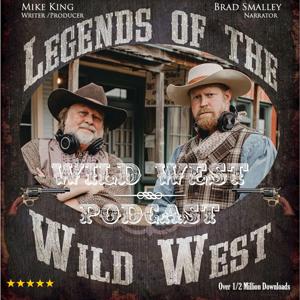
Saddle up for a journey into the heart of podcast storytelling excellence as we explore the remarkable success of the Wild West Podcast. Since 2017, this captivating show has transported listeners back to frontier America through its perfect tagline: "where fact and legend merge."
What makes this podcast truly exceptional is the extraordinary partnership that brings each episode to life. Michael King serves as the meticulous researcher and writer, crafting historically accurate narratives that go beyond the audio medium into carefully illustrated dime novel-style publications. This isn't just historical recounting—it's a deliberate homage to the very format that originally popularized Western tales 150 years ago. Meanwhile, Brad Smalley delivers each story with authentic frontier gravitas, his signature "Howdy from Dodge City" greeting backed by genuine credentials as a local Boot Hill gunfighter and historical reenactor. When Smalley narrates, you're not just hearing history; you're connecting with someone deeply embedded in the traditions and physical space that shaped these legendary tales.
While other Western podcasts cast wide nets across the entire frontier or rely on cinematic production values, the Wild West Podcast takes a different approach. By focusing intensely on Dodge City and prioritizing substance over flash, King and Smalley have created something remarkably authentic. Their 260+ episodes, typically running 20-30 minutes each, cover both iconic figures and obscure historical moments with equal dedication. The result? A show that's reached listeners in 150 countries and maintains an impressive 4.6-star rating. It proves something powerful about storytelling today: in our digital age, deeply local knowledge delivered through genuine voices can resonate globally, ensuring these complex, sometimes contradictory, but eternally fascinating chapters of American history continue to echo for generations to come. Subscribe now to experience the perfect blend of historical accuracy and spellbinding storytelling that only the Wild West Podcast can deliver.
Support the show
If you'd like to buy one or more of our fully illustrated dime novel publications, you can click the link I've included.
Send us Fan Mail
Get ready to celebrate the spirit of the West! The Kansas Cowboy Hall of Fame Committee is thrilled to invite you to honor remarkable individuals, both living legends and those who have passed, by nominating them for induction into the illustrious Kansas Cowboy Hall of Fame!
This is your chance to spotlight someone extraordinary! Whether you're part of an organization or an individual with a passion for preserving cowboy culture, we welcome your nominations. Each year, our dedicated nominating committee will meticulously review all submissions to choose the next inductees who deserve to be immortalized.
Ready to make your nomination count? You can easily request a nomination form from Boot Hill Museum, Inc., right on Front Street in Dodge City, Kansas, or take advantage of the convenience of their online form at www.boothill.org/kchf-nomination. But don’t wait too long! All nominations must be submitted by August 31, 2025, to be considered for the exciting 2025 induction ceremony which will be held on Saturday, November 8, 2025!
Support the show
If you'd like to buy one or more of our fully illustrated dime novel publications, you can click the link I've included.
Send us Fan Mail
The rugged terrain of Indian Territory in the 1880s offered both peril and possibility—a perfect backdrop for one woman's remarkable transformation from grieving widow to frontier legend. After losing both her brother to war and her husband to violence, Myra Maybel Reed found herself drawn to an untamed region where she would forge an extraordinary new identity.
Her fateful connection with the notorious Starr family wasn't merely about seeking protection in dangerous lands. The Starr's represented a powerful Cherokee lineage steeped in resistance, their outlaw status inextricably linked to tribal politics and the traumatic aftermath of the Trail of Tears. When Belle married Sam Starr in 1880, she gained more than a husband—she secured a tenuous foothold in a world where she might otherwise have remained perpetually vulnerable as an outsider.
At their homestead dubbed "Younger's Bend," Belle emerged as a formidable strategist at the heart of a sophisticated criminal operation. Far from a passive companion, she orchestrated logistics for the rustlers, thieves, and fugitives who sought refuge under her roof—even reportedly sheltering Jesse James himself. Her shrewd intelligence, celebrated by those who knew her, proved invaluable in navigating both the shadowy outlaw underground and the complex legal landscape that threatened to ensnare her.
Judge Isaac Parker's fearsome court finally caught up with Belle and Sam in 1882, resulting in her only documented conviction. Yet even facing imprisonment in Detroit, Belle adapted brilliantly, earning a reputation as a model prisoner while Sam struggled with incarceration. Upon their release, the brief flicker of domestic tranquility she attempted to build at Younger's Bend was repeatedly extinguished by Sam's reckless criminal pursuits and her own legal entanglements.
The violent death of Sam Starr in a Christmas party shootout with his own cousin in 1886 left Belle not only grieving but facing an existential crisis, as her very right to remain at Younger's Bend depended on her marriage to a Cherokee citizen. Through it all, she demonstrated remarkable resilience, adapting to survive in a land defined by shifting jurisdictions, tribal sovereignty, and the ever-present threat of violence—a true testament to the extraordinary will of the woman who became known as the Bandit Queen.
Support the show
If you'd like to buy one or more of our fully illustrated dime novel publications, you can click the link I've included.
Send us Fan Mail
Step back in time to July 4, 1884, when Dodge City, Kansas staged one of the most audacious spectacles ever seen on American frontier soil – a genuine Mexican bullfight. As the cattle trade slowed and prosperity waned, former Mayor A.B. Webster hatched a plan that would either save the town's economy or cement its reputation for lawlessness.
The Great Bullfight of 1884 represents the fascinating collision of American frontier spirit with Spanish tradition. Within days, Webster raised $10,000 from local merchants desperate for economic revival. In less than two months, they transformed 40 acres into an arena capable of seating 2,500 spectators. When faced with legal opposition, Webster's response became legendary: "Hell. Dodge City ain't in the United States."
The story unfolds like a frontier drama – five flamboyantly dressed Mexican matadors facing off against carefully selected ferocious longhorn bulls, thousands of spectators filling the stands, reporters from major newspapers documenting every moment, and special excursion trains bringing visitors from across the country. The pinnacle came when matador Gregorio Gallardo confronted "the meanest bull in the West" in a breathtaking display of courage that still echoes through Dodge City's history. What followed was a night of wild celebration, keeping the Marshal and his deputies scrambling to maintain order as the town enjoyed its last hurrah before settling into quiet small-town life.
Join us for this remarkable tale of American ingenuity, defiance, and spectacle that changed Dodge City forever. Subscribe to Wild West Podcast for more fascinating stories from the American frontier, and share your thoughts at [email protected] – we value your input and may feature your comments in future episodes.
Support the show
If you'd like to buy one or more of our fully illustrated dime novel publications, you can click the link I've included.
Send us Fan Mail
The remarkable transformation of Myra Maybel Shirley from educated piano player to notorious outlaw woman unfolds against the chaotic backdrop of post-Civil War Texas. What forces drive a respectable young woman into the dangerous world of outlaws? The answer lies in the unlikely sanctuary her family's farm provided to some of America's most wanted men.
Scyene, Texas was described as "a rendezvous of the reckless raiders of the Southwest," a perfect hideout for Missouri's Confederate guerrillas-turned-outlaws. When the James-Younger gang sought refuge at the Shirley farm, they found in May a woman hardened by war and displacement, who moved comfortably among them despite her formal education. Her friendship with Cole Younger sparked persistent rumors, while her marriage to former Quantrill raider Jim Reed cemented her connection to the outlaw world.
Reed's criminal career dragged May into an increasingly dangerous existence. As they fled from Texas to Missouri to California with their two young children, Pearl and Ed, May's options narrowed. When authorities issued a warrant for her arrest as an accessory to Reed's crimes, the line between being an outlaw's wife and an outlaw herself blurred. After Reed's violent death in 1874, May faced the ultimate challenge: surviving as a widow with two children in a society that offered little support for women in her position. These formative years, marked by hard choices and compromised morality, set the stage for her emergence as the legendary Belle Starr.
Join us for Part 3 of Belle Starr's story - "Younger's Bend: The Cherokee Queen" - where we'll explore her captivating years from 1875 to 1880. Subscribe now to follow this fascinating journey through the life of one of the Wild West's most misunderstood figures.
Support the show
If you'd like to buy one or more of our fully illustrated dime novel publications, you can click the link I've included.
Send us Fan Mail
The afternoon of April 14, 1935, began with an unsettling calm across the southern Great Plains. After weeks of relentless dust storms, this brief moment of respite felt almost divine—until an ominous black line appeared on the horizon. Witnesses described a sky divided between golden sunlight and a monstrous curtain of dust that towered a thousand feet high, churning like a reverse waterfall.
When this apocalyptic wall struck, it transformed day into a darkness "worse than any midnight." The assault was multi-sensory and terrifying. Wind-driven sand lacerated exposed skin, buildings trembled, and the air itself became a choking hazard loaded with particulate matter. Perhaps most bizarre were the electrical phenomena—static electricity generated by billions of dust particles created blue sparks dancing between animals' ears and enough charge to short-out automobile engines or knock people to the ground with a handshake.
Black Sunday wasn't merely a weather event but the physical manifestation of America's worst man-made ecological disaster. This catastrophe emerged from a perfect storm of misguided federal policies, economic desperation, and ecological ignorance. The transformation of native grasslands into unsustainable farmlands had stripped away nature's defense mechanisms against drought and wind. When these elements combined with economic pressures of the Great Depression, the result was catastrophic—a haunting reminder that our relationship with the natural world requires respect for systems that evolved over millennia. What lessons can we draw from this devastating chapter in American history as we face our own environmental challenges today?
Support the show
If you'd like to buy one or more of our fully illustrated dime novel publications, you can click the link I've included.
From the publisher's feed
Welcome to the Wild West Podcast, winner of the 2026 Best of Western Podcast award, where fact and legend merge. We present the true accounts of individuals who settled in towns built out of hunger…
Ranked by our users in the last 21 days

44,984 Listeners
4,711 Listeners
1,785 Listeners

1,677 Listeners

2,772 Listeners

1,498 Listeners

3,986 Listeners

6,174 Listeners

19,147 Listeners

3,637 Listeners

19,093 Listeners

2,936 Listeners
777 Listeners
927 Listeners

1,592 Listeners