
Sign up to save your podcasts
Or



Based on Podcast App listening data
Send us Fan Mail
What makes a true cowboy? It goes far beyond the iconic hat and weathered expression – it lives in the worn leather of a saddle that's witnessed countless sunsets and the rhythmic jingle of spurs that speak their own language.
In this captivating conversation, author Michael King joins us to discuss his new book "A Cowboy's Tale of Words: The Meaning of Saddles and Spurs," which explores the soul of the American West through its most iconic tools and terminology. King, whose fascination with etymology began in graduate school, has crafted a unique blend of historical research, creative storytelling, and linguistic exploration that brings the authentic cowboy experience to life.
The highlight of our discussion centers on the fascinating etymology of "buckaroo" – primarily derived from the Spanish "vaquero" but potentially influenced by the Gullah-Geechee culture's term "bukhra." This multicultural linguistic heritage mirrors the diverse influences that shaped frontier life itself. King's book captures this complexity through meticulously researched fictional narratives that transport readers to specific moments in cowboy history, like the spring branding of 1874, complete with historically accurate details about everything from local flora to period-specific slang.
For anyone who's ever felt the call of the open range or wondered about the deeper significance behind cowboy culture, this conversation offers fresh insights into a defining chapter of American history. Grab your copy of "A Cowboy's Tale of Words" through the link in our description, and don't forget to subscribe to our podcast for more explorations of the Wild West's enduring legacy. Have thoughts to share? We'd love to hear from you at [email protected]. Order the book" A Cowboy's Tale of Words: The Meaning of Saddles and Spurs.
Support the show
If you'd like to buy one or more of our fully illustrated dime novel publications, you can click the link I've included.
Send us a text
Ghost stories often begin with dark and stormy nights, but Marshal Ed Masterson's begins with moonlit rails and the low, mournful groan of Santa Fe tracks. This poetic journey through time explores the tragic fate of a forgotten lawman whose remains have been relocated multiple times as Dodge City expanded, ultimately losing his marker and proper recognition.
Marshal Ed Masterson once wore his star with pride, keeping peace in wild Dodge City until a fateful gunfight ended his life. First laid to rest on Cemetery Hill, his remains were later moved to Prairie Grove and then to Maple Grove as the growing town required more land for development. Somewhere between these transitions, his name was lost—"a casualty of gain" as the poem hauntingly describes. While tourists flock to Dodge City seeking the ghosts of more famous figures like Wyatt Earp and Doc Holliday, they remain unaware of the true phantom in their midst: Ed Masterson, eternally walking his final patrol.
The ballad presents a stark contrast between Ed and his brother Bat Masterson, whose "legend lives" while Ed remains "lost to time and cold." This powerful meditation on memory, progress, and what we owe to forgotten heroes serves as a cautionary tale about how easily history can erase even those who made the ultimate sacrifice. The next time you feel an unexpected chill on the streets of Dodge City, remember it might just be Marshal Ed—still searching for his rightful resting place, a lawman without a sanctuary, forever seeking the peace that progress denied him.
Support the show
If you'd like to buy one or more of our fully illustrated dime novel publications, you can click the link I've included.
Send us a text
Step across the threshold of the Mueller-Schmidt House and embark on a captivating journey through time. This remarkable limestone residence in Dodge City, Kansas—affectionately known as the "Home of Stone"—stands as one of America's most authentic windows into late 19th century domestic life.
Built in 1881, when the American frontier was still taking shape, this architectural gem immediately captivates visitors with its breathtaking handcrafted spiral staircase—an elegant masterpiece of woodworking that serves as the home's stunning centerpiece. As you move through the meticulously preserved rooms, each space reveals intimate details of frontier family life: the formal Victorian parlor with its sumptuous furnishings designed for social gatherings; the spacious, light-filled master bedroom that served as John and Caroline Mueller’s private sanctuary; and the practical basement kitchen that kept cooking heat separate from living areas in the days before modern ventilation.
What makes the Mueller-Schmidt House truly exceptional is the remarkable preservation of its original elements. Each room stands as a testament to frontier resilience and ambition, with exquisite woodwork and period-appropriate furnishings that tell the story of a successful family establishing permanence in what was once the wild west. Now curated by the Ford County Historical Society and proudly listed on the National Register of Historic Places, this limestone treasure preserves an irreplaceable connection to Dodge City's rich past. Visit to experience firsthand how the pioneering spirit of America's westward expansion manifested not just in adventure, but in creating homes of beauty, comfort, and lasting significance.
Support the show
If you'd like to buy one or more of our fully illustrated dime novel publications, you can click the link I've included.
Send us Fan Mail
Ever wondered how true American humor differs from its European counterparts? Clay Calloway joins the Wild West Podcast to reveal the secrets behind genuine frontier storytelling through his introduction to "The Legends of Dodge City: The Enterprise."
Calloway's masterful analysis connects human anatomy to narrative structure, using the "funny bone" as a metaphor for how great stories deliver their impact. Unlike the immediate burst of a comic tale, true American humor bubbles along gently before delivering a lingering intellectual jolt. The distinction lies not in content but in delivery – grave, wandering, and punctuated by powerful pauses.
The conversation reveals how Dodge City wasn't born from traditional city planning but from entrepreneurs who "simply uncorked a barrel of whiskey, pitched a tent, and laid down a few boards." This reckless pursuit of profit created a legendary legacy that outlasted both the mighty buffalo herds and the whiskey that once flowed freely through its streets. Calloway's introduction frames the book's approach to telling the stories of Dodge City's founders with authentic frontier humor.
Drawing from the ancient theory of the four humors, Calloway creates a fascinating framework for understanding different storytelling temperaments. This classification system reveals that genuine humor isn't born from pure levity but emerges from understanding life's contradictions and absurdities. As he notes with philosophical insight, "There is no laughter in heaven because there is nothing to laugh at" – humor serves as our weapon against life's hardships.
Join us for this captivating episode that offers not just a preview of an exciting new book but a masterclass in the art of storytelling. Subscribe to our podcast on iTunes or visit wildwestpodcast.com to ensure you never miss an episode. Have thoughts or want to contribute to future discussions? Reach out to us at [email protected] – we'd love to hear from you.
Select the link to order the dime novel “Legends of Dodge City: The Enterprise.”
Support the show
If you'd like to buy one or more of our fully illustrated dime novel publications, you can click the link I've included.
Send us Fan Mail
The tangled web of myth and reality surrounding Dutch Henry Borne reveals a captivating window into the American frontier experience. Our exploration of this enigmatic outlaw's life continues as we examine the controversial claims and counterclaims about one of the West's most fascinating characters.
Dutch Henry's transformation from military scout to notorious criminal traverses the shifting moral landscape of the frontier. Beginning his Western career in 1867 as a scout for Custer's 7th Cavalry, Borne witnessed the brutality of the Ouachita Massacre in 1868, which seemingly triggered his disillusionment with military service. By 1871, he had staked a claim in Kansas and ventured to Colorado for buffalo hunting. After suffering an attack by Cheyenne warriors and facing accusations of instigating the conflict, Bourne's sense of injustice drove him to steal Army mules and the commandant's horse, vowing revenge and setting him on a path toward outlaw status.
The most fascinating controversy we tackle is whether Dutch Henry was actually present at the Second Battle of Adobe Walls in June 1874. Official records indicate he was incarcerated in Kansas at the time, yet multiple independent sources—including the battle site monument, Olive Dixon's account of her husband Billy Dixon's experiences, and Borne's own later correspondence—place him at this pivotal frontier conflict. This historical mystery highlights the challenges of frontier record-keeping and the complex nature of Western mythology.
Our examination of Dutch Henry's later years reveals his evolution from notorious horse thief to family man, marrying Ida Dillabaugh in 1900 and fathering four children while maintaining his frontier identity. His correspondence with Western writer Charles Seringo demonstrates how aging frontiersmen often sought to cement their places in the narrative of the American West.
What makes Dutch Henry's story so compelling is how it illustrates the blurred lines between lawman and outlaw in a land where personal vendettas and survival often trumped abstract ethics. Was he truly at Adobe Walls? The evidence is compelling but contradictory—much like the man himself. Listen and decide for yourself as we unravel one of the West's most enduring mysteries.
Support the show
If you'd like to buy one or more of our fully illustrated dime novel publications, you can click the link I've included.
Send us Fan Mail
Some monsters aren't fiction – they're buried in Dodge City Cemetery beneath stones that read "beloved husband and father."
The story of Print Olive might be the most shocking true tale we've covered on Whiskey and Westerns. While sipping Bullet Bourbon (a fitting choice given Print's remarkable ability to absorb lead throughout his violent career), we unraveled the brutal history of a man whose sadistic tendencies would make even fictional villains seem tame.
Print began as a Texas cattle baron in the post-Civil War era, accumulating wealth by gathering "maverick" cattle – a term derived from Samuel Maverick, who famously refused to brand his herds. But Print's legacy wasn't built on business acumen alone. His reputation for horrific violence preceded him across the frontier. He once tied suspected rustlers to trees, wrapped them in freshly skinned wet cowhides, and watched as the rawhide slowly dried and crushed them to death in the hot Texas sun. Those who crossed the Olives had a tendency to "leave the country" permanently.
When Nebraska farmers Mitchell and Ketchum killed Print's brother Bob in self-defense, Print's revenge was swift and gruesome. After capturing the men through a bounty, Print hanged Ketchum while Mitchell remained handcuffed to him, forcing Mitchell to dangle by his arm while watching his partner strangle. Print then shot both men repeatedly before burning their bodies, earning the nickname "The Man-Burner." This incident forced Print to relocate to Dodge City, where he eventually met his own violent end in a Trail City saloon.
Perhaps most fascinating is how Print's brutal story influenced American literature. Larry McMurtry's Pulitzer Prize-winning "Lonesome Dove" contains characters and scenes directly inspired by Print Olive's life. Jake Spoon, the hanging scene, Dietz and PI – all have roots in the actual history of this forgotten frontier monster.
Want to learn more? Visit our website to download "Ladder of Rivers," the book that chronicles Print's complete story and likely inspired McMurtry's masterpiece. Our next episode will feature the Dora Hand story, another fascinating tale connected to Print's violent web of influence.
Support the show
If you'd like to buy one or more of our fully illustrated dime novel publications, you can click the link I've included.
Send us Fan Mail
Step back in time to the dusty, lawless streets of Dodge City, Kansas as we unravel the enigmatic legend of "Mysterious" Dave Mathers over glasses of Knob Creek bourbon. Few characters in Western lore earned their nicknames more honestly than Mathers, whose life story combines gunfights, peculiar behavior, and ultimately, a disappearance that sealed his place in frontier mythology.
We trace Mathers' journey from his early days as a horse thief running with Dave Rudabaugh to his arrival in Dodge City around 1874. After surviving a near-fatal knife attack and forming an unusual business relationship with local physician Dr. Thomas McCarty, Mathers embarked on a colorful career that regularly blurred the line between lawman and outlaw. You'll hear the hilarious tale of "the conversion of Dave Mather," where he exposed a preacher's congregation as hypocrites with a well-placed gunshot, and discover his unique method for testing his sobriety—shooting at the town fire bell after leaving saloons.
The heart of our story follows Mathers through his time with the notorious "Dodge City Gang" in Las Vegas, New Mexico, his return to Dodge as assistant marshal, and his fateful, escalating feud with town founder Tom Nixon. Their rivalry over politics, business competition, and a woman culminated in one of Dodge City's most telling shootouts—where Mathers killed Nixon with four bullets and walked away free on self-defense claims, despite the shooting occurring weeks after Nixon's initial attempt on his life.
What happened to Mysterious Dave after that deadly encounter? Like many aspects of his life, his ultimate fate remains shrouded in mystery—a fitting end for a man whose very nickname acknowledged the enigma of his existence. Join us for this captivating glimpse into frontier justice, personalities, and the complex moral code that governed the American West.
Support the show
If you'd like to buy one or more of our fully illustrated dime novel publications, you can click the link I've included.
Send us Fan Mail
Gunfire echoes across the Kansas plains, where desperate men take cover behind a hasty barricade of battered wagons and lifeless horses. With their ammunition dangerously low and hope dwindling, the situation looks grim—until one valiant soldier boldly steps forward, ready to embark on what appears to be a suicide mission.
Welcome to the gripping tale of the Battle of Little Coon Creek, set in September 1868. This extraordinary tale chronicles how Corporal Patrick "Patty" Boyle’s unrivaled bravery turned the tides in what seemed like a certain death sentence for his comrades. Historian Jeff Broome unveils how a typical dispatch run between frontier forts transformed into a desperate struggle when Boyle and Corporal Leander Herron stumbled upon their fellow soldiers under fierce attack by warriors along the Santa Fe Trail.
As the drama unfolds, we see Boyle make a heart-wrenching choice—handing over his weapons with the unforgettable words, "Here, boys, you want them more than I do." He then charges headfirst into enemy lines, determined to seek reinforcements. Meanwhile, the defenders are locked in a harrowing battle that stretches through the night, their ammunition dwindling to a mere twelve rounds by dawn. Just when hope is all but lost, an unexpected sight emerges on the horizon: cavalry soldiers, gallantly charging to the rescue, clad only in their white underwear, appearing like ghostly apparitions on the battlefield.
What’s even more captivating is what happened after the battle. Decades later, while Corporal Leander Herron was awarded the Medal of Honor for his valor, the memory of Boyle—who had tragically passed away before he could receive recognition—remains unadorned despite his incredible heroism. In his extensive research, Broome unearthed a rare gem: a 1930 radio interview featuring the then 85-year-old Leander Herron sharing his vivid memories of that fateful night, connecting us to this often-overlooked chapter of frontier history.
This tale is more than just a recounting of a military skirmish; it delves into the profound themes of sacrifice, duty, and the complex nature of heroism through the ages. For enthusiasts of the American frontier, military history, or tales of remarkable courage, Patty Boyle’s midnight ride is a powerful testament to the extraordinary individuals whose stories have shaped the West.
Listen, share, and subscribe to our podcast for more hidden gems from America's frontier past—where everyday heroes made history through remarkable acts of bravery.
Support the show
If you'd like to buy one or more of our fully illustrated dime novel publications, you can click the link I've included.
Send us Fan Mail
The violent clashes that erupted across the Kansas frontier in 1868 have often been shrouded in overly simplistic narratives. Historian Dr. Jeff Broome courageously challenges these conventional interpretations, revealing the intricate realities that drove Southern Plains tribes to warfare against white settlers.
Through his remarkable research into Indian depredation claims—sworn testimonies encompassing nearly 800 storage feet at the National Archives—Broome uncovers perspectives that have long been overlooked. "Here is a hidden voice of these settlers," he explains, shedding light on the experiences of frontier families intertwined in the conflict.
The roots of violence run deeper than commonly perceived. The Cheyenne migrated from Minnesota centuries ago, displacing other tribes and asserting their dominance over the Central Plains. Yet by 1868, their control had lasted merely two generations, while a series of treaties had drastically reduced their lands by approximately 15 times. The tipping point arrived as settlers disrupted the buffalo migrations essential to the Cheyenne's survival.
Most revealing is Dr. Broome's evidence regarding Chief Black Kettle, who was traditionally viewed as a steadfast peace advocate. Settler accounts suggest he "played both sides"—cultivating relationships with military authorities while supporting war preparations. Although he did not directly participate in raids, his role appears more intricate than previously recognized.
The August 1868 raids commenced along Spillman Creek, where newly arrived homesteaders suddenly became vulnerable on isolated claims. With no established towns or newspapers in the area, ascertaining exact casualty numbers remains challenging, though Governor Crawford estimated "upwards of 40 settlers" killed.
By delving into these untapped primary sources, Broome helps us grasp that the violence in 1868 resulted from a potent combination of diminishing resources, broken promises, tribal dynamics, and government shortfalls—a nuanced perspective vital for anyone striving to comprehend this pivotal moment in American frontier history.
Would you be ready to explore more? Subscribe to our podcast for the complete "Trails to the Washita" series, and share your thoughts at [email protected] about what aspects of this complex history you'd like us to examine next.
Support the show
If you'd like to buy one or more of our fully illustrated dime novel publications, you can click the link I've included.
Send us Fan Mail
Step back in time to the American frontier of 1872, where massive buffalo herds still thundered across the plains in their ancient migration patterns. Through the eyes of George W. Brown, we witness these magnificent beasts as they moved with the seasons—northward in spring to the Dakotas and Canada, then southward again as winter approached, seeking shelter in the river valleys of the Great Plains.
Brown's tale centers on a hunting expedition along the Smoky Hill River with his colorful companion, Dave "Prairie Dog" Morrow. As they track buffalo herds through territories known to be hunting grounds of the Cheyenne, Brown uncovers the entrepreneurial spirit that earned Morrow his unusual nickname. From catching and selling prairie dogs to eastern tourists for five dollars a pair, to developing increasingly sophisticated trapping methods, Prairie Dog's business ventures reveal the speculative mindset that drove many frontier entrepreneurs until competition inevitably flooded the market.
The narrative takes an unexpected turn when Prairie Dog mysteriously vanishes one morning, leaving Brown to encounter other characters like Thomas Nixon—a former Nevada miner who claimed to have killed over 2,000 buffalo in just over a month. These personal stories unfold against the backdrop of a rapidly changing West, where railroads were pushing into new territories and the massive buffalo herds that had dominated the landscape for centuries were facing their final days. This episode offers not just a glimpse into the practical aspects of buffalo hunting, but also the camaraderie, competition, and challenges that defined life on America's western frontier during this pivotal era.
Support the show
If you'd like to buy one or more of our fully illustrated dime novel publications, you can click the link I've included.
From the publisher's feed
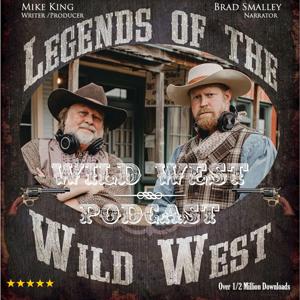
Welcome to the Wild West Podcast, winner of the 2026 Best of Western Podcast award, where fact and legend merge. We present the true accounts of individuals who settled in towns built out of hunger…
Ranked by our users in the last 21 days
44,984 Listeners
4,711 Listeners
1,785 Listeners

1,677 Listeners

2,772 Listeners

1,498 Listeners

3,986 Listeners

6,174 Listeners

19,147 Listeners

3,637 Listeners

19,093 Listeners

2,936 Listeners
777 Listeners
927 Listeners

1,592 Listeners