
Sign up to save your podcasts
Or



Based on Podcast App listening data
Ever wondered where all our squiggles and dots of modern punctuation come from? Author of On The Mark Florence Hazrat gives us a witty and fascinating insight into how punctuation began and has evolved through the centuries, continuing to adapt and change as our methods of writing and communicating become increasingly short and pithy as we do so much online.
Produced in partnership with the Open University by Maggie Ayre for BBC Audio Bristol
Michael Rosen talks to security guard George Bass, the author of What The Bouncer Saw: Life on the Front Line of the Security Business. George says words and tone are his riot shield. He shares what he's learned about how to talk and joke people down from anti-social behaviour and also how to communicate in code on the radio.
Produced for BBC Audio Bristol by Beth O'Dea, in partnership with the Open University
Rob Drummond, Professor of Sociolinguistics at Manchester Metropolitan University, talks to Michael about the ways people talk in Greater Manchester. They discuss which areas are seen as more 'Lancashire' or more 'Manc' in their speech, and what is known as the 'happy vowel.' Plus they dissect the accents of celebrities such as the Gallagher Brothers, Gary Neville and Sara Cox.
Rob's project can be found here: https://explore.manchestervoices.org/
Produced for BBC Audio Bristol by Sally Heaven, in partnership with the Open University
Jane Setter talks to Michael Rosen about negative attitudes to vocal traits seen as exclusively female, from vocal fry to higher pitch. Can men really not talk in a sexy voice? And why did Margaret Thatcher change hers?
Produced for BBC Audio Bristol by Sally Heaven, in partnership with the Open University
Radio 4 is marking the arrival of the Bayeux Tapestry in Britain with a special day of programmes reassessing the Norman Conquest and its meaning for us today.
In Word of Mouth, Michael Rosen explores the impact of the Norman invasion on the English language. He asks Dr Philip Durkin about the huge influence of Anglo-Norman, the dialect of French that was used in Britain after the Conquest for about 300 years. Philip's research found that of the 1000 most frequent words in modern-day written English, almost 50% of those words are borrowed from either French or Latin, or a mixture of both, and most of those show at least some influence from French and came into the language in this period. It would be difficult for us to speak English now without using these words.
Dr Philip Durkin is Deputy Chief Editor of the Oxford English Dictionary and leader of its team of specialist etymology editors. He's the author of Borrowed Words: A History of Loanwords in English.
Free Anglo-Norman dictionary online at: https://anglo-norman.net/
On-air programme announcements translated into Anglo-Norman by Dr Geert De Wilde, Senior Researcher and Principal Investigator, Anglo-Norman Dictionary. Pronunciation guidance provided by Dr Edward Mills from the Learning Anglo-French project at the University of Exeter.
Produced for BBC Audio Bristol by Beth O'Dea, in partnership with the Open University
Michael Rosen is in conversation with Gaelic language expert Roddy Maclean about the status of Gaelic in Scotland. Roddy explains its origins as one of the Indo-European languages, a Celtic language we characterise by sound differences. One group is called P-Celtic, the other is called Q-Celtic, and Gaelic's in the Q-Celtic group. Traditionally Gaelic has been spoken in The Highlands - the Gàidhealtachd - but its growing in popularity in Scottish cities these days with new learners and schoolchildren helping boost the language. A few decades ago there were fears the language would die out.
Among the facts Michael picks up is that Gaelic has no single word for Yes or No and that the landscape of the Highlands can be better understood by understanding the origin of Gaelic place names. He also gets to hear some of his work performed in Gaelic by Glasgow schoolchildren.
Produced in partnership with The Open University
Michael Rosen talks to anthropologist Jamie Tehrani about how fairy tales travel the world, ever changing and evolving. He’s traced their transmission across oral traditions: the kinds of plots, characters and motifs that endure. From the Iranian Prince Zāl to Little Red Riding Hood's compelling Chinese cousin: The Tiger Grandmother.
Michael Rosen on the words used to describe the qualities of smells in different languages. Asifa Majid is Professor of Cognitive Science at Oxford and her research has found that some do it much better than others. She puts Michael to the test to see how English stacks up.
Michael Rosen meets popular YouTuber Simon Roper, who tries to recreate how people spoke in the past.
The words that we use to label or describe things in nature – words for landscapes, creatures, seasons, the weather – can they help awaken us to the world around us? Drawing on languages from all over the world, Michael Rosen hears about Words to Love a Planet: An Illustrated Dictionary of Language, Landscape and Life from author Ella Frances Sanders.
Produced for BBC Audio Bristol, in partnership with the Open University, by Becky Ripley.
Subscribe to the Word of Mouth podcast and never miss an episode: https://www.bbc.co.uk/sounds/brand/b006qtnz
From the publisher's feed
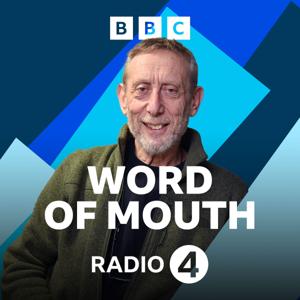
Series exploring the world of words and the ways in which we use them
Ranked by our users in the last 21 days

7,593 Listeners

371 Listeners

879 Listeners

1,042 Listeners

5,496 Listeners

1,798 Listeners

1,829 Listeners

1,038 Listeners

2,096 Listeners

487 Listeners

112 Listeners

46 Listeners

265 Listeners

404 Listeners
96 Listeners

811 Listeners

233 Listeners

161 Listeners
83 Listeners

478 Listeners
133 Listeners

3,212 Listeners

1,005 Listeners

712 Listeners

1,006 Listeners