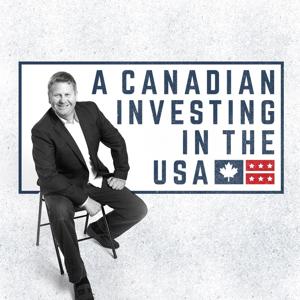
A Canadian Investing in the U.S. with Glen Sutherland

A Canadian Investing in the U.S. with Glen Sutherland

By Glen SutherlandEducation
Download on the App Store

A Canadian Investing in the U.S. with Glen Sutherland episodes

  • EP 441 - Why Boring Commercial Real Estate Beats Risky Value-Add Deals With Stewart Heath
    Stewart Heath is a CPA turned commercial real estate sponsor and founder of Harvard Grace Capital, where he buys "boring," already-stabilized properties instead of chasing ground-up development or heavy value-add deals. After years of doing both, Stewart explains why predictable, recurring cash flow beats the higher-risk upside promised by construction and renovation plays. He walks through his favorite scenario: buying mismanaged, doctor-owned medical office buildings where the physical asset is well kept but the leases are stuck far below market, then raising rents gradually over two to three years without losing tenants.
    Stewart and Glen dig into the math behind his model: locking in fixed-rate debt to eliminate interest rate risk, focusing on the spread between the cap rate and the interest rate rather than the rate itself, and using cost segregation studies to generate roughly 30 percent of the purchase price in bonus depreciation, which shelters cash flow from tax for several years. They also cover how the recent run-up in interest rates actually created buying opportunities from sellers stuck in expiring bridge loans, and why sticking to the numbers, not the asset class, is what keeps his model asset-class agnostic. Stewart closes by sharing his book, "My 10 Rules for Investing in Commercial Real Estate: Don't Do What I Did," free at harvardgrace.com.
    22 min
  • EP 440 - Why a $40K Airbnb Near Disney Can Suddenly Earn $160K a Year With Marc Younger
    Marc Younger is back on the show after six years (he was previously on episodes 76, 77, and 116). He grew up in Edmonton, moved to Orlando, and built Home Theme Orlando, a company that has themed roughly 200 short-term rental homes for investors near Walt Disney World. Marc also runs a property management arm that now handles 40 to 50 vacation homes for owners. In this episode, Glen and Marc dig into what buying and running a themed short-term rental in the Orlando area actually looks like today, from price cycles to the strict zoning line that decides where you can even legally rent nightly.
    Marc breaks down real numbers: a plain, non-themed 7 to 8 bedroom home might bring in $40,000 a year, while the same house themed around a Disney-style concept can pull $140,000 to $160,000. He explains why Highway 192 splits Orange County (no short-term rentals allowed) from Osceola and Polk counties (rentals allowed), why buying inside a large amenity-rich community beats a standalone house, and how cost segregation lets investors get back a big chunk of their down payment through accelerated depreciation. If you're a Canadian or American investor weighing a themed vacation rental near Orlando, this episode gives you current price ranges, the zoning rules, and the real revenue math.
    29 min
  • EP439 Canada vs. USA Real Estate Where Can Investors Still Find Cash Flow with Bryce Kaminsky
    In this episode of Canadian Investing in the US, Glen reconnects with Bryce Kaminsky to compare the realities of real estate investing in Canada versus the United States. Bryce shares his experience investing in Cleveland and explains why many Canadian investors are struggling to make buy-and-hold rentals work due to higher purchase prices, rising renovation costs, mortgage renewals at higher rates, and increasingly thin cash flow. He contrasts that with lower-cost U.S. markets where investors may still be able to find stronger rental yields, especially by targeting off-market opportunities and properties that can be improved through renovations.
    The conversation also explores where opportunities may still exist for investors who want to stay in Canada. Bryce suggests buying aggressively below market value, focusing on solid working-class neighborhoods, using forced appreciation, and being careful not to over-leverage during refinances. Glen and Bryce also discuss property management for remote U.S. investing, including why scenario-based interview questions can reveal far more than simply comparing management fees. The broader message is that investors should focus less on geography alone and more on finding properties that truly produce cash flow, fit their risk tolerance, and support their long-term goals.
    23 min
  • EP438 Real Estate Wire Fraud How Investors Can Avoid Losing Their Money with Robert Siciliano
    In this episode of Canadian Investing in the US, Glen speaks with security-awareness expert Robert Siciliano about the growing threat of scams, identity theft, wire fraud, and social engineering—especially for Canadians investing remotely in U.S. real estate. Robert explains that modern scammers operate like sophisticated businesses and often rely less on hacking technology than on manipulating human behaviour. He introduces the concept of becoming a “strategic human firewall” and shares his AAA protocol: Analyze, Authenticate, Act. Investors should recognize manufactured urgency, independently verify who they are communicating with, and never rely on phone numbers, email addresses, links, or wiring instructions contained in an unexpected message.
    The conversation becomes especially relevant to real estate investors when Robert explains why criminals target email accounts and how compromised or spoofed communications can be used to impersonate title companies, attorneys, lenders, buyers, and sellers. He shares a sophisticated scam in which criminals impersonated Google Security, triggered legitimate Google emails and text messages, and nearly convinced him to authorize access to his own account. Robert recommends using unique passwords for every account, a password manager, and two-factor authentication on all critical financial and email accounts. The takeaway for investors is simple: when money, account access, or wiring instructions are involved, slow the process down and independently verify everything before acting.

    35 min
  • EP437 When To Add a Canadian Corp to your USA Structure with Tim Miron
    In this episode of Canadian Investing in the US, Glen speaks with repeat guest Tim Miron, founder of Pursuit CPA, about when a Canadian real estate investor should add a Canadian corporation to their U.S. investment structure. Tim explains that the answer depends on the investor’s long-term goals, where the original investment capital comes from, and what they eventually plan to do with U.S. profits. One major reason to use a Canadian corporation is when the investor already has retained earnings inside an operating company or holding company; instead of withdrawing those funds personally and triggering another layer of tax, the corporation may be able to deploy more of that capital into U.S. investments. They also discuss moving money between Canadian and U.S. entities through properly documented management fees and intercompany loans.
    The conversation also covers the additional compliance that comes with adding a Canadian corporation, including setup costs, annual corporate tax filings, foreign reporting requirements, legal minute-book maintenance, and HST considerations. Tim explains that services provided by a Canadian company to a U.S. customer may generally be zero-rated for HST, while the Canadian corporation can potentially recover HST paid on eligible business expenses. They also discuss a second major reason to add a Canadian holding company later: once a U.S. real estate portfolio becomes profitable, investors may want to move profits back to Canada without taking the money personally, allowing the corporation to reinvest in stocks, bonds, Canadian real estate, or other opportunities
    22 min
  • EP436 Why Self Storage Beats Rental Properties with Fernando Angelucci
    In this episode of Canadian Investing in the US, Glen speaks with Fernando Angelucci, CEO of SSSE, a private equity firm focused on self-storage acquisitions and development across the United States. Fernando explains why he moved away from single-family and small multifamily investing after years of dealing with high management demands, contractor issues, tenant problems, and relatively lower profits. He shares how self-storage allowed him to operate fewer, larger transactions while increasing profitability and working with more sophisticated lenders, operators, and professionals.
    The conversation dives into Fernando’s self-storage strategy, including sourcing more than 90% of acquisitions off-market, building long-term relationships with owners, targeting larger facilities, expanding properties, increasing NOI, and eventually selling to institutional buyers. He also discusses financing options such as SBA loans and seller financing, the legal advantages of self-storage compared with residential rentals, auction procedures for delinquent units, stabilized occupancy levels, and dynamic pricing strategies similar to airlines. For investors looking for a scalable commercial real estate niche with fewer traditional landlord headaches, Fernando makes a strong case for self-storage as a business as much as a real estate investment.
    27 min
  • EP435 How to Identify and Sell Underperforming Rental Properties with Tim Tsai
    In this episode of Canadian Investing in the US, Glen reconnects with experienced real estate investor Tim Tsai to discuss one of the most overlooked decisions in real estate: when it makes sense to sell a rental property instead of continuing to hold it. Tim explains that he evaluates properties based on cash flow, NOI, cash-on-cash return, maintenance costs, and opportunity cost rather than simply focusing on how many doors he owns. After more than two decades of investing across Canada, the U.S., and the UK, Tim is now exiting the UK market because the numbers no longer justify keeping the properties. He emphasizes that aging properties often require increasing amounts of capital and attention, and investors should regularly ask whether their equity could be producing stronger returns somewhere else.
    Glen and Tim also challenge the popular real estate mindset of accumulating as many rental units as possible, arguing that portfolio performance matters more than door count. They discuss lease options as a strategy that can generate upfront option money, monthly cash flow, and a future sale while potentially reducing traditional landlord-management headaches. The conversation also explores the hidden emotional cost of owning troublesome properties, the importance of redeploying trapped equity, and why inherited or underperforming rental portfolios can eventually become liabilities rather than assets. Tim closes by emphasizing that investors make much of their money—and protect themselves from future problems—by buying correctly from the very beginning.
    28 min
  • EP434 Is Mexico Real Estate a Good Investment? What Canadians Should Know! with Matthew Scott
    In this episode of Canadian Investing in the U.S., Glen reconnects with repeat guest Matthew Scott, a Canadian real estate investor who has flipped approximately 40 properties in Southwestern Ontario and raised more than $10 million in capital. After travelling to Mexico and deciding to spend more time there, Matthew shifted his attention toward Mexican real estate, land development and the process of preparing land for future development. He discusses his work with local developers, plans to create a real estate agency and his involvement in a large land-entitlement project that could eventually be sold to a developer.
    Matthew explains how he evaluates potential areas by studying tourism, government development plans, infrastructure expansion and the activity of other developers. The conversation also examines the risks of purchasing land in Mexico, including unclear ownership records, restrictions on certain types of land, unreliable representatives and the importance of working with experienced lawyers and notaries. Matthew discusses cash purchases, financing and residency considerations before sharing how living in Mexico has changed his lifestyle and perspective. He describes his personal experiences with the culture and safety while emphasizing the importance of knowing the area, avoiding flashy displays of wealth and building relationships with trustworthy local professionals.
    31 min
  • EP433 How Rent Reporting Can Improve Credit Scores and Reduce Late Rent with Steve Harmer
    In this episode of Canadian Investing in the U.S., Glen speaks with Steve Harmer, president of FrontLobby, about how rent reporting and tenant screening can help landlords reduce risk while helping responsible tenants build their credit history. Steve explains how rental payments can be reported to major credit bureaus in both Canada and the United States, including Equifax, TransUnion and Experian depending on the country. Because rent is often a tenant’s largest monthly financial obligation, reporting on-time payments can help establish or strengthen a tenant’s credit profile. Steve also discusses a study conducted with Equifax Canada that found some participants experienced credit-score increases in the range of 40–80 points during their first six months, although the impact varies significantly depending on each tenant's existing credit history.
    The conversation also explores how landlords can use rent reporting as part of their tenant-screening and rent-collection strategy. Steve explains how landlords can screen applicants using credit reports, background checks and identity verification, while rental-payment history can provide additional insight into how applicants have handled previous leases. They also discuss reporting late or unpaid rent, obtaining tenant consent for positive reporting, reporting former tenant debt, and how small landlords can implement the system with only a few rental properties. Ultimately, the episode shows how rent reporting can create accountability for tenants while rewarding those who consistently pay on time, potentially creating a more balanced relationship between landlords and renters.
    27 min
  • EP432 Why Real Estate Investors Are Shifting from Flipping to the BRRRR Strategy with Juan Munoz
    In this episode of Canadian Investing in the U.S., Glen speaks with Jeff, an experienced real estate investor, hard money lender and coach who operates Best REI Funding, Alpha Lending and Best Capital Management. Jeff explains how his career evolved from actively flipping houses and managing rentals to focusing primarily on real estate lending and education. He emphasizes that successful investors should avoid becoming locked into a single strategy and instead develop the skills to evaluate whether each property is best suited for wholesaling, flipping, refinancing, holding as a rental or selling on the retail market.
    Jeff also discusses how higher interest rates have caused a major shift from fix-and-flip projects toward the BRRRR strategy. His lending companies previously financed approximately 80% flips and 20% BRRRR projects, but that ratio has now reversed. The conversation also explores the increasing challenges surrounding DSCR loans, including changing underwriting requirements, reduced loan-to-value ratios, higher reserve requirements and unexpected closing delays. Jeff explains that investors can reduce their risk by underwriting properties with multiple exit strategies and matching the property, financing and investment plan rather than forcing every deal into a predetermined strategy.
    25 min

About A Canadian Investing in the U.S. with Glen Sutherland

From the publisher's feed

Helping anyone invest in the U.S. real estate market from anywhere!

More shows like A Canadian Investing in the U.S. with Glen Sutherland

BiggerPockets Real Estate Podcast by BiggerPockets

BiggerPockets Real Estate Podcast

16,690 Listeners

Rich Dad Radio Show: In-Your-Face Advice on Investing, Personal Finance, & Starting a Business by The Rich Dad Media Network

Rich Dad Radio Show: In-Your-Face Advice on Investing, Personal Finance, & Starting a Business

3,838 Listeners

Build Wealth Canada Podcast by Kornel Szrejber: Investor

Build Wealth Canada Podcast

17 Listeners

The Dividend Guy Blog Podcast by Dividend Guy

The Dividend Guy Blog Podcast

61 Listeners

Ken McElroy Show by Ken McElroy

Ken McElroy Show

700 Listeners

Real Estate Rookie by BiggerPockets

Real Estate Rookie

1,809 Listeners

The Canadian Investor by Braden Dennis & Simon Belanger

The Canadian Investor

79 Listeners

PassivePockets: The Passive Real Estate Investing Show by PassivePockets, Chris Lopez

PassivePockets: The Passive Real Estate Investing Show

131 Listeners

On The Market by BiggerPockets

On The Market

887 Listeners

The BetterLife Podcast by Brandon Turner and Cam Cathcart

The BetterLife Podcast

839 Listeners

Angry Mortgage by Ron Butler

Angry Mortgage

7 Listeners

The Canadian Real Estate Investor by Daniel Foch & Nick Hill

The Canadian Real Estate Investor

31 Listeners

The Loonie Hour by Steve Saretsky

The Loonie Hour

14 Listeners

The David Greene Show by David Greene

The David Greene Show

699 Listeners

The Wealthy Barber Podcast by The Wealthy Barber Inc.

The Wealthy Barber Podcast

51 Listeners