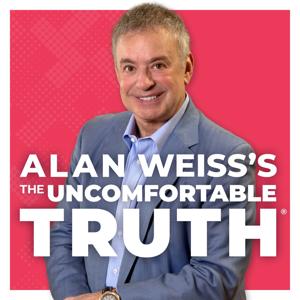
Alan Weiss's The Uncomfortable Truth®

Alan Weiss's The Uncomfortable Truth®

By Alan WeissSociety & Culture
Download on the App Store

Alan Weiss's The Uncomfortable Truth® episodes

  • A Great Education
    I was required to engage in a “liberal arts” education at Rutgers. That meant that I had to have credits in languages over two or three years, science every year, history for two years, and English for two years. Although I majored in Political Science, because I thought I was going to law school (!), these other classes were required.
    The length and amount of education is far less important than the quality and depth of education. A lot of people attend school (sometimes for far more than four years) and simply get their “ticket stamped.” I sat next to a great many students who were no better off leaving school than they were entering it except that they had more job prospects.
    In these times, with competence more sought than credentials, that might no longer be true. Airlines are looking for qualified pilots whether or not they have a college education. We have a shortage of air traffic controllers. Do they need college educations? An electrician doesn’t.
    We tend to focus on business books and the “idea du jour.” I had a client who wanted to change her Fortune 100’s organization every time she went to a new seminar or read another book.
    It is okay to be the smartest person in the room—someone has to be. It’s not okay to try to be the second smartest. You’ll earn what that means when you listen to the podcast.
    You’ll also hear my two key criteria to determine intelligence. See if you pass my test.
    10 min
  • A Conversation with Al McCree
    Al McCree is a former fighter pilot who has flown 196 missions! He is an executive in the music business and has managed all kinds of talent. He’s also worked with top business executives.
    We talk about the differences and similarities of combat flying and the competition of the music business and the challenges of changing hearts and minds in a business setting. Ironically Al thinks music can be a distraction at work, even though we see so many people with ear buds in all kinds of workplaces.
    I challenge Al a bit on his belief that DNA and genetics are important for success. We both reflect on the wonderful, developmental feedback we obtained at the Johnson O’Connor Research Foundation (and why he can play a musical instrument and I can’t, authoritatively validated).
    We fondly recall Jeanne Robertson, a brilliant speaker and storyteller who, in a beauty contest, enthralled the judges with her “talent” of twirling an invisible baton, which she lit on fire and had it descend on the judges’ heads.
    The role of luck is analyzed in any pursuit, and Al feels it’s a stronger factor than might be realized. But what is luck, really? And before we end we discuss how to exemplify what will make your kids successful, especially if they’ve led a privileged life and may not have the parents’ “hunger.”
    30 min
  • How I'd Change Education
    Primary and secondary
    1 End the “warehousing” of children
    • Chronology is silly and hundreds of years old
    • Socialization is important, but not at this cost
    • Move kids as they learn
    • Measure learning by outcomes: application, tests, etc.
    2. Stop defaulting to college educations
    • Prepare for a range of employment opportunities
    • I sat next to too many duds in college
    • Teach life skills: civics, account management, do-it-yourself repairs (remember shop and home economics)
    • Growing tendency to hire competence and not credentials
    3. End the teachers’ unions control of schools
    • Introduce carrots and sticks for teachers
    • The Rubber Room in New York City
    • Albert Shanker’s quote
    • Randi Weingarten’s $600,000
    • The customers are the parents and kids, not teachers
    • Make the job rewarding and also demanding
    • Recreate school “open houses”
    • End the mainstreaming of behavioral problems
    • End the inclusion on non-English speakers
    • My experience with Tourette’s Syndrome
    • Teachers have lowest grade point averages and attend the worst academic schools
    • Former president of URI: People with poor finances and/or grades go to inexpensive and mediocre schools
    • Get rid of failed progressive nonsense like “new math”
    • Allow for school choice of all kinds with vouchers
    4. Change school financing
    • The affluent/tax/attraction/more tax trap
    • Pool money within the state for equal distribution
    • Create true equal opportunity with equivalent resources, quality, teaching across the state
    5. Enforce discipline
    • Assistant principle might go to jail for stopping a female, black student from heading for a fight, she claimed he physically abused her in doing so. She had threatened the fight.
    • Mandate school officers. Anyone who says that children are fearful of uniforms and police should understand they’d be more fearful of being beaten up or shot at.
    6. Apply common sense and avoid political correctness and the woke
    • Teachers may not involve themselves with personal, sexual, gender, and similar issues without involving parents, including names kids use, how they dress, and how they want to be addressed.
    • Teachers’ personal politics, gender beliefs, and religious beliefs are not permitted in the classroom.

    12 min
  • Conspiracies
    Not just about the government or the banks or big Pharma, but even sports when YOUR team loses! “The refs were crooked, it was rigged.”
    9/11 was an “inside” job, and we never landed on the moon.
    Key elements: belief in a pattern underlying the event; provocative and deliberate plans; coalitions or groups are involved, even disparate ones; there is a clear and present danger; secrecy that is hard to justify or believe by non-conspirators. Groups blamed are typical targets: wealthy, politicians, business leaders (especially bankers), historically stigmatized minorities, such as Jews or Roma.
    Conspiracists defy pragmatism and evidence, e.g., “Princess Diana actually killer herself or faked her death.”
    The threat of lack of control forces insecure people to find cause and effect outside of their control that explains their fate. (THEY are out to get me/us.) Paranoia is a key element, involving perceived victimization, social isolation, and the refusal to admit that others succeed by their talents and hard work. Paranoia generally starts individually but then lends itself to “groupthink.”
    Conspiracy thinking, or the tendency to believe in conspiracy theories, shares several characteristics with paranoia. Both involve ideas that harmful outcomes can be attributed to malevolent agents rather than to more benign or non-agentive causes. Other similarities in concept are notable, for example, both paranoia and conspiracy thinking represent suspicions that can be hard to falsify and may concern events or theories that later emerge to be true, for example claims about pandemic demands by the government that, scientifically, were incorrect and ineffective.
    In an increasingly volatile age, without confirmations of power and control, people default to these “settings.” This will become worse.
    Perhaps paranoid to begin with, see this as a conspiracy, though I doubt that Trump ever did.
    11 min
  • Pressure
    The more pressure you feel, the more your talent is “masked” and the worse you perform. You control pressure.
    You can’t allow yourself to feel “judged” every time you speak, write, or perform. And when and if you do need feedback, never accept it from unsolicited sources, which is always for the sender’s benefit, not yours. Seek solicited feedback from trusted people you respect.
    It’s fine to feel anticipation and eagerness to proceed, which should heighten your performance, but not fear and dread which will diminish it. The greatest athletes are who they are not because of their everyday performance, but because of how well they perform in championship games, under maximum pressure from the other team, the media, and fans.
    Maintain perspective. No one is shooting at you. You should fear a tornado in Kansas in a storm, but not a question in a conference room during a meeting.
    We too often create pressure on ourselves by comparing our intended performance against great performances we’ve seen, and therefore fear being seen as inferior to them. In fact, we need simply to prepare well, do our best, and then go home. Our lives are greater than a single event or a single day.
    When you’re afraid to post on social media, or have to rewrite or re-record something six times, you’re simply creating your own tornado. And this isn’t Kansas anymore, Dorothy.
    10 min
  • Skechers
    Do you need shoes that you can put on without touching them, without bending down, without even sitting down? Barring those whose illnesses or conditions prohibit bending, just how lazy are the rest of us becoming?
    Skechers sells some shoes which have a patented device near the top of the heel that allows you to slip into them without manipulating the shoe: no shoehorn, no wiggling, no close proximity at all. (Of course, you have to have the mental capacity to know your toes go in first.) I can understand this if you’re, say, 90. But they’re advertising this for everyone. How lazy are we becoming?
    Our luggage has wheels these days. People can gamble on their smart phone apps and talk into their wrists. We may think that garage door openers and TVs “must” be remote, but why fireplaces? You no longer build a satisfying fire any more, you program one. How lazy are we becoming?
    Vacuum cleaners now self-clean, and lawn mowers self-mow. Cars can self-park. Gym trainers assist their customers in lifting weights. Siri keeps interrupting intelligent thought to see if she can be of further annoyance. People try to cut turkeys with electric knives, which is like using a blowtorch to light up a cigar. How lazy are we becoming?
    One of my cars “hands” my seatbelt to me, and the car manuals are six hundred pages because of all the automatic features. Meanwhile, I haven’t used cruise control, which has been on every one of my cars, in 25 years.
    And now we have those Japanese toilets….
    11 min
  • Control
    Some things we can control, some we can influence, and some we can neither control nor influence. It’s important to understand the differences, and it’s vital to never cede control nor underestimate our abilities to control.
    Facing a prospect for the first time, what do you think you can control, influence, or affect neither? (Listen to the podcast to hear the examples.) Do you tend to surrender control because the prospect is powerful or wealthy? Do you sacrifice personal time, change important personal appointments, and inconvenience your family over client issues that the client could easily change?
    You can control where your kids go to school, what kind of insurance you carry, where to go on vacation, and how to deal with colleagues. You can certainly influence the boss, clients or prospects, or suppliers, a lot more than you think (or currently are).
    If nothing else, consider this: language controls discussion, discussion controls relationships, and relationships control business.
    The larger and more diverse our vocabulary, the more we can use metaphors, analogies, metonymy, hyperbole, and so forth, the more we can influence. When someone objects to my fees I point out that my fees are less than they pay to plow the parking lots, mist the plants, and compensate for spillage and spoilage. Where is the best ROI?
    You best ROI, of course, is listening to and heeding this free podcast!
    12 min
  • Electric
    We’re going to need tens of millions of electric charging stations to satisfy goals for electric cars in six years set by the government. It looks like we might have 500,000.
    Electric cars might represent zero carbon footprint improvement. The mining of lithium is dirty and expensive and requires a lot of energy. Disposal of the batteries presents similar problems. Fires are a danger and are harder to extinguish.
    Hertz is returning or cancelling orders for a thousand electric vehicles because they are not in demand for rentals and are hard to maintain. Ford has pulled back investment in battery plants. Toyota has committed solely to hybrids.
    I’ve driven in them and driven them myself. Meh. Not a big deal, and still limited ranges.
    We’re going to have to overcome our own hubris and realize that climate change isn’t going to be reversed and maybe not even halted. We can’t build (and insure) housing on the water’s edge or in forests. We can’t expect to ban internal combustion engines, gas stoves, and gas leaf-blowers (which is ludicrous).
    What we DO need in the US is energy independence (which we once had and can easily have again with our huge reserves), control of the southern border to permit legal immigration for white and blue-collar jobs, and a vast improvement in educational equal opportunity.
    Otherwise it may be “lights out” for reasons other than insufficient electrical power.
    12 min
  • Quantity Over Quality
    I send out
    • Daily video
    • Monthly video
    • Weekly podcast
    • Monthly newsletter
    • Weekly newsletter
    • Blog 7 days publicly
    • Blog 7 days to community
    • Post on X 7 times per week
    • Post on LinkiedIn 3 times per week
    • Send out monthly promo piece
    That’s 1,651 potential contact points with clients and prospects annually
    That’s why I receive unsolicited referrals and purchases
    People can always unsubscribe, I’m never offended
    How long does this take me: Total is three hours a week or half a day.
    I don’t self-edit or cover up mistakes
    I use self-effacing humor
    I tackle some tough issues
    I have a huge net, so I only pull out the fish I desire
    I have offerings at various levels for everyone
    I market before I create content
    I rely on external resources for technology, etc.
    I’m faster at both quality and quantity than ChatGPT
    Does this really work?
    Well, you’re listening right now, right?
    5 min
  • The Post-Pandemic Blues
    The pandemic is a milestone event. Even if the medical effects have been ameliorated (which is debatable), the social impact is huge and continuing. Some of the evidence:
    • Some people continuing to wear masks, which also serve as a “warning” to others, and is an extreme behavior if one isn’t otherwise medically compromised. Covid transmission interpersonally would require someone in very close proximity for an extended period of time. Also, masks prompt people to keep touching their faces, which can cause further disease spread.
    • “Live” business meetings have been hugely reduced, from conventions of thousands to conferences among a few people.
    • Business travel has been commensurately reduced with remote meetings preferred.
    • People are suffering from mental health issues being in isolation in their homes, even with family, because of the inability to have lunch or a drink with co-workers.
    • Work pressures have mounted as leaders try to figure out how to assign and measure productivity among people who are not physically present. This has ranged from many tech workers never coming into an office to Elon Musk demanding that his SpaceX workers show up physically for 40 hours a week.
    People are more isolated than ever, and more despairing than ever. Add to the increasing automation and AI integration and the trend worsens. Once upon a time a driver could chat with a gas station attendant about politics, sports, the weather and so forth. Now, most gas stations are self-serve, attached to a mini-mart. (The gas pump, however, does talk to you, since it’s programmed to play advertisements.)
    We’ve made some progress in dealing with business needs and travel needs since the pandemic, with supply chains and international trade, but not so much with emotional needs. Our ability to express ourselves to colleagues and acquaintances, to learn whether our positions are supported or resisted, to share a laugh or a celebration are severely reduced.
    It’s true that people continue to gather in large number for sports and entertainment events, whether locally or remotely, but these aren’t frequent and far from intimate. A million people might gather for New Year’s in Times Square, but they’re only sharing some moments in time and not personal sentiments. (Is there anything so superficial as an entertainer telling the audience that he or she “loves them all”?)
    We’ve actually made more emotional progress, however, socially than we have professionally and in business settings. Coffee shops are still jammed in the mornings, restaurants are overflowing, golf courses and pickleball courts are filled. Most people in these venues know each other and continue the relationship, and newcomers are usually welcomed.
    8 min

About Alan Weiss's The Uncomfortable Truth®

From the publisher's feed

Alan Weiss's The Uncomfortable Truth® is a weekly broadcast from “The Rock Star of Consulting,” Alan Weiss, who holds forth with his best (and often most contrarian) ideas about society, culture,…

More shows like Alan Weiss's The Uncomfortable Truth®

The Tim Ferriss Show by Tim Ferriss: Bestselling Author, Human Guinea Pig

The Tim Ferriss Show

16,052 Listeners

The Knowledge Project by Shane Parrish

The Knowledge Project

2,699 Listeners

Making Sense with Sam Harris by Sam Harris

Making Sense with Sam Harris

26,243 Listeners

The Amy Porterfield Show by Amy Porterfield

The Amy Porterfield Show

4,585 Listeners

HBR IdeaCast by Harvard Business Review

HBR IdeaCast

143 Listeners

The StoryBrand Podcast by StoryBrand.com

The StoryBrand Podcast

1,932 Listeners

The Martell Method w/ Dan Martell by Dan Martell

The Martell Method w/ Dan Martell

578 Listeners

The Daily by The New York Times

The Daily

111,821 Listeners

The Cure for Chronic Pain with Nicole Sachs, LCSW by Nicole Sachs, LCSW

The Cure for Chronic Pain with Nicole Sachs, LCSW

2,511 Listeners

My First Million by Hubspot Media

My First Million

2,649 Listeners

At The Table with Patrick Lencioni by Patrick Lencioni

At The Table with Patrick Lencioni

1,126 Listeners

All-In with Chamath, Jason, Sacks & Friedberg by All-In Podcast, LLC

All-In with Chamath, Jason, Sacks & Friedberg

10,124 Listeners

The Ezra Klein Show by New York Times Opinion

The Ezra Klein Show

15,911 Listeners

Pulling The Thread with Elise Loehnen by Elise Loehnen

Pulling The Thread with Elise Loehnen

1,106 Listeners

The AI Daily Brief: Artificial Intelligence News and Analysis by Nathaniel Whittemore

The AI Daily Brief: Artificial Intelligence News and Analysis

674 Listeners