
Sign up to save your podcasts
Or

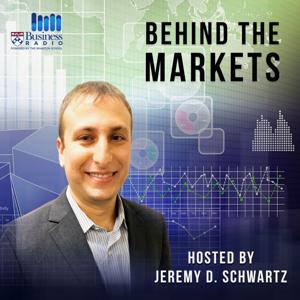
By Behind the Markets


4.4
9797 ratings


The podcast currently has 656 episodes available.
The most played episodes among Podcast App listeners.
Show from 2026-08-28 Jeremy Schwartz and Professor Siegel open with a discussion of the latest Federal Reserve signals, with Siegel praising the renewed emphasis on money supply, bank credit, commodity prices, market-based inflation expectations, and interest rates. Siegel views the Fed’s tone as more hawkish than expected, but argues that markets responded positively because policymakers provided clearer criteria and demonstrated a more disciplined framework. He also discusses the possibility of additional rate hikes, the resilience of economic activity, and the market implications of strong earnings from NVIDIA and Salesforce. (12:40) After Professor Siegel leaves, Schwartz is joined by Michael Fridman, Sam Rines, and Chris Gannatti for a broader market and technology discussion. The group examines NVIDIA’s continued data-center growth, the widening base of AI demand, improving sentiment toward software, Salesforce’s rebound, and the distinction between broad software recovery and selective opportunities. They also debate potential risks to the AI trade, custom chips versus NVIDIA’s full-stack ecosystem, Marvell’s positioning, Meta’s legal settlement, and developments in quantum computing. The conversation closes with signs of resilience in consumer spending, the transition from AI infrastructure buildout toward commercialization, improving profit margins, and renewed interest in gold as a portfolio diversifier. Michael on LinkedIn: https://www.linkedin.com/in/michaelfridman23/ WisdomTree: https://www.wisdomtree.com/investments

Show from 2026-08-21 Professor Jeremy Siegel joins Jeremy Schwartz to discuss Treasury Secretary Scott Bessent’s efforts to influence the yield curve, the implications for Fed credibility, and the market’s reaction across bonds, crypto, gold, and the dollar. Siegel also previews Jackson Hole, arguing investors need more clarity on Chair Kevin Warsh’s reaction function, while noting that rising commodity prices and continued money-supply growth could strengthen the case for higher rates later in the year. He also weighs geopolitical risks surrounding Iran, China, oil flows, and the Strait of Hormuz. (14:12) After Siegel leaves, Sam Rines and Chris Gannatti join Schwartz for a broader discussion spanning consumers, technology, and global markets. Rines assesses Walmart, Target, Ross Stores, and Redbook data, concluding that consumer spending remains resilient despite mixed retail earnings. The group explores AI-driven drug discovery, Moderna’s cancer-treatment developments, humanoid robotics, drones, and the growing overlap between defense technology and commercial applications. They also examine opportunities in Europe and Japan, renewed momentum in crypto and gold, the impact of a weaker dollar, China’s AI ecosystem, and NVIDIA’s expanding role in financing AI infrastructure. Gannatti closes with developments in quantum computing, including sensing, navigation, cybersecurity, and emerging commercial applications. WisdomTree: https://www.wisdomtree.com/investments
Show from 2026-09-11 Jeremy Schwartz and Professor Jeremy Siegel open the show by assessing hotter-than-expected inflation, rising Treasury yields, and the growing likelihood of a Federal Reserve rate hike. Siegel argues that credit expansion, persistent inflation pressures, and signals from the yield curve support tighter policy, while noting that equities have remained surprisingly resilient despite higher rates and volatile energy prices. The discussion also covers oil, diesel, geopolitical risks surrounding Iran and key shipping routes, and concerns about Treasury-market credibility and policy coordination. (18:00) After Professor Siegel leaves, Jeremy is joined by Sam Rines and Chris Gannatti for a broad look at earnings, artificial intelligence, and global macro developments. They discuss Oracle’s massive backlog, data-center financing, and continued demand for compute; Kroger’s AI-driven precision marketing business; Meta’s AI investments; and Adobe’s valuation, AI strategy, and content-provenance advantages. Chris also reviews Apple’s latest product event and progress in quantum computing, including developments at IonQ. The conversation closes with the ECB, European energy pressures, Middle East negotiations, currency-market reactions, the Japanese yen, and how a potential Fed rate hike could influence the dollar and longer-term yields. WisdomTree: https://www.wisdomtree.com/investments
Show from 2026-09-04 Jeremy Schwartz and Professor Jeremy Siegel open with the latest jobs report, highlighting stronger-than-expected payroll growth, upward revisions, rising hours worked, improved labor-force participation, and contained wage pressures. Siegel argues the data point to a resilient economy but may temper hopes for a dramatic AI-driven productivity surge this quarter. He also discusses the case for a Federal Reserve rate hike, rising money supply growth, bond yields, inflation risks tied to oil and Iran, and the market implications of stronger growth and higher discount rates. The conversation also touches on AI-related productivity gains, limited evidence of widespread AI-driven layoffs, and geopolitical developments involving Russia and Ukraine. (16:00) After Professor Siegel signs off, Schwartz continues with Sam Rines and Chris Gannatti. They examine whether longer-duration bonds are becoming more attractive, along with opportunities in gold, housing, and other rate-sensitive areas. The discussion then turns to AI, including hyperscaler spending, data-center commitments, semiconductor beneficiaries, the risks surrounding future compute demand, and whether major technology companies are becoming value opportunities. They also cover Tesla’s robotaxis, the strategic importance of compute, Japan’s currency and rate outlook, Venezuela’s potential role in U.S. energy security, and continued progress in quantum computing. WisdomTree: https://www.wisdomtree.com/investments
Show from 2026-08-14 Host Jeremy Schwartz and Professor Siegel discuss weaker retail sales, inflation trends, strong corporate earnings and the market continuing to reach new highs. The Prof notes that some recent economic data has softened, but higher-frequency indicators are not yet pointing to a major slowdown, while lower oil prices and encouraging inflation details remain supportive for markets. He also focuses on Fed policy, arguing that while avoiding forward guidance is defensible, the Fed still needs to be clearer about its reaction function, the inflation measures it is watching and the conditions that would lead to a rate change, with Jackson Hole potentially providing that clarity. Jim Bianco joins the discussion with the Prof to break the issue into forward guidance, the Fed’s reaction function and the increasingly independent voting behavior of committee members. (21:12) Jeremy continues with Jim Bianco, Sam Rines and Chris Gannatti to discuss their takeaways from Camp Kotok, including the massive scale of AI capital spending, the federal deficit, geopolitical risk and the changing nature of warfare as drones and lower-cost technologies challenge traditional military spending. Sam expands on defense procurement and tariffs, while Chris discusses developments in quantum computing and the roadmaps public companies are laying out toward fault-tolerant systems. Jim then walks through his current bond-market positioning, including a more neutral stance on duration, corporate bonds and mortgages, along with exposure to convertible bonds tied to the AI theme. He also explains why moderately higher rates may be consistent with a strong economy, where rates could begin to pressure equities, and why lower mortgage rates alone may not solve housing affordability. The conversation closes with global markets, Japan, rising rates overseas, currency intervention, the yen and the effect of tariffs on corporate capital flows. About the guest: Jim Bianco is President and Index Manager at Bianco Research Advisors. He is also the President of Bianco Research LLC. Since 1990, Jim’s commentaries have offered a unique perspective on the global economy and financial markets. Unencumbered by the biases of traditional Wall Street research, Jim has built a decades long reputation for objective, incisive commentary that challenges consensus thinking. Jim appears regularly on CNBC, Bloomberg, and Fox Business, and is often featured in the Wall Street Journal, Bloomberg News, Grants Interest Rate Observer, and MarketWatch. Jim has a Bachelor of Science degree in Finance from Marquette University (1984) and an MBA from Fordham University (1989). Learn More about the Bianco Total Return Index: https://www.biancoadvisors.com/ WisdomTree: https://www.wisdomtree.com/investments
The podcast currently has 656 episodes available.
970 Listeners
3,061 Listeners

590 Listeners
2,192 Listeners
954 Listeners

2,025 Listeners

2,140 Listeners

88 Listeners
89 Listeners
98 Listeners
210 Listeners
826 Listeners

168 Listeners
268 Listeners

156 Listeners