
Sign up to save your podcasts
Or



Anxiety around authority isn't a professionalism problem — it's a nervous system response. This episode helps you communicate upward with clarity instead of panic.
Key reminder: Authority doesn't require self-erasure. Clarity is not disrespect.
This week, notice one interaction with authority that triggers anxiety. Name the worry, identify the hidden commitment, and choose one experiment. Communicate once without over-performing.
At Communicate Connect Thrive, we believe you can hold both respect and self-trust at the same time — and this episode shows you exactly how. Power doesn't have to produce panic when you have a framework to stand on.
Connect with us!
Until next time — speak clearly and listen bravely.
• Why feeling evaluated at work can trigger anxiety—even for experienced professionals
When you feel evaluated, your attention often turns inward.
Pause and breathe – regulate your body before responding
Reconnect to your goal – ask: What am I here to accomplish?
Stay flexible – allow new ideas and perspectives to emerge
You are doing better than you think.
Speak clearly.
Spiraling after feedback doesn't mean you're weak — it means your system is treating information like a threat. This episode helps you change that.
Key reminder: Feedback is information, not identity.
This week, notice one moment when feedback triggers anxiety. Pause before interpreting it. Name the worry and the assumption underneath it. Then choose one response experiment and stay curious instead of collapsing.
Communicate Connect Thrive is built on the belief that discomfort is the doorway to insight — and nowhere is that more true than in how we receive feedback. This episode gives you the tools to walk through that door with your confidence intact.
Connect with us!
Until next time — speak clearly and listen bravely.
Inclusive cultures aren’t built by accident. They’re built when individuals become conscious of how power moves — and choose to move differently.
Diversity isn’t just about representation. It’s about how we distribute voice, validation, and opportunity.
When women move from scarcity to solidarity, workplaces change.
We would love to connect with you.
Microaggressions between women in the workplace are often subtle, confusing, and deeply invalidating. In this episode, we explore why they hurt more when they come from another woman—and how to respond with clarity, boundaries, and self-trust.
In This Episode, We Cover:
Key Takeaway:
We would love to connect with you.
We'd love to connect with you in the Facebook group: Communication Skills for Working Women
You asked for help.
The tone shifted.
In this short solo episode of Communication Skills for Working Women, we talk about what to do when your ask doesn’t go the way you expected.
Because sometimes it’s not incompetence.
Sometimes it’s timing.
And repair is part of professional communication.
Why asking for help can feel high-risk at work
How timing affects how your request is received
What to do instead of panicking when the energy shifts
Why the first attempt is not the final verdict on your competence
How to create space and revisit a conversation strategically
Four ways to ask for help that signal initiative, not insecurity
1. Show Your Work Before You Ask
Signals effort. Protects credibility. Invites collaboration.
2. Frame the Ask Around Impact, Not Your Limitation
Leaders respond to outcomes.
3. Ask to Learn the System, Not Just Fix the Moment
Shows ownership and long-term thinking.
4. Name the Gap Without Apologizing for It
Neutral. Clear. Direct.
If your first ask lands wrong, that does not mean you are incompetent.
You are allowed to:
Pause.
Revisit.
Clarify.
Try again.
Asking for help is not a one-shot performance.
It’s an experiment.
And capable professionals don’t grow by struggling silently — they grow by asking strategically.
The barrier to asking for help isn't pride — it's an internal system convinced that needing support means you're failing. This episode changes that story.
Key reminder: Asking strategic questions is a competence signal — not a weakness signal.
This week, notice one moment you need help but hesitate to ask. Name the worry, identify the assumption, and choose one experiment. Ask once before you talk yourself out of it.
At Communicate Connect Thrive, we know that connection and growth happen when we're willing to be honest about what we need. Asking for help is one of the most powerful ways to do both.
Connect with us!
Until next time — speak clearly and listen bravely.
In this short mid-drop episode, we continue to explore imposter syndrome—also known as the impostor phenomenon—and why it disproportionately impacts women, particularly those from marginalized communities.
Imposter syndrome isn't a confidence problem — it's a protection strategy. In this episode we use our communication framework to understand what's really happening and how to show up anyway.
Key reminder: Confidence is built through action — not certainty.
This week, notice one moment imposter syndrome shows up. Identify the worry, the hidden commitment, and the assumption underneath it. Then choose one small experiment and speak once before you talk yourself out of it.
Communicate Connect Thrive exists to help you move from discomfort to insight to confident visibility — and this episode is that formula in action.
Connect with us!
Until next time — speak clearly and listen bravely.
Reaching out to a quiet or withdrawn friend seems simple but for many of us, it feels surprisingly hard.
In this episode, we explore why caring deeply doesn’t always translate into action, and how a maladaptive internal process can quietly keep us from making meaningful connection. In this episode, we unpack the fears, assumptions, and protective strategies that stop us from reaching out and offer practical, low-pressure ways to show up for the people we care about.
This episode is for anyone who has thought, “I should check on them,” and then talked themselves out of it.
We would love to connect with you.
From the publisher's feed
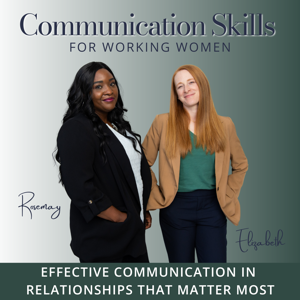
We’re Elizabeth and Rosemay, women, mothers, spouses, friends. Rosemay is a therapist and current PhD candidate, and Elizabeth is a facilitator and coach.
Over the last 20 years, we’ve lived, worked, and studied across different industries and cultures, and one thing has become clear: there’s no substitute for communication. Skill gaps can be fixed, connection is a basic human need, and when you learn to communicate with clarity, you can truly thrive.
We look forward to meeting you!
This podcast is designed to help you do just that. Each week, we share practical, communication skills you can apply right away, at work, at home, and in the relationships that matter most.
🎧 Hit play to learn a new skill you can start using today.
Ready to dive deeper?
✨ Visit us at: communicateconnectthrive.com
✨ Email us: [email protected]
✨Facebook: Develop confidence in relationships through effective communication skills
✨ Instagram: Communicationskillsforwomen https://www.instagram.com/communicationskillsforwomen/?hl=en

8,840 Listeners

43,324 Listeners

8,463 Listeners

369,570 Listeners

164,509 Listeners

41 Listeners

27,855 Listeners
8 Listeners

824 Listeners
15 Listeners

1,390 Listeners

15,295 Listeners

45 Listeners

19,270 Listeners

730 Listeners