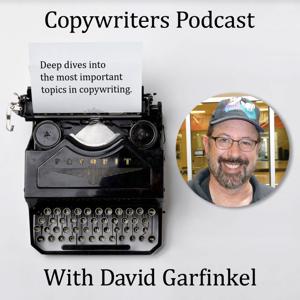
Copywriters Podcast

Copywriters Podcast

By David GarfinkelBusinessEducation
Download on the App Store

Copywriters Podcast episodes

  • A-List Copywriter Carline Anglade-Cole Shares Freelancer Secrets

    We’re back Carline Anglade-Cole, is a top copywriter with a track record and a level of creativity anyone else would be jealous of.
    Her latest book is called, “My Life as a 50+ White Male.” That’s because, as a biracial woman, Carline has successfully found a way to get into the mindset of her prospect. Which, as you can imagine, is quite different than she is!
    Last week, Carline traced back the lessons of her career as an in-house copywriter for Phillips Publishing, and especially her mentorship with the late Clayton Makepeace.
    She’s back today because she has agreed to share some of her highly valuable freelancer secrets, which everybody needs to hear -- even if you’re not a freelancer!
    She generously agreed, and that’s what we’ll talk about today.
    Here is what I asked her:
    1. In your new book, you write:
    “You’ve got to remember, when you’re a freelancer, your first client is YOU!”
    Sage advice, and I’ve never heard it put quite that way before. How about a couple tips for freelance copywriters on marketing themselves?
    2. You were raising your kids both in your time as a team member at Phillips, and as a freelancer. Could you talk about the challenges you faced in your two roles as mom and copywriter, and how you handled the challenges?
    3. What were the most important lessons you learned from your first gig, writing the male potency product promo?
    4. What are the biggest mistakes you see freelance copywriters making? What should they do instead?
    5. This part in your book really impressed me:
    “If I was not comfortable with the product, why should I try to sell it to my market? These folks are counting on me to look out for them.
    “I really believe that’s a big reason for my success. It’s much easier to write strong sales copy and get controls when your products actually help people.”
    Could you talk about that and how it has guided your career?
    6. Tell us more about your book!
    Carline’s new book: https://www.amazon.com/Life-Year-Old-White-Male-Direct-Response-ebook/dp/B08DJDDKPY


    Download.
    30 min
  • A-List Copywriter Carline Anglade-Cole Shares Career Secrets

    Our guest today, Carline Anglade-Cole, is a top copywriter with a track record and a level of creativity anyone else would be jealous of.
    Her latest book is called, “My Life as a 50+ White Male.” That’s because, as a biracial woman, Carline has successfully found a way to get into the mindset of her prospect. Which, as you can imagine, is quite different than she is!
    I asked Carline if she would trace back the lessons of her career as an in-house copywriter for Phillips Publishing, and especially her mentorship with the late Clayton Makepeace.
    She generously agreed, and that’s what we talked about. Here are the questions I asked her:
    1. I’m going to guess most people outside direct marketing have no idea what a big publisher like Phillips even is (or was, since Phillips now has a different name). But I also imagine a lot of people in direct marketing who’ve never worked on staff for one of these big publishers think the organizations are different than they really are.
    When people ask you about working on staff for a company like Phillips, what’s the biggest misconception you find they have -- and what was the reality for you?
    2. You had the good fortune to have Clayton Makepeace as a mentor. Could you walk us through a few high points of what it was like to get a copy critique from Clayton?
    3. Regarding copywriting, what was the most important thing Clayton every told you?
    4. You say in your book that sometimes when you face a tough copy decision, you ask yourself, “What would Clayton do?” Could you tell us about a time or two that happened, what your thought process was, and what you ended up doing?
    5. In your book, you write, “Anyone can learn to write in any niche.” Could you explain how that is even possible? (Your male potency supplement story would work well here, if you like.)
    6. What’s your advice to women — especially, women of color — who want to make waves writing promo’s for the big publishers?
    7. Tell us about your new book!
    Carline’s new book: https://www.amazon.com/Life-Year-Old-White-Male-Direct-Response-ebook/dp/B08DJDDKPY


    Download.
    32 min
  • Copywriter-Fueled Product Creation, Part 2

    Last week we talked about the Big Four questions you need to answer when you’re designing a new product you’d like to sell a lot of. You can also use these questions to fix a product that’s not selling very well.
    As I said last week, I really got a lot out of interviewing my friend and former mentoring client Chris Haddad over the last two shows.
    One of the things that struck me about what he said was: That he creates products exactly, or almost exactly, the way he writes sales letters and VSLs.
    I’ve been doing that for so long myself that I had forgotten most people don’t know about this trick. And if they know about it, they don’t do it.
    Then, a couple weeks ago, I did a consult for a client who wanted help planning a new product. I realized this would be the perfect opportunity to reverse-engineer what I did and share it with everyone who listens to the podcast.
    This is information I’ve been using for years, but frankly it’s never occurred to me to share it before.
    This week we’re going to drill down with seven detailed questions that really help you hone your product’s appeal. Especially after you’ve handled the Big Four questions that cover the big picture.
    We’re continuing from where we left off last week. If you haven’t watched or listened to that show yet, it might be worthwhile to listen to it first before you listen to this one.
    Now, I do a lot of copy consults for people, usually on their sales copy after they’ve got the product done and when they’re just about ready to launch. I’ve been able to help people avoid problems and also crank up higher sales with these consultations. But I would be able to help them a lot more if they brought me in at the time they were conceptualizing the product.
    Most people don’t do that, but one client did last week. In light of what Chris Haddad told us in one of his interviews, I took a lot of notes on my questions. I’m keeping my client’s particular answers confidential, as I always do.
    But as we get into the seven nitty-gritty questions this week, I’ll fill in answers for one of my products, and I’m hoping Nathan will have some experiences with his own products, or his clients’ products, early on enough in the development cycle so we can show you how this works.
    These questions really force you to focus on what’s important to your prospect — what’s going to grab their attention right away, and hold it. Use them correctly, and they’ll end up thinking, “Wow! This product was built just for me!”


    Download.
    33 min
  • Copywriter-Fueled Product Creation, Part 1

    I really got a lot out of interviewing my friend and former mentoring client Chris Haddad over the last two shows.
    One of the things that struck me about what he said was: That he creates products exactly, or almost exactly, the way he writes sales letters and VSLs.
    I’ve been doing that for so long myself that I had forgotten most people don’t know about this trick. And if they know about it, they don’t do it.
    Then, last week, I did a consult for a client who wanted help planning a new product. I realized this would be the perfect opportunity to reverse-engineer what I did and share it with everyone who listens to the podcast.
    This is information I’ve been using for years, but frankly it’s never occurred to me to share it before.
    However, it just did occur to me, so let’s do it. If you are planning to create a new product, or fix one that isn’t very popular… then this will be valuable to you.
    Now, a lot of people still try to create products using the “Field of Dreams” approach. I’m referring to the Hollywood movie about baseball, which has the memorable, but financially toxic, line in it: “Build it and they will come.”
    Hey, even Hollywood, which lives in a magical world of its own, doesn’t entirely just build a movie and hope the audiences will come. They do test screenings of different versions of a movie to see which one audiences like better before they release a movie.
    But we’re not Hollywood, and especially when you’re creating a product for a particular niche, rather than a mass movie-going audience, you have access to better information than Hollywood does when they try to come up with a new movie that’s familiar, yet different. And, if the stars align, something good enough so a lot of people are willing to pay to watch it.
    I do consultations for people, usually on their sales copy after they’ve got the product done and when they’re just about ready to launch. I’ve been able to help people avoid problems and also crank up higher sales with these consultations. But I would be able to help them a lot more if they brought me in at the time they were conceptualizing the product.
    Most people don’t do that, but one client did last week. In light of what Chris Haddad told us in one of his interviews, I took a lot of notes on my questions. I’m keeping my client’s particular answers confidential, as I always do. But I’ll fill in answers for one of my products, and I’m hoping Nathan will have some experiences with his own products, or his clients products, early on enough in the development cycle so we can show you how this works.
    Now, when I did my consultation with my client, she found three missing things in the product she was planning. When she adds those things, I think her sales will later end up being a lot higher. There’s another thing to consider, though. If you can’t answer some of these questions in a way that directly shows what your product is, the way you have planned it, you may need to go back to the drawing board, or abandon the idea altogether.
    Because… while it’s possible, it’s really hard to sell people something they don’t want.
    In the show, we go over the Big Four Questions you really need to drill down on to get the product aligned with the prospect’s wants and needs, as well as values, mindset, and their current experience of life. This is part one of a two-part series. We’ll go over some additional important detailed questions in next week’s show.


    Download.

    29 min
  • Mr. MoneyFingers with Chris Haddad

    We’re back for another show with legendary copywriter and info-products publisher Chris Haddad.
    As a freelancer, he was so good that one of his clients referred to him as “moneyfingers!” We happened to be working together at the time, and I told him he should take the word and run with it. Which he has — Mr. Moneyfingers.
    As a marketer of his own products, Chris went way outside of the niche and managed to get himself on a national TV show with Rachel Ray. This was for his product “Text the Romance Back.”
    Though he really is legendary today, he was once just an under-the-radar copywriter. That was a long time ago, for sure. I bring that up only to point out he’s worked his way to where he is.
    Today’s show is called “My Life In Copywriting,” and Chris has agreed to take us on a VIP tour of how he got to where he is today.
    Here are the questions we asked him:
    1. What was your first big win as a copywriter?
    2. When you started writing for people like Joe Barton and Jeff Walker, what do you think you did that got such big results?
    3. Normally I wouldn’t bring this up, but if you’re willing, I’d really like you to talk about keeping your business alive when you were seriously sick with Lyme disease. I thought it would be of interest because there’s so much concern about covid and health in general these days.
    4. You made a transition from copywriter to business owner, something that would scare a lot of copywriters. Complete with employees, systems and everything that goes with having a business. Could you talk about the challenges, and what you learned?
    5. Looking at the world as someone who has been a copywriter for hire, and, if I remember correctly, you hired copywriters at one time. How did that work out, and, what tips would you offer copywriters today?
    6. Wanna talk about your latest project and how it’s going?


    Download.
    27 min
  • How I Write Million-Dollar VSLs, with Chris Haddad

    We’ve got legendary copywriter and info-products publisher Chris Haddad on the show today, and for that I am grateful.
    As a freelancer, he was so good that one of his clients referred to him as “moneyfingers!” We happened to be working together at the time, and I told him he should take the word and run with it. Which he has — Mr. Moneyfingers.
    As a marketer of his own products, Chris went way outside of the niche and managed to get himself on a national TV show with Rachel Ray. This was for his product “Text the Romance Back.”
    Though he really is legendary today, he was once just an under-the-radar copywriter. That was a long time ago, for sure. I bring that up only to point out he’s worked his way to where he is, and I’m hoping he can share some stories and secrets you’ll find inspiring as well as useful for wherever you are on your own path.
    Here are the questions we asked:
    1. Chris, welcome and thanks for joining us! I’ve found people at very high levels in this business speak about your work in hushed tones, unless they have a competing product, and then their voices get a lot louder. Could you tell us how you get started on a project, and how you’ve been able to create so many winners?
    2. The stories you write at the start of your scripts and letters are like nothing I’ve ever seen. You seem to get so deep into the mind of your prospects that I wonder if you use acting techniques to emotionally “become” your prospects. How do you get so in touch with the inner dialogue of the people you’re selling to?
    3. I think it’s fair to say that you’re a contrarian. What are some things “everybody” says you should do in copy that you disagree with — and what do you do instead?
    4. What’s the most interesting feedback you’ve gotten from customers and JV partners about your copy?
    5. Your copy is so in-your-face, and Facebook doesn’t look kindly on really strong copy, in my experience. How do you work around that, or, do you simply not advertise on Facebook?
    6. What advice do copywriters need to hear in 2020 that no one else is telling them?

    Download.
    25 min
  • Believability in Copywriting

    Have you ever noticed that some copy you read is immediately believable, while other copy leaves you wondering whether it’s the real deal or not?
    One of the most important reasons copy is believable is whether the copywriter used one or hopefully more of a few little hacks. Today, continuing our Old Masters series, I found an extremely valuable chapter in an old book that spells out what these hacks are.
    I’ll leave it to you to decide how valuable they really are, and whether you are already using them, or should use them even more than you do now.
    So, again -- I’ve noticed a lot of copywriters miss out on these things. It hurts the believability of your copy when you don’t use use things. I’ve picked five of them from A.O. Owen’s chapter in Masters of Advertising Copy.
    But to make them a little clearer and more obvious, I’ve included examples from three winning pieces of copy, so you can see and hear exactly what they look like.
    The first place I went looking for examples was from a famous newspaper ad from the 1970s, The Lazy Man’s Way to Riches, by Joe Karbo.
    The second source of examples was a sales letter I wrote for a local business in San Ramon, California in 2006. Once he mailed the letter, his business was flooded with customers. The ad was for a summer special to get your car detailed. The business was Mendelson Autobody.
    And the third sources of examples was an online sales letter that’s running right now, and has just crossed the $10 million mark in sales. It’s by Million Dollar Mike Morgan. It’s a financial promotion, and for business reasons I don’t have permission to tell you anything more than that about the letter. But I will mention that Million Dollar Mike is a former guest on Copywriters Podcast.
    OK, so as for the old master, A.O. Owen. I can’t find out much about him other than what it says at the beginning of the chapter, which is that he was a well-known sale promotional copywriter and copy chief with large publishing houses who has lectured on copywrting and written many ads of all types.
    I believe he wrote the chapter in the 1920s. But as you will see, what he wrote is every bit as true today as it was 100 years ago.


    Download.
    28 min
  • The Lion Tamer of Copywriting

    Lori Haller is known as the Lion Tamer of Copywriting, because she has successfully collaborated with some of the most headstrong personalities in the industry… and afterwards, everyone left as friends!
    Lori is a creative strategist, speaker, author and trainer. Her company, Designing Response LLC, has been creating award-winning, sales-generating direct mail, online promotions, space advertising and design for more than 20 years.
    She’s worked with every big name in direct response you can think of. She’s the author of AWAI’s Ultimate Guide to Building a Highly Profitable Graphic Design Business, and she works with clients around the world.
    On the show, she talks about little tweaks in the way your promotion looks that can lead to big gains in response.
    Lion Tamer Lori says her quest is “to annihilate the great, grey wall of type.”
    Meaning, she wants to page to be as interesting to look at as it is to read.
    To most copywriters, that might seem like no big deal.
    A typical copywriter would say, “Copy is king!”
    And Lori would be first to agree! But, she would add, if your page makes the reader feel uncomfortable in any way — not because of the words on the page, but the feeling the reader gets simply by trying to read it — then all the hard work the copywriter has done, is for naught.
    On today’s show, Lori talks about little-known distinctions in things like color, type font, and designing your page so it will work on multiple platforms (like a large computer monitor, a tablet, AND a smartphone)… information some of the largest direct marketers in the world pay her a lot of money to help them with, day in and day out.
    Find out more about Lori: https://lorihaller.com/http://lorihaller.com


    Download.
    36 min
  • The Four Corners of Getting Attention, with Roy Garn

    The number one thing you’ve got to do as a copywriter is first, get people’s attention.
    Sounds obvious, I know. But how many times have you had to write a headline and you spent hours, not knowing where to start?
    It happens to all of us.
    I found an old book in my personal library that can help you out. It’s called “The Magic Power of Emotional Appeal,” by Roy Garn. It was a best-seller, way back in 1960.
    And so this is part of our Old Masters series.
    And it turns out the author boiled it all down to four specific ways that get attention. After doing a lot of research and field testing. We will reveal all four ways today and give you some ideas on how to weave these emotional appeals into your copy.
    This is a book about what makes people tick.
    And once you have deeper insights into what makes people tick, it’s one hell of a lot easier to figure out how to get their attention.
    Here’s an important quote from the book:
    “The people with whom you live, work, and interact rarely want to think; they emotionally enmesh with what they feel. These individualized feelings are emotional activators, as well as barriers to communication.”
    Now, let me add, when you can tap into the right feelings for the right reasons, you can own the attention of other people, including your prospects.
    This may be the best book I’ve ever read about human nature.
    It’s out of print, so if you hunt it down, I ought to give you a heads up:
    If you are very analytical and/or you’ve had a lot of advanced education, you might find it tedious and/or rambling. I’ve taken that part out and slanted it hard towards copywriting. It wasn’t as simple as it sounds. But once you get below the surface, you realize it’s actually pretty deep and insightful.
    Just not presented in the book in a structured and logical way. It’s extremely conversational and emotional.
    Here are some hints about what we cover in today’s show:
    1. The first attention-getting emotional appeal speaks to the primary unconscious objective of every living being.
    2. They’ve written songs about it, they’ve got huge buildings and institutions devoted to it, they even made a movie with Paul Newman and Tom Cruise about the color of this emotional appeal.
    3. People with dirty minds only think of one or two things when they hear this emotional appeal. But it actually goes much further than what they’re thinking of.
    4. This one’s so obvious it’s easy to overlook. But it’s reasonable to say that this appeal has sold more expensive goods and services than anything else in the world.

    The Magical Power of Emotional Appeal, by Roy Garn: https://www.amazon.com/Magic-Power-Emotional-Appeal-Situation/dp/B000FJEPRU


    Download.
    31 min
  • Spy Secrets, TV Tricks, and Copywriting

    Our guest today has lived the kind of life most of us only see on TV and movies. He worked as a specialized contractor in Iraq in PsyOps, which in a way is like the military version of persuasion or direct marketing. Of course, much of what he did is classified, but he’ll share some insights that don’t compromise sensitive information today.
    He’s also worked at the heartbeat of world media, as an editor for CNN, NBC, Sky, CNBC and MTV.
    Our guest is Christian Dixon, and these days, he’s pursuing copywriting with a ferocity I see only in the most obsessed practitioners of the craft, and I would include Nathan and myself in that group.
    We invited Christian to come on the show to talk about what he learned in his other professions that would be interesting insights for copywriters.
    And while this is NOT the most interesting insight, what I am about to say IS nonetheless important. And that is this:
    Copy is powerful. You’re responsible for how you use what you hear on this podcast. Most of the time, common sense is all you need. But if you make extreme claims... and/or if you’re writing copy for offers in highly regulated industries like health, finance, and business opportunity... you may want to get a legal review after you write and before you start using your copy. My larger clients do this all the time.
    Here’s what we covered:
    PsyOps lessons:
    1. In terms of the actions people will actually take in life, people will do more / give more / take bigger risks for a cause they believe in than they will do for themselves alone, or even for their families.
    2. People being interviewed/interrogated will give up more information when the questioner uses sincere empathy and a gentle approach than they will when the questioner uses a tough and confrontative approach.
    TV editing lessons
    3. People tend to believe what they see more than the words they hear.
    4. Sequence is more important than content in determining what meaning or conclusion a viewer will come away with (the magic of editing).
    5. A single powerful idea or theme, well illustrated, communicates and convinces more than a complicated idea with a lot of data.
    6. Finally, with all your skills, talents, and experience, what was it about copywriting that made you want to get really good at this craft?


    Download.
    28 min

About Copywriters Podcast

From the publisher's feed

Copywriting lessons from David Garfinkel

More shows like Copywriters Podcast

The GaryVee Audio Experience by Gary Vaynerchuk

The GaryVee Audio Experience

16,846 Listeners

The Amy Porterfield Show by Amy Porterfield

The Amy Porterfield Show

4,584 Listeners

The StoryBrand Podcast by StoryBrand.com

The StoryBrand Podcast

1,932 Listeners

Marketing School - Digital Marketing and Online Marketing Tips by Eric Siu and Neil Patel

Marketing School - Digital Marketing and Online Marketing Tips

1,256 Listeners

Founders by David Senra

Founders

2,199 Listeners

The Martell Method w/ Dan Martell by Dan Martell

The Martell Method w/ Dan Martell

578 Listeners

The Copywriter Club Podcast by Rob Marsh

The Copywriter Club Podcast

209 Listeners

The Game with Alex Hormozi by Alex Hormozi

The Game with Alex Hormozi

4,452 Listeners

The Diary Of A CEO with Steven Bartlett by DOAC

The Diary Of A CEO with Steven Bartlett

8,306 Listeners

The Russell Brunson Show by Russell Brunson

The Russell Brunson Show

919 Listeners

My First Million by Hubspot Media

My First Million

2,648 Listeners

Huberman Lab by Scicomm Media

Huberman Lab

29,138 Listeners

The Startup Ideas Podcast by Greg Isenberg

The Startup Ideas Podcast

209 Listeners

Marketing Against The Grain by Hubspot Media

Marketing Against The Grain

358 Listeners

Good Content with Shannon McKinstrie by Shannon McKinstrie

Good Content with Shannon McKinstrie

153 Listeners