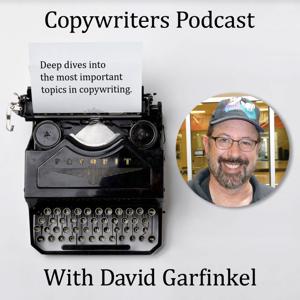
Copywriters Podcast

Copywriters Podcast

By David GarfinkelBusinessEducation
Download on the App Store

Copywriters Podcast episodes

  • Teaching Kids Copywriting

    I’ve been wanting to do a show on this topic for quite a while. I kept hitting a roadblock in my mind every time I started to prepare.
    Now, with the coronavirus keeping so many kids out of school and at home, I realized I needed to get past the roadblock. And, ironically, it was the stay-at-home order that cleared the mental roadblock out of the way.
    Here’s an outline of what I came up with.
    Since Nathan has a young person he helps with her homework, he had some real-world-inspired insights that are especially worth listening to.
    1. What gets in the way (or would get in the way) of making copywriting a class in all elementary, middle, or high schools.
    2. Who should teach kids copywriting, and who shouldn’t
    3. Which kids should be taught copywriting, and which kids shouldn’t
    4. What to teach, and what not to teach
    5. What a typical copywriting assignment for a young student, might look like
    6. The big idea about teaching and learning copywriting


    Download.
    33 min
  • Short Copy


    When I first started writing copy, before there was an Internet, we had
    an old saying:
    “There’s no such thing as copy that’s too long. Only copy that’s too boring.”
    Great point back then. Because short copy was what you would see on wasteful print ads, and on tv commercials that were trying to convey a feeling, instead of trying to sell something.
    But try talking smack about short copy to someone who’s writing ads for Facebook or Google.
    Short copy is now part of the toolkit of hard-core direct-response copywriters.
    Today we take a look at short copy from this new point of view:
    1. What is short copy that works for direct response in today’s environment?
    2. Why did direct marketers oppose short copy in the past?
    3. The concept of the “horizontal sales letter” (funnel).
    4. The job short copy has to do in a direct response campaign.
    5. How today’s short copy has changed the game as far as graphics and appearance go.
    6.Two questions I used critiquing a client’s funnel the day before we recorded this show.


    Download.
    28 min
  • Time Tricks and Productivity Secrets for Copywriters from Robert Updegraff

    Have you ever given up on time management, because every technique and system you’ve tried just doesn’t work for you?
    If so, it’s not your fault.
    Time management systems don’t work for creative people in most cases. But in our second Old Masters show with Robert Updegraff, we’re going to show you an approach that does.
    It’s from a 1958 book “All the Time You Need” by Robert Updegraff. It’s out of print, but you might be able to find a copy on Amazon.
    Thanks to Copywriters Podcast guest expert, master copywriter David Deutsch, for telling me about this book many years ago.
    What’s great about this book is it shows you how to solve the biggest problems that rob you of time, and rob your time of its potential to be productive for you.
    I’ve used all of the ideas here, but I don’t use all of them all of the time. That would be impossible. You’d spend more time using his time-maximizing techniques than getting anything done.
    I can tell you:
    - they work, and
    - it’s better to use one or a few than to try to use all of them perfectly
    What’s good about them is these are all biased towards practical creative people, including of course copywriters and entrepreneurs.
    Four parts to what we’ll cover today
    - The two dimensions of time
    - The four enemies of clock time
    - The four enemies of energy
    - Using your unconscious mind to supercharge your creativity and productivity
    The two dimensions of time
    Productivity is about how much you can produce in any given amount of time.
    In one hour, if you are sleepy, distracted, pissed off and would rather be or be doing something or somewhere else, you probably won’t be all that productive.
    But… if you are focused, and excited – even on fire about something you’re doing, during that same period of 60 minutes you can get a lot better stuff done. Maybe even more than most people get done in a full day.
    Two dimensions: calendar/clock time
    energy
    The Four Enemies of Clock Time
    1. Procrastination
    Updegraff’s method for overcoming procratination:
    - if you’re stalling on something, take a moment to visualize what it is that you need to do that you’ve been putting off.
    - then, decide: to do it later, or never to do it.
    And if you decide to do it later, set a specific time when you plan to do it, and stick to it.
    2. “Sometime-itis”
    Saying you’ll do something “sometime” is usually no better than procrastination.
    3. Condoning inaction
    This means being vague about when you’re going to do something you need to get done but don’t want to do right now.
    Updegraff says that some people will spend more time coming up with excuses why they didn’t do something than the time it would have taken to do the thing they’re making excuses about
    4. Regretting
    Spending time dwelling on what might have been or what you might have done differently can really eat into your work productivity if you spend too much time on it.
    Updegraff says, “The person of mature mind knows every day spent in regretting is a day wasted. When an experience is passed, it is beyond recall. We can learn from it, but we cannot correct it.”
    Yes, there are lots of exceptions to these four assertions. Meaning, sometimes you won’t be able to make them work the way you’d like.
    But bringing them into your work process can help you be a LOT more productive when you’re writing or coming up with new ideas.
    Defeating the Four Enemies of Energy
    Energy is the second dimension of time, particularly when it comes to productivity, in Updegraff’s view of things. I happen to agree with him.
    Scott Adams talks about this in one of his books, too, but in a different way.
    Here are the four enemies Updegraff id’s:
    1) Frustration
    “Our frustrations burn our energy three or four times faster than it is consumed by our work.”
    His point is not to avoid frustration, but just expect it. And don’t overreact. Don’t wallow in it. Sometimes, when you’re really frustrated, go do something else for a while. Come back to it and your unconscious mind may have solved the problem your frustration was causing.
    2) Irritation
    “A brief flash of impatience, exasperation, or even anger is sometimes highly beneficial in that it stirs us to decision or action.”
    But again, wallowing in irritation does nobody any good. And it certainly hijacks your attention and your energy from creative productivity.
    3) Impatience
    This is interesting. Updegraff sees impatience as being stalled, stuck, pinned to the wall. And slowly seething that something’s not ready or getting done fast enough.
    He says, “Keeping busy at something — almost anything — is a simple antidote for impatience.”
    4) Worry
    My point of view is that some worry is good. Like with a launch, for example. You want to think of everything that reasonably could go wrong, and then take steps to prevent those things from happening. But then, be done with it.
    The kind of worry that Updegraff sees as an energy drain is obsessive worry. If you do that and you can find a way to stop doing that, you’ll probably see a dramatic increase in your creative productivity.
    He says, “Worry saps the spirit and drains the nervous system at an appalling rate.”
    Partnering up with your unconscious mind
    I’ve used this one a LOT. It always works, as long as you don’t rush it. In my experience.
    Updegraff suggests you use the unconscious mind for:
    - solving problems
    - developing ideas
    - formulating plan
    Here is how:
    - Write down the problem you want to solve, or the kind of idea you want to develop and how you’ll use it, or what you’ll be creating a plan for
    - Ask your unconscious mind for a solution. Give it a deadline. At least a few hours or overnight.
    - After you do this, forget about it for a while. Do something else. Don’t consciously think about the problem. Let the unconscious mind do its magic.
    - The idea will come to you. Possibly when you least expect it. Have some way to record it, whether audio or paper and pen, nearby as much as possible.
    - You get better at this, the more you do it.
    --
    Summary:
    - Two dimensions of time: clock/calendar time, and energy
    - Four enemies of clock time: procrastination, sometime-itis, condoning inaction, regretting
    - Four enemies of energy: frustration, irritation, impatience, worry
    - Enlist your unconscious mind to help you with creative jobs
    All the Time You Need, by Robert R. Updegraff (used copies):
    https://www.amazon.com/All-time-you-need-greatest/dp/B0007E2IQ8
    Download.
    30 min
  • Copywriting - The New Normal

    Tell me if you’ve had this experience:
    You get up in the morning, and within a few minutes this sharp pang of confusion runs through your body as you wonder, “What world am I living in?”
    Yep. These are disorienting times, that’s for sure. We’re all doing the best we can to adjust to it. And based on my very limited view of what’s going on, most people are doing OK.
    I know some people are suffering terribly right now. I have one friend who had what he was pretty sure was coronavirus, and he got through it. I’m grateful for that. And I’m aware there are many others who are having a pretty tough time with it.
    What I want to talk about today is not the present, but the future. And not the general state of the world, but copywriting in what’s starting to be called “The New Normal.”
    Yes, it’s the doctors, nurses and first responders who will get the world at large through this. But copywriters can do a lot to help keep some businesses afloat and maybe, just maybe, increase the number of employees of those businesses who keep getting paychecks.
    So on today’s show we looked at these topics, which are important to copywriters and business owners:
    1. Where we are now. Not everyone’s in the same place or headed in the same direction, and that’s vitally important to understand as you move ahead with marketing. We look at what people in the market want (and will want, for at least the next six months), and what negative feelings people are having. And how this applies to you and your business.
    2. What “the new normal” will mean for existing businesses driven largely or completely by copy. Tone of messaging matters. The mood of the market has changed, and we need to adjust.
    3. What “the new normal” will mean for businesses that didn’t use copy in the past. “Remote selling” is going to be a new concept for a lot of traditional businesses. Of course it’s the stock-in-trade of copywriters. A look at how copy may find its way into a broader range of businesses than ever before.
    4. What all this means for copywriters. We’ve seen a lot of mistakes made in the first months of the pandemic. And a lot of good things, too. Some idea on how to maximize the odds that your copy will be well received, and your response will be as high as possible.


    Download.
    25 min
  • How Ideas Go Viral with Robert Updegraff

    Today in our Old Masters series, we have someone a little different whose work we’re going to look at.
    His name is Robert Updegraff. He wasn’t really a copywriter, but experienced copywriters and marketers know him. In today’s show, we’re going over a short book he published originally in 1916. It’s called Obvious Adams and it’s a story about a copywriter that took the business world by storm.
    Jack Trout, author of the modern marketing classic “Positioning,” wrote an article about Obvious Adams in Forbes. This is a guy who knows a thing or two about marketing, and he called Obvious Adams “the best book that I have ever read on marketing.”
    The hero of the story, Obvious Adams, had a knack for finding the simplest, most obvious idea. And his ideas led to great increases in sales. It turns out, that’s exactly what a viral idea is. Today, we’ll show you what to look for in an idea — whether it’s a positioning statement, or a headline, or a product idea — to see how likely it is to go viral.
    We’ll talk about the book and include the five tests for a marketing idea that Robert Updegraff added to the book years after it was first published.
    I first came upon Obvious Adams in the early 1990s. As I reviewed it for this show, 30 years later, I realized what a major impact it had on my thinking.
    In the story, the advertising agency who first hired Obvious Adams when he was 18 says his initial impression was that he was “a very ordinary-looking boy, it seemed to me, rather stolid, not overly bright in appearance. [Stolid is an old-fashioned word which means calm and not particularly emotional.]”
    What set Obvious Adams apart in the story was his uncanny ability to find the obvious selling points in a product that no one else could, and that the clever copywriters scoffed at.
    But over and over, the ads he wrote out-performed everyone else’s. As he rose to the top of the agency, he stayed the same, never became a snazzy guy but kept focusing on the obvious, and large clients sought out his help personally.
    I’ve heard some rumors that the author modeled this fictional character after the great copywriter Claude Hopkins. I can see some similarities and I really don’t know for sure myself.
    Some people who read the book believed Obvious Adams was a real person, and wrote to Updegraff, asking how they could hire him.
    Others understood he was a fictional character, but couldn’t replicate his thinking. That is, try as they might, they could find the obvious in what they were selling, themselves. And they wanted to.
    After the book was published, the author figured people would get the idea and be able to start focusing on obvious ideas on their own. But it didn’t turn out that way.
    In a second section of the book, years later, he wrote:
    “BACK IN 1916 when Obvious Adams was first published, I thought getting businessmen to do "the obvious" would be simple enough: that it would only be necessary to point out the obvious solution or course of action.
    But I was quite wrong.
    The reason, he said, was that it involved logical thinking, which he called “the trickiest of mental processes.”
    So, to help people along, he developed “five tests of obviousness.”
    And before he announced them, he provided, of all things, a disclaimer:
    “They are not sure-fire. Nothing is in this complex and changing world. But they are good rule-of-thumb checks.”
    Personally, I think these are great tests. You don’t have to pass all of them to have a good promotion. I’ll mention this again at the end: You should consider all of them. Just thinking things through this way will sharpen up your thinking and could easily improve your promotion.
    I’m going to add one 21st-Century example as we go, and we may come up with some others along the way. The good news about this book is you can get it on Amazon for a few dollars. It is well worth your time and money. We’ll put a link to it in the show notes.

    Five tests of obviousness
    1. The problem, when solved, will be simple.
    - Complicated solutions to problems are ways of someone trying to show off how smart they are or a sign of laziness. A solution that is simple borders on the invisible, and that’s OK.
    Especially with copywriting. Nobody cares about how clever your whiz-bang solution is. They care about their problem, and how certain it seems that you can solve it.
    The more “obvious” the answer, the more certain they will feel that you can.
    Einstein said, “Everything should be made as simple as possible, but not simpler.”
    Updegraff wrote: “The history of science, the arts and great developments in the world of business is a history of people stumbling upon simple solutions to complex problems.”
    Our example, which we’ll use throughout to measure against each test, is the same. It’s the messaging Steve Jobs came up with originally to sell the iPod:
    “10,000 songs in your pocket.”
    2. A question: Does it check with human nature?
    To pass this test, your idea needs to be quickly and easily understood by ordinary people.
    For copywriters and marketers, you don’t need everybody if you’re writing for / selling to a niche audiences. But what it does mean is that everyone across your niche should get the idea instantly.
    Updegraff says, “The public is curiously obvious in its reactions — because the public’s mind is simple, direct and unsophisticated.”
    Let’s look again at the iPod tagline: “10,000 songs in your pocket.”
    3. Put it on paper

    “Write out your idea, in words of one and two syllables, as though you were explaining it to a child.”
    This is a cheap and quick way to troubleshoot an idea, project, plan, offer. If you can’t explain it simply, that’s a sure sign you have more work to do on it.
    Key point: Most ideas ultimately involve more than one person, even if one person only came up with it and handles all the details. In copywriting and marketing, for example, even if you are a one-person business, for your idea to succeed, it also involves customers, who have to understand it in order to take advantage of your offer.
    And most ideas, especially the bigger ones, involve more than one person. Like: partners, employees, investors, and contractors — as well as, of course, customers.
    How do you expect to get their buy-in if they can’t easily understand your idea?
    “10,000 songs in your pocket” works as something you can put on paper in one- and two-syllable words. Especially is you write out the words “ten thousand.”
    4. Does it explode in people’s minds?
    When you share your idea, or post your copy, and you get responses from people like, “Why didn’t I think of that?” you know you’ve passed the “explode-in-people’s minds” test.
    It most likely means you’ve got an idea that’s both new and familiar. And that sounds easier to come up with than it actually is. This rare combination almost always leads to blockbuster success.
    Updegraff says, “If an idea or proposal does not ‘explode,’ if it requires lengthy explanation and involves hours of argument, either
    - it is not obvious
    or
    - you have not thought it through and reduced it to obvious simplicity.”
    you know you are creating mental “explosions” when you see instant and intense reaction from people to your idea.
    A great example and step-by-step method to help you learn to do this is in Oren Klaff’s new book, “Flip the Script.”
    I would say “10,000 songs in your pocket” definitely exploded in people’s minds!
    5. Is the time Ripe?
    Timing is everything. So make sure you don’t get a yes to either of these two questions:
    Is your idea too late?
    Is it too far ahead of its time?
    An idea that passes all the other test of “obviousness” will still not work if it is not timely.
    So pay careful attention to this one.
    Updegraff said that you don’t need to pass all five tests to have a successful idea/offer/hook.
    But it’s a good idea to consider every one of them, and see if it applies.
    For example, test #4 -- “Does it explode in people’s minds?” mind end up a “no.”
    That where you need to put more work into your idea.
    Steve Jobs got the timing just right with “10,000 songs in your pocket.”
    Summary: The Five Tests
    1. The problem, when solved, will be obvious.
    2. Does it check with human nature?
    3. Put it on paper.
    4. Does it explode in people’s minds?
    5. Is the time Ripe?

    link to Obvious Adams

    Download.

    33 min
  • Trigger-Happy Facebook Posting, with Nathan Fraser

    You may know Nathan as the producer and my confabulation partner on Copywriters Podcast, and some of you know he’s an accomplished and profitable copywriter himself.
    But not everyone knows another aspect of Nathan’s public face, and that is as a very provocative Facebook poster. His posts trigger people in a way I’ve never seen before. A lot of them are funny and nearly all of his posts are thought-provoking.
    I asked him if he would share the story behind what he thinks and why he does what he does, and he readily agreed.
    So that’s what we did on today’s show.
    1. You seem to thrive writing Facebook posts that polarize a lot of people. Some love these posts and some people really get triggered. Could you talk about why you do this?
    2. Could you share some of your “greatest hits” — posts that you consider among your most controversial?
    3. A lot of times your posts are ironic, or downright sarcastic. Do you find that some people miss the irony or sarcasm and take what you say literally?
    4. I’ve noticed three kinds of posts that you do
    - triggering (which is most of them)
    - personal reveals (where you tell a story that makes you come across as genuinely vulnerable and authentically human)
    - marketing tips (which are educational and useful)
    What’s your strategy in the mix of what you post?
    5. Now, let’s talk marketing. I think you’ve mentioned that you deliberately say things that will strongly attract certain kinds of prospects, as well as push others away. How has that worked out and what do prospects say to you about your posts?
    6. I’ve gotten the impression that early on, you put a lot of thought into your strategy. Could you walk us through your thought process leading up to what you’re doing today?
    7. What do you think of the way most people use Facebook, especially for marketing themselves and their businesses in unpaid posts? What would you suggest they do differently?
    Nathan's Book, SalesPageBook.com


    Download.
    32 min
  • Old Masters Series - Robert Collier

    We’re back with another episode in the Old Masters Series. Today we’re going to talk about Robert Collier.
    Most people know of him as the author of The Robert Collier Letter Book, which we’ll talk about in this show. But it’s important to know that besides being one of the best copywriters of the first half of the 20th Century, Collier was also a prolific and highly successful author. One of his other books, for example, sold 300,000 copies.
    We’re going to take some powerful ideas from just a couple pages of the Robert Collier Letter Book. It’s such a rich resource. My pal John Carlton, who has been on this podcast three times, says that book was one of the three books he referred to all the time when he was just starting out.
    Here are the seven topics we cover in the show:
    Word Pictures: After you get your reader’s attention, “your next problem is to put your ideas across, to make him see it as you see it — in short, to visualize it so clearly that he can build it, piece by piece in his own mind as a child builds a house of blocks, or puts together the pieces of a puzzle.”
    Six essential elements of a sales letter (VSL, sales page, ad):
    1. The opening: Not only do you need to capture attention. You need to speak to what the reader is interested in, using language that the reader instantly recognizes. Also, keep in mind that the opening “sets the table” for what comes next.
    2. The motive, or reason-why. Collier talks about the reason why the prospect would want to buy your offer. I agree with that. There’s also another kind of reason-why: The reason why you’re making the offer. This is also important — and necessary — when you are offering what might seem like an unreasonably low price or good deal. You need to state a reason that makes sense to your prospect.
    3. The description, or the explanation: When describing what you’re offering, Collier suggests that you start with the big picture — features, overall benefit — and then immediately fill in the details, like benefits, fine points, and what sets this product apart from competing products. Why it’s better.
    4. The proof or the guarantee: Collier presents this as one or the other. Actually, and especially these days, you need both: convincing proof of your claims throughout your message, and the strongest guarantee you can offer.
    5. The snapper or the penalty: What happens if the prospect DOESN’T take action? We see this in a lot of different forms these days. What’s important is that you don’t leave it to the prospects to figure this out on their own. Spell it out for them.
    6. The close, “which tells the reader just what to do and how to do it, and makes it easy for him to act at once.” This is one place where you definitely do NOT want to get lazy. Every time the reader isn’t 100% sure what to do, how to do it, or whether it’s too hard to take action, you lose sales. So follow this one carefully!
    Robert Collier Letter Book: Letters

    Download.
    31 min
  • Targeting and Copywriters

    The online marketing world has gone crazy with targeting.
    It’s great for all the media buyers and traffic managers, since they can get paid work out of it.
    Targeting… like Chicken Man of old-time radio, targeting — It’s everywhere!
    But what good does all this targeting do copywriters… and the marketers they work for?
    Today I’d like to look at targeting from a copywriter’s point of view. Not how to do targeting, but how to make the most out of what the media buyers and traffic managers deliver to you.
    At the core, copywriting is about writing precisely to your qualified prospect’s state of mind.
    Targeting is the way, unless you know each prospect personally, to find out as precisely as possible what your qualified prospect’s state of mind is.
    Let’s look at two types of targeting and figure out how each one is useful — or not useful — for different kinds of offers, and how you can use it:
    Traditional and Tuning-Fork Targeting
    Traditional 1: Demographics and Geographic (measuring prospects: age, number of kids, ZIP code, region of the country, net worth, number of guitars in the household)
    Traditional 2: Psychographics, which opens the passageway to Tuning-Fork Targeting (identifying what prospects feel and do)...
    Tuning Fork 1: Psychographics - Affinity
    - easiest
    - membership, interests, subscription
    - the problem with this is, what they like doesn’t tell you what they buy (except, maybe, other memberships or subscriptions)
    Tuning Fork 2: Values
    - a little harder to determine
    - religion, politics, other cultural and life choices
    - Only of limited use unless you are selling religion, politics, or a lifestyle product or service
    Tuning Fork 3: Behavior
    - This is the holy grail, but it’s hard to get this information from most targeting methods
    - However, two dependable sources of behavior are:
    1. Previous buyers (buyer lists, endorsed mailings)
    2. Retargeting (if they keep clicking on an ad after they know what you’re selling, the clicking behavior is valuable targeting information)
    In conclusion...
    From a copywriter’s point of view, the best targeting is information that can predict how likely it is for the prospect to buy.


    Download.
    28 min
  • Don Hauptman: The Most Successful Copywriting Techniques I’ve Learned in 45 Years - And Why So Many Promotions Fail To Exploit Them

    Today we have one of the world’s great teachers and practitioners of direct-response copywriting on the show — Don Hauptman.
    You’ll see what I mean about teaching in a moment, when Don shares the most successful copywriting techniques he’s learned in 45 years — techniques you may not be using, or not using as well as you could, yourself.
    As a copywriter, Don’s accomplishments are legendary. He’s a ten-time winner of the Newsletter on Newsletters promotion award for subscription acquisition packages.
    Don’s the copywriter who created the ads with the classic headline “Speak Spanish Like A Diplomat.” Those ads (and variations of it, such as “Speak French Like A Diplomat,”) sold tens of millions of dollars worth of language course in many languages for Audio-Forum.
    His work has been featured in college advertising textbooks and collections including “Million Dollar Mailings” and “The World’s Greatest Direct Mail Sales Letters.”
    These days, Don’s officially retired. But he still does pro bono marketing, consulting and fundraising work for non-profits and friends’ businesses and professional practices.
    Also, Don’s the author of a very valuable book, “The Versatile Freelancer,” which he’ll tell us about later.
    In the show, Don talks about the techniques that give copy its power, persuasiveness, motivation and credibility. These are techniques that keep readers reading, and gets them to respond the way you want them to.
    Don says, “In a lot of copy I see, these principles are absent, omitted, overlooked.
    Why? And how can you avoid these mistakes?”
    And then he proceeds to explain what they are, how they work, and how you can put them to work in your own copy.
    1. Adding human interest to your copy. One step copywriters skip is finding and adding the inherent drama of stories that add to the emotional response of the reader. He shares some examples from highly successful ads and reveals the hidden psychology behind these successful stories.
    2. Making your proof convincing. Credibility overcomes reader/listener/viewer skepticism. But vague generalities and promises made but not backed up won’t get the job done.
    Don shares which details he used, and how he used them, to create conviction in readers, which leads to the “yes” we’re all looking for.
    3. When content market brings prospects closer to buying. Sometimes the best way to make a sale is to give something valuable away first. Don explains how he did this in some of his winning promotions, and the proven best ways to use these techniques yourself.
    Don’s book, “The Versatile Freelancer” http://versatilefreelancer.com


    Download.
    29 min
  • Write Tight With Rudolph Flesch

    We’re back with another show in the Old Masters series today. First I need to tell you about something you probably never knew about before: The RCA principle.
    I end up telling even some of my advanced mentoring clients about the RCA principle, which I learned about from Joe Karbo in his book “The Lazy Man’s Way To Riches.”
    The RCA principle is a copywriting concept that goes like this:
    “Build the best radio you can, and take as many parts out of it as you can until it stops working.”
    In copywriting terms, that means: Write the best (whatever) you can, and then whittle it down to the smallest number of words, possible.
    So that’s the RCA principle. Sounds simple enough, right? All you have to do is write big and then edit it down to as tight as possible.
    The problem is, most people I talk to about this have NO IDEA how to do this.
    Fair enough. I didn’t learn this in school myself. Even on the college newspaper.
    Even in my private tutorial with the department chairman who used to write for Time magazine.
    So, to do today’s show, I had to turn to the Old Master of concise, powerful writing himself, Rudolf Flesch.
    You know him already through the readability index he helped create, although you may not have realized it.
    If you look for a readability score on your copy, as many writers do, that comes directly from Flesch’s work.
    He was born in Vienna, Austria, in 1911. In 1938, he fled to the United States to escape the Nazis. By 1943, he had earned a PhD in Library Science from Columbia University. It was then and there he developed the Flesch Reading Ease Formula, which has evolved into the “readability index” that so many copywriters use today.
    I took one of his books, The Art of Readable Writing, and cracked it open like a walnut.
    Then I picked out the most important pieces…
    … .to show you how to use the tools of an Old Master to implement the RCA principle.
    On the show, we go over these five steps, harvested from The Art of Readable Writing. And, as a special bonus for Copywriters Podcast subscribers, we also showed an equivalent step each time for achieving a Joe Karbo RCA principle result.
    1. Research and organize
    KARBO EQUIVALENT: Design the biggest, best radio you can. Don’t build it yet. Just design it.
    2. Give shape to your idea
    KARBO EQUIVALENT: Build the biggest, bestest radio you can.
    3. Make longer words shorter
    KARBO EQUIVALENT: Use chips, PC boards, or anything else you can to make the big bad radio work more efficiently,
    4. Organize your copy with shorter words into a chronological story.
    KARBO EQUIVALENT: Rearrange the parts of your big new radio into the smallest space possible.
    5. Edit ruthlessly to get your story into the fewest words possible.
    KARBO EQUIVALENT: This is where you take out all the parts of the radio until it stops working.
    The Art of Readable Writing, by Rudolf Flesch

    link (for used copy): https://www.amazon.com/dp/006011293X

    Download.
    28 min

About Copywriters Podcast

From the publisher's feed

Copywriting lessons from David Garfinkel

More shows like Copywriters Podcast

The GaryVee Audio Experience by Gary Vaynerchuk

The GaryVee Audio Experience

16,846 Listeners

The Amy Porterfield Show by Amy Porterfield

The Amy Porterfield Show

4,584 Listeners

The StoryBrand Podcast by StoryBrand.com

The StoryBrand Podcast

1,932 Listeners

Marketing School - Digital Marketing and Online Marketing Tips by Eric Siu and Neil Patel

Marketing School - Digital Marketing and Online Marketing Tips

1,256 Listeners

Founders by David Senra

Founders

2,199 Listeners

The Martell Method w/ Dan Martell by Dan Martell

The Martell Method w/ Dan Martell

578 Listeners

The Copywriter Club Podcast by Rob Marsh

The Copywriter Club Podcast

209 Listeners

The Game with Alex Hormozi by Alex Hormozi

The Game with Alex Hormozi

4,452 Listeners

The Diary Of A CEO with Steven Bartlett by DOAC

The Diary Of A CEO with Steven Bartlett

8,306 Listeners

The Russell Brunson Show by Russell Brunson

The Russell Brunson Show

919 Listeners

My First Million by Hubspot Media

My First Million

2,648 Listeners

Huberman Lab by Scicomm Media

Huberman Lab

29,138 Listeners

The Startup Ideas Podcast by Greg Isenberg

The Startup Ideas Podcast

209 Listeners

Marketing Against The Grain by Hubspot Media

Marketing Against The Grain

358 Listeners

Good Content with Shannon McKinstrie by Shannon McKinstrie

Good Content with Shannon McKinstrie

153 Listeners