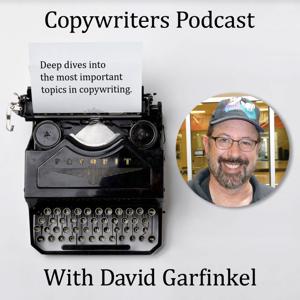
Copywriters Podcast

Copywriters Podcast

By David GarfinkelBusinessEducation
Download on the App Store

Copywriters Podcast episodes

  • Newbie Copywriter Payday Formula, with Jesse Moskel

    Our guest today was featured on the National Geographic channel last week for something no one would want to be seen for: The show “Locked Up Abroad.” The episode is about the time Jesse spent in prison in Thailand, and how copywriting helped him cut, oh, 20 years off his sentence.
    And he turned his life around after he came back to the USA.
    Actually, that’s not the most important thing about copywriting Jesse’s going to share today.
    He made a discovery at an AWAI meeting that I’ve never heard anyone else talk about the way he does. And for every beginning copywriter who wants to get more clients, Jesse has some unique ways to do it.
    Best of all, they don’t require serving time in Thailand or anywhere else.
    Besides writing copy and appearing on TV, Jesse speaks a lot at direct marketing events like Dan Kennedy’s Renegade millionaire, where he shared some of what you’re going to hear in full today.
    This show is a wild ride.
    Here are the questions I asked him:
    1. First, tell us about how you escaped a life sentence with copywriting…
    2. Back in the US of A, how did your first efforts at finding work, work out?
    3. You told me your brother was your mentor, back on the path to success and financial stability. What did he teach you about?
    4. So let’s get to your stunning discovery at AWAI. What did you find out?
    5. Tell us a little more about the Copykickstart course.

    link to his course: copykickstart.com/win

    discount code: DAVID

    Download.
    32 min
  • Wisdom from Aesop Glim

    We’ve got another episode today in our Old Masters series. New York City, 1892: An advertising man named George P. Rowell starts a weekly advertising journal called Printer’s Ink.
    Decades later, another man, George Laflin Miller, started writing a column for Printer’s Inc., under the pen name “Aesop Glim.” In the 1940s and 1950s, Aesop Glim’s column was the Copywriters Podcast of the time, as best I can tell.
    I couldn’t find out much more than that about Mr. Glim, also known as Mr. Miller. But I did find in my bookcase the book “How Advertising Is Written — and Why.” This book has some terrific, unique ideas and techniques, and we’re going over them today.
    The book is concise, only 150 pages. But it’s powerful. Eight chapters, with three to nine meaty sections in each chapter.
    I’ve cherry-picked four key ideas that I haven’t seen presented this way elsewhere. We’re covering the bare bones of Aesop Glim’s ideas and filling in the blanks with our own examples and comments.
    1) The substitute for inspiration — is saturation!
    Instead of waiting for inspiration to strike, saturate your mind with
    • facts
    • experience
    • knowledge about user experience
    “The trouble with inspiration is that — like luck or lightning — you can’t possibly tell when it will strike.”
    2) Headlines - 3 steps
    Headlines need to “reach out from the page, seize the lapels on your prospects, and persuade them to read the first paragraph of your copy.”
    3 steps of the job of the headline
    1. select the right prospects
    2. “arrest” them
    3. persuade them to read your first paragraph
    3) The Rudyard Kipling Secret For Copy - Minus One
    We’re going to have our first poetry reading on Copywriters Podcast.
    Title - I keep six honest serving men
    I KEEP six honest serving-men
    (They taught me all I knew);
    Their names are What and Why and When
    And How and Where and Who.
    Aesop Glim left out “how.”
    So: when - where - who - what - why
    Example:
    Yesterday (WHEN), in Australia (WHERE), one of my clients (WHO) had a major breakthrough (WHAT) because of one stunning idea he swears he’ll use from now on to write copy (WHAT).
    Next-level tip from Aesop Glim: Put most of your copy in the present tense.
    Same sentence that way:
    In Australia, one of my clients is having a major breakthrough because of one stunning idea he swears he’ll use from now on to write copy.
    Present tense in headlines:
    Compare
    Old Dutch Cleanser Chases Dirt
    to
    Old Dutch Cleanser Might Conceivably
    Remove The Accumulated Filth If Properly Applied
    Use singular instead of plural:
    Easier to visualize
    one hour
    one cake of soap
    one man
    … than a lot of them.
    4) 3 things that have to happen for an ad to work.
    The ad must be
    1. seen
    2. read
    3. believed


    Download.

    29 min
  • Copywriting Life Lessons with Doberman Dan

    Our special guest today, Doberman Dan, has been a direct-response copywriter and serial entrepreneur for 33 years.
    He’s started four of his own nutritional supplement business, and sold three of them. As a copywriter, he specializes in the health, fitness and bodybuilding markets. But he’s written in many other markets as well.
    Dan’s work has appeared in Entrepreneur Magazine, Penthouse, Investors Business Daily, The National Enquirer, and many other newspapers and magazines.
    He’s been publishing The Doberman Dan Letter for the past nine years, and it counts many of the world’s most successful marketers among its subscribers, including me.
    We’re going to a wild ride through Dan’s life and times today and find out how his unusual experiences — and there are many — have contributed to what he knows and teaches about copywriting.
    He’s been publishing The Doberman Dan Letter for the past nine years, and it counts many of the world’s most successful marketers among its subscribers, including me.
    We took a wild ride through Dan’s life and times today and find out how his unusual experiences — and there are many — have contributed to what he knows and teaches about copywriting.


    Download.
    44 min
  • Copywriter Story Secrets

    One of my best-performing sales letters took three months to write. A big part of the time it took to write it had little to do with the headline or the rest of the copy.
    The letter crushed it. Literally. We broke the server the first day. This was for a small company and total sales were over $1 million on their mentoring program I had written the sales letter for.
    To prepare for that letter, I sought out stories from people in the marketplace who would end up being prospects and customers for the mentoring program.
    When I did the interviews, talking to people who were very different from me, I learned things about their motivations and their preferences that never would have occurred to me on my own.
    I don’t think the letter would have broken $1 million in sales or sold out in three days if I hadn’t done the work to get those stories out of prospective customers.
    Today, we talk about getting stories before you start writing your copy. In this fast-paced show, we cover:
    >Why it’s important to get stories from clients and their customers — two reasons most copywriters never consider
    >How most people screw this up… and… how to fix this
    >Who you want to talk to (far more types of people than you think now)
    >How you want to talk to the people you’re getting stories from (vitally important — makes all the difference)
    >What kind of questions to ask
    >What you want to get from the people you interview
    >What to do with what you get


    Download.
    27 min
  • Pitchman Secrets with Legendary Copywriter David Deutsch

    In the offices of the most successful direct marketers in the world, when a promo isn’t making the money it should, you’ll hear most people speak these three words: “Call David Deutsch.”
    Because he’s the guy who can fix it.
    And, he’s our guest today. David’s promo’s have come close to pulling in $1 billion in sales. He’s written for Agora and the company formerly known as Boardroom (it’s now called Bottom Line Publications). David works with copy teams in the U.S. and around the world.
    He’s the author of Million Dollar Marketing Secrets and Think Inside The Box, two books I’m proud to say I have in my most important bookshelf (the one closest to my computer).
    I’m also proud that David’s a friend as well as a colleague. Today he’s going to talk about something you might have never thought had anything to do with copywriting. My goal, by the end of today’s show, is for you to see how it has EVERYTHING to do with copywriting.
    That topic is pitchmen. From Billy Mays and Ron Popeil to the carnival barker at the county fair, pitchmen — and pitchwomen — hold some secrets that make our copy better. And David knows more about them than you would ever imagine.
    Here’s what David talked about with us on this special show:
    - How he got into studying pitchmen.
    - Who pitchmen are and why what they do is so close to writing copy
    - Why he has studied pitchmen (and why you should, too)
    - With a pitchman, it’s NOT “all in the wrist” — it’s all in the VOICE
    - What pitchmen do all the time that the best copy does as well
    - Think word choice is important in copy? Take a close look at what pitchmen do!
    - How and when pitchmen reveal the product they’re pitching
    - How pitchmen MAXIMIZE the chance that every prospect will buy
    There’s so much good info in this show you may want to listen to it more than once!

    Go to David’s website and get a free report: “Copywriting from A to Z”

    www.DavidLDeutsch.com


    Download.
    31 min
  • John Caples Copywriting Secrets

    John Caples is best known as a pioneer and master practitioner of testing copy, but he was also a brilliant copywriter.
    His first year writing copy, he wrote an ad with the headline “They Laughed When I Sat Down At The Piano… But When I Began To Play…” which is famous to this day.
    He taught copywriting at Columbia Business School in New York.
    Caples is truly an old master, and that’s why we’re including him in our Old Masters Series. His book “Tested Advertising Methods” has so much value for copywriters we could barely cover a few parts of a few chapters. But it’s easily available on Amazon, and I’ve included a link at the bottom of the show notes on copwriterspodcast.com
    Here are the key points. Much more detail in the recorded podcast itself.
    1. The kind of headlines that attract the most readers
    Based on tests, usually headlines with a combination of self-interest and curiosity, work best. Sometimes, adding or implying “quick and easy” will boost response even further.
    2. How to put enthusiasm into your copy
    Forget about everyone except your prospect… write fast… get worked up… let momentum launch you into a wave of enthusiasm.
    3. Simple hacks to get more opt-ins
    Lots of proven “little” things will increase your response dramatically. Most people fall short here on some of the basics.
    4. Simple hacks to multiply your copy’s selling power
    The key word here is “simple.” Fight every urge to be philosophical, elaborate or flowery in your writing.

    Tested Advertising Methods

    Download.
    23 min
  • Powerful Takeaways From Scientific Advertising

    When I first started learning how to write copy, everybody told me “read Scientific Advertising.” It’s a book written at the beginning of the 20th century, over 100 years ago, by Claude Hopkins, who many consider the father of direct-response copywriting.
    I did read the book. I read it again. In fact, I read it 15 times.
    For today’s show, I reviewed it. This is part of our Old Masters series.
    I pulled out five powerful takeaways and we’re going to talk about them and how they apply to copywriting today. In the show notes on copywriterspodcast.com, you’ll find a link to get the book on Amazon.
    All I can say is, it’s well worth it. One of the most valuable books I’ve ever read.
    Here are the key takeaways. Much more detail on the podcast itself:
    1. The only purpose of advertising is to make sales
    “Advertising is multiplied salesmanship.” Ask this question about your sales copy: “Would it help me sell them if I met them in person?”
    2. The right headline can increase sales by 5 to 10 times.
    You can use your headline to target a particular type of prospect. The trick is to call out the type of qualified prospect that there are the most of.
    3. Psychology is the gas in the engine — and the GPS — of all advertising.
    We can’t actually read people’s minds. But we can keep track of all their different behaviors. And the more specific things we know about what people respond to, and how they behave, the better our copy will perform.
    4. The more specific you are, the more people will believe you.
    It’s always a bad idea to lie about specifics. But it’s always a good idea to include as many meaningful specifics as you can.
    “Platitudes and generalities roll off the human understanding like water from a duck… [but] the weight of an argument can often be multiplied by making it specific.”
    5. How to guarantee your advertising WON’T make a profit.
    You can lose a lot of money by trying to change people’s habits. “It is a very shrewd thing to watch the development of a particular trend, the creation of new desires. Then at the right time offer to satisfy those desires.”
    Link to Scientific Advertising on Amazon: https://www.amazon.com/dp/0844231010


    Download.
    30 min
  • Maxwell Sackheim’s Magic List - 2

    Today we return to our new series called “Old Masters,” and we’re going to look at another list from Maxwell Sackheim’s book, “My First 65 Years In Advertising.”
    Sackheim started in direct mail in 1906. In 1927 he was a co-founder of a highly successful direct-mail business, The Book-of-the-Month Club.
    He wrote a very famous ad with the headline, “Do You Make These Mistakes In English?”, which ran for 40 years and was always profitable.
    The list we’re going over today is called “Seven Deadly Direct Mail Mistakes.” But don’t worry if you don’t do direct mail yourself. It’s based on hard-won wisdom and it applies just as well today with Facebook ads and funnels as it does to actual direct mail.
    (Seven deadly Direct Mail mistakes)
    1. Failing to Give The Reader a Good Reason to Open Your Envelope
    This applies to ALL forms of direct marketing. Almost all forms involve more than one step — whether the first step is opening the envelope, responding to a print ad, or clicking on a Facebook ad. Be sure that you’re giving your prospect a strong reason to take the FIRST step.
    Cheat Sheet Question #1: Did I give me prospect a good enough reason to take the the first step?
    2. Failing to Give The Reader a Good Reason for Reading Your Mailing
    Every step of the way through your funnel, make sure you give your prospect a good reason to read it and move on to the next step.
    Cheat sheet question #2: Did I give my prospect a good enough reason to read this copy and move on to the next step?
    3. Making Trivial Tests
    Important tests are of major elements that can really affect response. Headline, lead, offer, pricing, for example. Test the things that are most likely to make a real difference in response.
    Cheat sheet question #3: Make sure you’re testing elements of your copy that are likely to make an important difference.
    4. Making Sales, Not Customers
    It costs a lot to acquire a customer. Why WASTE that money when you can turn it into profit by making additional offers to each customer?
    Cheat sheet question #4: What am I doing to increase the lifetime of each customer, and extend the lifetime value?
    5. Believing that People Won’t Read Long Letters
    “People read long books, take long trips, watch long movies and plays, and read long letters — provided they justify the time. They must be interesting. They must promise a profit, in entertainment, in money, in enlightenment.”
    Cheat sheet question #5: Am I providing all the information my prospect needs—and doing it in a compelling way?
    6. Letting the List Go to the Last
    “The reasons many mailings fail is that they are directed to too many wrong people.” Same is true for ads and other types of copy that are targeted wrong.
    Cheat sheet question 6: Am I targeting the right people?
    7. Forgetting that Your Letters Are You
    “Every letter you send is your personality on paper. Whether you mail one or one million, each letter tells who YOU are.”
    Cheat sheet question #7: Am I writing to my customers like I would talk to a friend?


    Download.
    30 min
  • Maxwell Sackheim’s Magic List - 1

    Today we’re starting a new series called “Old Masters,” where we find wisdom from some of the Founding Fathers of copywriting and see how we can apply them today. On this show, we’re going to look at a list from Maxwell Sackheim’s book, “My First 65 Years In Advertising.”
    Sackheim started in direct mail in 1906. In 1927 he was a co-founder of a highly successful direct-mail business, The Book-of-the-Month Club.
    He wrote a very famous ad with the headline, “Do You Make These Mistakes In English?”, which ran for 40 years and was always profitable.
    Today the list we’ll go over is called “Seven Deadly Advertising Mistakes.” There’s nothing obsolete about anything on this list. And I’ve added a lot of information for each item on the list so you can put the information to work right away.
    1. Failing to Give The Reader a Reason to Read Your Ad
    You need to make a promise that your reader will find worth reading the rest of your ad.
    Cheat Sheet Question #1: Did I give my reader a good enough reason to read the ad?
    2. Using Headlines That “Whisper Sweet Nothings”
    You need to get readers excited about something that’s important to them, in a direct and powerful way.
    Cheat Sheet Question #2: Does your headline reach out and grab the reader?
    3. Using Pictures that Do Not Talk
    Any picture you use needs to tell a story, by itself, that furthers the purpose of the ad itself.
    Cheat Sheet Question #3: Is the picture so good that it could partially or fully make the ad work by itself?
    4. Giving In To The Curse of Cleverness
    If you try to show how entertaining you are more than how much you know and care about a problem the prospect has, and how you can solve it… you’re making a deadly mistake.
    Cheat Sheet Question #4: Am I making my prospect laugh… or am I locking in my prospect’s serious attention?
    5. Going Around Robin Hood’s Barn
    A lot of advertising makes readers jump through mental hoops to understand what it’s trying to sell you. Make yours a smooth glide in a straight line.
    Cheat Sheet Question #5: How easy is it to follow my pitch all the way through?
    6. Leavin’ ‘em Dangling
    Always give your reader something to do. Otherwise, risk losing them forever.
    Cheat Sheet Question #6: Did I give my prospect something specific to do?
    7. Using “Yackety-Yack” Copy
    Don’t waste your reader’s time. Make everything you say interesting, useful, intriguing, or curiosity-provoking.
    Cheat Sheet Question #7: Am I providing interesting value every step of the way?


    Download.
    28 min
  • Billionaire Business Secrets

    Sara’s dad was a lawyer. After she finished college, she wanted to go law school, but her Legal SAT scores weren’t good enough. So she tried stand-up comedy, but that didn’t catch fire.
    So, she became a billionaire instead. The youngest woman billionaire ever, according to Forbes magazine in 2009.
    A few weeks ago, I saw that Sara Blakely, founder of Spanx, had a class on entrepreneurship up on MasterClass.com. I was curious and so I watched a few sessions.
    Not only was it the best program on business I’ve seen on MasterClass, but it’s also the best program for copywriters and entrepreneurs I’ve ever seen by a “big name” in business. Sara Blakely is a gifted teacher as well as a standout entrepreneur.
    I picked three lessons from the treasure trove of suggestions and ideas that make up the class. The reason I picked each one is that it would help copywriters as well business owners, and two of the three are things we haven’t talked about nearly enough on this podcast.
    But everything she had to say was unique, valuable and interesting.
    So here’s something really ironic about Sara Blakely. She said right on her Masterclass that for the first 16 years of her business, she didn’t do any advertising. None. Zero. Zip. Nada.
    So why are we devoting an entire show to her?
    Here’s why:
    What she DID do, to get the business up and running -- and what she continues to do on a daily basis -- are so valuable that they really transcend copywriting and spending money on ads. They are at the core essence of what we do as copywriters and business owners, which is to GET and KEEP customers.
    It’s also nice to get advice from someone who is actually running a huge business, rather than making their living running around sharing their theories about how the world might work and making their living doing seminars. In contrast, Sara’s making her living serving customers and innovating new products for her business.
    We cover three tips. You’ve probably heard them before, but Sara has a unique take on them… and, she’s made them work to literally build a business from scratch. Which gives them extra weight.
    Her first tip: Protect Your Mindset.
    Sara shared a very personal story about how she protected her idea from the criticism of others until she was ready to share it… and how she knew she was ready.
    We talk about how to protect your mindset so your ideas don’t die abornin’.
    Second Tip from Sara: Create Big Ideas
    Sara admits she takes idea-creation very seriously, and she devotes time every day to doing it.
    We’ll share her method and talk about what everyone has in common when you need to create big ideas, as well as what’s unique to each person.
    Third Tip from Sara: Connect… Really Connect
    Probably the most underrated asset in business is the act of deeply connecting with your customers. Sara turned her ability to do that into a net worth of more than one billion dollars in less than 10 years.
    We explore how copywriters - as well as business owners - can leverage this underrated asset themselves.


    Download.
    27 min

About Copywriters Podcast

From the publisher's feed

Copywriting lessons from David Garfinkel

More shows like Copywriters Podcast

The GaryVee Audio Experience by Gary Vaynerchuk

The GaryVee Audio Experience

16,846 Listeners

The Amy Porterfield Show by Amy Porterfield

The Amy Porterfield Show

4,584 Listeners

The StoryBrand Podcast by StoryBrand.com

The StoryBrand Podcast

1,932 Listeners

Marketing School - Digital Marketing and Online Marketing Tips by Eric Siu and Neil Patel

Marketing School - Digital Marketing and Online Marketing Tips

1,256 Listeners

Founders by David Senra

Founders

2,199 Listeners

The Martell Method w/ Dan Martell by Dan Martell

The Martell Method w/ Dan Martell

578 Listeners

The Copywriter Club Podcast by Rob Marsh

The Copywriter Club Podcast

209 Listeners

The Game with Alex Hormozi by Alex Hormozi

The Game with Alex Hormozi

4,452 Listeners

The Diary Of A CEO with Steven Bartlett by DOAC

The Diary Of A CEO with Steven Bartlett

8,306 Listeners

The Russell Brunson Show by Russell Brunson

The Russell Brunson Show

919 Listeners

My First Million by Hubspot Media

My First Million

2,648 Listeners

Huberman Lab by Scicomm Media

Huberman Lab

29,138 Listeners

The Startup Ideas Podcast by Greg Isenberg

The Startup Ideas Podcast

209 Listeners

Marketing Against The Grain by Hubspot Media

Marketing Against The Grain

358 Listeners

Good Content with Shannon McKinstrie by Shannon McKinstrie

Good Content with Shannon McKinstrie

153 Listeners