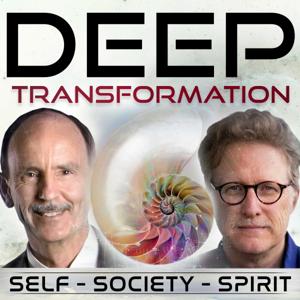
Deep Transformation

Deep Transformation

Download on the App Store
  • Favorites

    28

    Followers

  • Typical duration

    67 min

    per episode

Based on Podcast App listening data

Deep Transformation episodes

  • Swami Beyondananda / Steve Bhaerman – Laugh Yourself Sane, Enlighten Up & Awaken to Cosmic Comic Consciousness with the Wit & Wisdom of This Hilarious Duo (Part 2)

    Ep. 95 (Part 2 of 2) | Author, activist, and humorist Steve Bhaerman (aka Swami Beyondananda) realized the power of humor as well as his talent for making people laugh early on, when his schoolmates would laugh so hard, milk would come out of their nose. Steve’s spiritual and psychological wisdom, his deep love and concern for humanity, and his clever, refreshing humor come together in a perfect triad to create the wise, inspired, and funny political and spiritual commentary that have delighted so many for so long. Steve’s mission is to bring people together to work for the things everybody wants—rather than a tug of war, his vision is of a tug of peace, all pulling in the same direction. He has seen over and over how effective comic relief is at bridging people’s differences; it can even disrupt dualistic thinking to where oneness becomes real and unity is achieved.

    Steve’s sidekick, Swami Beyondananda, will make you laugh and his humorous perspective on the great issues of our time (like truth decay) and insights about how we can create a more positive future for ourselves (like self-facing laughter and tantrum yoga) really help to lighten the load. Hope is transmitted through levity and we find we can all laugh at human behavior together. Steve explains that with laughter we release emotions, trauma, and mental structures because truth is being liberated, and that comedy’s role is to deconstruct toxic narratives yet leave people standing. In this conversation, you will experience the power of humor to make even the dire circumstances of today’s world feel a bit lighter—Steve/Swami’s inspired comedy is not only politically astute but palpably heartwarming. Recorded August 10, 2023.

    “We need to create a sane and sacred center that transcends both religion and non-religion…bring left, right, front and center to face the music and dance together.”

    (For Apple Podcast users, click here to view the complete show notes on the episode page.)

    Topics & Time Stamps – Part 2
    • Swami’s take on Donald Trump (01:36)
    • The shadow side of well meaning liberal progressives (02:20)
    • The trans-humanist movement: don’t neglect real intelligence (04:37)
    • Believing in the primacy of the human mind is as dangerous as right-wing totalitarianism (05:17)
    • Steve never does comedy to hurt anyone, but Swami knows how to insult people when necessary (05:32)
    • How the progressive movement has heightened sensitivities to the point where comedians won’t perform on college campuses (09:55)
    • Breaking the trance of people believing insane things (11:42)
    • Humor disrupts dualistic thinking and puts things together in a new way—we like it when our mind is tricked (13:27)
    • Steve’s podcast, Front and Center: From Political Battlefields to Cooperative Playing Fields (16:26)
    • Lesser evil politics always empowers evil (17:08)
    • As spirituality evolves, it recognizes everyone has to have a relationship with the transcendent (17:59)
    • Reuniting the cosmos in love and practicing virtues can bring heaven to Earth (20:21)
    • The future of spirituality combines walking the talk, being the love that you are, and releasing the grip of the ego with all of its insecurities and paranoias (21:49)
    • How humor evolves in 4 stages: what we laugh at as we develop (23:31)
    • With laughter we can release emotions, trauma, and mental structures because truth is being liberated (24:20)
    • Comedy has always been anti-authoritarian and why there are no humorous right-wingers (29:26)
    • People don’t want to be canceled by their tribe, and the casualty of nuance (32:48)
    • The high level of public intimidation going on, transgenderism, and how the left is the new corporate party (35:39)
    • Steve’s mission is to bring people together to work for what everybody wants (38:04)

    Resources & References – Part 2
    • Voltaire, “Those who can make you believe absurdities can make you commit atrocities.”
    • Henny Youngman, comedian and musician, master of one-liners and famous for his “wife” jokes
    • Swami Satchidananda, “Nothing will make you enlightened.”
    • Maharishi Mahesh Yogi, the Giggling Guru
    • St. Maximus the Confessor, Christian monk, theologian, and scholar who coined the phrase cosmic love in the 8th century
    • Elaine Park, The Habits of Unity: Twelve Months to a Stronger America… One Citizen at a Time
    • Mel Brooks & Carl Reiner, The 2000 Year Old Man (YouTube video)
    • Bill Maher, comedian and political satirist
    • Jimmy Dore, comedian, political commentator, conspiracy theorist, host of The Jimmy Dore Show
    • Stephen Colbert, comedian, producer, political commentator, TV host
    • Charlie Chaplin, The Great Dictator (1941 trailer on YouTube)
    • Groucho Marx, Duck Soup (1933 trailer on YouTube)
    • George Carlin, comedian, actor, author, social critic
    • Martine Rothblatt, From Transgender to Transhuman: A Manifesto On the Freedom Of Form*
    • 12Habits4AllofUs.org: The 12 Practices of Unity
    • Richard Flyer, created the conscious community network in Reno, Connecting the Good, a radically inclusive group
    • Martin Luther King, Jr., “Those who love peace must learn to organize as effectively as those who love war.”
    • Swami and Steve’s website: Wake Up Laughing.com
    • Steve’s podcast, Front and Center with Steve and Michael: From Political Battlefields to Cooperative Playing Fields
    • Steve’s Wiki Politiki Radio Show
    • Bruce Lipton & Steve Bhaerman, Spontaneous Evolution: Our Positive Future (and a Way to Get There From Here)*

    * As an Amazon Associate, Deep Transformation earns from qualifying purchases.

    ---

    Steve Bhaerman is an internationally known author, humorist, and workshop leader. For the past 36 years, he has written and performed as Swami Beyondananda, the “Cosmic Comic.” Swami’s comedy has been called “irreverently uplifting” and has been described both as “comedy disguised as wisdom” and “wisdom disguised as comedy.” Author Marianne Williamson has called him “the Mark Twain of our generation.”

    As the Swami, Steve is the author of Driving Your Own Karma (1989), When You See a Sacred Cow, Milk It For All It’s Worth (1993), Duck Soup for the Soul (1999), and Swami for Precedent: A 7-Step Plan to Heal the Body Politic and Cure Electile Dysfunction (2004). On the more serious side, he co-authored with cellular biologist Bruce H. Lipton, PhD, Spontaneous Evolution: Our Positive Future and a Way to Get There from Here (Hay House, 2009). Steve is co-host of the Front and Center podcast (“from political battlefields to cooperative playing fields”), and is working with All of Us, Inc. to present and promote the 12 Habits of Unity). He can be found online at Wake Up Laughing.

    ---

    Podcast produced by Vanessa Santos and Show Notes by Heidi Mitchell

    45 min
  • Swami Beyondananda / Steve Bhaerman – Laugh Yourself Sane, Enlighten Up & Awaken to Cosmic Comic Consciousness with the Wit & Wisdom of This Hilarious Duo

    Ep. 94 (Part 1 of 2) | Author, activist, and humorist Steve Bhaerman (aka Swami Beyondananda) realized the power of humor as well as his talent for making people laugh early on, when his schoolmates would laugh so hard, milk would come out of their nose. Steve’s spiritual and psychological wisdom, his deep love and concern for humanity, and his clever, refreshing humor come together in a perfect triad to create the wise, inspired, and funny political and spiritual commentary that have delighted so many for so long. Steve’s mission is to bring people together to work for the things everybody wants—rather than a tug of war, his vision is of a tug of peace, all pulling in the same direction. He has seen over and over how effective comic relief is at bridging people’s differences; it can even disrupt dualistic thinking to where oneness becomes real and unity is achieved.

    Steve’s sidekick, Swami Beyondananda, will make you laugh and his humorous perspective on the great issues of our time (like truth decay) and insights about how we can create a more positive future for ourselves (like self-facing laughter and tantrum yoga) really help to lighten the load. Hope is transmitted through levity and we find we can all laugh at human behavior together. Steve explains that with laughter we release emotions, trauma, and mental structures because truth is being liberated, and that comedy’s role is to deconstruct toxic narratives yet leave people standing. In this conversation, you will experience the power of humor to make even the dire circumstances of today’s world feel a bit lighter—Steve/Swami’s inspired comedy is not only politically astute but palpably heartwarming. Recorded August 10, 2023.

    “The creator is watching the comedy channel and we decide what’s on.”

    (For Apple Podcast users, click here to view the complete show notes on the episode page.)

    Topics & Time Stamps – Part 1
    • Introducing Swami Beyondananda (the comedian Roger wanted to be when he grew up) who integrates humor, wisdom & spirituality (01:15)
    • What is Swami’s spiritual orientation? FUNdamentalism (05:27)
    • The Great Up-wising: wake up, wise up, grow up, show up (06:33)
    • Levity vs gravity: laughing creates endorphins, lowers blood pressure, and strengthens our immune system (08:23)
    • Crisis precipitates evolution: the challenge of our times (10:32)
    • Why is mindfulness so important? Because so many people are suffering from mindFULLness! (13:03)
    • How do you know if you are enlightened? (14:42)
    • How do you release the grip of the ego? (16:17)
    • Roger represents emptiness and John is full of it (16:55)
    • Whatever your problem is, nothing will help (17:45) 
    • How to get beyond political polarization: leave the identity issues, focus on the identical issues that everybody faces (19:20)
    • Creating a sane asylum: developing cosmic comic consciousness and practicing tantrum yoga (22:58)
    • A story about praying for peace in the Middle East (24:59)
    • Instead of a tug of war, let’s have a tug of peace, where we all pull together (29:19)
    • What is Swami’s take on the climate issue? We need warmer hearts, cooler heads, and to restore balance on Earth (30:05)
    • What is the secret for human happiness? (32:09)
    • Introducing Steve Bhaerman, author, political humorist, and the story of how his character Swami Beyondananda came to be (34:05)
    • Pumping ironies and laughing together at human behavior (38:43)

    Resources & References – Part 1
    • Swami and Steve’s website: Wake Up Laughing.com
    • Steve’s podcast, Front and Center with Steve and Michael: From Political Battlefields to Cooperative Playing Fields
    • Steve’s Wiki Politiki Radio Show
    • Bruce Lipton & Steve Bhaerman, Spontaneous Evolution: Our Positive Future and a Way to Get There From Here*
    • Norman Cousins, Anatomy of an Illness*
    • Arthur Deikman’s test of enlightenment: Ask the spouse
    • Common Ground was the San Francisco Bay Area’s Magazine for Conscious Community since 1974 (no longer in publication)
    • Yuval Harari, author of science bestsellers: Sapiens: A Brief History of Humankind*, Homo Deus: A Brief History of Tomorrow*, and 21 Lessons for the 21st Century*
    • 12Habits4AllofUs.org: The 12 Practices of Unity

    * As an Amazon Associate, Deep Transformation earns from qualifying purchases.

    ---

    Steve Bhaerman is an internationally known author, humorist, and workshop leader. For the past 36 years, he has written and performed as Swami Beyondananda, the “Cosmic Comic.” Swami’s comedy has been called “irreverently uplifting” and has been described both as “comedy disguised as wisdom” and “wisdom disguised as comedy.” Author Marianne Williamson has called him “the Mark Twain of our generation.”

    As the Swami, Steve is the author of Driving Your Own Karma (1989), When You See a Sacred Cow, Milk It For All It’s Worth (1993), Duck Soup for the Soul (1999), and Swami for Precedent: A 7-Step Plan to Heal the Body Politic and Cure Electile Dysfunction (2004). On the more serious side, he co-authored with cellular biologist Bruce H. Lipton, PhD, Spontaneous Evolution: Our Positive Future and a Way to Get There from Here (Hay House, 2009). Steve is co-host of the Front and Center podcast (“from political battlefields to cooperative playing fields”), and is working with All of Us, Inc. to present and promote the 12 Habits of Unity). He can be found online at Wake Up Laughing.

    ---

    Podcast produced by Vanessa Santos and Show Notes by Heidi Mitchell

    43 min
  • Mark Forman (Part 3) - Hot Button Issues in Mental Health & Psychotherapy: Trauma, Transgender, Psychedelics, SuperShrinks, Feminism's Shadow & the Loneliness Epidemic

    Ep. 93 (Part 3 of 3) | Integral psychotherapist Mark Forman, author of the seminal work A Guide to Integral Psychotherapy, doesn’t mince words when it comes to the field he is passionate about: helping people out of their mental pain and dysphoria. Mark’s Integral perspective and longtime work in the trenches—with clients from all income levels, political persuasions, and levels of development—put him in a unique position to illuminate us as to the nuances of the hot button issues new to psychotherapy or ones that have suddenly exploded in numbers: misuse of the term trauma and its diagnostic creep, what the research says about the effectiveness of psychedelics to treat mental health disorders and what that portends for the future, the exponentially growing trend of teenage girls deciding they are transgender and the crying need for more data to help with counseling transgender and trans-curious youth, what is causing the loneliness epidemic, the pressing need to reimagine the male role to balance how feminism has changed the female role, and more. 

    Mark describes the “therapeutic zone” that can happen in therapy when inspiration strikes, and shares the latest research on what makes therapists into “super-shrinks” who have client outcomes ten times better than average. He also relates how living in our psychologized culture affects therapy, and how it can get tricky when therapist and client are at different levels of development. Mark’s vast knowledge and big heart shine through the many topics he delves into and his tales of actual therapeutic encounters are eye opening and moving. This is an impassioned, courageous conversation on the front lines of mental health and psychotherapy. Recorded May 4, 2023.

    “Human beings are a species designed for the genders to work together.”

    Topics & Time Stamps – Part 3
    • The loneliness epidemic is a wicked problem: what are the causes of this culture wide problem? (01:28)
    • Mark’s longtime at odds-ment with feminism (03:59)
    • First wave feminism: setting men up as oppressive enslavers (05:34)
    • Enter Integral, with Ken Wilber writing that the oppression model is not an applicable social theory (09:36)
    • We are now at a place where men have been severely beaten down psycho-socially (12:34)
    • How men’s roles have flipped from the 1950s, to where we now expect men to be everything (15:31)
    • Do we need feminism to uphold women’s rights? (17:33)
    • Looking at the low self-esteem of boys (19:29)
    • Looking at male/female roles and the balance of genders at a very fundamental level: wars, stress & mortality rates (20:48)
    • Can men be feminists? Are women smarter than men? What does it mean to be a good woman or a good man? (30:34)
    • Reimagining and liberating the male role as the female role has been reimagined since the rise of feminism (33:07)
    • On the need for sacralizing our relationships (40:25)
    • Relational aggression by women (42:21)
    • Roger’s summary of the conversation and praise for Mark’s books (47:07)

    Resources & References – Part 3
    • Declaration of Sentiments, document signed in 1848 by 68 women and 32 men at the first women’s rights convention to be organized by women
    • Charles Darwin, The Origin of Species*
    • Desmond Morris, The Naked Ape: A Zoologist’s Study of the Human Animal*
    • Steven Goldberg, The Inevitability of Patriarchy*
    • Ken Wilber, Sex, Ecology, Spirituality: The Spirit of Evolution*
    • Warren Farrell, political scientist, activist, and author, The Myth of Male Power* et. al.
    • Ken Wilber, The Eye of Spirit: An Integral Vision for a World Gone Slightly Mad*
    • Marilyn French, Beyond Power: On Women, Men, and Morals*
    • The Manichaean view breaks everything down into either good or evil
    • Ken Wilber, Up From Eden: A Transpersonal View of Human Evolution*
    • Empathy gap, a breakdown or reduction in empathy
    • Mark Forman, A Guide to Integral Psychotherapy: Complexity, Integration, and Spirituality in Practice*
    • Mark Forman, The Monster’s Journey: From Trauma to Connection*
    • Mark Forman’s website: http://www.drmarkforman.com/

    * As an Amazon Associate, Deep Transformation earns from qualifying purchases.

    ---

    Mark Forman, PhD is a licensed clinical psychologist with over twenty years experience working with individuals, couples, children, teens, and families. His text – A Guide to Integral Psychotherapy: Complexity, Integration, and Spirituality in Practice – is one of the seminal works in the field of Integral Psychotherapy. Dr. Forman is more recently the author of The Monster’s Journey: From Trauma to Connection, which is a reimagining of the The Hero’s Journey archetype for those who have suffered early childhood trauma. Dr. Forman has an academic background in philosophy and religion and is a long-term practitioner of yoga, reiki, martial arts, and meditation.

    ---

    Podcast produced by Vanessa Santos and Show Notes by Heidi Mitchell

    51 min
  • Hot Button Issues in Mental Health & Psychotherapy: Trauma, Transgender, Psychedelics & SuperShrinks (Part 2)

    Ep. 92 (Part 2 of 2) | Integral psychotherapist Mark Forman, author of the seminal work A Guide to Integral Psychotherapy, doesn’t mince words when it comes to the field he is passionate about: helping people out of their mental pain and dysphoria. Mark’s Integral perspective and longtime work in the trenches—with clients from all income levels, political persuasions, and levels of development—put him in a unique position to illuminate us as to the nuances of the hot button issues new to psychotherapy or ones that have suddenly exploded in numbers: misuse of the term trauma and its diagnostic creep, what the research says about the effectiveness of psychedelics to treat mental health disorders and what that portends for the future, the exponentially growing trend of teenage girls deciding they are transgender and the crying need for more data to help with counseling transgender and trans-curious youth, what is causing the loneliness epidemic, the pressing need to reimagine the male role to balance how feminism has changed the female role, and more.

    Mark describes the “therapeutic zone” that can happen in therapy when inspiration strikes, and shares the latest research on what makes therapists into “super-shrinks” who have client outcomes ten times better than average. He also relates how living in our psychologized culture affects therapy, and how it can get tricky when therapist and client are at different levels of development. Mark’s vast knowledge and big heart shine through the many topics he delves into and his tales of actual therapeutic encounters are eye opening and moving. This is an impassioned, courageous conversation on the front lines of mental health and psychotherapy. Recorded May 4, 2023.

    “Reflective listening is the beating heart of all therapy.”

    (For Apple Podcast users, click here to view the complete show notes on the episode page.)

    Topics & Time Stamps – Part 2
    1. Trauma is less severe where there is a sense of purpose & meaning (00:50)
    2. The “gifts” trauma can offer: post traumatic growth, a resiliency generating idea that you can give back, take part, reduce someone else’s suffering (04:19)
    3. What makes psychotherapy so effective? Research suggests it’s an individual thing rather than which psychological school the therapist follows (07:07)
    4. The matrix problem: it’s almost impossible to define outcome measures (09:38)
    5. What does research show makes the biggest difference in outcomes? Super-shrinks make a lot of room for negative feedback (11:34)
    6. The therapeutic zone: conceptual curiosity, receptive listening, and dropping into the witness or pure awareness (23:08)
    7. The developmental stage of the therapist’s effect on the client: where it gets tricky is if the client is in a later stage of development than the therapist (27:40)
    8. Reflective listening is the beating heart of all therapy (36:59)
    9. Recent research on psychedelic therapy is showing it is amazingly effective: psilocybin for depression and MDMA for PTSD (38:06)
    10. Will the psychedelic therapy bubble burst when the risks become more apparent? (44:46)
    11. What about ketamine? (47:57)
    12. Trans issues in psychotherapy: the controversy is really over what is the appropriate age to socially transition versus the various steps of medical transition (51:28)
    13. Trending upwards exponentially: teenage girls suddenly deciding they are transgender—is this a “social contagion”? What is the right pace of care? (56:39)
    14. Are there inherent dangers with surgery? What happens with puberty blockers? (01:00:24)
    15. Trans-curious youth, are we treating youth in the most cautious way? And the big need for research and data (01:02:42)

    Resources & References – Part 2
    1. Victor Frankl, Man’s Search for Meaning*
    2. Michael Lambert, Benjamin Ogles, Scott Fields, Essentials of Outcome Assessment*
    3. Scott Miller, Mark Hubble, Daryl Chow, Better Results: Using Deliberate Practice to Improve Therapeutic Effectiveness*
    4. Sri Nisargadatta Maharaj, guru of nondualism, author of I Am That*
    5. Carl Rogers, one of the founders of humanistic psychology, master of reflective listening
    6. Roland Griffiths, director, Center for Psychedelic and Consciousness Research at Johns Hopkins University, Johns Hopkins press release on Griffiths’ 2006 psilocybin study
    7. Stanislav Grof, LSD: Doorway to the Numinous: The Groundbreaking Psychedelic Research into Realms of the Human Unconscious*
    8. Don Lattin, Changing Our Minds: Psychedelic Sacraments and the New Psychotherapy*
    9. Transgender health care and gender-affirming care
    10. American Psychological Association (APA)
    11. Mark Forman, A Guide to Integral Psychotherapy: Complexity, Integration, and Spirituality in Practice*
    12. Mark Forman, The Monster’s Journey: From Trauma to Connection*
    13. Mark Forman’s website: http://www.drmarkforman.com/

    * As an Amazon Associate, Deep Transformation earns from qualifying purchases.

    ---

    Mark Forman, PhD is a licensed clinical psychologist with over twenty years experience working with individuals, couples, children, teens, and families. His text – A Guide to Integral Psychotherapy: Complexity, Integration, and Spirituality in Practice – is one of the seminal works in the field of Integral Psychotherapy. Dr. Forman is more recently the author of The Monster’s Journey: From Trauma to Connection, which is a reimagining of the The Hero’s Journey archetype for those who have suffered early childhood trauma. Dr. Forman has an academic background in philosophy and religion and is a long-term practitioner of yoga, reiki, martial arts, and meditation.

    ---

    Podcast produced by Vanessa Santos and Show Notes by Heidi Mitchell

    1 hr 10 min
  • Hot Button Issues in Mental Health & Psychotherapy: Trauma, Transgender, Psychedelics & SuperShrinks

    Ep. 91 (Part 1 of 2) | Integral psychotherapist Mark Forman, author of the seminal work A Guide to Integral Psychotherapy, doesn’t mince words when it comes to the field he is passionate about: helping people out of their mental pain and dysphoria. Mark’s Integral perspective and longtime work in the trenches—with clients from all income levels, political persuasions, and levels of development—put him in a unique position to illuminate us as to the nuances of the hot button issues new to psychotherapy or ones that have suddenly exploded in numbers: misuse of the term trauma and its diagnostic creep, what the research says about the effectiveness of psychedelics to treat mental health disorders and what that portends for the future, the exponentially growing trend of teenage girls deciding they are transgender and the crying need for more data to help with counseling transgender and trans-curious youth, what is causing the loneliness epidemic, the pressing need to reimagine the male role to balance how feminism has changed the female role, and more.

    Mark describes the “therapeutic zone” that can happen in therapy when inspiration strikes, and shares the latest research on what makes therapists into “super-shrinks” who have client outcomes ten times better than average. He also relates how living in our psychologized culture affects therapy, and how it can get tricky when therapist and client are at different levels of development. Mark’s vast knowledge and big heart shine through the many topics he delves into and his tales of actual therapeutic encounters are eye opening and moving. This is an impassioned, courageous conversation on the front lines of mental health and psychotherapy. Recorded May 4, 2023.

    “The therapist is the priest of our times…imbued with a certain amount of metaphysical responsibility. So when the therapeutic field gets out of balance, it makes a difference.”

    (For Apple Podcast users, click here to view the complete show notes on the episode page.)

    Topics & Time Stamps – Part 1
    1. Introducing Integral psychotherapist Mark Forman, author of A Guide to Integral Psychotherapy and The Monster’s Journey: From Trauma to Connection (00:52)
    2. How we have moved from the animistic to the religious to the scientific worldview, and now look at the world through a predominantly psychological perspective (02:25)
    3. 42 million people in the U.S. interacted with therapy or counseling, which is up 20 million people from the year 2000 (03:41)
    4. The therapist is the priest of our times…imbued with a certain amount of metaphysical responsibility. So when the therapeutic field gets out of balance, it makes a difference (06:41)
    5. Has there been a shift in what clients are bringing up? It’s still often about love or work, as Freud said; diagnoses are depression, anxiety, panic disorder, bipolar, eating disorders, substance abuse (09:20)
    6. What might be new is people venting their political worries, gender dynamics, and how informed people are about psychology, largely via the internet (10:45)
    7. Positive effects of people being more informed about their own condition (13:35)
    8. What are the negative effects of the psychologization of our culture? Falsely self-labeling disorders (15:25)
    9. The paradoxical nature of labels and the skillful use of labels (20:15)
    10. The phenomenon of diagnostic creep in recent decades, especially in regard to trauma (24:53)
    11. Kaiser’s study of 17,000 members provided a watershed moment correlating cause and outcome: 65% of adults had a traumatic event in childhood (abandonment, abuse), and the more boxes people checked, the worse their mental & physical outcomes were (27:40)
    12. Mark has found the hero’s journey motif doesn’t apply with people who suffered early childhood trauma (31:11)
    13. The magic quality of resilience (33:23)
    14. The widespread mistake of inflating upsets to trauma status and its effect of negating the research (33:54)
    15. The concept of “self as instrument” (40:48)
    16. Differentiating between real trauma and upsetting events (43:10)
    17. What are the forces making trauma labeling so popular: absolving ourselves of responsibility and playing the victim role (45:24)
    18. The role of the therapist is validating people’s pain, while offering a more practical, moderated narrative that is not so fire & brimstone: trauma means there is a lasting imprint on brain, body, nervous system, psyche (49:16)
    19. The supershrink literature: what constitutes the most effective therapist? (52:08)

    Resources & References – Part 1
    1. Mark Forman, A Guide to Integral Psychotherapy: Complexity, Integration, and Spirituality in Practice*
    2. Mark Forman, The Monster’s Journey: From Trauma to Connection*
    3. Mark Forman’s website: http://www.drmarkforman.com/
    4. Sigmund Freud: “Love and work are the cornerstones of our humanness.”
    5. Diagnostic and Statistical Manual of Mental Disorders (DSM)
    6. The World Health Organization’s International Classification of Diseases and Related Health Problems (ICD)
    7. The Rumpelstiltskin Principle
    8. Diagnosis creep, expanding disease definitions
    9. The original Kaiser Permanente/CDC Adverse Childhood Experiences (ACE) Study
    10. Bessel van der Kolk, The Body Keeps the Score: Brain, Mind, and Body in the Healing of Trauma*
    11. Gabor Mate, The Myth of Normal: Trauma, Illness, and Healing in a Toxic Culture*
    12. Janina Fisher, psychoeducator, Transforming The Living Legacy of Trauma: A Workbook for Survivors and Therapists*

    * As an Amazon Associate, Deep Transformation earns from qualifying purchases.

    ---

    Mark Forman, PhD is a licensed clinical psychologist with over twenty years experience working with individuals, couples, children, teens, and families. His text – A Guide to Integral Psychotherapy: Complexity, Integration, and Spirituality in Practice – is one of the seminal works in the field of Integral Psychotherapy. Dr. Forman is more recently the author of The Monster’s Journey: From Trauma to Connection, which is a reimagining of the The Hero’s Journey archetype for those who have suffered early childhood trauma. Dr. Forman has an academic background in philosophy and religion and is a long-term practitioner of yoga, reiki, martial arts, and meditation.

    ---

    Podcast produced by Vanessa Santos and Show Notes by Heidi Mitchell

    57 min
  • Deep Diversity: Integrating Psychological, Scientific & Spiritual Contributions for Healing Injustice and Inequity (Part 2)

    Ep. 90 (Part 2 of 2) | Award-winning educator and activist Shakil Choudhury is the author of the outstanding book Deep Diversity: A Compassionate, Scientific Approach to Achieving Racial Justice, and in this potent conversation we learn a lot we perhaps didn’t know about the psychological, emotional, and neurobiological reasons for our ingrained biases, and the systemic bias in the culture at large. How and why do we discriminate? Many of our biases are hidden in the unconscious, which makes it that much harder to bring them into the light so we can begin to understand what’s going on and find ways to move ourselves and society toward justice and equity. Shakil explains that changing societal norms is at the heart of the battle for racial and social justice, as our habitual cultural behaviors tend to be viewed as legitimate, normal, and natural, when actually they may be outdated, off base, offensive, and unjust. Shakil deftly lines us out with specific steps we can take to recognize and change our own behaviors, as well as actions organizational leaders can take to effect change on a broader level.

    Shakil contends that educating people to become diversity and equity literate is the first essential step, and the 360-hour program he has designed to this end has proven very effective. Once people see the data, they cannot help understanding the drivers of racial and social injustice more clearly, which leads to the place where real transformation can happen. Shakil’s extraordinarily insightful and illuminating approach is fueled by many years of contemplative practice, and he leaves us with a vision of what we are fighting for—not just what we are fighting against—based on Dr. Martin Luther King’s dream of Beloved Community. Small groups of dedicated people have managed to successfully nudge societal norms in the direction of justice in the past, and this conversation and Shakil’s book, Deep Diversity, most certainly contribute a compassionate nudge in the right direction. Bit by bit, recognizing that this is a journey, Shakil conveys both the means and the hope that justice will prevail. Recorded April 26, 2023.

    “Can we hold the tension between our common humanity and our differences simultaneously?”

    (For Apple Podcast users, click here to view the complete show notes on the episode page.)

    Topics & Time Stamps – Part 2
    • How classism and racism come together, and the importance of asking the right questions about the variables that affect equality and diversity in our culture (01:43)
    • Culture wide hypnosis and cultural hegemony (05:03)
    • Where are we now as a species? We have made progress…but this doesn’t mean people are happy about the changes (07:03)
    • System justification theory: we justify the system no matter what because we’re herd people (08:29)
    • Changing the norms of society is the whole battle: small groups on the right side of justice can create a culture change (09:20)
    • People coming together for shared purpose is deeply meaningful; contact activates empathy (11:17)
    • The more we can see this as a literacy project, the more clearly we’re able to see the problems, the behavioral patterns (15:10)
    • The data does not validate the fear that is being expressed about women and people of color getting preferential treatment (19:24)
    • The empathy response to people who are like us and the threat response with people unlike us are biological responses (25:51)
    • Does being on the right side of justice require a postconventional stage of development? (27:14) 
    • What can organizational leaders aspire to? Moving from a reactive form of leadership to a pro-active, responsive form of leadership (28:26)
    • Listening, doing the pre-work, building relationships, and asking the right questions (36:21)
    • Racial justice & equity, diversity and inclusion—what are we fighting for? Dr. Martin Luther King’s concept of Beloved Community (39:21)
    • Can we hold the tension between our common humanity and our differences simultaneously? (42:06)

    Resources & References – Part 2
    • Shakil Choudhury, Deep Diversity: A Compassionate, Scientific Approach to Achieving Racial Justice*
    • References for the research studies mentioned in this podcast can be found in Shakil’s book, Deep Diversity*
    • Ayn Rand, creator of the philosophy Objectivism, and author of the bestselling novel Atlas Shrugged*, The Fountainhead*, et. al.
    • Cultural hegemony
    • The Anglican hymn All Things Bright and Beautiful (“The rich man in his castle, the poor man at his gate…” This verse is now often omitted from the song.)
    • System justification theory
    • Dr. Martin Luther King, Jr.’s vision of The Beloved Community
    • Shakil Choudhury, co-founder & Chief Visionary Officer, Anima Institute: A Compassionate Approach to Racial Justice, offering innovative organizational change and training solutions to nurture inclusive, productive workplaces and communities

    * As an Amazon Associate, Deep Transformation earns from qualifying purchases.

    ---

    Shakil Choudhury, M.E.S., B.Ed., B.P.E., co-founder & Chief Visionary Officer of Anima Institute, is an award-winning educator, consultant, and author with over 25 years of experience in the field of racial justice, diversity, and inclusion. He coaches executive teams and has worked with thousands of leaders across sectors in Canada and the United States to help improve their equity outcomes. Shakil also facilitates dialogue processes to resolve inter-group conflict, having led projects internationally as well as with organizations locally. 

    Shakil is the author of Deep Diversity: A Compassionate, Scientific Approach to Achieving Racial Justice. Written in an accessible, storytelling manner, many have called it a “breakthrough” book on issues of systemic racial discrimination due to its non-judgmental approach that integrates human psychology with critical race perspectives. Shakil’s most challenging and rewarding management experience, however, involves his two high-spirited children repeatedly teaching him the humble lessons of fatherhood. To clear his head during the week, Shakil loves to run the beautiful ravine trails near his home in Toronto.

    ---

    Podcast produced by Vanessa Santos and Show Notes by Heidi Mitchell

    46 min
  • Deep Diversity: Integrating Psychological, Scientific & Spiritual Contributions for Healing Injustice and Inequity

    Ep. 89 (Part 1 of 2) | Award-winning educator and activist Shakil Choudhury is the author of the outstanding book Deep Diversity: A Compassionate, Scientific Approach to Achieving Racial Justice, and in this potent conversation we learn a lot we perhaps didn’t know about the psychological, emotional, and neurobiological reasons for our ingrained biases, and the systemic bias in the culture at large. How and why do we discriminate? Many of our biases are hidden in the unconscious, which makes it that much harder to bring them into the light so we can begin to understand what’s going on and find ways to move ourselves and society toward justice and equity. Shakil explains that changing societal norms is at the heart of the battle for racial and social justice, as our habitual cultural behaviors tend to be viewed as legitimate, normal, and natural, when actually they may be outdated, off base, offensive, and unjust. Shakil deftly lines us out with specific steps we can take to recognize and change our own behaviors, as well as actions organizational leaders can take to effect change on a broader level.

    Shakil contends that educating people to become diversity and equity literate is the first essential step, and the 360-hour program he has designed to this end has proven very effective. Once people see the data, they cannot help understanding the drivers of racial and social injustice more clearly, which leads to the place where real transformation can happen. Shakil’s extraordinarily insightful and illuminating approach is fueled by many years of contemplative practice, and he leaves us with a vision of what we are fighting for—not just what we are fighting against—based on Dr. Martin Luther King’s dream of Beloved Community. Small groups of dedicated people have managed to successfully nudge societal norms in the direction of justice in the past, and this conversation and Shakil’s book, Deep Diversity, most certainly contribute a compassionate nudge in the right direction. Bit by bit, recognizing that this is a journey, Shakil conveys both the means and the hope that justice will prevail. Recorded April 26, 2023.

    “Can we hold the tension between our common humanity and our differences simultaneously?”

    (For Apple Podcast users, click here to view the complete show notes on the episode page.)

    Topics & Time Stamps – Part 1
    • Introducing Shakil Choudhury, award-winning educator, racial justice & equity activist, author of Deep Diversity (01:17)
    • How did Shakil come to create this “deep diversity” approach to racial justice and equity work? (02:15)
    • Shakil’s healing journey: finding inner freedom, the world began to look different (03:16)
    • The historical and sociological perspectives help us understand how we got here but it’s the emotional and psychological perspectives that can help us understand why we do what we do (05:38)
    • The unconscious role of emotions, bias, identity, and power (08:11)
    • Cultural diversity, wokeism, ethnocentricity, and how to talk with people at a traditional level of development about racism (10:54)
    • How to get the most people on the side of justice? Let’s make it as easy as possible for people: agnosticizing racial justice and equity work (14:37) 
    • Racism is a systemic problem: it’s more than hate crimes, the KKK, and neo-Nazis, more than “spot the bigot” (16:27) 
    • We have to help people become systems thinkers: the key is pattern recognition (18:48)
    • Moving racial justice work from an urgency project to a literacy project: changing behavioral patterns is like developing literacy, once you can read, you never stop (19:14) 
    • We need to bring forward a framework to make it easier for people to accept that becoming educated about diversity is a journey (22:55)
    • What are effective interventions to begin to change specific behaviors? (26:33)
    • Countering stereotypes: training ourselves to catch our biases when they show up (28:00)
    • Shakil was socialized with a pro-white bias like the rest of society—our biases are not individual problems but a systems problem (31:41)
    • What can we do on an individual level? (33:08)
    • Internalized racism, sexism, and the unconscious nature of our biases (39:31)
    • The ways in which the privileged are unaware of the realities of their own privilege and power: privilege is like a tailwind at your back (41:00)

    Resources & References – Part 1
    • Shakil Choudhury, Deep Diversity: A Compassionate, Scientific Approach to Achieving Racial Justice* (Research and data references can be accessed in Deep Diversity*)
    • Shakil Choudhury, co-founder & Chief Visionary Officer, Anima Institute: A Compassionate Approach to Racial Justice, offering innovative organizational change and training solutions to nurture inclusive, productive workplaces and communities

    * As an Amazon Associate, Deep Transformation earns from qualifying purchases.

    ---

    Shakil Choudhury, M.E.S., B.Ed., B.P.E., co-founder & Chief Visionary Officer of Anima Institute, is an award-winning educator, consultant, and author with over 25 years of experience in the field of racial justice, diversity, and inclusion. He coaches executive teams and has worked with thousands of leaders across sectors in Canada and the United States to help improve their equity outcomes. Shakil also facilitates dialogue processes to resolve inter-group conflict, having led projects internationally as well as with organizations locally. 

    Shakil is the author of Deep Diversity: A Compassionate, Scientific Approach to Achieving Racial Justice. Written in an accessible, storytelling manner, many have called it a “breakthrough” book on issues of systemic racial discrimination due to its non-judgmental approach that integrates human psychology with critical race perspectives. Shakil’s most challenging and rewarding management experience, however, involves his two high-spirited children repeatedly teaching him the humble lessons of fatherhood. To clear his head during the week, Shakil loves to run the beautiful ravine trails near his home in Toronto.

    ---

    Podcast produced by Vanessa Santos and Show Notes by Heidi Mitchell

    48 min
  • The Psychology of Climate Change: Understanding the Causes & Finding Solutions to the Great Challenge of Our Time (Part 2)

    Ep. 88 (Part 2 of 2) | Climate change researcher, sustainable development expert, and activist Gail Hochachka works on the front lines of climate change research, asking—and answering—questions like: How does the way we make meaning, at all our different stages of development, relate to the ways we act on climate change? How can we foster more engagement with climate change? Is climate action scalable? And how are we going to show up for the people who are facing the greatest impacts? So far, in searching for solutions, we have largely neglected tapping into the human dimensions of the problem—the ways we understand climate change, the ways we respond, and the ways we can communicate together and make decisions about how to act. Herein lies the potential to come up with more viable solutions than we have so far, and this is the focus of Gail’s current research.

    Climate change is such a hugely complex and also emotional issue, it is understandably hard for anyone to wrap their head around it, Gail tells us, but the good news is that research is showing that taking action—in whatever way seems most appropriate and meaningful to each individual—is scalable, and that there are ways, which Gail outlines, of creating meaningful communication between people who have very different understandings, to where people can actually come to a place of agreement on how to move forward. Gail’s deep understanding of integral theory and stages of psychological development, combined with her extensive experience in sustainable development, gives her a uniquely insightful perspective on ways of confronting the climate challenge. Gail relates that, surprisingly, a positive way to look at climate change has come to light, which is that climate change is actually presenting us with an opportunity—an opportunity to become more conscious about the way we live, to the great benefit of people and planet. Recorded January 18, 2023.

    “We know that individuals collectively created the problem of climate change…but when it comes to solutions, we don’t honor that we individuals count.”

    (For Apple Podcast users, click here to view the complete show notes on the episode page.)

    Topics & Time Stamps – Part 2
    • Research shows that a sense of the spiritual arises in later stage development (01:40)
    • At later stage development, climate change presents us with an opportunity to be more conscious as to how we live our lives (03:06)
    • Climate change scientists only represent a narrow bandwidth of psychological development (05:43)
    • Research shows, even if we come from different understandings, we can have conversations and find ways to act that we agree upon (07:41)
    • Psychic benefits and how later stage individuals show up in every group (09:26)
    • What brought Gail into this field of study and research? (13:08)
    • Is how women approach climate change different than how men do? (18:30)
    • Social holons and sub holons: the group’s center of gravity will either grow you or limit you (20:53)
    • Mentors and the paradox of success (23:06)
    • How predictable are the outcomes of our changing environment? (25:26)
    • We have the physio sphere, the biosphere & the noosphere—it is the noosphere that would be the first to go (27:28)
    • How are we going to show up for people who are feeling the greatest impacts? (31:55)
    • Double exposure, overlays, looking at communities facing multiple issues: which part of this ball of yarn are we going to pull? (33:12)
    • How to avoid the single issue fallacy, single cause fallacy, and single solution fallacy, in order to maintain civilization (35:27)
    • The extent to which you cross your own value action gap, sustainability does scale—there is an enactment in this moment that has ripple effects (36:36)

    Resources & References – Part 2
    • The STAGES model of ego development
    • Tom Murray, Emerge podcast on Wisdom Skills
    • See also Deep Transformation podcast with Beena Sharma, Vertical Development’s Many Gifts (on YouTube)
    • Robert Kegan, The Evolving Self*
    • Venn diagram
    • Ken Wilber, Sex, Ecology, Spirituality: The Spirit of Evolution*
    • Corey deVos, Holons: The Building Blocks of the Universe (on Integral Life)
    • John O’Neil, The Paradox of Success*
    • David Christian, Maps of Time*
    • Morphogenetic fields
    • Andrew Harvey’s Institute for Sacred Activism
    • Gail Hochachka’s website: https://www.gailhochachka.com
    • Gail’s recent publications: https://www.gailhochachka.com/publications

    * As an Amazon Associate, Deep Transformation earns from qualifying purchases.

    ---

    Finding One’s Own Soul-Centric Climate Action [Live Online Course]

    with Gail Hochachka & Lisa Gibson, August 16th & 23rd, 12 pm Mountain Time

    ---

    Gail Hochachka, B.Sc., M.A., Ph.D. works with the human dimensions of climate change using a transdisciplinary, integral approach. Her work focuses on understanding how people make meaning of climate change and how to engage with diverse groups towards a shared sense of the climate challenge. Her research has been published in various academic journals and has been used to support non-profit, private, and city actors in advancing climate action. Prior to this, Gail did her PhD at the University of Oslo on how climate change adaptation can account for meaning-making stages in diverse social groups and be carried out in a transformative manner, with fieldwork in Guatemala. Gail also has substantial previous NGO experience working in sustainable development in Latin America and Africa, and co-founded Integral Without Borders Institute. She is based in Vancouver, Canada, www.gailhochachka.com, and on her Recent Publications webpage, you can find a number of articles she drew from in this podcast: https://www.gailhochachka.com/publications/.

    ---

    Podcast produced by Vanessa Santos and Show Notes by Heidi Mitchell

    43 min
  • The Psychology of Climate Change: Understanding the Causes & Finding Solutions to the Great Challenge of Our Time

    Ep. 87 (Part 1 of 2) | Climate change researcher, sustainable development expert, and activist Gail Hochachka works on the front lines of climate change research, asking—and answering—questions like: How does the way we make meaning, at all our different stages of development, relate to the ways we act on climate change? How can we foster more engagement with climate change? Is climate action scalable? And how are we going to show up for the people who are facing the greatest impacts? So far, in searching for solutions, we have largely neglected tapping into the human dimensions of the problem—the ways we understand climate change, the ways we respond, and the ways we can communicate together and make decisions about how to act. Herein lies the potential to come up with more viable solutions than we have so far, and this is the focus of Gail’s current research.

    Climate change is such a hugely complex and also emotional issue, it is understandably hard for anyone to wrap their head around it, Gail tells us, but the good news is that research is showing that taking action—in whatever way seems most appropriate and meaningful to each individual—is scalable, and that there are ways, which Gail outlines, of creating meaningful communication between people who have very different understandings, to where people can actually come to a place of agreement on how to move forward. Gail’s deep understanding of integral theory and stages of psychological development, combined with her extensive experience in sustainable development, gives her a uniquely insightful perspective on ways of confronting the climate challenge. Gail relates that, surprisingly, a positive way to look at climate change has come to light, which is that climate change is actually presenting us with an opportunity—an opportunity to become more conscious about the way we live, to the great benefit of people and planet. Recorded January 18, 2023.

    “We know that individuals collectively created the problem of climate change…but when it comes to solutions, we don’t honor that we individuals count.”

    (For Apple Podcast users, click here to view the complete show notes on the episode page.)

    Topics & Time Stamps – Part 1
    • Introducing Gail Hochachka, climate change expert & researcher at the University of British Columbia, who brings a profound integral understanding to the way we look at climate change (01:05)
    • What are the most exciting research findings? Global problems are actually global symptoms, and we need to look at what shaped the actual problems to come up with effective solutions (02:24)
    • When we integrate the human dimensions into the global environmental problems, solutions become more apparent (03:47)
    • How much of climate change can we actually make meaning of? We make a whole mental model based on only a fragment of the problem (04:32)
    • The knowledge deficit model: do we do the right thing and respond skillfully if we have all the knowledge we need? No. (06:15)
    • The value action gap in climate change: when it comes to making changes in our lifestyle, we don’t (08:24)
    • The need to foster worldcentric awareness in order to foster climate action (10:08)
    • Gnostic intermediaries: speaking across different cultures, translating concepts across space & time, translating meaning across developmental stages (13:14) 
    • How to approach engagement on environmental issues and the 5 why’s of what is most important to people (15:16)
    • How to get people together and discuss climate change (18:54)
    • Considering supply chains and the individuals who add value at each stage of the chain allows people to realize both common ground and that these are problems we all share (23:20)
    • Interdependence reflection: reflecting on Indra’s net ends up as a meditation on boundless gratitude (27:10) 
    • We’re all talking from our fragments (29:47)
    • Later stages of development and of meaning making make for more flexibility around your attachment to yourself, greater self-responsibility (30:32)
    • Recommended climate change adaptations and indigenous cosmologies: given sovereignty of their own meaning making, the solutions are better connected to reality—and more likely to be implemented (36:03)
    • Re-owning your sovereignty in relation to the issue is very empowering (38:43)
    • The process of “photovoice:” taking photos in response to the question, what does climate change mean to me? (39:57)
    • How does meaning making change as we mature developmentally? The object of awareness becomes more subtle, the complexity of thought changes, and the future comes more online (41:53)

    Resources & References – Part 1
    • Gail Hochachka’s website: https://www.gailhochachka.com
    • Gail’s recent publications: https://www.gailhochachka.com/publications/
    • Ken Wilber’s Integral Theory, Who Is Ken Wilber? (Integral Life), The Integral Vision*
    • Tomas Björkman podcast, Cultivating Psychological Maturity in Both Individuals and Societies: The Race Between Maturity and Catastrophe, on Deep Transformation
    • What Are the Stages of Development?, in cinematic form on Integral Life 
    • St. Paul, Romans 7:19-25, “For the good that I will to do, I do not do; but the evil I will not to do, that I practice.” 
    • Roger Walsh, The Transmission of Wisdom: The Task of Gnostic Intermediaries
    • The Deconstruction of the World Trade Center (Integral Life pdf), where Ken Wilber explores the many reactions people had to 9/11 as a way of explaining stages of development
    • The net of Indra
    • The STAGES model of ego development
    • Tom Murray, Emerge podcast on Wisdom Skills
    • See also Deep Transformation podcast with Beena Sharma, Vertical Development’s Many Gifts (on YouTube)

    * As an Amazon Associate, Deep Transformation earns from qualifying purchases.

    ---

    Finding One’s Own Soul-Centric Climate Action [Live Online Course]

    with Gail Hochachka & Lisa Gibson, August 16th & 23rd, 12 pm Mountain Time

    ---

    Gail Hochachka, B.Sc., M.A., Ph.D. works with the human dimensions of climate change using a transdisciplinary, integral approach. Her work focuses on understanding how people make meaning of climate change and how to engage with diverse groups towards a shared sense of the climate challenge. Her research has been published in various academic journals and has been used to support non-profit, private, and city actors in advancing climate action. Prior to this, Gail did her PhD at the University of Oslo on how climate change adaptation can account for meaning-making stages in diverse social groups and be carried out in a transformative manner, with fieldwork in Guatemala. Gail also has substantial previous NGO experience working in sustainable development in Latin America and Africa, and co-founded Integral Without Borders Institute. She is based in Vancouver, Canada, www.gailhochachka.com, and on her Recent Publications webpage, you can find a number of articles she drew from in this podcast: https://www.gailhochachka.com/publications/.

    ---

    Podcast produced by Vanessa Santos and Show Notes by Heidi Mitchell

    51 min
  • Nondual Love: Awakening to the Fundamental Benevolence of Reality with A. H. Almaas (Part 2)

    Ep. 86 (Part 2 of 2) | Hameed Ali (A. H. Almaas), founder of the contemporary spiritual path the Diamond Approach, beloved teacher, and author of many outstanding spiritual classics, has written a trilogy on the subject of love, and in this conversation the focus is on the recently published second book, Nondual Love. Hameed explains that most wisdom traditions target various ultimates: pure emptiness, pure consciousness, nondual awareness, being, non-being—each of which is sufficient for liberation, but fails to include the qualities of nondual love: goodness, sweetness, abundance, benevolence. Hameed brings these dimensions of love to the table, asking what does divine love feel like, look like, what is it made of? 

    Listening to Hameed is a beautiful, rich experience, due to his extraordinary lucidity, gentle humor, and the profound understanding and assurance that pervade his words from his long experience swimming in the waters of which he speaks. He tells us we all have the potential to experience nondual love, although there are significant obstacles along the path that are inherent to being human. Hameed describes the different stages of opening to nondual love, from the first glimmerings of “unearthly sweetness” to the realization that we ourselves are love. And he outlines the nature of the barriers we face, like the beast of anger and hatred that arises in us when we perceive that reality has abandoned us. Hameed explains that by re-establishing basic trust, and feeling the presence of benevolent love, we can regain the sense that things will be okay and unfold ultimately for the good. Recorded April 12, 2023.

    “Our true nature has infinite potential of how it can be.”

    (For Apple Podcast users, click here to view the complete show notes on the episode page.)

    Topics & Time Stamps – Part 2
    • The personal nature of God is responsive; the closer you are, the happier you are (01:24)
    • The personal is a spiritual quality of presence that comes from pure being or source, as an expression of it (03:59)
    • Practicing surrender and recognizing our true helplessness completely (06:01)
    • The practice of awakening: how do we put practice (doing) together with the importance of non doing? (08:58)
    • In a dualistic way, we have responsibility, free will, intention, and effort and we have to apply these to awaken; in time this shows us we are helpless: when we truly give up doing, then things can open up (11:35)
    • It is inherent to the ego consciousness that we can’t do it—it’s an objective helplessness, not the fault of any one individual (13:31)
    • Obstacles on the way to divine love: settling for substitute gratifications, the separate ego self (14:32) 
    • The beast arises when people have suffered and reality has left them hurt and feeling abandoned—then you hate God, you hate good (17:43) 
    • Transformation is through understanding; we have to be nonjudgmental about everything that arises in our experience (23:28)
    • Jabba the Hutt, archetypal symbol of attachment, desire, greed, is disconnected from abundance, from divine love—to heal this in yourself, you welcome it (29:56)
    • The main barrier to all nondual experience is believing we are separate entities—we feel the shape of our bodies, and we have to work through this central construct of our ego (33:51)
    • Ego is a stage the soul goes through; to believe this stage is the only and final stage, that is the error (37:24)
    • How does Hameed experience himself? Nobody, nothing here. Basic trust is second nature (38:27)
    • How does Hameed teach others basic trust? By exploring and working through the limitations that came about in people’s lives where basic trust was lost (40:14)
    • The more basic trust, the more people can open up, relax, let things happen—how Hameed discovered the importance of basic trust in teaching his students (42:44)
    • Volume III of Hameed’s trilogy will be The Beloved and a brief blessing (45:19)

    Resources & References – Part 2
    • Rigpa, the true nature of our mind, pure awareness, a central concept of Dzogchen
    • Dharmakāya, the “body” or sum of Buddha’s teachings
    • Ramesh Balsekar, one of Sri Nisargadatta’s disciples
    • The Ājīvika school of Indian philosophy taught there is nothing you can do to awaken
    • Dilgo Khyentse Rinpoche, Vajrayana master, scholar, poet, Dzogchen teacher, and recognized by Buddhists as one of the greatest realized masters; The Collected Works of Dilgo Khyentse, Vol. 1: Journey to Enlightenment; Enlightened Courage; The Heart of Compassion*
    • Padmasambhāva, a central figure in the transmission of Buddhism to Tibet, renowned for taming the spirits and demons of Tibet and turning them into guardians for the Buddha’s Dharma
    • Neti, neti (not this, not that)
    • Freud’s concept of the unconscious: What is the Unconscious? (Freud Museum London)
    • Jabba the Hutt, an expression of desire, greed, insatiability from the Star Wars movie
    • A. H. Almaas, Nondual Love: Awakening to the Loving Nature of Reality*
    • A. H. Almaas, Love Unveiled: Discovering the Essence of the Awakened Heart*
    • A. H. Almaas, The Beloved, the third book in the trilogy, is in the process of being edited
    • Hameed Ali, founder of The Ridhwan School, home to the Diamond Approach
    • Hameed Ali’s book page on the Deep Transformation website
    • See also Deep Transformation podcast #43 with Hameed Ali, Nonduality and Beyond: The Exhilarating Adventure of Discovering the Nature of Reality and How Awakenings Can Unfold Endlessly (YouTube video)

    * As an Amazon Associate, Deep Transformation earns from qualifying purchases.

    ---

    A. Hameed Ali (A. H. Almaas) was born in Kuwait in 1944. At the age of eighteen, he moved to the U.S. to study at the University of California in Berkeley. Hameed was working on his Ph.D. in physics when he reached a turning point in his life and destiny that led him to inquire into the psychological and spiritual aspects of human nature rather than the physical nature of the universe. He left the academic world to pursue an in-depth journey of inner discovery, applying his scientific precision and discipline to personal, experiential research. This included study with different teachers in different modalities, extensive reading, and continuous study of his own consciousness in an effort to understand the essential nature of human experience and reality in general.

    Hameed’s process of exploration led to the creation of the Ridhwan School and, with his colleague Karen Johnson, resulted in the founding and unfoldment of the Diamond Approach. He is the author of 20 books, including Nondual Love: Awakening to the Loving Nature of Reality, Love Unveiled: Discovering the Essence of the Awakened Heart, Keys to the Enneagram: How to Unlock the Highest Potential of Every Personality Type, The Unfolding Now: Realizing Your True Nature through the Practice of Presence, and more.

    ---

    Podcast produced by Vanessa Santos and Show Notes by Heidi Mitchell

    48 min

About Deep Transformation

From the publisher's feed

Deep Transformation offers dialogues with cutting-edge thinkers, artists, contemplatives, and activists who combine big-picture, integrative perspectives with profound, contemplative depths. With these remarkable people, we explore the great questions of our time, such as how best to live, and how best to heal, learn, create, and contribute in our era of unprecedented challenges and opportunities.

More shows like Deep Transformation

Tara Brach by Tara Brach

Tara Brach

10,521 Listeners

Tricycle Talks by Tricycle: The Buddhist Review

Tricycle Talks

367 Listeners

Sounds True: Insights at the Edge by Tami Simon

Sounds True: Insights at the Edge

1,854 Listeners

Heart Wisdom with Jack Kornfield by Be Here Now Network

Heart Wisdom with Jack Kornfield

1,470 Listeners

Buddha at the Gas Pump by Rick Archer

Buddha at the Gas Pump

629 Listeners

Insight Hour with Joseph Goldstein by Be Here Now Network

Insight Hour with Joseph Goldstein

942 Listeners

On Being with Krista Tippett by On Being Studios

On Being with Krista Tippett

10,142 Listeners

Living Myth by Michael Meade

Living Myth

1,029 Listeners

Emergence Magazine Podcast by Emergence Magazine

Emergence Magazine Podcast

501 Listeners

This Jungian Life Podcast by Joseph Lee, Deborah Stewart, Lisa Marchiano

This Jungian Life Podcast

1,661 Listeners

The Emerald by Joshua Schrei

The Emerald

1,033 Listeners

Turning to the Mystics with James Finley by Center for Action and Contemplation

Turning to the Mystics with James Finley

1,876 Listeners

Pulling The Thread with Elise Loehnen by Elise Loehnen

Pulling The Thread with Elise Loehnen

1,106 Listeners

Sounds of SAND by Science and Nonduality

Sounds of SAND

114 Listeners

Point of Relation with Thomas Huebl by Thomas Huebl

Point of Relation with Thomas Huebl

116 Listeners