
Sign up to save your podcasts
Or

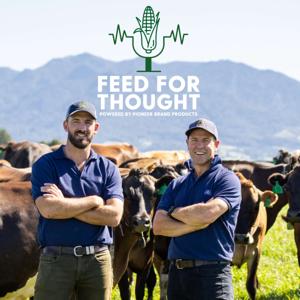


Dr Grant Matthews, our new Farm Systems Manager for the South Island, joins us in this episode to bring his perspective to a question many dairy farmers are asking: how do we build farm systems that stay productive, simple, and resilient?
Grant shares his background and the shift from large-animal veterinary work into dairy nutrition and farm systems, explaining why focusing on what goes into the cow can change everything downstream. We get specific about the South Island, from Canterbury through to Southland, where maize silage and maize grain are becoming more realistic options thanks to shorter-maturity maize hybrids.
This episode serves as an introduction to Dr Grant Matthews and sets the scene for practical farm systems conversations. If you’re based in the South Island and interested in getting in touch with Grant, you can find his contact details at www.pioneer.co.nz/contact-us/find-your-local-pioneer-rep
How do you run a high‑input dairy system that performs without burning out your people or drowning in feed complexity? In this episode, Matt and Wade are joined by Nic and Kirsty Verhoek to unpack how they’ve kept a high‑input system productive while simplifying the ration, lowering risk, and protecting time. They walk through the numbers behind the change, using Feed Checker to compare diets on ME, protein, and cost, and explain how they’ve built a stable maize‑based ration with flexible protein and energy on top.
The team explain how lifting pasture and silage quality has helped protect milk production, how wearables and smartphone tools reduce key‑person risk and support better decision‑making, and what “no hungry minutes” really means for cow performance and condition. They also dive into liveweight targets, tightly controlled young stock growth, and the breeding and welfare decisions behind polled genetics and a future without bobby calves.
What does it take to run a 1,000‑cow free stall barn system in New Zealand while keeping milk solids, cow health, and staff workload on track? Matt and Wade sit down with Arjun Singh of Lawwal Holsteins to unpack the realities of running a large-scale free-stall operation, from feeding and effluent management to staff routines and daily decision-making. Arjun explains to achieve over 800 milk solids per cow from his autumn herd requires attention to detail, tight targets, and good data.
The conversation covers how maize silage is the backbone of a TMR diet, rations are adjusted using milk dockets, milk urea, and wearable data. We also dive into Lawwal Holsteins' breeding strategy, combining North American genetics with NZ index lines. Arjun also speaks to their upcoming event “Land at Lawwal”, an on-farm sale, open day, and fundraiser happening on Friday, April 24. For more information, visit https://issuu.com/lawwalholsteins/docs/_land_at_lawwal_by_lawwal_holsteins.
In the first official episode of Season 4, Matt and Wade sit down with James and Debbie Stewart of Stewart Dairylands, a fifth‑generation family farm that has been operating in Hiwinui (Manawatū-Whanganui region) for more than 120 years. Together the team explore the farm’s evolution from sheep and beef to a high‑performing dairy operation, with a strong focus on environmental stewardship, succession planning, and building a resilient future for the next generation.
The Stewarts run an 850‑cow herd across linked platforms, utilising grass and silage, targeted in‑shed feeding, and a feed pad, all supported by smart technology such as collar systems, milk quality apps, and real‑time data to guide daily decisions. James and Debbie also share their involvement alongside family, with Hiwinui Country Estate, a boutique lodge offering luxury accommodation, events, and weddings.
This episode delivers insights into how the Stewarts are shaping Stewart Dairylands in to forward‑thinking farming business.
Find out more about Stewart Dairylands at www.stewartdairylands.nz
Season 4 is here, and we’re kicking things off by sharing what’s in store for the year ahead. Wade and Matt reflect on a huge Season 3, including the Rural Roadie - three weeks on the road, north to south, getting on farm and pulling up seats for awesome unplanned chats. This season, we’re leaning into real stories while building stronger synergy across the Feed for Thought podcast and our wider content. If there’s a topic you’d like us to cover, we’d love to hear from you. Hit subscribe, share the podcast with a mate, and join us as we return to the airwaves.
A quiet reset is reshaping New Zealand’s rural property market, and the signals are clear: liquidity is back, vendors are willing, and buyers are disciplined. In this episode, Matt and Wade sit down with Conrad Wilkshire, General Manager of Property Brokers. The conversation digs into why month-on-month sales have returned to the 10-year median, what’s powering renewed confidence, and how dairy is leading big-ticket transactions while sheep and beef rebuild on firm ground. Tune in to discover what is driving the rural property market reset.
In this episode, Matt and Wade welcome Chris Lewis of Baker AG to explore the “sweet spot” in dairy systems and how top operators focus not just on producing more, but on converting resources more efficiently. Drawing on two decades of Dairy System Monitoring, Chris explains how benchmarking pasture, milk, and costs at 10-day intervals enables real-time planning, scenario modelling for feed shortages, and a clear view of how today’s decisions impact the season.
Chris explains that efficiency, not just high production per hectare, defines success. The discussion breaks down feed and non-feed costs per kilogram of milk solids, highlights how the margin curve favours disciplined management, while signalling the risks of pushing beyond the optimal limit. Chris highlights that the top farms, ranked by EBIT per hectare, succeed through adjustments and systems tailored to their resources. The data shows that high-performing farms can achieve greater productivity while also improving environmental outcomes.
Join us for a special podcast celebrating 50 years since the signing of the seed production and distribution agreement between Pioneer® Hi-Bred International Incorporated and the Yates family. We’re joined by our Founder Philip Yates, Managing Director Will Yates, and Raewyn Densley to reflect on this 50-year journey.
We follow the story from importing maize genetics to building a domestic seed production facility and partnering with Gisborne growers to produce New Zealand grown maize seed. Raewyn Densley talks to how maize silage has shaped dairy systems in New Zealand. Through setbacks, grit, and a long-term view, the Yates' family remain committed to enhancing the future of New Zealand agriculture.
It’s been a privilege for the Yates family to represent the Pioneer brand in New Zealand over the past five decades. They sincerely thank the farmers who’ve planted Pioneer maize seed, along with the merchants, contractors, consultants, and the Pioneer team who’ve supported them throughout the years.
In this episode, Wade and Matt sit down with James Allen, CEO of Ag First, to unpack three decades of insights from the dairy sector. Drawing on long-term financial data, James explores the gap between average and top-performing farms and how small, targeted changes can lead to impactful improvements.
From micro-improvements to smarter decision-making, James delves into the numbers of average farms versus the top 20% performers, outlining the gains that can be made by breaking away from being an average farm. James provides a practical roadmap for farmers looking to lift profitability without overhauling their systems. With relatable examples and a focus on achievable gains, this episode offers valuable takeaways for anyone interested in what drives exceptional farm performance.
As spring approaches, maize growers across New Zealand are preparing for planting. Understanding how to set up your crop for success is critical. In this episode, Wade and Matt welcome Dr Rowland Tsimba, National Research & Agronomy Manager, who says it all begins with knowing your growing environment.
“The key to cropping success is a combination of understanding the science and good strategic planning”, says Rowland. “While factors like temperature, radiation levels, soil type, and moisture availability are largely beyond a grower's control, understanding how they influence crop growth allows for better management decisions that can mitigate their impact on yield”.
From the publisher's feed
Welcome to Feed for Thought, a regular podcast hosted by Pioneer® Farm Systems Specialists Wade Bell and Matt Dalley. In this podcast series we aim to share in-depth information on technical and…

42 Listeners

0 Listeners
10 Listeners
8 Listeners
2 Listeners

159 Listeners
1 Listeners

24 Listeners

0 Listeners
90 Listeners
1 Listeners
1 Listeners

0 Listeners

0 Listeners