
Sign up to save your podcasts
Or

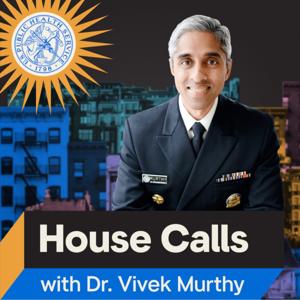


Based on Podcast App listening data
How do you experience stress? Does it come from a hard day at work? Or being stretched too thin supporting others? Worrying about food? Living in a difficult environment?
So many factors can contribute to stress, and we’re all feeling it. Dr. Rangan Chatterjee believes our stress levels are higher than ever and that it’s making us sicker. Dr. Chatterjee is a physician who practices lifestyle medicine, meaning he treats his patients with chronic conditions in part through helping them live healthier, happier lives – which includes less stress.
In this episode, the Surgeon General and Dr. Chatterjee explore the impact of stress on the body, the journey of wellness/lifestyle medicine, and what makes them feel passionate about being doctors. As they reach into personal stories to explain how and why they care for people, Dr. Chatterjee reveals his frustration with how the medical establishment has historically treated lower-income people and his firm belief in making great medical information available to all.
We’d love to hear from you! Send us a note at [email protected] with your feedback & ideas.
(03:26) How stressed are we?
(05:55) How does stress influence our behaviors?
(08:57) How have you seen stress manifest in people’s lives?
(11:57) How is stress like being chased by a tiger?
(15:57) Why does stress hit us in the gut (and the libido)?
(20:03) How did you become a doctor?
(26:40) How has doctoring become so much more than seeing a patient in an office?
(31:48) Listening is real medicine.
(35:05) How Dr. Chatterjee’s son’s illness changed everything.
(41:15) What’s Dr. Chatterjee’s approach to treating chronic conditions?
(45:27) How does lifestyle influence our health?
(46:49) Why all patients should get great health information.
Dr. Rangan Chatterjee, Physician & Podcast Host
Twitter: @drchatterjeeuk
Instagram: @drchatterjee
Facebook: @drchatterjee
About Dr. Rangan Chatterjee
Dr. Chatterjee is regarded as one of the most influential medical doctors in the UK and wants to change how medicine will be practiced for years to come. His mission is to help 100 million people around the globe live better lives.
He hosts the most listened to health podcast in the UK and Europe, "Feel Better, Live More" – which regularly tops the Apple Podcast charts. The podcast has received 125 million audio downloads to date and is listened to and watched by over 8 million people every month. Chris Evans calls Feel Better Live More ‘One of the best podcasts on the planet.’
Dr Chatterjee is known for his ability to simplify complex health advice and find the root cause of people's health problems - he highlighted his methods in the ground-breaking BBC One television show, “Doctor in the House,” which has been shown in over 70 countries around the world. He has recently been awarded the title of Professor of Health Communication and Education at The University of Chester.
He is the Number 1 selling health author in the UK; each of his 5 books are Sunday Times Bestsellers in the UK and international bestsellers across the globe. His latest book “Happy Mind, Happy Life” was published on March 31st 2022 and was an instant No.1 Sunday Times Bestseller.
Dr. Chatterjee hosts his own Amazon Original daily podcast “Built to Thrive,” regularly appears on BBC Television and has been featured in numerous international publications including The New York Times, Forbes, The Guardian and Vogue. His TED talk, How To Make Disease Disappear, has been viewed over 5.5 million times.
How can we create a meaningful life in a self-centered world? Have our societal notions of success misled us? How does connection underpin our sense of meaning? What practical skills do we need to understand other humans? And what do morals and values have to do with any of this?
A few years ago, David Brooks, columnist & cultural commentator, experienced deep personal loss. He suddenly found himself emotionally at sea. As he looked for ways to keep his head afloat, he realized he wasn’t alone; that somehow many Americans had become disconnected from their families or beliefs or way of life. Brooks saw an America drifting from its values and morals, to the point that the basics of human relations were out of reach. Instead of moralizing, Brooks set out on a journey to find people who are truly connected and anchored, and to learn what they do and how they do it.
In this episode, the Surgeon General and David Brooks dig into deep questions. In a world that can feel uncertain and pressured, this episode is a pause to ask what stories we tell, about ourselves and the world, and to think about what gives each of us a sense of meaning in our lives.
Email us at [email protected] with your feedback & ideas.
(03:33) Why is America in a state of emotional pain?
(00:08) Can we even talk about morals, values, and social skills?
(11:38) People or government: where can we find moral support?
(14:06) Can AI provide emotional sustenance for humans?
(17:56) How can parents help kids build a moral foundation?
(21:16) Is being social a teachable skill?
(25:03) What is the “moral and relational hunger” that fascinates David Brooks?
(27:52) David Brooks’ personal quest to better relate to people.
(29:30) Can the pressure of striving de-humanize us?
(31:25) How can we be authentic in a world of likes and clicks?
(35:06) How do external notions of “success” shape us?
(38:41) What is the story of the Weavers?
(42:38) How can we build up the Weaver movement?
(45:12) How do we expand positive social norms?
(48:45) How's your social life? What keeps you from hosting gatherings?
(55:47) Can we connect across difference?
(01:01:13) Where does David Brooks find hope?
(01:04:12) Is faith a source of inspiration for David Brooks?
David Brooks, Columnist
Twitter: @nytdavidbrooks
Weave: the Social Fabric Project: @weavetheppl
About David Brooks
David Brooks is a columnist for The New York Times and a contributor to The Atlantic. He is a commentator on “The PBS Newshour."
His most recent book, “The Second Mountain,” shows what can happen when we put commitment-making and relationships at the center of our lives. He is also the author of “The Road to Character,” “Bobos In Paradise: The New Upper Class and How They Got There” and “The Social Animal: The Hidden Sources of Love, Character, and Achievement.”
Mr. Brooks is on the faculty of Yale University and is a member of the American Academy of Arts & Sciences.
How do you want to spend your time? Where do you want to focus your attention?
Science journalist and author Catherine Price poses these questions because she believes that, ultimately, our lives are what we pay attention to. If you add up all the time spent on devices, these days the average person is spending upwards of 60 days a year on their smartphone.
Price is the author of “How to Break Up with Your Phone,” a guide to creating screen-life balance. Her ongoing research has revealed just how intertwined our brains and our devices have become. Technology impacts our impacts our health and well-being, from our attention spans to our sleep and our relationships. Tune in for ideas on how to set boundaries with our devices to regain real time and space.
Have questions for Dr. Murthy or ideas for future episodes? Email us at [email protected].
(03:08) Really, how much time do we spend on our phones?
Catherine Price, Science Journalist and Author
Twitter: @Catherine_Price
Instagram: @_catherineprice
About Catherine Price
Dubbed “The Marie Kondo of Brains” by The New York Times, Catherine Price is an award-winning science journalist and speaker and the author of books including The Power of Fun: How to Feel Alive Again, and How to Break Up with Your Phone. She is also the creator and founder of ScreenLifeBalance.com, which is dedicated to helping people learn how to scroll less and live more. Catherine’s work has appeared in publications including The Best American Science Writing, The New York Times, O: The Oprah Magazine, Los Angeles Times, San Francisco Chronicle, The Washington Post Magazine, Slate, Men's Journal, Self, and Outside, among others.
We all need to have hope. It’s essential to living a healthy life. So it’s no surprise that “What gives you hope?” is one question Dr. Murthy always asks his guests. In this compilation episode, tune in to hear from Chef José Andrés, Father Greg Boyle, friendship expert Dr. Marisa G. Franco, and others. Even during life’s difficult times, they all have found hope in their own special ways. And as you listen, we invite you to think about what brings hope to your life and why, and share with us at [email protected].
Also, please take a moment to rate House Calls! It will help new listeners discover it.
(00:41) Finding hope during illness
(02:37) Finding hope in connection
(05:25) Finding hope in loss and grief
(08:33) Finding hope in friendship
(09:40) Finding hope in times of darkness.
Produced together with Calm, here is one of a 5-part series of Mindfulness Tools to offer support during stressful times. Guided by Dr. Murthy, these meditations are intentionally short, meant to fit into your day whenever feels right. We also encourage you to share these episodes with others.
Also, we’d appreciate it if you took a moment to rate and review our podcast. Email us at [email protected] with your feedback and ideas.
How can we help young people build healthy friendships? How do we balance old friendships with new ones? And why should we be strategic about the energy we put into friendships? The truth is, friendship doesn’t just happen. Great friendships take effort.
In Part 2 of our conversation about friendship with Dr. Marisa G. Franco, psychologist and the New York Times bestselling author of “Platonic: How the Science of Attachment Can Help You Make—and Keep—Friends,” House Calls explores some of the underpinnings for strong platonic relationships.
Building on the first part of their conversation, the Surgeon General and Dr. Franco talk about the mental health challenges young people are experiencing and how to help them create the types of connections that lead to meaningful relationships. Later in the conversation, Dr. Franco shares her tips for using the “intimacy skills” we often save for romantic partners to deepen our important friendships.
* Help us get the word out about House Calls by rating and reviewing wherever you get your podcasts.
(02:14) Why “phubbing” isn’t just rude
(05:40) How are young people doing with friendship?
(10:36) How does Dr. Franco support her students’ mental health?
(13:58) What makes someone a social igniter?
(18:04) How do we balance old and new friendships?
(22:30) Why is it important to be strategic about friendships?
(24:27) Can we move away from a friendship?
(26:33) How can we address conflict in a friendship?
(29:59) Has it become harder for us to talk to one another?
(31:35) What are some great friendship songs?
(33:21) What gives Dr. Franco hope for the future?
Dr. Marisa G. Franco, Friendship Expert & Psychologist
Twitter: @DrMarisaGFranco
Instagram: @drmarisagfranco
About Dr. Marisa G. Franco
A psychologist, speaker, and bestselling author, Dr. Marisa G. Franco is known for digesting and communicating science in ways that resonate deeply enough with people to change their lives. She is a professor at The University of Maryland and authored the NYT bestseller Platonic: How The Science of Attachment Can Help You Make—and Keep—Friends. She writes about friendship for Psychology Today and has been a featured in The New York Times, The Telegraph, and Vice. She speaks on belonging at corporations, government agencies, non-profits, and universities.
For tips on friendship, you can follow her on Instagram (DrMarisaGFranco), or go to her website, www.DrMarisaGFranco.com, where you can take a quiz to assess your strengths and weaknesses as a friend.
Produced together with Calm, here is one of a 5-part series of Mindfulness Tools to offer support during stressful times. Guided by Dr. Murthy, these meditations are intentionally short, meant to fit into your day whenever feels right. We also encourage you to share these episodes with others.
Also, we’d appreciate it if you took a moment to rate and review our podcast. Email us at [email protected] with your feedback and ideas.
What’s the single best action a person can take now to live a longer life? How do you take the edge off depression? What can single people do to flourish, and partnered people do to revitalize their romantic relationships? One answer: having good friendships.
Our guest is Dr. Marisa G. Franco psychologist and author of “Platonic: How the Science of Attachment Can Help You Make – and Keep - Friends.” In this episode (part 1 of 2), they talk about loneliness, how to have high-quality friendships, friendship among men, and the pitfalls of leaning on romantic partnerships for everything.
(03:38) Have we gotten rusty at friendship?
(05:22) Are we in a state of “learned loneliness?”
(07:53) What’s driving the narrowing of friend networks?
(10:54) What makes for a high-quality friendship?
(14:36) Romantic versus platonic love
(17:07) How can same-sex friendships help us understand friendship?
(21:43) How can men have deeper friendships?
(25:05) Dr. Franco’s interest in friendship
(27:48) What is attachment theory and what’s your style?
(30:13) Setting up our kids for healthy friendships
* Help us get the word out about House Calls by rating and reviewing wherever you get your podcasts.
Dr. Marisa G. Franco, Friendship Expert & Psychologist
Twitter: @DrMarisaGFranco
Instagram: @drmarisagfranco
About Dr. Marisa G. Franco
A psychologist, speaker, and bestselling author, Dr. Marisa G. Franco is known for digesting and communicating science in ways that resonate deeply enough with people to change their lives. She is a professor at The University of Maryland and authored the NYT bestseller Platonic: How The Science of Attachment Can Help You Make—and Keep—Friends. She writes about friendship for Psychology Today and has been a featured in The New York Times, The Telegraph, and Vice. She speaks on belonging at corporations, government agencies, non-profits, and universities.
For tips on friendship, you can follow her on Instagram (DrMarisaGFranco), or go to her website, www.DrMarisaGFranco.com, where you can take a quiz to assess your strengths and weaknesses as a friend.
Produced together with Calm, here is one of a 5-part series of Mindfulness Tools to offer support during stressful times. Guided by Dr. Murthy, these meditations are intentionally short, meant to fit into your day whenever feels right. We also encourage you to share these episodes with others.
Also, we’d appreciate it if you took a moment to rate and review our podcast, wherever you get your podcasts. Email us at [email protected] with your feedback and ideas.
We all experience change. Sometimes we plan a change, sometimes we’re thrown a curveball. It’s just part of life. But why do some changes feel harder to manage than others? And why does change seem easier for some people than others? Guest Maya Shankar is a cognitive scientist and host of the podcast “A Slight Change of Plans,” where she weaves people’s personal stories of change with the science of human behavior. As we kick off a new year, Maya and the Surgeon General talk about the nature of change and how to handle it, with the intention to help all of us navigate life’s curveballs, in whatever form they arrive. And if you’re thinking about making a change, tune into this episode for strategies about how to plan and stick to it.
(04:28) What are the kinds of change that humans experience?
Help us get the word out about House Calls by rating and reviewing wherever you get your podcasts. Email us at [email protected] with your feedback and ideas. Thank you!
Maya Shankar, Cognitive Scientist & Podcast Host
Twitter: @MayaUmaShankar
Instagram: @drmayashankar
Facebook: @drmayashankar
About Maya Shankar
Maya Shankar is a cognitive scientist and the creator, executive producer, and host of the podcast, “A Slight Change of Plans,” which Apple awarded "Best Show of the Year" for 2021. Maya was a Senior Advisor in the Obama White House, where she founded and served as Chair of the White House Behavioral Science Team. She also served as the first Behavioral Science Advisor to the United Nations under Ban Ki-moon, and as a core member of Pete Buttigieg’s debate preparation team during his 2020 presidential run. Maya has a postdoctoral fellowship in cognitive neuroscience from Stanford, a Ph.D. from Oxford on a Rhodes Scholarship, and a B.A. from Yale. She's been profiled by The New Yorker and been the featured guest on NPR's “All Things Considered,” “Freakonomics,” and “Hidden Brain.” Maya's a graduate of the Juilliard School of Music's pre-college program, where she was a private violin student of Itzhak Perlman.
From the publisher's feed
Ranked by our users in the last 21 days

43,852 Listeners

38,016 Listeners

43,359 Listeners

1,219 Listeners

729 Listeners
10,502 Listeners

111,799 Listeners
5,108 Listeners
14,353 Listeners

3,340 Listeners

15,882 Listeners

2,042 Listeners

10,532 Listeners

19,254 Listeners
4,284 Listeners