
Sign up to save your podcasts
Or

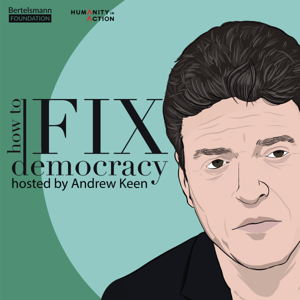


Laboratories of Democracy
Anne-Marie Slaughter is the CEO of New America, a think tank in Washington, DC. In this interview, she discusses with host Andrew Keen possible structural changes to American democracy, including adopting ranked-choice voting and re-thinking campaign finance. She argues that capitalism--it's ethos and influence--has infected the political process. American politicians have taken on capitalist forces before, Slaughter argues, but it will take major political cooperation to do it again.
Crisis of Confidence
Ian Bassin is the Co-founder and Executive Director of Protect Democracy, a non-profit created to fight threats to democracy in America. Bassin explains some of the factors eroding liberal democracy in the United States, including economic causes. From tackling voter suppression and checks and balances in the federal government, this interview covers a wide range of challenges to healthy democracy in the United States.
Mark Blyth is William R. Rhodes Professor of International Economics at Brown University. In this interview, he discusses how our economics are rife with anger and frustration. Blyth's "angry-nomics" emerged from financial crises and a decline in social institutions, like unions, that give people feelings of stability and control. In this frank discussion of the conflicts between our economics and politics, Blyth offers several concrete recommendations to get capitalism to work for democracy instead of against it.
Political Power without Capital?
Peniel Joseph, Professor of Public Affairs and Barbara Jordan Chair in Ethics and Political Values at the University of Texas at Austin, explains the critical views of capitalism that emerged in the American Civil Rights movement. Major figures in this movement, like Martin Luther King Jr, Malcolm X, and Stokely Carmichael, explored social democratic and socialist political ideas when trying to find a path to equal rights in America. Moving beyond these early critics of capitalism's influence on democracy, Peniel Joseph and host Andrew Keen explore the legacy of these ideas on the Black Lives Matter movement in contemporary America due to persistent political and economic inequality.
Listening to Others
Arlie Hochschild is Professor Emerita of Sociology at the University of California, Berkeley. Her recent work deals with the rise of the American far-right. Her book, Strangers in Their Own Land: Anger and Mourning on the American Right, was built on interviews with Tea Party supporters in Louisiana. For Hochschild, it is important to understand the feelings behind political views, though listening and feeling empathy does not imply agreement. If Americans are to reconcile their differences, she argues, more people must learn how to listen to views they might not agree with.
Winner Takes All
Robert H. Frank is the Henrietta Johnson Louis Professor of Management Emeritus at Cornell University's SC Johnson Graduate School of Management. What does a winner take all ethos in capitalism mean for democracy? Robert Frank discusses with Andrew Keen what the concentration of wealth amongst the best of the best and the sinking top tax rates means for conceptions of equality and fairness in America. Understanding this is essential to understanding the disconnect between politics and people today.
Four Horsemen of Leveling
Walter Scheidel is the Dickason Professor in the Humanities, Professor of Classics and History, and the Catherine R. Kennedy and Daniel L. Grossman Fellow in Human Biology at Stanford University. Scheidel specializes in the history of economic inequality, and his book The Great Leveler examines what forces have reduced economic inequality throughout history. Politicians and governments are often tasked with dealing with economic inequality today, but in reality, Scheidel says, societal collapse, epidemics, war, and communist revolutions do it much better. Listen to hear what this means today for a route to economic fairness in America and Europe, and what impact the coronavirus pandemic could have.
This Is When You Want Deficits
Maya MacGuineas is the president of the bipartisan Committee for a Responsible Federal Budget and an expert on budget, tax, and economic policy. In this interview, hosted by Andrew Keen, they discuss the economic threats to democracy in America, in particular the loss of trust in our institutions and in the very system of capitalism. At the core of this loss of trust is growing economic inequality. Can capitalism be reformed to reduce economic inequalities and restore trust in institutions and capitalism?
System Attrition
Adam Tooze is Director of the European Institute & Kathryn and Shelby Cullom Davis Professor of History at Columbia University. In this interview with Andrew Keen, he discusses the past relationship between capitalism and liberal democracy and how the development of the two went hand-in-hand in the modern era towards a high-point, in large part due to the wars of the 20th century. Our crises today are also formative, but not in the same way as back then, Tooze argues. It is yet to be seen, he says, how crises of our time, such as COVID-19 and economic inequality, will shape our societies in this century, but the system that has combined capitalism and liberal democracy is facing serious attrition.
Describing the Deficit
Stephanie Kelton is a Professor of Economics and Public Policy at Stony Brook University focusing on monetary policy and public finance. In this interview, she explains modern monetary theory (MMT) and clarifies some of the myths surrounding spending deficits, especially concerning the U.S. federal government's massive debt. MMT is a change in the way the government explains its deficit, Kelton says, and is important for politically justifying big expenditures. When it comes to the health of democracy, Kelton argues, fear of contributing to the deficit means the U.S. has not been able to enact the big policies to help those left behind.
From the publisher's feed

31,996 Listeners
47 Listeners

11 Listeners

87,077 Listeners

111,868 Listeners
18 Listeners
12,533 Listeners
6,061 Listeners
50,422 Listeners

15,915 Listeners
9,190 Listeners
2,633 Listeners

3,017 Listeners

3,435 Listeners
781 Listeners