
Sign up to save your podcasts
Or

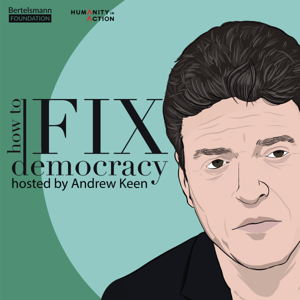


Presidential Scholar at CUNY and author of Capitalism, Alone, Branko Milanovic kicks off the second season of How to Fix Democracy. He discusses elements of different capitalistic systems, such as in the United States and Denmark, and rejects the commonly held assumption that people universally value freedom over economic prosperity.
Considered one of the world's leading experts on democracy, Larry Diamond, senior fellow at Stanford University's Hoover Institution, believes democracy worldwide is in a recession. The crisis is "bad, deepening, accelerating," but he suggests several steps we can take to reverse the trend, such as ranked choice voting to tackle the two-party system, and spreading "motor voter" laws to increase the number of registered voters. For Diamond, democracy is the only political system that can preserve freedom, which is itself intrinsic to being human.
Annika Savill, Executive Head of the UN Democracy Fund admits that the word "democracy" doesn't appear anywhere in the UN charter, but finds it exists in the demands of people everywhere who are working to hold their governments accountable. She tells Andrew Keen that, as a former journalist, she is passionate about facts and worried about clickbait and "tidbits of information without verification." She also offers the concept of "citizens' assemblies" as an alternative for referenda, and muses about exploring the relationship between "linguistic echo chambers" and democracy.
Prior to the 2016 election, Richard Stengel, former managing editor of Time magazine, witnessed the rise of disinformation firsthand from his position as Under Secretary of State for Public Diplomacy and Public Affairs. He believes that consuming media with caution could be a powerful antidote to efforts to deceive us, and is skeptical that governments attempting to "counter" disinformation on social media platforms is the correct approach. From the limits of free speech laws to legislation erring on the side of privacy, Stengel and host Andrew Keen discuss what does and doesn't work in the information wars.
Leon Botstein, music director and conductor, scholar, and president of Bard College in upstate New York, had once thought that the Berlin Wall would never come down. And he found the revolutions surrounding 1989 "frightening" because they could lead to the ascent of unregulated capitalism and the release of suppressed nationalism. Botstein explains that democracy "is harder than people expected" and worries that we are spending too much time staring at our smartphones and "mesmerized by nothing" rather than finding meaning and value by our own activity.
Referenced in the interview: https://www.pbs.org/kenburns/college-behind-bars/
Consumer advocate, lawyer, and former U.S. presidential candidate Ralph Nader believes that democracy is about civic organization, not just public opinion. In his assessment, the American people have lost perspective and ceded control of politics to "big money." But they should understand that there is broad popular support for many of the things they want, and the key is Congress. Nader, who made a career on circumventing big business control in Washington, urges Americans to put the focus on Congress, the most powerful branch of government, and remarks that, historically, it's only taken concerted effort from 1% of the population to push major change. He reminds the public that there is something that politicians want more than money from special interests: your vote.
Canadian political philosopher and writer John Ralston Saul discusses how the crisis in democracy today is self-inflicted and intentional. The people, he says, have given up holding power themselves, accepting instead to gain influence over power. In pursuing good causes they have turned over the levers of power to business and the higher echelons of government. To fix democracy, Ralston Saul hopes that citizens — a concept he says has been abandoned — will seek to participate in democracy at local levels in order to reclaim the foundations of democratic power.
Rob Riemen, Dutch philosopher and founder of the Nexus Institute, names Baruch Spinoza, the 17th century philosopher, as one of the first great minds to understand the importance of democracy. Spinoza, he says, saw that only democracy would be able to put human dignity and individual freedom first. But maintaining democracy, Riemen says, is not about institutions. Instead, it relies on cultivating the "spirit of democracy" through liberal education.
Carl Gershman, founding president of the National Endowment for Democracy, recalls how the September 11, 2001 attacks on the United States marked a turning point, derailing the idea that democracy would simply continue its forward march in history. His hope, however, is that democracy's current regression spurs people around the world to defend it more vigorously.
Brookings Institution Senior Fellow Constanze Stelzenmüller discusses how domestic problems have led to disruptions in foreign policy—turning partners into rivals. At home, many democracies are struggling with balance: between national security and privacy, the political center and the peripheries, or direct and representative democracy. Stelzenmüller goes into detail about the many aspects we should re-evaluate, particularly in Germany, France, the UK, and the United States. And she relishes the challenge for her generation to preserve democracy for the future.
From the publisher's feed

31,996 Listeners
47 Listeners

11 Listeners
87,077 Listeners

111,868 Listeners
18 Listeners
12,533 Listeners
6,061 Listeners
50,422 Listeners

15,915 Listeners
9,190 Listeners
2,633 Listeners
3,017 Listeners
3,435 Listeners
781 Listeners