
Sign up to save your podcasts
Or

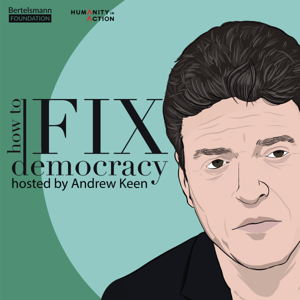


Rappler CEO and co-founder Maria Ressa got her start as a journalist in the Philippines in the 1980s and has seen the pendulum of democracy swing in both directions since. In her interview with Andrew Keen, Ressa—who was among the journalists named Person of the Year by Time Magazine in 2018—dives into the way that "lies laced with anger" have spread faster than facts across social media, playing to the worst of human nature and undermining democracy. As we find ourselves in a political environment she likens to dystopia and chaos, Ressa asks us all to reflect on the values that guide us.
Yascha Mounk, associate professor at Johns Hopkins SAIS and expert on the rise of populism, describes three main challenges to democracy: the stagnation of living standards in developed democracies, cultural and demographic changes that are shifting the status quo, and the social media's domination. These elements have combined to increase the supply of "noxious ideas" that have led to factions and division in the United States and other countries. One way to reverse this process, Mounk argues, is to resist divisive ideology in favor of what he calls "inclusive nationalism."
Norman Ornstein, resident scholar at the American Enterprise Institute, has been immersed in U.S. politics since the late 1960s and has watched the evolution of the Republican Party with concern. Ornstein no longer views the GOP as conservative, he tells Andrew Keen, but as radical, leaving behind its ideology for a theology. And though he cannot point to a period in American history where the political situation was ideal — even the post World War II years of bipartisan cooperation were fraught with racial divisions — today it is about as dire as he's seen.
For Cornell William Brooks, former president of the NAACP and current professor at Harvard's Kennedy School of Government, democracy is not an ethereal concept from Greece; it is about his family lineage. For centuries, the story of democracy in the United States has been about an expanding definition of citizenship and what an American looks like. Brooks encourages us to remember the art of conversation in an increasingly digital world and promotes removing obstacles to voting, even making voting a requirement.
Director of the German Marshall Fund's Alliance for Securing Democracy and former White House and State Department official, Laura Rosenberger views democracy from a national security perspective. In this interview, she urges the United States to pay close attention to threats from without and within. In addition to focusing on borders, security means focusing on systems, she claims. Otherwise, the United States leaves itself vulnerable to authoritarian regimes and illiberal forces who could seek to undermine democracy in order to increase their relative power. Americans' first line of defense is to not let external interference divide them, an important message heading into a year of presidential campaigning.
Washington commentator and columnist for the Financial Times Ed Luce recounts the many misunderstandings we've had over the past few decades. From the fall of the Berlin Wall in 1989 to the collapse of the neoliberal Washington Consensus in 2008, Luce illustrates how political developments frame how we experience economic events, and how economics can predict politics. Ultimately, he asks us to consider the price we must pay for social peace and warns about the stakes of the 2020 election in the US.
Sheri Berman, professor of Political Science at Columbia University's Barnard College offers a historical perspective of democracy, along with some very useful definitions of concepts like illiberal, liberal, fascism, populism, and democracy. She argues that polarization, even at the scale we're experiencing today, is very common throughout history; what is unique about today is that a lot of changes are happening all at once.
Historian and journalist Anne Applebaum sat down with Andrew Keen during the opening dinner of the Bertelsmann Foundation's Washington Symposium in April 2019 for a live episode of How to Fix Democracy. A thought leader on disinformation, Applebaum commented on current political polarization by arguing that unless you can have debates based on a commonly agreed upon set of facts, you cannot have democracy at all. For a deeper dive into these themes and others beyond her interview, read the essays that she and other leading experts on democracy prepared for the Symposium here.
Sir Malcolm Rifkind, interviewed at the Aspen Ministers Forum in Kansas City, sees the challenges to liberal values as tied to, but separate from, the challenges to democracy. He explains how many places where democracy is said to be in crisis today are actually experiencing a shift away from liberal ideas rather than from democracy itself. In a conversation that touches upon Brexit, the Cold War, and China's rise, Sir Malcolm frames the challenge to liberal democracy today as a battle between "rule of law" and "rule by law."
Mete Coban is a Councillor for Stoke Newington in the London Borough of Hackney and Chief Executive at My Life My Say, a youth-led, non-partisan charity focused on increasing participation in democracy. Mete offers his views on how young people view democracy differently and how Brexit helped draw more young people into politics.
From the publisher's feed

31,996 Listeners
47 Listeners

11 Listeners

87,077 Listeners

111,868 Listeners
18 Listeners
12,533 Listeners
6,061 Listeners
50,422 Listeners

15,915 Listeners
9,190 Listeners
2,633 Listeners

3,017 Listeners
3,435 Listeners
781 Listeners