
Sign up to save your podcasts
Or

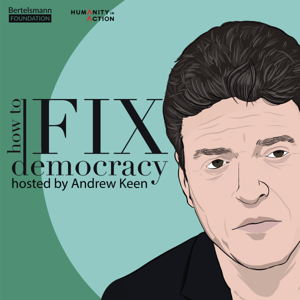


Us Later, Not Me Now
Rebecca Henderson is the John and Natty McArthur University Professor at Harvard University Business School. In this interview, hosted by Andrew Keen, she explains how she has been re-imagining capitalism. Free markets, Professor Henderson argues, need to be balanced with free politics, mirroring what many others in How to Fix Democracy Season 2 have identified as a core linkage between unhealthy capitalism and damaging politics. There's an immediacy and selfishness in politics and business now, she says, which reflects more of a "me now" instead of an "us later" mentality.
All About Taxes
Gabriel Zucman is an Associate Professor of Economics and Director of the Stone Center on Wealth and Income Inequality at the University of California, Berkeley. In this interview, hosted by Andrew Keen, Professor Zucman discusses issues of taxation and tax havens. According to Professor Zucman, a major problem within free market capitalism is tax avoidance. He argues that in a globalized economy there should be new tools to ensure companies pay taxes where they make their profits.
Redistribute Productivity
Sir Paul Collier is Professor of Economics and Public Policy at the Blavatnik School of Government and a Professorial Fellow of St Antony's College, Oxford University. In this interview, hosted by Andrew Keen, Sir Paul Collier explains why he thinks the biggest problem of capitalism in the last two centuries in the US and UK has been the concentration of moral load-bearing. While in the past, derailments of capitalism have been remedied by families and firms, along with governments, all taking responsibility, nowadays, that burden has concentrated in the state. Decentralization of political and economic power can be a way to reverse this, and the key is re-skilling workers whose labor has become less and less valuable outside of the few major clusters of knowledge intensive firms.
Individual Choice
Gideon Rachman is the chief foreign affairs columnist for the Financial Times. He was previously at the Economist for fifteen years, during which time he was a foreign correspondent in Brussels, Washington, and Bangkok, and editor of the business and Asia sections. In this interview with Andrew Keen, Rachman discusses how globalization has deepened conflict between capitalism and democracy. Individual choice is at the core of both capitalism and democracy, and so the two work better together than it may seem today, when anti-democratic, anti-globalist politics are emerging in many democratic, free market countries.
Reform and Revolution
Richard D. Wolff is Professor of Economics Emeritus, University of Massachusetts, Amherst and a Visiting Professor in the Graduate Program in International Affairs of the New School University, New York City. In this interview, host Andrew Keen and Professor Wolff discuss the definition of capitalism from the Marxist perspective. When the system of capitalism experiences dire crises, Wolff argues, it has been natural to question the nature of the system itself, just as the financial crises of the early 20th and 21st centuries have prompted reforms of capitalism to varying extents. Today, the path to better political democracy, says Wolff, lies in stronger economic democracy.
Helen Thompson, Professor of Political Economy at the University of Cambridge, talks with host Andrew Keen about the impact capitalism has on the health of democracy. Both are powerful forces, she says, and are closely linked to such an extent that a crisis in one seemingly always leads to a crisis in the other. Historically it was naïve, she argues, to assume that democratic states would continue to strengthen during globalization, and we are now dealing with the consequences.
Amity Shlaes is a best-selling author, Chair of the Calvin Coolidge Presidential Foundation, and Presidential Scholar at The King's College in New York City. Her most recent book Great Society: A New History, presents a critical view of President Lyndon Johnson's campaign to expand the social safety net and reduce poverty in the United States in the 1960s. Shlaes argues in this interview with Andrew Keen, our first remote interview of the series, that government intervention is not how the United States will economically recover from the coronavirus pandemic. Instead, she recommends tax cuts and finding ways to bolster Wall Street to help the U.S. economy. To remedy this crisis, Shlaes argues, more people need to buy into America.
Sarah Miller, Executive Director of the American Economic Liberties Project, talks with host Andrew Keen about trust-busting. From the Gilded Age and the New Deal to the present day, their discussion touches upon how capitalism has been met with regulation over the last century. Miller argues that now is the time once again to revisit such measures as power, both economic and political, is concentrating in the hands of the few, thereby posing a threat to the health of American democracy.
In this episode, host Andrew Keen sits down with distinguished economist, Sir Angus Deaton, the Dwight D. Eisenhower Professor of International Affairs, Emeritus, Professor of Economics and International Affairs, Emeritus, and Senior Scholar at Princeton University. Sir Angus Deaton, who was awarded the Nobel Prize in Economics in 2015 for his analysis of consumption, poverty, and welfare, discusses why capitalism is no longer delivering happiness and quality of life for working class people in the United States. Instead, it has created growing inequality in the U.S. healthcare system as many Americans are deprived of health insurance and can no longer afford care, especially when they are unemployed. Deaton's latest book, "Deaths of Despair and the Future of Capitalism", written with his fellow Princeton economist and wife Anne Case, looks at precisely this issue: how a changing global economy can have dire public health consequences. Fixing healthcare inequality, Deaton argues in this interview, must be a top priority for the future of capitalism and democracy in the land of the American Dream.
Raghuram Rajan is the Katherine Dusak Miller Distinguished Service Professor of Finance at the University of Chicago Booth School of Business. Previously, he was the 23rd Governor of the Reserve Bank of India and the Chief Economist at the IMF. In this interview, hosted by Andrew Keen, Rajan calls capitalism today an uneven playing field that doesn't efficiently skill people to meet the needs of the economy. This leads to unequal access to good jobs and growing income inequality. As a result, democracy has at times turned against capitalism. But Rajan reminds us that capitalism works best when there is economic competition, while democracy works best when there is political competition. With this in mind, Keen and Rajan discuss how these two forces can work better together.
From the publisher's feed

31,996 Listeners
47 Listeners

11 Listeners

87,077 Listeners

111,868 Listeners
18 Listeners
12,533 Listeners
6,061 Listeners
50,422 Listeners

15,915 Listeners
9,190 Listeners
2,633 Listeners

3,017 Listeners

3,435 Listeners
781 Listeners