
Sign up to save your podcasts
Or

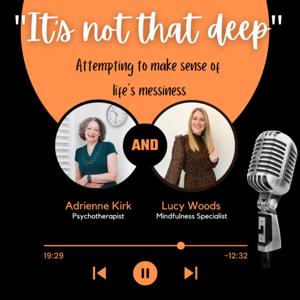


There’s a societal lean towards prioritising our rational brains over our emotions, but is that always helpful? In this episode we explore what we know about the science around the role of the gut in emotions, how we might be able to notice what’s going on in our bodies, rather than just relying on our brains, and how we use our gut feelings in our work. When we have had a difficult start in life, it can be difficult to trust our guts, or even know how to engage with our gut feelings. This is not an either/or situation, so again we are discussing how we can be in the ‘messy middle’ of both sources of biological data.
Find us at: www.adriennekirk.uk or www.presenceofmind.life
Hosted on Acast. See acast.com/privacy for more information.
In this episode we discuss the feeling of unfairness if we let someone off the hook! If we forgive, does that mean we need to forget? And does that make us naïve? There is an ‘unsafe’ feeling when someone we thought we knew acts in a way we weren’t expecting. We may feel that it says something about us – that we are too vulnerable, something has been exposed and that can feel scary.
But, when we hold a grudge, does the other person even know they have wronged us, and that we are dwelling on the upset?! We can hold on to it because we don’t want to discuss it – mostly we do not like conflict.
So how can we deal with our feelings in a way that stops us from suffering with the grudge? We discuss strategies to help us let go, and move past to the end result we would like.
Find us at: www.adriennekirk.uk or www.presenceofmind.life
Hosted on Acast. See acast.com/privacy for more information.
Most of us will have had the experience of feeling offended by something someone says about us. There is a difference between a personal comment, and a difference of opinion. When our opinions are challenged, we can think that we are personally being attacked – that our opinions ARE us. We explore how true this is, and discuss the idea that we grow and change our ideas over time.
Should we be so thin-skinned that someone else’s different view to mine is intolerable? How can we stretch our comfort zone of being with difference? Living in silos, with no difference of opinion, means that we end up being pushed further away from anything that might feel challenging. We discuss how to become more curious about difference rather than threatened by it. And even change our opinions over time!
Find us at: www.adriennekirk.uk or www.presenceofmind.life
Hosted on Acast. See acast.com/privacy for more information.
In this episode we discuss why we often don’t feel comfortable in our own skins, and how we look at others and wish we were more like them. Why is it we want to be different from how we are? We ponder how we can become more comfortable, to show kindness to ourselves whilst encouraging ourselves to push at our window of tolerance.
As always, we offer some strategies to accepting ourselves and allowing growth. We need to notice when our inner critic is present, and be able to catch the stories we tell about ourselves. Can we accept that rather than others judging us, they are probably feeling just the same as we are – and judging themselves too!
Find us at: www.adriennekirk.uk or www.presenceofmind.life
Hosted on Acast. See acast.com/privacy for more information.
Our thoughts can feel like they are part of us, that they are fixed and unchangeable. We explore where ‘thinking’ happens in the brain, and when in evolutionary terms thinking – the ability to ‘time-travel’ in thoughts started. This ability can, and is, a great benefit to us; AND it can also cause us problems!
In the past, we have both been experts at worrying, catastrophising about potential problems! And we have both spent a lot of time working at being able to catch the pattern, and interrupt it happening. We explore the negativity bias and ways to overcome it. We discuss strategies to learn how to stop believing all our thoughts, to step away from thinking they say something about ourselves, and the barriers to sometimes being able to do so.
Find us at: www.adriennekirk.uk or www.presenceofmind.life
Hosted on Acast. See acast.com/privacy for more information.
Why do we feel guilt?
Most of us experience guilt at some point. In this episode we begin with discussing why we would need guilt as a useful human tool – given how unpleasant it feels. It is a process that helps us to stay part of a group, it’s entirely about relationships and the way we relate to others, and historically that helped to keep us safe.
Our childhood patterns mean that we are more or less disposed to assume things are our fault, and that leads us to feel guilt. However, we can learn to challenge these sedimented beliefs, to examine the stories we are telling ourselves and to stay with the facts as we know them. It’s uncomfortable, but can we learn to live with the uncertainty – at least until we can check out the facts?!
Find us at: www.adriennekirk.uk or www.presenceofmind.life
Hosted on Acast. See acast.com/privacy for more information.
This is something that feels very familiar to both of us, and we suspect, many other people too! It can be driven by not feeling good enough, which then drives us to strive to be ‘perfect’. We discuss where that comes from in an evolutionary sense, that generalisation of needing to be safe in the group – and how those are now distorted into self-limiting beliefs.
We think about how much of that switch from spotting danger into spotting negatives comes from societal norms, and we can see that through history as well as things like playground hierarchy.
As always, we offer some ways of being kinder to ourselves, to challenge those limiting beliefs and to move towards a more compassionate way of being. Just because we think something, that doesn’t make it true!
Find us at: www.adriennekirk.uk or www.presenceofmind.life
Hosted on Acast. See acast.com/privacy for more information.
In this episode we discuss how our loved ones don't always get the best version of us?’
This is something we probably all recognise at times! We perhaps make more of an effort with work-colleagues and friends than we do with those at home. Is there something about it being more comfortable – perhaps we can relax and ask for our own needs to be met at home in a way we can’t in the outside world? There is, after all, a freedom in being able to be ourselves without feeling that we might be judged.
We muse on how this shows up in our own lives, and also explore the idea of ‘silent seething’ – our expectations that those who matter most to us ‘ought’ to know what we are thinking and what we need.
Additionally, Adrienne offers some suggestions from her work with couples that might help with showing attention to our most important relationships. We discuss how giving our loved ones our full attention can strengthen our relationships and make them more easeful.
Find us at: www.adriennekirk.uk or www.presenceofmind.life
Hosted on Acast. See acast.com/privacy for more information.
In this episode, we discuss how nervousness is a way to keep us connected to the group, and this is an evolutionary mechanism (of course!). It’s separate from a survival fear, though related to it.
We explore how this may show up in our modern worlds, and how it can be a useful way of being able to focus on a task, and how this might be organised in the brain.
We turn to what we might be able to do to support ourselves when we get nervous, how to separate the story we are telling ourselves versus the evidence. How might we, as best we can, prepare for this situation? It’s also helpful to recognise when we are getting nervous – what are our physical responses to it? Can we develop an ease, an acceptance of the possibility that nervousness is here, and that we do have some control?
Find us at: www.adriennekirk.uk or www.presenceofmind.life
Hosted on Acast. See acast.com/privacy for more information.
This episode focusses on goals and achievements – most of us love a list! Completing tasks can feel great; and sometimes it can be overwhelming. We split apart different types of goals – those that are tangible and those that are intangible. The intangible ones may be things that society tells us we ‘ought’ to have achieved by a certain age or stage of life. Tangible ones give us a purpose, they are the things that get us up in the morning.
We also explore how the fixed ways we see the world, schemas or sedimented beliefs, inform how we engage with our lives. And not in a helpful way! Can we move away from an ‘either or’ approach to life and find the middle way. A steady way that still isn’t boring. Can we explore where the motivation for goal-setting comes from – what’s driving it (threat, drive, or soothing system)?
We end as usual by offering ways to help ourselves; rather than punish ourselves, how can we nourish or be kind to ourselves.
Find us at: www.adriennekirk.uk or www.presenceofmind.life
Hosted on Acast. See acast.com/privacy for more information.
From the publisher's feed
In each episode Adrienne Kirk, a Psychotherapist and Lucy Ranger (was Woods), a Mindfulness Specialist bring some lightness to often difficult subjects, helping to navigate through the messiness of…
Find us at: www.adriennekirk.uk or www.presenceofmind.life
Hosted on Acast. See acast.com/privacy for more information.