
Sign up to save your podcasts
Or



Your "morning routine" isn't a health choice - it's a series of manufactured solutions.
In this episode of One-Minute What, we’re exposing Albert Lasker, the "Father of Modern Advertising" who realized that the easiest way to sell a product is to invent a problem first.Lasker didn't just meet consumer demand; he created shame. From turning floor cleaner into a cure for "Halitosis" to forcing orange juice onto your breakfast table to save a surplus crop, Lasker’s "Salesmanship in Print" changed the human psyche forever.
Stop buying the "Reason Why" and start seeing the sales tool. This is your One-Minute What.
You didn't want the Large fries.
In this episode of Lies We Bought, we unpack the "Bigger is Better" business model. We explore the psychological traps that make "more" feel like the only rational choice, from fast food menus to the SUV loophole.
Inside this episode:
"Bigger is better" isn't a natural law; it's a margin strategy. If you’ve ever upgraded for forty cents, this episode is for you.
Enjoyed the episode? Drop us a review! It helps other people realize they don't need that XL soda either.
P.S. This episode is the shortest one yet on purpose - because bigger isn't always better.
"Good" companies don't exist - only very good storytellers do.
In this episode of One-Minute What, we’re peeling back the curtain on the man who invented the modern "corporate soul" - Ivy Lee.
Before Lee, if a monopoly did something wrong, they hid. Lee taught them to do the opposite: flood the zone. By exploiting what psychologists call the "Availability Cascade," Lee proved that if you repeat an idea enough in public discourse, our brains eventually accept it as truth.
Stop falling for the story and start looking at the dimes.
It’s 1993. You’re one trivia question away from $10,000, but your mouth is full of peanut butter and the milk carton is empty. Welcome to Lies We Bought. Today, Emily unpacks the "Got Milk?" campaign—the marketing "miracle" that saved a dying industry. But the story doesn't start with celebrities and white mustaches. It starts with "swill milk," wartime price supports, and a government that accidentally produced so much dairy they had to hide it in limestone caves.
We’re diving into:
Is milk a nutritional powerhouse, or just a really successful redemption story? Let’s unpack the lie.
Love the show?
Can a single bite of a burger start a corporate war?
In this episode of One-Minute What, we’re breaking down the PR disaster currently taking over social media.
It all started when McDonald’s CEO Chris Kempczinski posted a video trying the new Big Arch Burger. Instead of a mouth-watering review, fans were left watching a "tentative, fearful bite" and cringing as he repeatedly referred to the food as a "product". The internet was quick to call him out for looking like he’s never actually stepped foot inside a McDonald’s.The
Clapback: Enter Burger King. Their President, Tom Curtis, stepped up with a massive, messy bite of a Whopper, showing exactly how a real human eats a burger. From "burgermogging" to the "Battle of the Bites," we dive into why authenticity (and a napkin) is winning this corporate food war.
Why does aging feel loaded now when it didn’t used to?
In this episode of Lies We Bought, we trace how the beauty industry transformed getting older into something women were taught to manage, monitor, and correct. From early skincare diagnosis and salon culture to Botox, preventative treatments, and modern “longevity” language, this episode explores how fear became one of the most profitable tools in beauty marketing.
We look at the history, the money, and the psychology behind anti-aging, and why staying “on top of yourself” started to feel like responsibility instead of choice.
If this episode made you think differently, consider following the show and leaving a review on Apple Podcasts. It helps more people find the series and keeps these conversations going.
Another lie, bought and sold.
Some ideas don’t spread because they’re true.
This One-Minute What looks at cultural brainworms and why they’re not accidental. How simple ideas, repeated often enough, start to feel like facts. Not because they’re proven, but because they’re familiar.
Brands don’t need to convince you. They just need to remind you. Again and again. Until belief feels obvious.
So if something feels self-evident but you can’t remember where it came from, it might not be truth.
And that’s your One-Minute What.
Ever notice how “Mercury in Retrograde” is the only astronomical event that makes everyone panic?
Before you decide you’re just “off” today, this episode looks at how astrology became one of the most effective belief systems in modern marketing.
We trace astrology back more than 4,000 years to Babylonia, where tracking the stars wasn’t about personality traits or compatibility. It was a high-stakes survival tool used by kings to anticipate famine, war, and political collapse. Over time, that complex system was simplified, personalized, and repackaged.
By the 20th century, astrology had been transformed into something scalable. Sun signs replaced planetary charts. Horoscopes shifted from nations to individuals. Media learned that identity sells better than prediction, and astrology became a brand.
We explore how zodiac signs turned into personality shorthand, why retrogrades offer emotional cover when life feels chaotic, and how ancient meaning was reshaped into modern reassurance.
This episode isn’t about whether astrology is real.
Welcome to Lies We Bought.
Follow the show for future episodes.
Work-life balance isn’t a personal failure. It’s a system problem.
In this One-Minute What, we’re unpacking why burnout isn’t caused by bad boundaries, poor time management, or not trying hard enough. Research shows burnout comes from chronic workload, lack of control, unclear expectations, and workplace stress, not individual weakness.
So how did work-life balance become your responsibility instead of your employer’s? Marketing, wellness culture, and productivity hacks quietly shifted the blame.
If you’re exhausted, you’re probably not doing life wrong. You’re operating inside a system that was never designed to be balanced.
And that’s your One-Minute What.
Diamonds feel ancient. Inevitable. Like they’ve always been part of love.
In this episode of Lies We Bought, we dig into the marketing history behind diamonds and how one of the most successful advertising campaigns of all time turned a plentiful gemstone into a symbol of forever.
We explore how De Beers controlled supply, reshaped social expectations, and tied diamonds to love, sacrifice, and seriousness through repetition and psychology rather than tradition. From the invention of the Four Cs to the myth of the salary rule, this episode breaks down how diamonds became mandatory, why they still feel emotionally charged today, and what happens as lab-grown diamonds begin pulling at the threads of that story.
This is a cultural and marketing history of diamonds, not a judgment on personal choice. Understanding the story doesn’t mean rejecting it. It just means finally seeing it.
Welcome to Lies We Bought.
Follow the show for future episodes.
From the publisher's feed
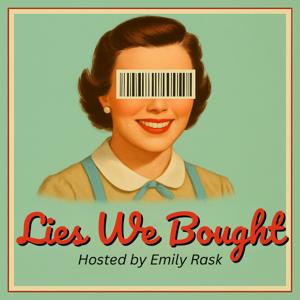
Lies We Bought is an award-winning podcast that traces advertising lies and marketing deception back to where they started. Host Emily Rask spent over a decade building marketing and advertising campaigns, and now she's reading the fine print out loud (think everything from "got milk?" to "clean beauty") to show how the message got made and why we believed it. Part branding history, part consumer psychology, part 1950s wink.
If you love smart, myth-busting shows about advertising, branding, and the hidden tricks behind the stuff you buy, you're in the right place.
Pulled fresh from the oven every Tuesday at 7 AM EST. Hit follow and start questioning the receipts.
Ranked by our users in the last 21 days
15,747 Listeners

28,864 Listeners
2,223 Listeners

99,674 Listeners

1,991 Listeners
6,472 Listeners
4,138 Listeners
5,659 Listeners
7,346 Listeners
3,036 Listeners

12,323 Listeners

855 Listeners

12,506 Listeners
49 Listeners